
Fallen Angel by Daniel Silva – Book

the fallen angel You Tube

Fallen Angel by Daniel Silva is Book 12 in the Gabriel Allon series, the fictional, but famous spy for the Israeli Intelligence Service at the Office on King Saul Boulevard in Tel Aviv Israel. Gabriel is an unusual person to be an assassin for justice, world peace, and the survival of Israel. He is an artist who gave up an artist’s life (his own) when recruited by Shamron, the aging hero of Israel, to pursue the terrorists who killed athletes from his beloved homeland at the Olympics in Munich.

Since that op he has trained with a talented art restorer and has become one of the best restorers of classic religious art in Europe. He is a bundle of contradictions but his strong values tie the whole package together. Gabriel’s family was, for the most part, killed in the Holocaust, except his mother who never really recovered from the horrors she experienced. Gabriel lost his first wife and his son to a car bomb, probably targeted towards Gabriel. Terrorists blew his life away right before his eyes. And even though they failed to kill the one the car bomb was designed to kill this became a sorrow he had to carry with him always. It hardened his heart in a more personal way and made him more lethal, more determined to fight evil in the world.

Through the first 11 books there have been plenty of evil actors to stop in their tracks, tracks which always are about either power and world domination or money or both. Eventually Gabriel remarried to the beautiful Chiara, daughter of a Rabbi, who also does intelligence work for the Office. Sometimes she is with him on ops and sometimes she stays home. Putting her at risk brings back old memories for Gabriel. After a while Allon is joined by a team, each person with different strengths and we become concerned about their safety in these rather impossible-seeming, risky, but usually successful operations they undertake. Gabriel is frequently wounded because he cannot let a villain get away. He retires every time he completes a mission as if he has beaten evil once and for all. But he knows this war is endless and he up-ends his life over and over again to do battle when he must. After a while we begin to wish there really was a Gabriel Allon and a Chiara, et al out there in the world, abolishing amorality and immorality.

So in Fallen Angel we have a lovely young woman who agrees to inventory antiquities in the Vatican collection who is found artistically dead after a fall from a balcony in the Sistine Chapel. At first her death is ruled a suicide. But Gabriel is a friend of the Vatican’s top two people, the Pope and his constant companion Father Donati, because he saved the Pope’s life and unraveled one of the plots that live in the competitive Vatican culture. Gabe is restoring a Caravaggio in some basement on the Vatican grounds and Donati has him summoned to tap into his expertise. Gabriel (also a fallen angel) does not believe this is a suicide. But when he pulls a couple of strings he opens a Pandora’s box of illegal trading in antiquities. These thieves never preserve provenance and this represents a huge loss of historical data about ancient sites and people. Once again what begins in Italy leads Gabriel all over the world and eventually home to Israel.

Photo Credit: From a Google Image Search – You Tube

Find me on goodreads.com as Nancy Brisson
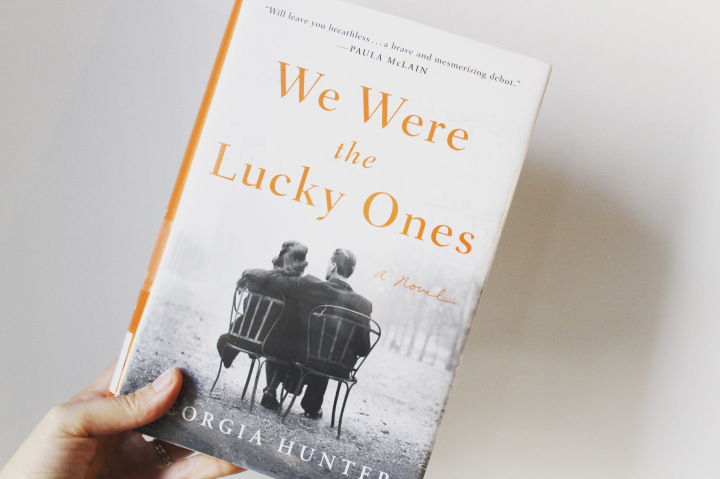
We Were the Lucky Ones by Georgia Hunter – Book


We Were the Lucky Ones Book and A View

We meet the Kurc (Kur-see) family in Rodam, Poland in 1939. Hitler is on the move and we know what is coming, but this close-knit family of middle class Jewish Poles does not. We Were the Lucky Ones by Georgia Hunter, covers familiar and dreaded ground, but this is a family of survivors. How did that happen?

Not one of these five siblings or their parents ended up at a concentration camp. They saw that Jews were being rounded up. They saw the railroad cars crammed with frightened humans supposedly going off to work in war factories. How is it that of the five (Addy, Halina, Bella, Genek, and Mila) and their parents only Mila ended up on such a train and she managed to escape a truly traumatic fate. They did not collaborate, they did not thrive; they worked almost to breaking in factories, subsisted on little food and sometimes no food. They often did not know where their other siblings were and they missed their family terribly, and worried about each other all the time.

The book skips between siblings and their spouses so we know where the Kurc’s are and how close they came to discovery and death, but they only learn this after the war when they all meet their son/brother Addy in Brazil. Georgia Hunter, the author, is Addy’s grandchild. He married a woman in Brazil who was from the American South. How did he get to Brazil?

Dumb luck and many delays, near capture, and the ability to anticipate and avoid being trapped helped Addy survive. He learned the name of a man who was supplying visas to Jews so they could leave Europe. He went to see this man and ended up on one of the last ships to Brazil. Even so all aboard the ship got rerouted to Casablanca and Addy almost ended up being caught there with an expired visa and sent back to Europe. This is just one of the family’s survival stories. The rest are just as compelling although told more as history than drama.

Georgia wrote a fictional story for the sake of flow and form and character development, but this is essentially a true story she researched for a decade, interviewing family, visiting museums and Holocaust data centers. Her family, whose stories she tells in We Were the Lucky Ones, may have only survived because they did not stay in one place and they were willing to learn new languages, buy papers that said they were Catholic, and because they were the recipients of favors from non-Jewish Europeans.

I don’t know why stories about WW II and the Holocaust keep falling into my hands, but this period in human history was a time when heroes and villains reigned. This was a time when what we learned about human nature was that we could succumb to a sickness of the spirit, to our most negative traits, envy, fear of others, national pride, genocide; or resist and become our better selves. Such books have special relevance in 2018 when we are in the midst of dealing with our fear of Muslims and “the others”, inclined to isolationism, and fomented to an exaggerated nationalism similar to what sent the German people so spectacularly and disgustingly awry in those WW II years.

Every time I read about WW II I learn something I did not know and feel things that I would not have felt otherwise. This may not be a perfect book; but it’s a very good debut and a great addition to the growing library of books about WW II for Jews in Europe.

Photo Credit: Book and a View

Love and Ruin by Paula McLain – Book

love-and-ruin-book-cover ohiomagazine.com

Paula McClain wrote about Ernest Hemingway’s first wife, Hadley Richardson in her novel, The Paris Wife and, this time, in Love and Ruin she writes about Hemingway’s third wife, Martha Gellhorn. I can understand the fascination with the women who married this literary giant. What kind of woman does such a legendary figure find himself attracted to? Hemingway was a handsome guy. Women found him desirable. It is almost tempting to wonder why only four women. But Hemingway sounds like he was not really a “ladies man”. He spent most of his social hours with men. He also seems to have seen women as occupying pretty traditional roles in a marriage, although he seems to have treated his wives as companions some of the time. Everyone in Hemingway’s world had a nickname.

Some readers do not value a fictional account of a Hemingway wife as they would a nonfiction one, but Paula McClain does do her homework, which she describes after the novel ends. So Love and Ruin is grounded in fact. But the day-to-day exchanges in a marriage are usually private business between husband and wife, although friends are privy to some of it, and can only be imagined in fiction.

Martha Gellhorn and her mother were recovering from the death of Martha’s father when they made a trip to somewhere as different and faraway as they could get without complicated travel arrangements. They fled to Key West and who should they meet in a bar almost immediately upon their arrival but Ernest Hemingway.

Both mother and daughter were pretty, long-legged and not at all shy. Ernest, married to Pauline Pfeiffer (Fife) with three boys (two from his first marriage) had his home, with his wife, right there in Key West. But he offered these two Gellhorn women a tour of the island. It was then he found out that Martha Gellhorn was a published writer. He began their relationship as her mentor. She was quite a bit younger. It seemed innocent enough.

If they had never gone off to report on the Spanish Civil War (Franco) at the same time (together) they might never have fallen in love and broken up Hemingway’s thirteen year marriage to Pauline. But Martha Gellhorn was not a “little wife” type of girl. She always wanted to be at the center of the biggest storm. She wanted to live life and she insisted that involved covering events like wars that only men generally wrote about. She and Ernest began as fellow war writers; she for Colliers, he making notes for a novel. Both felt more alive when death was everywhere around them.

When they needed to get away from the war they fled to Cuba, a place that Hemingway loved almost as much as Key West. They could not go to Key West because Hemingway was still married to Pauline. Martha found an old Cuban farm and when her book sold she used the money to restore it. It became the famous Finca where Hemingway still resided at the end of his life.

Martha imagined a sort of nirvana, with two writers living and sharing their craft, but Hemingway did not cooperate. He was demanding and selfish, and loving and ardent, and a partier and a hard drinker. Martha often found him exasperating. But just before World War II began Hemingway and Pauline divorced and Martha and Ernest married. They went to Hawaii for their honeymoon but trouble already was brewing. Martha had an independent streak that Hemingway despised and when she wanted to go off on her own to work or visit home he pouted and acted out. Although they both went off to London to cover the war they were more like rivals than sweethearts by then. Their marriage barely survived the war.

HEMINGWAY's wives France 24

Martha Gellhorn went on to have her own career as a writer of some fame and Hemingway wrote one of my favorite books Islands in the Stream. Hemingway remarried to Mary Walsh, a bond that lasted until they both died in a plane crash in Africa. We leave Martha behind when her marriage to Hemingway ends which belies the contention that this is a book about Martha Gellhorn. It is a book about a Hemingway wife, but one stamped out of such an independent and adventurous mold that the marriage was doomed to end in ruin. It made me aware of her as a writer and a dashing person who was ahead of history, and an admirable person in her own right.

You will have to decide about the fiction/nonfiction choice for yourself and also about whether or not this is a “chick” book. But Martha Gellhorn is worthy of our attention and Paula McClain made her quite real. A worthwhile read.

My Year of Rest and Relaxation by Ottessa Mesfegh – Book

my year of rest -You Tube

Do we act the way we do because of nature or nurture? Is our behavior inevitable, either genetically, or by upbringing, or do we always bear final responsibility for the way we behave? Don’t judge a book by its cover. Literally. If you consider the cover of My Year of Rest and Relaxationby Ottessa Mosfegh you might expect period fiction, but what you get is something quite of-the-minute, new and fresh right down to its bones. The young women our attention is focused on does not even have a name, perhaps because the book is written in the first person, but perhaps with some symbolic significance also.

We listen to a pretty, blonde, thin, 26-year-old who is already exhausted by life. She finds no authenticity anywhere, nothing to dedicate herself to, nothing to love, even, apparently herself. She nails the superficialities of various “cultural tribes” she is surrounded by at Columbia and in her neighborhood. The 40-something moms on the upper East Side come under her judgmental perusal as do the young males in the art history department at her college and the avant-garde artists who exhibit at the gallery where she works. She finds little to really admire in her handsome on-again, off-again boyfriend, Trevor, or her best friend Reva. Only Harrison Ford and Whoopi Goldberg escape her societal ennui.

When she is a junior at Columbia art school she loses both of her parents. Her parents were not exactly warm and fuzzy. About her mother she says: “She was not the type to sit and watch me draw or read me books or play games or go for walks in the park or bake brownies. We got along best when we were asleep.” “My father slept on the sofa in the den that year.” “None of us had much warmth in our hearts. I was never allowed to have any pets. Sometimes I think a puppy might have changed everything. My parents died one after the other my junior year of college – first my dad from cancer, then my mother from pills and alcohol six weeks later.”

Is our girl experiencing some kind of separation anxiety or does the loss of even bad parents cause us grief? Did her family’s inability to connect destroy her ability to feel empathy and affection? She decides that she will sleep for a year and then wake up a new person. Her inheritance from her parents allows her this option and she gets to sleep through the year in a very nice apartment on East 84thSt. which she owns outright.

But it is not so easy to sleep for an entire year. A psychiatrist must be found who has few compunctions about using a prescription pad. Dr. Tuttle is perfect, a real psycho-babble nut who knows her way around insurance rules. Pretty soon our blondie’s life becomes a long list of meds that she pops or guzzles whenever sleep is hard to find. Trazodone, Ambien, Nembutal, Solfolton, Xanax, Lithium, Haldol, Neuroproxin, Maxiphenphen, Valdignor, Silencior, Benadryl, Robitussin, NyQuil, Seconals, Libriums, Pacidyls, Noctecs, Miltowns, Lunesta, primidone and Risperdal, chewable melatonin…until she meets the ultimate sleep drug, Infermiterol. Too bad Infermiterol has one very worrisome side effect.

Even after a couple of months of chemical abuse our sleepy-head, catching sight of herself in the lobby mirror on one of her rare trips to the Egyptian bodega down the street says, “But I was tall and thin and blond and pretty and young. Even at my worst, I knew I still looked good.” But we wonder if anyone could actually survive on this much medication.

We have only covered two somnolent months of a long year. There is plenty more to this story. Do we care about this young lady? Should we care about her? Is there a message to this madness? Only you can decide. But for people who are tired of conventional fiction this certainly isn’t that. Just the gutsiness that comes up with fiction like this makes it well worth a read. Does it matter that our girl’s long sleep ends at a significant historical moment?

I keep thinking about this one, trying to care about this character. My admiration is more for form than any significance to the human condition at this point. Some books have to percolate. I also have a few caveats. One, don’t try this at home. Two, many of these scripts did not work as sleep aids. Three, as an experiment in rebirth, the outcome seems inconclusive.

Look for me on goodreads.com

Photo Credit: From a Google Image Search, You Tube

Warlight by Michael Ondaatje – Book


warlight big lawn gnome publishingMichael Ondaatje never writes an ordinary book, at least in my estimation. His books put me in a reverie of unique experiences lived in far off places and times. In his novel, Warlight he writes of some of the people of England and London who performed secret services all over Europe and the Baltic states during World War II. These services had to be kept so discreet that it is difficult for these members of the intelligence service to reenter their prewar lives.

Wars don’t end on the day that a treaty is made. The hurts, the resentments, the losses stay with people affected by wars. People swear to avenge their loved ones from cruel strikes perhaps necessitated by war, but still seen as desecrations. Strategy may deem it appropriate to level a village but the relatives and friends or absent residents cannot rationalize. They carry their shock with them and they nurse their anger and they vow they will seek retribution.

When first their dad and then their mom leave, Nathaniel and his older sister Rachel are in their early teens. They think their mom has gone to Singapore to be with their dad who was sent there by his company, until they discover her carefully packed trunk in the basement of the family home in London.

These two have been left in the care of a man called The Moth, a rather lackadaisical caretaker, and all that was orderly about their lives falls away. Rachel (nicknamed Wren by her mother) learns that she has epilepsy and of course she is a girl so what she experiences is quite different from what Nathaniel is allowed to get involved with. The Moth is soon joined by another character, The Darter.

Nathaniel is allowed to work with the immigrant staff overseen by Moth at Criterion’s Banquet Halls, setting up for events and washing dishes. Later he helps The Darter smuggle greyhounds into unsanctioned race tracks through keeping a schedule of nighttime pickups at various stops along a network of rivers and streams near London. Nathaniel is the narrator of Warlight but he does not know why his mom left him and his sister with these strange guardians.

As a grown man Nathaniel (who was nicknamed Stitch by his mother, Rose), is offered a job going through the archives collected during World War II, and although he has been reunited with his mother, her continued secrecy prods him to take the job. He begins to learn about what his mom did during the war and how it has followed her home, why she feels she endangers her own children. With great detail Ondaatje creates a world of lives lived outside the mainstream, interesting but slightly dodgy lives. Rose’s caretaker picks prove wiser than they seem.

Ondaatje reminds us that the human memory is long and that there are rarely clear demarcations between one event and the next, in fact the more complex and heartrending events leave traces that may never quite go away. He teaches us that life, like certain passages in music has moments that can best be described by a term Mahler uses to mark a passage that is difficult or heavy. Life can be schwer. I think you will love learning Rose’s story along with Nathaniel, and how it intertwines with that of Marsh Felon, a thatcher’s son who once fell off the family’s roof and had to mend on a cot in their kitchen. And just to add a bit more mystery, you will find out about Viola and many more ordinary heroes.

Find me at Goodreads at Nancy Brisson

Photo Credit: From a Google Image Search – Lawn Gnomes Publishing

A Death in Vienna by Daniel Silva – Book

book-death-vienna-lg

Three of the books I have read in the Gabriel Allon series, Daniel Silva tells us in the end notes of A Death in Vienna, are thematically related. They each are “dealing with the unfinished business of the Holocaust.” In The English AssassinSilva looks at “art looting” and the “collaboration of Swiss banks”. In The Confessorhe looks at the “role of the Catholic Church in the Holocaust and the silence of Pope Pius XII. In A Death in Viennahe looks into Aktion 1005 which was “the real code name of the Nazi program to conceal and destroy the remains of millions of Jewish dead” and the activities of Bishop Aloïs Hudal “rector of the Pontificio Santa Maria dell’Anima, who helped hundreds of Nazi war criminals flee Europe.” He tells us that the Vatican still maintains the Bishop acted without the knowledge of the pope. It is unusual for a thriller to have an Israeli subtext, and it takes skill on the part of the author to expose real wrongs while his novel still unfolds as an exciting puzzle for a spy, or spy organization, to solve.

This tale begins with a bomb at the Wartime Claims and Inquiry Office. Eli Lavon, who runs this office is critically injured. His employees, Reveka and Sarah are killed. Eli Lavon is an Israeli but he has a closer connection to the Israeli Secret Service known as the Office. In the early 70’s he worked for them and the skills he possesses are legendary. Gabriel, art restorer and Israeli spy, leaves another Bellini in another Venetian Cathedral to find out why the Wartime Claims and Inquiry Office was bombed and why his friend Eli Lavon is lying unconscious in a hospital in Vienna.

Clues lead Allon to a Nazi hiding under a new name in Vienna. At least he seems to be this certain Nazi, but research is necessary to confirm it, even involving travel to South America. This hidden Nazi basically worked for the Germans as an eraser. Mass graves full of dead bodies were beginning to show signs of what had been hidden under too little earth. It was this man’s job to uncover these putrefying mass graves full of Jewish people who had been gassed or executed and to sanitize them by burning the remains and scattering the ashes. Of course this would also erase any evidence of what the German’s had been doing. This particular Nazi had value because he had devised a way to make a fire that was hot enough to do the sad job. He used Jewish prisoners to do the macabre work and the ashes and bones were moved to local rivers and streams. He never got to erase all of the evidence because the German’s ran out of time and lost the war.

This eraser man, like many Nazi’s saw himself as culturally sensitive because he loved great art and music. Since he did not actually get his hands dirty he apparently did not feel that the inhumanity of what he did compromised his elitism. He accompanied Gabriel’s mother on the Death March out of the “camps”. He killed survivors on the way out if they gave the wrong answer to the question “What will you tell the world and your children?” He once spent on day on a railroad platform forcing a Jewish man to play a classical piece of music over and over again. This Nazi on the rise asked arriving prisoners if they knew the name of the music. If they didn’t know he shot them.

Does such a man deserve to be stalked and taken off to prison in Israel? Almost any human being would say yes. But for Gabriel this one is very personal.

The Confessor by Daniel Silva – Book

The Confessor by Silva audiobookstorelcom

Not my favorite book of the Gabriel Allon series, The Confessor  by Daniel Silva should not be skipped if you want to do justice to the chronology. In Munich a Jewish professor and scholar, Benjamin Stern, is murdered and the manuscript he is working on is stolen. In Rome a Pope is elected who is not well loved by some of the Cardinals. He chooses the name, Paul VII. What is the connection between a Jewish professor/doctor and the Vatican in Rome? That is the business of this Silva thriller.

The Catholic Church is full of power politics and holds both traditionalists and reformers. We learned this in real life when Pope Francis was chosen, and the tug of war keeps emerging from time to time in the news. Wherever power is possible people will conspire to attain it. Investigation exposes a secret conservative cabal within the Catholic Church called Crux Veraand we get whiff of possible scandal, that the Roman Catholic Church (some of it) has things to hide, things left over from WWII that link the church to the Nazi’s and also to the Jews. Whatever happened could be so harmful to the image of the church that there are those who will kill to keep it a secret. Gabriel has a friend in the Vatican though, the Pope’s right hand man and bodyguard, Father Donati.

Gabriel, an Israeli man, not religious but definitely Jewish in his soul, is often to be found restoring religious art painted by now famous artists whose work adorns cathedrals all over Europe. Currently he is restoring a Bellini painting in Venice. He has many aliases but is known in the art world as Mario Delvecchio. With the death of Dr. Stern he will put down his paint brush and pick up his gun because his mentor, Shamron, the tough old Israeli is almost impossible to say no to. Here is one reason to read this book – you learn more of Shamron’s past.

We also learn more of Gabriel’s back story. We learn that an aleph in the Israeli Secret Service is an assassin. Gabriel is an aleph. Gabriel also meets the Rabbi’s lovely daughter Chiara, who becomes important to Gabriel and in this series of books.

Once Gabriel begins to follow the trail backwards from Dr. Stern’s murder it becomes clear that wherever Gabriel goes he is clearly being watched. That is how he knows that his investigations are poking the hornet’s nest hidden in the Catholic Church. Crux Verahas their own assassin, The Leopard. Guess what his assignment is? As I said, The Confessor is not my favorite, and it may not please Roman Catholic readers, but it gives you key information to put future sagas in context. And it is still a thriller of that cerebral variety that keeps readers returning to Silva’s novels.

The English Assassin by Daniel Silva – Book

The_English_Assassin_Cover big

I have just finished reading the second book in the Gabriel Allon series, The English Assassin by Daniel Silva. One of the things that separates the Gabriel Allon series from other spy thrillers is that Gabriel works for Israeli intelligence. He is often considered such a good spy because he can kill without getting too emotional about it. In fact, critics say he may not have blood in his veins, which, I guess, is a way to say he is too robotic, or workmanlike. In the spy thrillers I have read, the best agents are not necessarily warm, cuddly individuals. Gabriel actually seems, to me, a bit more human than some agents who use a more military model. But he is a loner, and does not ever put together a permanent team. He actually has an adversarial relationship with many of the other members of the Office. Gabriel doesn’t create an ersatz family, unless a bunch of old curmudgeons qualify.

Another thing that separates the Allon series from other thrillers is Allon’s talent as an art restorer. Gabriel always says that he would like to restore art and not be a killer of bad guys. He blames the man who turned him into his protégé in the spy trade – Ari Shamron who runs the Office on King Saul Boulevard in Tel Aviv. Gabriel has some affection and plenty of hostility for Shamron. Shamron changed the path of Gabriel’s life, made him a spy instead of a painter. Gabriel always fools himself into believing that each case is his last. However, his conscience convinces him to take on project after project. But even more often Shamron convinces (bribes) him to take a case. In the case of Augustus Rolfe, Anna Rolfe, and the missing Impressionist paintings, Shamron gets Gabriel to investigate the matter using false pretenses.

We are made aware of the role bankers in Switzerland played in a war where they allegedly remained neutral. Because they were the world’s bankers, with accounts guaranteed as secret, they accepted money, art, jewels, gold, and anything valuable from German leaders who were members of the Nazi government – Jewish valuables stolen from citizens they knew they intended to gas. When the Nazi’s lost the war, the Swiss did not give the valuables back because the transactions were still supposedly protected by privacy laws. But the banks, Silva contends, often came to believe that these spoils of genocide and war were theirs. When one such Swiss banker, Augustus Rolfe, the very one Shamron sent Gabriel to meet, is found dead, Gabriel is arrested and thrown into a cell in Zurich even though logistically he could not be the murderer. Shamron hears of this and gets him out. He sends Gabriel off to meet Anna Rolfe, a famous violinist, whose father is the dead banker. Through Anna, Allon finds out about the large and illegal collection of Impressionist paintings owned by her father. Anna needs to be protected. After all, her father was murdered in his own salon. The paintings must be found. A secret group in Switzerland (the Council of Rütli) exists solely to make sure these paintings are not found.

A second assassin, one who trained under Gabriel for a while, is killing anyone connected with this painting chase. Christopher Keller, who most people think died in the SAS, is very much alive, living on Corsica and killing whoever the Orsati family wants him too. (The Orsatis do believe in justice but this time they are on the wrong side. Keller switches side, and stops killing the good guys.) He decides he wants to kill the same awful men that Gabriel kills. This may explain how Gabriel gets out of the clutches of Otto Gessler alive so he can retire to Cornwall to recover from his injuries and restore works of art until Shamron intervenes once again.

The English Assassin has a fairly convoluted plot with lots of traveling involved. But there is satisfaction in the possibility that the recovered works of art will be returned to the original owners or their offspring, if anyone in the owner’s family is still alive. While this thriller is fictional, art stolen by Germans in WWII really has been found and returned when possible. This amazing story has been told again and again since some of the caches of paintings have been found, and it always feels like justice.

Whether there is really a shadowy group of Swiss bankers whose key goal is to keep the cruelly appropriated wealth stored in the vaults and cellars in their banks, or even in their houses, I do not know. It certainly fits with what we know of human greed.


Be sure to look for me on goodreads.com as Nancy Brisson.

The Kill Artist by Daniel Silva – Book

The Kill Artist by Daniel Silva- big OverDrive

I finally managed to find the first book in the Gabriel Allon series, only to find out that this book refers back to three prequels, including one about an operation to avenge the deaths at the Munich Olympics. These books are not in the Allon series but they offer explanations for the events in The Kill Artist which is considered the first book in the series. In 1996, Silva wrote The Unlikely Spy, in 1998 he wrote the Mark of the Assassin, and in 1999, The Marching Season.

The events that caused the death of Gabriel’s son and the maiming of his wife – events that haunt Gabriel’s dreams and inform his current activities, happened because Allon had killed two members of a family of Palestinian terrorists who killed Israeli athletes at the Munich Olympics. Tariq al-Hourani, Gabriel’s target in The Kill Artist, is the man who placed the bomb that blew up Gabriel’s family, as he watched helplessly. Tariq is also a Palestinian, related to the two terrorists killed for their murders in Munich, his car bombing an act of revenge.

(Many readers, sympathetic to the needs of Palestinians, find this plot line unpalatable. It is true that readers of thrillers don’t want to dwell on the Israeli-Palestinian divide. But after these early books, Silva is not always focused on righting wrongs (imagined or real) of Palestinian “terrorists” against Jews. If this was the axe that was ground by the author through every book, his work would not be so popular. Silva chooses to address diverse forms of the terror humans perpetrate against each other.)

Another interesting element to note in Silva’s books is his female characters. They are usually strong, beautiful, and driven by some injustice or injury in their past. Silva creates his spy, Gabriel, who trusts women to be as talented and ruthless as men, given the proper training, and using their existing motivations to exact justice. Although he sometimes sleeps with these talented beauties, they know he doesn’t love them and they know he will not let them be victimized if he can prevent it. These women bear no grudges against the handsome spy who has lost his family, although considering how almost every operation ends, they would, if they knew, probably be less inclined to cooperate.

Tariq al-Hourani is a brutal guy but he is dying. Gabriel uses a woman, born Jewish but raised by a French family; a woman whose parents were murdered by the Nazis at Sobibor. She is Sarah Halévy, but her French name is Jacqueline Delacroix. She has her own reasons to help Gabriel assassinate al-Hourani. Things, as usual, go terribly awry but Gabriel is the one who ends up with a bullet in his chest. This is not really a spoiler because we never wonder if Allon will be hurt, only how it will happen. Roaming around the best bits of Europe with Gabriel Allon is always a nerve-wracking adventure. But this book begins and ends in one of my favorite Gabriel locations, an isolated cottage in Cornwall, England.

Moscow Rules by Daniel Silva – Book

Moscow-Rules-by-Daniel-Silva-big-PIcClick

In Moscow Rules by Daniel Silva, when a Russian journalist dies in the arms of Gabriel Allon, an Israeli operative, at the Basilica in Rome, Gabriel’s highest level friends in the Vatican are not thrilled. Gabriel had a meeting with this, now dead, reporter who had something to tell him. Gabriel is not thrilled either. He was on his honeymoon in Umbria and he does not want any part of this. But it’s a mystery that involves injustice, assassination, and perhaps more; clarion calls that Allon can never fail to answer. Gabriel immediately knows his honeymoon is over.

Ops inside Russia, especially in Moscow, are rarely undertaken by any nation’s spy agency, let alone the Israelis. Moscow plays by its own rules. What is supposed to be a quick in and out excursion, under a false identity, to talk with Olga Sukhova, another journalist, goes badly awry when Gabriel decides to outstay his team. Moscow rules say, “Assume every room is bugged and every telephone monitored. Assume every person you encounter is under opposition control. And don’t look back. You are never completely alone.” And yet he defies his boss and friend Ari Shamron and stays. Guess how that turns out.

In these days when we talk about Russia every day, the information the author gives us about Russia is very familiar to us. Olga tells Gabriel, “To understand Russia today, you must understand the trauma of the nineties. Everything we had, everything we had been told, was swept away. We went from superpower to basket case overnight. Our people lost their life savings, not just once but over and over again. Russians are paternalistic people. They believe in the Orthodox Church, the State, the Tsar. They associate democracy with chaos. Our president… uses words like ‘managed democracy’ and ‘State capitalism’ but they’re just euphemisms for something more sinister, fascism.”

Gabriel’s Russian op does not stay in Russia. He learns that the man our reporters were so worried about is a very wealthy Russian oligarch who is very well guarded. Olga tells Gabriel exactly why this particular oligarch is so dangerous and exactly how he has stepped over a “red line” to pursue a business deal that must be stopped.

In Moscow Rules you can read about the plan Gabriel comes up with to flush him out. Since we know that Gabriel’s plans do not go smoothly, find out how he messes up this time. Find out if his new wife is still speaking to him after he never gets back to the honeymoon. It’s a very satisfying Gabriel Allon book. It has all the characteristic parts of the pattern readers expect when they throw in their lot with the Israeli Secret Service and their painterly operative, who manages, despite the powerful people he chases down, to get some of the worst players off the world  stage. I think you will find that it also resonates with the situation we find ourselves in today, vis a vis Russia. Serendipity.