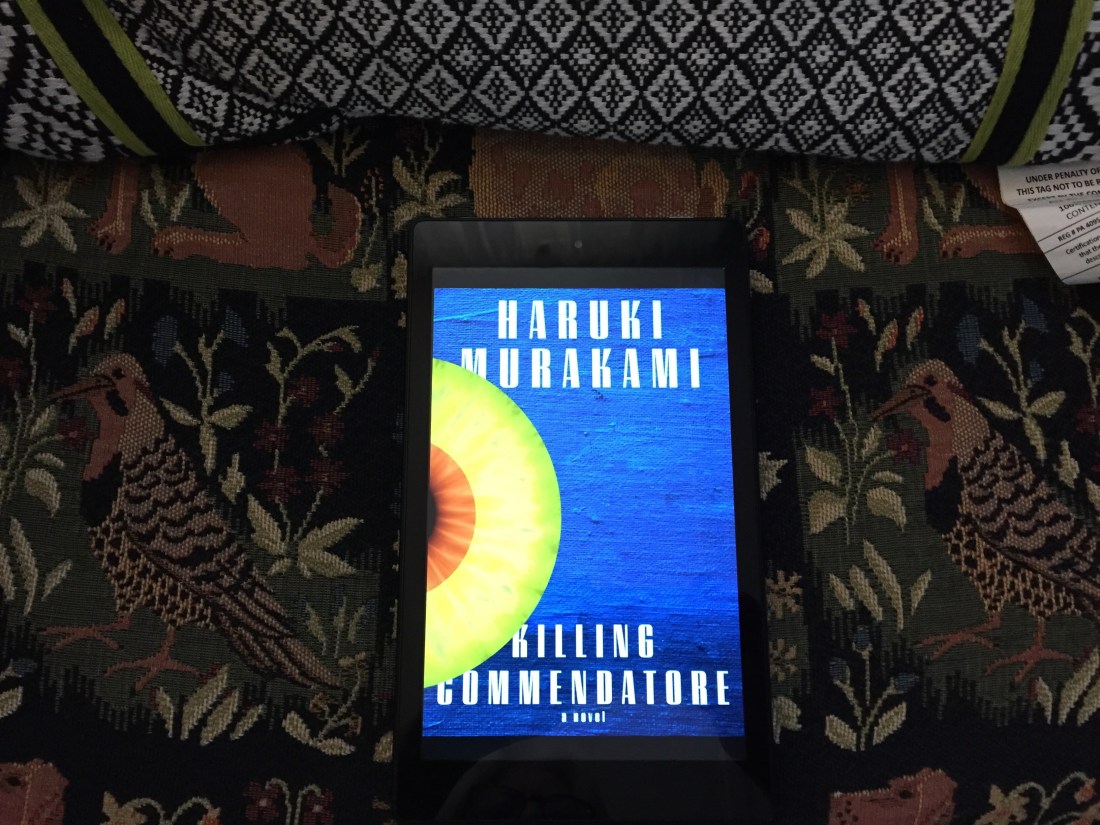
Killing Commendatore by Haruki Murakami – Book

IMG_0953

“Beware the double metaphors”, our artist, our main character, our guy in an early mid-life crisis is told by the Commendatore. Haruki Murakami bends our brains in fiction once again and his readers, and I, enjoy every minute.

Killing Commendatore by Haruki Murakami does something several books have done recently. It begins at the end and then fills us in. Of course by the time I immerse myself in this story I forget that it is all a flashback. The end of the story we get in the beginning is hardly definitive. But we do meet the artist, acting like a true artist in that little scene.

In present time (in the novel) he is feeling that his life has robbed him of the excitement and ambitions he once had as an artist. He, in a way, blames his wife. He rationalizes that he has had to be practical since he is a family man. He earns his living painting portraits and as his wife works away from home and he is often working at home, he does most of the housework. He feels he has “sold out” by painting portraits, which he considers a lesser form of art. He is feeling dead inside. Just when he is most dissatisfied with life and his art his wife asks for a divorce, says she is sleeping with another man and will not sleep with two men at once.

Yuzu’s husband (the artist) grabs a few clothes (very few) and begins a long journey in his car along the northern coast of Japan. Until he begins naming roads he could be living anywhere. He could be any modern man in any modern nation. He ends his journey months later when he has a very strange and concerning sexual encounter with a young woman and meets the possibly evil man in the white Subaru Forester.

His old college friend and fellow student Masahiko offers him the small mountain house where his father, the famous artist Tomahiko Amada, who is now in a nursing home with dementia, had his studio. Masahiko cannot care for the home as he works and lives in Tokyo.

Up to now. I must say, our artist (unnamed) seems more like an engineer. He has a very pragmatic approach to his wife’s confessions and his road trip. But Haruki Murakami paints his portrait with words. Our guy cannot have a boring identity crisis or get to know himself without going through an ordeal.

From the time he enters that mountain home his inner journey begins and it is a doozy. Temple bells ring in the dead of night with no temple nearby, a deep and magical pit is uncovered with meticulous and unusual stonework walls. There is a secret painting Tomahiko Amada has hidden in the attic with the pretty little owl, there is a collection of opera and classical music on vinyl, and there is a millionaire neighbor with a purring silver Jaguar (car) and many secrets. Then there is the young girl, Mariye, he meets in his children’s art class (about the same age as his beloved sister, Komi, who died as a young teen) and the older, married woman from his adult art class who we get to observe, along with the Commendatore, having satisfying illicit sexual relations with her teacher. Who is the Commendatore and how does he get killed? That I cannot tell you.

There is no blatant spirituality and our artist seems far too self-absorbed and modern to accommodate a deeply religious life, but, even so, in this novel the symbolism (the temple bell, the little shrine, the pit) and a certain sparseness in the prose give a religious tone to the artist’s inward journey. Whether it strikes you as spiritual or not, you can at least enjoy the novel as one great big entertaining Haruki Murakami double metaphor.



Milkman by Anna Burns – Book

IMG_0941

Milkman by Anna Burns follows none of the rules for storytelling or literary fiction that we are used to. The novel seems to be written as one long sentence (of course it isn’t really). I enjoy reading authors who try something new, especially if they do it well. Anna Burns does it well enough.

Middle sister comes of age in a divided culture, almost a tabloid culture. It is a paranoid, male-dominated place in a perpetual state of war (although most of the fighting happens elsewhere) with the “over the border”, “across the waters” people. Readers identify this unnamed country as Northern Ireland because Middle sister speaks of the on-going hostilities as ‘the troubles’. Men are either renouncers, soldiers, paramilitaries or police. Terrorist bombs from unidentified groups occasionally plague the residents and acts of personal terror up to and including death happen frequently enough to keep people on edge. Toxic masculinity is the expected male behavior. Of course, not all men conform but those who don’t are not allowed much peace by those who enforce the convoluted code these folks live with.

Middle sister is also maybe-girlfriend to her car loving mechanic, maybe-boyfriend, who seems nice and who says he would like to not be a ‘maybe’ anymore. Middle sister has her own reasons for wanting to remain a ‘maybe’ for now. Middle sister does things that make her stand out in a culture where women especially are not supposed to stand out. She reads books while walking (nothing newer than the 19th century). Now that she is of marriageable age her behavior is considered deliberately provocative. She is not being properly observant of possible dangers. She is too self-absorbed. She attracts the attention of the creepy, middle-aged Milkman (who is not the real Milkman).

Around her in her single state swings the true chaos of this time and this place. Young people go to bars to drink and mingle – not to dance it seems. Some bars cater to only one group for example, the paramilitary, others attract a more mixed group –  a more dangerous situation with violent fights and explosions more likely. Once Milkman shows an interest in Middle sister other men in the bar scene back off and certain women begin to offer her tips about what to wear and how to act.

Her relationship with maybe-boyfriend continues as he is not part of the mainstream toxic male culture. Middle sister is seriously weirded out by Milkman. She no longer walks and reads. She now runs with Third brother-in-law rather than alone. She knows better than to get in Milkman’s cars or his van. Because of Milkman’s attentions Middle sister becomes an object of gossip because rumor has it that she is having an affair with this Milkman. Until her recent difficulties she did not see herself as belonging or identifying with these grown up mothers (including her own) and widows (lots of widows). As her fate gets more precarious she begins to learn of the subtle power these women have.

Maybe-boyfriend, the car guy, wins ownership of a ‘Blown Bentley’ engine from over the water. Gossips claim that he got to keep the bit with the flag (not the right flag), but he didn’t. Eventually Milkman uses this gossip to threaten maybe-boyfriend whenever he runs into Middle sister – not often if she can help it. He talks about “car bombs”. He’s a real subtle guy.

Some may find this book difficult to read, although words, at first, tend to be short and simple. The breakneck pace lacks pauses or temporary stops, and the vague war between basically unidentified enemies, all the jargon of a carefully controlled society, gets repetitive and makes us long for some specificity. But Middle sister makes the perfect protagonist because, although she knows the rules, she doesn’t always follow them. She is bright, and cautiously adventurous. On occasion her internal dialogue breaks away from the monosyllabic argot and reveals some pretty sophisticated language skills. Of course she was a girl who read books while walking.

Creating a world, or even turning a real world place into something more generic, is not always easy if it is to be a believable world that readers want to occupy for a time. For me the world of Middle sister in Milkman by Anna Burns was well done. But see what you think about that ending.

Find me at

https://thearmchairobserver.com/

Goodreads.com as Nancy Brisson

Tremr.com as brissioni

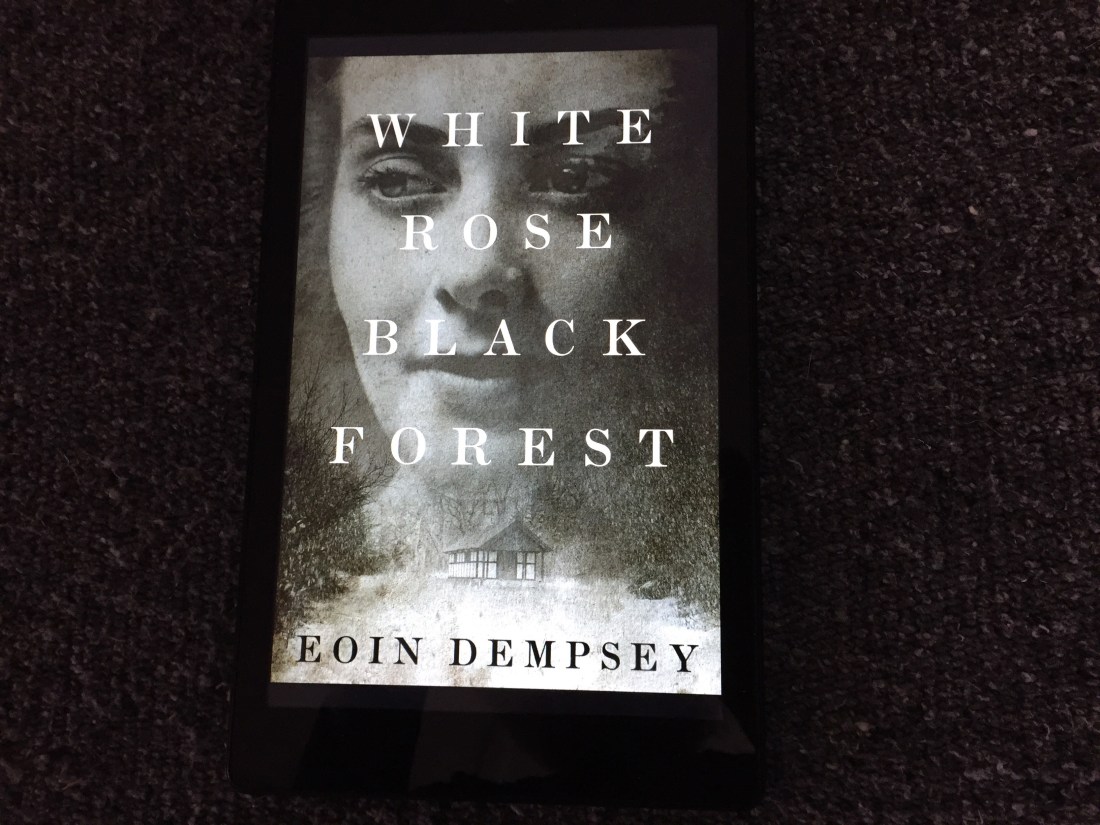
White Rose, Black Forest by Eoin Dempsey – Book

White Rose

White Rose, Black Forest by Eoin Dempsey starts with a real resistance movement inside Germany, the White Rose Society, and builds a novel around it. We can imagine that there were Germans living in Nazi Germany who did not buy into Hitler’s racism, his use of fear and instant retribution, the way he used his paranoia about what people said and did in privacy to justify invading everyone’s privacy, and setting neighbors to spy on neighbors.

In White Rose, Black Forest we meet a young German woman who was imprisoned for a short time because she had a boyfriend in the White Rose Society, the German resistance group which published underground news sheets called “The White Rose”. Franka Gerber, our young lady, a nurse in Munich, actually helped write that flyer and distribute it but was assumed to have been naively led astray by her boyfriend Hans. After serving time in prison she is now considered an outcast.

Now with all her family dead Franka lives alone in the family’s cabin in the Black Forest. She is devastated by the things that have happened to her family and the rumors of the terrible things happening to the Poles and the Jews. She sees no way forward for herself. She is planning to shoot herself out in the Black Forest with her father’s gun. It is the middle of winter and winter snows are deep on the ground, the cabin in a remote location, the roads closed due to the snow.

Her suicide is interrupted when she stumbles on a Luftwaffe officer attached to a parachute and unconscious, with two broken legs, who despite his extensive training speaks to her in English. This is where the story goes a bit off the rails. Some of the author’s explanations for what Franka does require a bit too much suspension of disbelief. Although the snow is a great device to buy her parachutist, John Lynch aka Werner Graf, time to heal.

What I did find relevant and worthy of attention were Franka’s interactions with her neighbors dished out in flashbacks to her years as a young girl when she joined the Hitler Youth movement, and with her earliest friends and her first boyfriend who shared these experiences with her. She eventually turned against Hitler and the Nazis, but her old beau, Daniel Berkel, became an agent of the Gestapo, became a loyal Nazi, and with promotions and power became quite a menacing figure.

Much is revealed about the role of women under Nazi rule which was defined by Hitler. Women were house frau’s and child bearers and kept an eye on their neighbors and reported their behavior when it seemed suspect. Women, unless single, did not work outside the home. However many German women became very good Nazi citizens and supported the regime in every way. Others obeyed because the penalties for not obeying were very steep, often even life-threatening.

White Rose, Black Forest by Eoin Dempsey is a very readable story, but not a polished literary novel. We do end up on the edge of our seats, and you might want to see if they are able to escape their very precarious situation.

From Wikipedia – “The White Rose (German: die Weiße Rose) was a non-violent, intellectual resistance group in the Third Reich led by a group of students and a professor at the University of Munich. The group conducted an anonymous leaflet and graffiti campaign that called for active opposition to the Nazi party regime.”

Find me at Goodreads.com as Nancy Brisson


All the Lives We Never Lived by Anuradha Roy – Book

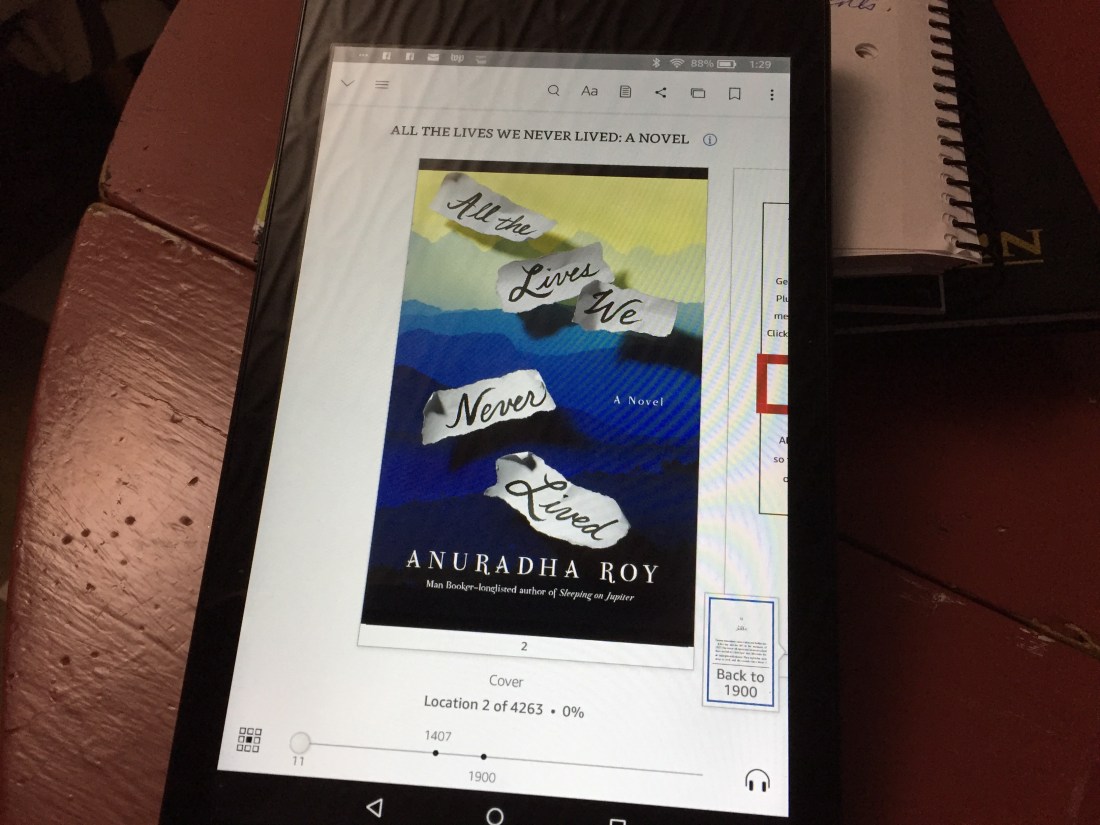
IMG_0931

Although All the Lives We Never Lived by Anuradha Roy is narrated, as it begins, by Myshkin, a young boy, and is also narrated by this boy grown to be an old man in his sixties, this is actually a book that has its roots in a true story of a German artist who travelled in Asia between the Great War (WW I to us) and World War II. Walter Spies was a creative person (and probably a wealthy person) who was so unique and charming that he was considered accomplished and interesting wherever he went, although he was also perceived as somewhat out-of-place, a curiosity. He travelled extensively in India (the author imagines) but he fell in love with Bali and made that his home base in Asia for many years.

Anuradha Roy wrote two stories in one because she admired Mr. Spies and wanted to bring him to life. So she begins her tale not with Spies but with that young narrator in India, a young boy with a mother who was given a nontraditional upbringing by her doting father, a woman born with a passion for an authentic life and a talent for painting and drawing. She was a woman, Gayatri, married to a professor and political activist, who felt held back, held down, imprisoned by her conventional life and loveless marriage. Her husband tried to give her a modicum of freedom but they did not perceive life in the same way. Women of that time, of course, were expected to marry and raise families and did not go traipsing off looking for their bliss.

But Gayatri did run off and left her husband and her young son. She meant to take her son with her but he got delayed at school that day and she had to leave him behind. She is happy in her new life but abandoning her child put a shadow of grief on her happiness. She ran off with a man, Walter Spies, but not to be his lover, rather to be free and live an artist’s life in the way that Walter and his friend Beryl de Zoete were living theirs. Beryl travelled in Asia studying dance and movement.

In this way Anuradha Roy is able to talk about the way women’s lives are curtailed by cultural expectations and public censure. She is also able to tell us about an artist she admired, whose freedom was likewise eventually curtailed, but not by the Asians he lived among, rather the Europeans he had fled.

Gayatri’s boy grows up and becomes, to his father’s dismay, a horticulturist, but he always remains the boy who lost his mother. Years later, as an adult he read the letters his mother wrote to her closest female friend from her life in India. We find that life can destroy our dreams in more than one way.

“As an old man, trying to understand my past, I am making myself read of others like her, I am trying to view my mother somewhat impersonally, as a rebel who might be admired by some, an artist with a vocation so intense she chose it over family and home.”

“But then his father left too to go off on his journey to the center of his self.” Interesting that in India, as in other places, if you are rich enough, both parents can leave but servants and relatives keep the details of the child’s life stable, even at the sacrifice of the child’s heart. Fortunately for Myshkin the grandfather in this story is a kindly and solicitous soul who stands in for the father.

In this way All the Lives We Never Lived by Anuradha Roy weaves the familiar daily routines of Indian life with the more foreign whims of European artists escaping from the daily routines of their own lives into a believable whole, a novel that explores the tension between art and cultural mores and rules. I just found myself wishing that both parts of the story were based on true events. However I remind myself that the author is an Indian woman and there may be kernels of truth in that fictional family’s portrayal. In the end I have always been happy so far when immersed in a story of India.

Photo Credit: Nancy Brisson

The Dreamers by Karen Thompson Walker – Book

thedreamers

The Dreamers by Karen Thomas Walker is a story of a viral outbreak, think ebola, only without bodily fluids. This virus hits a small college in the middle of nowhere, a tiny town, one road in-one road out. Where did the virus originate? Some said a strange haze moved through their college town one day. The town is in the middle of a drought. Is that the cause? The author suggests that letters from earlier centuries hint at a similar infection.

The virus strikes in the freshman college dorm first. Mei is a new student at Santa Lora who is finding social life difficult, but her roommate Kara connects with the other students easily. Kara is the first to feel woozy, she is the first to fall into her bed fully dressed after a night of drinking and partying, and she is also the first to die from whatever this is.

Caleb is the only person in the dorm who has the social skills to deal with Kara’s grieving parents. When the students drown their seriousness in a party that is pure escapism Caleb puts the moves on Rebecca, child of a religious family, home schooled, but finding herself a social success at school When he wakes everyone up in the morning with his screaming there is Rebecca in his bed and she has the virus.

The author tells us, “The first stage of sleep is the lightest, the brief letting go, like the skipping of a stone across the water. This is the nodding of a head in a theater. This is the dropping of a book in bed. Rebecca falls quickly into that first layer. Ten more minutes. She sinks further, just the beginning of the deep dive. This is when a sudden dream floats through her. She is at church with her parents. A baby is being baptized,”

The virus turns people into dreamers who cannot be awakened. If they are not fed through tubes and given water through IV’s they die of dreaming. It seems just a gentle virus, and few discussions of gross bodily functions trouble that dreamy quality (although such care must also be required).

I enjoyed reading The Dreamers but it left me with more questions than answers. Is it symbolic that this happens in a college town? Is it symbolic that the woods are dying from an attack by insects, that the lake is drying up from a long string of perfectly sunny days – a drought? Is it symbolic that the college administrators house the dreamers in a library?

The author takes us through the disciplines of thinkers who have dealt with dreaming, with mental time travel, with the past, present and the future – the Classics, the Psychology section, the Philosophers, the Physicists, the Linguists. Time does seem to morph for these dreamers in subtle ways.

Is it symbolic that Rebecca sleeps with a “sleeper” – a baby growing inside unknown to all, a baby whose every stage of development is described. Why does Rebecca dream that she has a boy child and then lose her sweet boy when she is delivered of a girl. She goes through the rest of her life loving her daughter but missing her son, who seemed more real in that dream state than what turns up in her actual life?

As with any virus some who fall to dreaming never wake up.

Is the small fire that begins in the forest and is quickly put out a foreshadowing of another key fire in this story?

The isolation of the college perhaps stops the virus from becoming widespread. So many volunteers show up to tend to the dreamers. In spite of protective suits and masks some get ill anyway and take their place on a cot. Some defy their suits to offer some personal gesture to a dreamer and get infected. Once you come into the village you cannot leave.

I just don’t know if this book simply takes us through an experience, the way an epidemic does, or if it has a point, a meaning, is perhaps a conceit, an extended metaphor. It strikes me as a skillful exercise in writing, immersive, beautifully realized, but, except for the baby growing in the midst of all that sleepiness in that lovely dying landscape, it seems without relevance, especially since it happens in a place almost as remote in time and place as Brigadoon. Perhaps a deeper message will dawn on me at some later moment. However Walker truly created a dreamy quality and that is skillful, like a painter who can capture transparency.

From a Google Image Search – The Bibliofile

There, There by Tommy Orange – Book

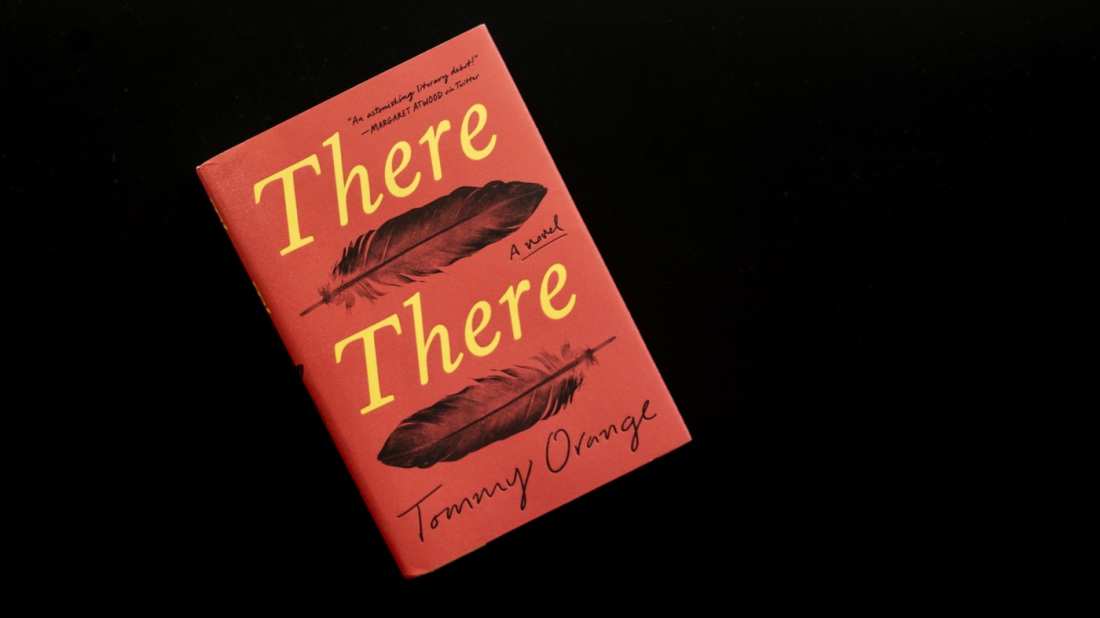
2018-06-06-therethere-sclark_01-1-

The acclaim There, Thereby Tommy Orange has earned is well deserved. I would think that there is nothing quite like it in the catalogue of the literature of indigenous people. There have been successful books, both fiction and nonfiction, by Native Americans, but this has a very modern sensibility and form.

Native Americans for the most part do not occupy their ancestral lands and we all know why. Although we cannot change what our nation’s forefathers did through arrogance, their misguided assurance of their supremacy as white-skinned people, their social structure which favored populated cities surrounded by farms, and their fear of warriors who were trying to make these settlers leave for reasons we can well understand, when Tommy Orange exposes the way we have turned a multiverse of Native Americans into a single stereotype we see that we are guilty.

Tommy Orange keeps these guilty realities sometimes in the foreground and sometimes tucked away in the background. We arrive early in his novel at the occupation of Alcatraz in 1969. What seemed like a fine symbolic gesture and a bid for active resistance against being assigned to reservations without any choice proved to be an untenable situation, in terms of supply lines, the harshness of the island itself with its dilapidated prison, and interpersonal relationships that went off the rails without strong leadership.

Orange makes it a point to tell us that it was believed that Native Americans would either hate cities or be assimilated into American cities, but then he shows us that urban areas have actually allowed Indians to keep their culture alive. I use the word Indian only because the author does. In every city there are Indian Centers and the stories, songs, and dances are keep alive and shared. If they aren’t shared person-to-person, they are shared on the internet.

“But what we are is what our ancestors did. How they survived. We are the memories we don’t remember, which live in us, which we feel, which make us sing and dance and pray the way we do, feelings from memories that flare and bloom unexpectedly in our lives like blood through a blanket from a bullet fired by a man shooting us in the back for our hair, for our heads, for a bounty, or just to get rid of us.”

At first we seem to be reading a series of essays and short stories about Orange’s characters, but we can feel the pull of some event that ties all the elements together. Opal Viola Bear Shield and Jacquie Red Feather are sisters (to understand their non-matching surnames, read the book). Around these two revolve the stories of many other characters, mostly men and young boys. Overall looms the Pow Wow planned for the Oakland Coliseum towards which everyone moves to finally meet on a single fateful day.

I would have wished for a more upbeat ending, for more hope and the promise of positive outcomes. But this book, while it invites us all to read it, may not be something all of us can understand in a soul deep way, at least not without some time and thought. The ending, along with other factors, is what makes this book literature instead of just fiction. I may not belong at the pow wow, but we all may be headed for some sort of urban apocalypse, after which life will probably still go on, for good or ill.

Photo Credit: From a Google Image Search – NPR

Of Blood and Bone by Nora Roberts – Book

of blood and bone Characters Wanted

Of Blood and Bone by Nora Roberts is the second book in a trilogy called Chronicles of the One. This is a dystopian saga, but it is not Cormac McCarthy’s The Road. Roberts pits wholesomeness, the sweetness of summer sunshine, bees, honey, family, children, love—life lived simply and communally—against lives that feature hate, fear, intolerance, and brutality.

When Mr. McLeod cracked the shield and dark Magick was loosed on the world, two-thirds of the world’s population died of an incurable virus which became known as the Doom. Many survivors found themselves with magical talents. Some became faeries, some elves, and some witches. The world split into the light and the dark and war was in the air. Humans who survived with no magical talents also split between good and evil. Some humans felt that magical creatures were an abomination and they tortured, killed, or executed them whenever they got the chance. What was left of governments captured magical creatures ostensibly to save them and to study them, but they imprisoned them and strapped them to metal tables so they could learn what they could and then eliminated them. And gangs bent on chaos and mayhem killed anyone who was vulnerable.

The child of Lana and Max, two witches who had to flee NYC in the worst days of the Doom (Book 1),  Fallon Smith, was known to be “the One” who would set things right before she was even born. Fallon has lived quietly on an isolated farm with her family but now, on her thirteenth birthday, Mallick comes to take Fallon away for training. From here on the story resembles the King Arthur story, except this time the King is a woman. Mallick is her Merlin and when she successfully finishes her training she wins the sword and the shield from the sacred well. During her training she also wins three unusual and powerful companions.

It’s a great tale even if Fallon is a bit like heroic Barbie and the young man, Duncan that she meets in New Hope is a bit too much like Ken. Fortunately, although the novel holds out the promise of romance at some point in the future, for now it stays focused on war and setting the world to rights. This seems as if it would make a great YA fantasy series depending on where it goes in Book 3.

I liked Of Blood and Bone. Apparently, in real life, there was a little issue about two similar titles between two authors, but it was settled amicably I believe. I look forward to the third book. But if we find ourselves in a truly dystopian world I don’t expect that Magick (or even magic) will save us. There is too much fantasy in this to put it in the category of dystopian literature. Still when you need entertainment this trilogy could be a fun choice for a quick break from more serious fare.

Photo Credit: From a Google Image Search – Characters Wanted

Unsheltered by Barbara Kingsolver

Unsheltered floral KUOW

Unsheltered by Barbara Kingsolver is not the first book by this author that I have read. I have enjoyed her writing since her first book, The Bean Trees, appeared in 1988. I have also read Pigs in Heaven, Prodigal Summer, Flight Behavior, and The Poisonwood Bible (although I think I read all these books before I joined goodreads.com).

Kingsolver is an environmentalist who likes to use fiction to call attention to the havoc human excesses wreak on nature. She does it subtly, but unmistakably in very readable novels, that reflect the changing zeitgeist of the 30 years she, and we, have lived through since she started writing.

Her inspiration for Unsheltered came when she learned of a woman scientist named Mary Treat and she was given access to her notes and correspondence. Dr. Treat was a woman ahead of her time, a wife who thrived when her husband left her. She was fascinated by the plants and insects that lived in the Pine Barrens that were near her home. She filled her living room with small jars that look like terraria, but each contained a tower-building spider (small variety of tarantula).

Mary Treat wrote letters to Charles Darwin, who had recently published his Origin of the Species, a book that seemed to refute God, and set the world on fire, and he wrote back. She wrote to Dr. Asa Gray and he also answered her letters. Mary Treat is real, and a truly interesting woman. Thatcher Greenwood is also real. When he married his wife Rose, her family owned the house next door to Mary Treat. Thatcher Greenwood was hired to teach science in a high school run by a man who believed Darwin to be an abomination. The house he is living in was poorly built and is falling apart, as is his life.

A parallel story 150 years after Darwin’s book was published, gives us a family of the Trump era, living in the second incarnation of Thatcher Greenwood’s house, which was rebuilt by a second someone, equally without regard for sound building principals. A twice-unlucky house. When Willa’s family inherits the house in New Jersey from her Aunt, it is at a time when the economy is changing for everyone. Willa, a writer, loves her solid career footing but then the magazine she writes for folds. If she stays in New Jersey she will have to accept freelance writing jobs. Iano, her husband, a professor of political science cannot find a path to tenure, and in middle age is still working as an adjunct.

Their son, Zeke, is left, tragically, with a baby son, who he leaves with Willa to try for a tech startup with his college roommate. He owes $110,000 in college loans which he must pay off. Tig, their daughter, is an enigma as a member of what seems to be a whole new generation. She is a dynamic, pint-sized activist with dreadlocks who lived in Cuba for a year and took part in the Occupy movement. Tig (short for Antigone) may have the best grasp on our new shifting social landscape.

The house is what ties the two eras together and the two “evolutionary” women, Mary Treat and Antigone Tavoularis (Tig). As the house falls down around the inhabitants some find it extremely unsettling and others find it strangely freeing.

Kingsolver is a queen of dialogue, which makes her novels flow easily along, in spite of how dense the content seems after the fact. It was interesting that she never mentioned the modern folks who still deny Darwin and the sneaky tactics they often employ to make it mandatory to teach “Creationism” in 21st century schools. She may not have wanted to focus on something more political than environmental. The literary device that has us skipping back and forth over 150 years in every other chapter makes the reader look forward to getting back to the story line that will be taken up in the next chapter.

We have wandered pretty far from nature and I wonder how many of us would feel comfortable without a home base. Is there a generational divide, or will that disappear as mature responsibilities must be met? Will we have to learn to respect nature and live in greater harmony, without many of the creature comforts that we have convinced ourselves prove that we are above other living things. Will we ever be able to overcome our sense of superiority and separateness which allows us to believe that our survival trumps (sorry) theirs? Will we ever learn to feel our organic connection to every living and nonliving thing on this planet?

Engaging our thoughts is a hallmark of a skilled author. I can’t decide if the separation in time is so large that this felt more like two stories that blinked on and off like lights or if the connections are powerful enough to unify the novel. However this is a relatively insignificant flaw which was not jarring enough to ruin my enjoyment of Barbara Kingsolver’s book, Unsheltered.

Photo Credit: From a Google Image Search – KUOW (cropped)

Year One by Nora Roberts – Book

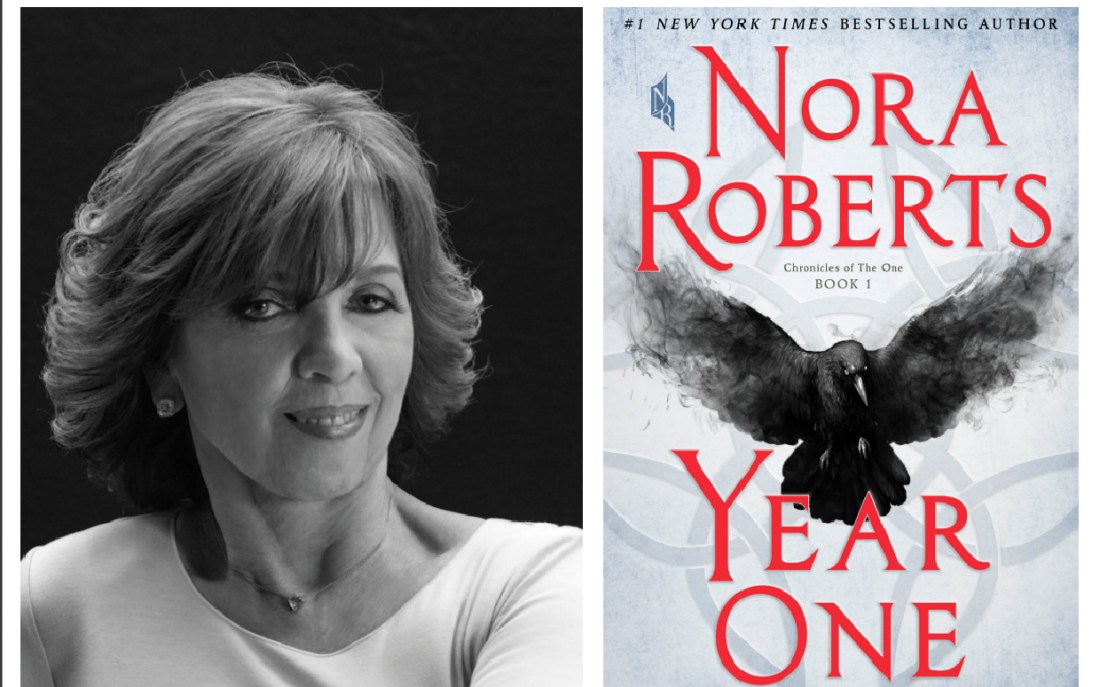
nora-roberts-year-one-ftr

Nora Roberts, author of Year One usually writes romance novels. I do enjoy a good romance novel. It doesn’t necessarily give your brain a workout but it sends you on an emotional journey that often ends in a happy sigh and a temporary uplift in your spirts. Lately I forgo the brief jolt of endorphins offered by fake joy for books with a more mental punch. But I will say that I think even fake joy can make your day. This time Nora Roberts goes off the chart and gives us an apocalypse. Even if it still encompasses a good deal of romance, there is also suspense and grief and magic and black magic, and this is only the first book of a trilogy, The Chronicles of the One. One of my sisters passed this book on to me.

The story begins in Scotland where Ross MacLeod, who now resides in NYC, visits the family farm in Dumfries, Scotland which has been in the family for over two hundred years. Ross goes for a walk on his land and changes the world when he shoots a pheasant that lands in a magic circle and activates an old blood sacrifice he accidentally contributed to fifty years earlier, simply by tripping and scraping a hand on a stone that sits in that ancient stone circle on the property. Ross is a bit freaked by the circling of crows above the site but he is no believer in magic. When he gets very ill he thinks it is a flu virus. Then he dies. Soon this untreatable and incurable disease, named the Doom, begins to spread as rapidly as people move around the globe these days.

The grief people feel is enormous. Max and Lana, newly in love and experimenting with some talents they seem to possess which indicate they might be witches, do not sense the enormity of the escalating depopulation right away. For a moment they are a spot of joy in a city that is being devastated by disease and looting and violence. Lana is a chef, Max a writer. Arlys, a newscaster on a popular NYC stations has been promoted to the main news desk by default. She offers daily news to anyone who is still listening. Fred is an intern who works with Arlys and who has a secret which might help explain her effervescent personality. One day Arlys is given reasons to tell her listeners the real news, which is far more frightening than what she is used to offering. Rachel is a doctor, Jonah an EMT. They are trying to run a hospital with fewer and fewer staff, and patients they are unable to save.

When these New Yorkers finally accept that they must leave their beloved city and travel to more rural areas we see them depart in pairs to look for more people who have survived the Doom. Why some people survive while others do not is something that has no satisfactory answer. Some survivors have found that they now have magical talents. Fred’s secret is that she is a faerie with wings and a sprightly spirit that makes her quite lovable. Max and Lana find that they have become more talented witches than they ever were before. Some people find they are elves. And yet some people like Rachel and Arlys have no discernible magical talents and yet they survive.

Getting out of New York is not an easy thing for anyone. It turns out that magical people, like normal people can use their talents for good or for evil. Many survivors have turned to evil and can harm magical people who strive to be good if they catch them off guard or if their talents are unequal. There are also the usual gangs that thrive on chaos. Traveling is scary and dangerous and there is more safety in numbers. Eventually all these New Yorkers meet, not quite by accident in a new community that is taking shape in New Hope, Virginia.

There is social commentary here. The Uncanny, as the magical humans are named, become “the other” and are feared by intolerant humans who cannot accept people with magical talents as neighbors. They taunt them and troll them and make sharing a community uncomfortable and sometimes worse things happen when the intolerants do more than use their words.

As soon as the internet is partially restored this message is posted:  “If you are reading this, you are one of the chosen. No doubt you have lost those dear to you and have felt, many still know, despair. No doubt you have witnessed firsthand the abominations that have desecrated the world Our Lord created. You may believe the End Times are upon us. But take heart! You are not alone! Have faith! Have courage! We who survived this demonic plague wrought by Satan’s Children face a Great Test. Only we can defend our world, our lives our very souls. Arm yourselves and join The Holy Crusade.” – The Purity Warriors

The Purity Warriors pretend to save the world in the name of religion but they actually spread terror and violent rape and death, especially targeting the Uncanny. But Lana is carrying The One. Will she bear the child in safety to grow to her full powers? How will she change the sad equation in a ruined world? Good stuff for real, even if a bit too much sugar on occasion.

Photo Credit: From a Google Image Search – Parade

Find me on goodreads.com as Nancy Brisson

Transcription by Kate Atkinson – Book

kate-atkinson-running in heels

Kate Atkinson’s new novel, Transcription, joins a spate of World War literature coming out of Great Britain. All these books talk about what British citizens who were not soldiers did during wars. People wanted to help with the war effort and since many of the adults who were still in British cities were women, the tasks women took on often affected them in ways similar to the way soldiers are affected. The end of the war found women who had done unlikely, dangerous and heroic things, having to assimilate their war time behavior into the person they would be moving forward in peacetime. Other recent novels include: The Alice Network by Kate Quinn which I have not read yet, Dear Mrs. Bird by AJ Pearce, and Warlight by Michael Ondaatje.

Why is this the moment when so many writers were moved to write about such very similar experiences? Are people feeling an instability in political institutions these days that could lead to war? Are people rushing to offer us some patriotic roles that we could play? Is this a creative brain meld? Is this just an odd coincidence or nostalgic moment? With all the authoritarian figures rising in nations that once flirted with democracy does this feel somewhat similar to the rise of “you know who” before WWII? Are authors feeling the same fears we all feel that we may be called upon to defend our freedoms in the very near future, or to keep them alive for what could be decades of darkness?

Transcription is an absorbing book all on its own, but I recommend giving all these books a read because each takes a different tack on the same subject. In Transcription our heroine Juliet Armstrong is recruited by MI5 to help keep an eye on Hitler lovers and want-to-be Nazi’s living in England. British intelligence rents two adjacent apartments. In one a rather convincing Godfrey Toby, a spy of course, makes friends and collects important data about England’s defenses. These friends of Hitler think Gordon will pass this strategic data on to Germany. Of course this is simply a way for Britain to keep this information away from Germany and keep potential British traitors from doing real damage to the allied side in the war.

The second apartment is filled with recording equipment and a typewriter where a very young Juliet listens to what Gordon’s unwary informants reveal and then types a transcript that tries to give a word-by-word script of who is talking and what they reveal. Not all of the dialogue comes across clearly but Juliet does the best she can. Then Juliet is embroiled further into spying when she is asked to adopt a new persona and join a more upscale right wing group of traitors. This is how a girl who simply types gets deeply into something that is so unforgettable that she will never be free of either her memories or her handlers.

Do books make the future and the culture happen, do they predict what will come, or do they just reflect the present and the culture of the times in which they are written? It seems that books can do all of these things, and they can sometimes do all of them at one and the same time, which is probably one of the aspects of reading great books that keeps readers hooked. So what will turn out to be true of this little cluster of intellectual doppelgangers?

I am happy to read every book that Kate Atkinson writes and I feel the same way about Michael Ondaatje. I don’t know the other two authors as well but I may eventually be adding them to my long list of beloved authors. However, I would much prefer that these novels be reflective rather than predictive. You may find that you begin asking yourself how you would have performed under similar circumstances. One more point, possibly a #metoo point, although all of these books feature female characters, not one of them is a “chick” book. But because they all happen in the past, all these women work for men. However war seems to blur the lines between women’s work and men’s work as you will see. Don’t forget to spend a few moments thinking about why this book is called Transcription rather than Transcriptions. Thank you Kate.

Photo Credit: From a Google Image Search – Running in Heels