

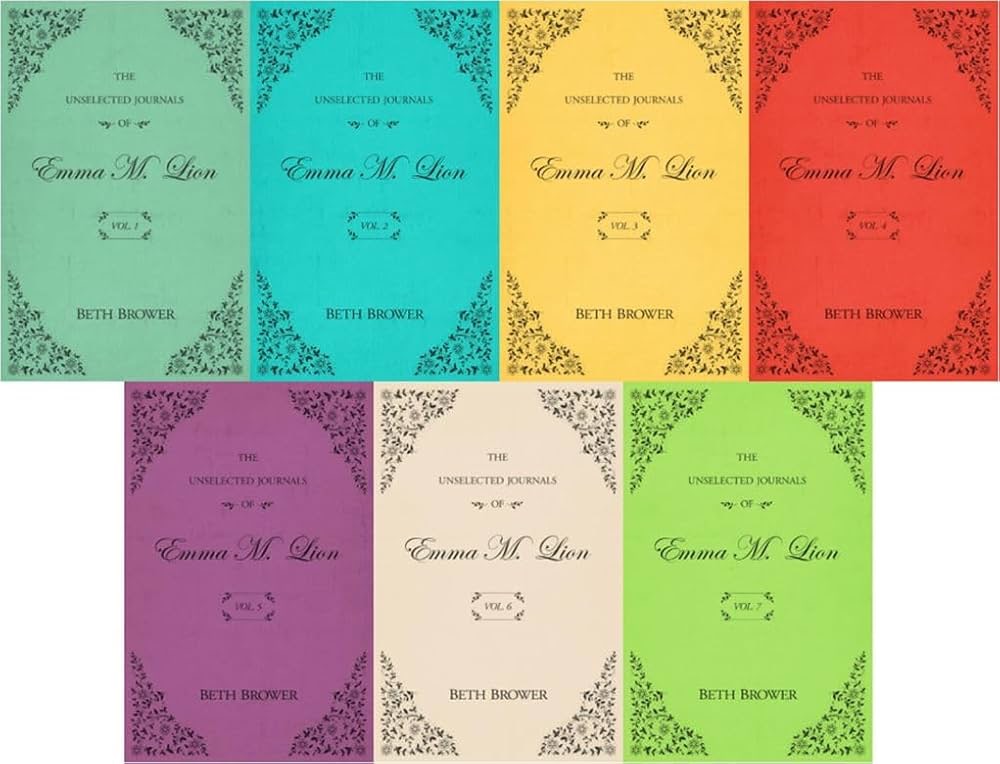
From a Google Image Search – Amazon – Books 1-7
Beth Brower has written a delightful set of short books called The Unselected Journals of Emma M Lion which can be enjoyed like a box of chocolates, some bitter and some very sweet indeed. Emma lives in the Victorian Age, and her social standing is high enough to be affected by her behavior, as was the behavior of any woman of means. Emma is hardly a woman of means these days, but she is a homeowner in the quirky, but upscale St. Crispian section of London. Emma lost her mother and her father at the age of 18. She could not become the legal owner of Lapis Lazuli House until turning 21. For three years she was the caretaker for a very cranky relative, Matilde, whose son, Archibald Flat, was installed in her beloved home. Archibald, it turns out, has a passion for morning coats, and a rather nasty disposition, perhaps inherited. He has eaten through most of Emma’s fortune, leaving her to live frugally upon reaching her twenty-first birthday.
However, Emma is gifted with a disposition that is philosophical, upbeat, undaunted, and magnetic. Emma wants to pursue an academic lifestyle. She wants to read every important book and learn all she can. Sadly, her father left his library to Archibald, who has locked the doors to the library and forbidden her to enter. She has only two books right now, the complete edition of Shakespeare with her father’s notes and drawings and the Bible, although she isn’t particularly religious.
Since Emma arrived at her house slightly before coming-of-age, she is denied access to her own room and sent to the garret. Over time she finds ways to turn the garret rooms into a comfortable and private space. Archibald has had a portion of the house partitioned off as a rental.
Here is a set of short books, pardon me, a set of addictive short books, featuring our plucky heroine who attracts near disaster and great companions, leaving her skating close to social ruin but exceedingly grateful and well protected. She must contend with her Aunt Eugenia Spencer, who is managing the Seasons of the lovely Arabella, leading to an advantageous engagement to a wealthy husband. Arabella to Emma’s dismay is perfectly willing to marry for status and doesn’t seem to believe in love. Because Emma’s services are required by her aunt to make sure only the best suitors dance or speak with her daughter by blocking unsuitable applicants, Emma is treated to seasonal wardrobes from one of the best dressmakers in London, which is lucky break given her rather impoverished state.
When a talented war photographer, Niall Pierce, rents Lapis Lazuli Minor, and later rents space to make a studio, not only are Emma’s fortunes uplifted, but so is her heart. Emma also has a cook and ally named Agnes, and her servant Parian is coming along nicely. A chance connection sees Emma befriended by the rather strait-laced Duke of Islington, a friendship that gives Emma a certain social cachet. Add in Young Hawkes the ever-disappearing vicar and Emma suddenly feels that she is part of a group of companions who seem to have what she calls “alchemy.” It’s easy to relate to the comfort she finds with these friends because many of us have experienced this happy phenomenon, an ersatz family.
These journals may remind you of the books of the Brontë sisters or of Jane Austen, but Emma is far less supervised than the women in those stories. Books 1-8 are now available, but I hope that Beth Brower will not stop where Book 8 ends. Read at the risk of destroying your schedule, or for using up those days when you are at your leisure. While there is plenty of happiness to be found in Emma’s journals, there is also sadness, poignancy, and heartbreak making outcomes uncertain. Keep writing Brower. These journals are winners.