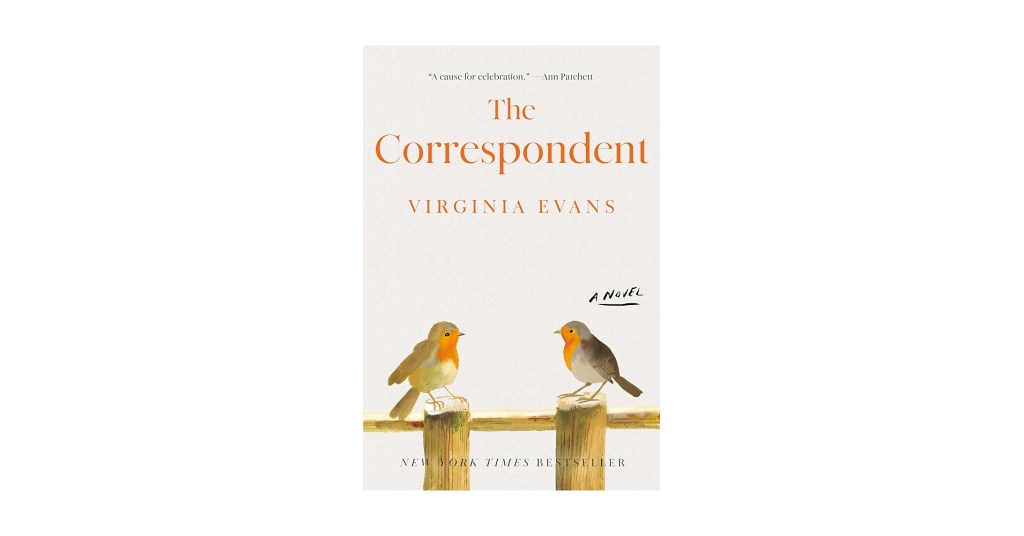
The Correspondent by Virginia Evans – Book

From a Google Image Search – Amazon

Sybil Van Antwerp rarely leaves her home these days. She runs errands, goes for walks, goes to garden club meetings and tends her flower garden. She clerked for many years for a well-known judge. People always ask her why she was content to be a clerk to a great man, when she could have been great in her own right. She always reminds them that when she grew up women did not have all the options available to them now.

Sybil writes. She corresponds. She writes letters on the stationery she has used for decades. Sybil writes letters to friends, to favorite authors, to her best friend, Rosalie, to her brother Bruce, her son Felix (and her dead son Gilbert), to her daughter Fiona, and even to her ex-husband Daan. Rosalie and Sybil always end their letters to each other by telling what book they are reading. She has written to Joan Didion and Ann Patchett and has no compunctions about sending off missives to famous people. Guilt is an undercurrent in her letters, but, of course, guilt is an undercurrent in all our lives if we are older than twenty-five.

Sybil knows that she will soon be blind, which may be a reason she stays so close to home. She knows her property is desirable as it has a water view and is close to DC. She writes all her letters while she can still while sitting at a window that faces the water. She hasn’t told even some of her family members about the condition that will most certainly end in blindness.

The universe is a mysterious place. Just when you’re enjoying your daily routine, your rut, your hamster wheel, the universe sets things in motion that will bring change to your life. Sybil doesn’t shift gears easily but, in the end, there is information and there are people that get her out of her rut and allow her to embrace the very things that will make her life fuller.

The Correspondent by Virginia Evans is a novel that consists completely of letters sent and received by Sybil. This cannot have been an easy novel to write and, unless it is based on real correspondence, required planning, consistency, a list of characters, and a coordinated timeline. Perhaps Virginia Evans will inspire you to become a correspondent, perhaps not. It doesn’t matter because the novel is well done and doesn’t make any demands on you to become a writer of letters.

The Widow by John Grisham – Book

From a Google Image Search – Penguin Random House

John Grisham has been a very prolific writer. I haven’t read all his books, but I remember reading The FirmThe Pelican Brief, and The Client, each in one gulp. You know the experience; you are so engrossed in reading that you forget to eat, and you stay up way too late. So, I check back in with John Grisham now and then and then wander off in other directions until I find myself picking up a new book he has written. He writes from the world of courts and lawyers for a legal adventure that reminds me of all the corruption humans are heir to, and all the ways good laws, good judges and good lawyers can set things right. The Widow, Grisham’s newest book tells just such a story.

Simon Latch is a small-town lawyer. He handles “bankruptcies, drunk driving charges, delinquent child support payments, foreclosures, nickel-and-dime car wrecks, suspicious slip-and-falls, dubious disability claims” and occasionally, estate work – updated last will and testaments. He is bored with it all and is finding excitement in sport’s gambling at Chub’s Pub, getting himself in a bit of debt, but still under control. He and his wife have three children but there is no love left between them. His blah life perks up when Eleanor Barnett (Nettie), an 85-year-old widow walks into his law office. 

Nettie wants Simon to write a new will. She doesn’t trust Wally Thackerman who wrote the last one. Wally did plan to steal a good chunk of Nettie’s net worth, even though no one could pin down whether she was rich at all. She mentioned Coca Cola stock and Walmart stock worth about 16 million. 

Greed is one of mankind’s seven deadly sins and it can afflict any of us. Wally was greedy and unethical. Simon silently vowed to keep his greed in check and keep his work on the right side of the law. He did keep the will secret from his secretary; he did meet his client for lunches so they could try ethnic foods. He was responsible for her love of a certain ginger cookie which led to Simon’s arrest for murder. Was he guilty? 

Enjoy the book to find out about Nettie’s bad driving and what happens to Simon. See if you like Raymond Lassiter as well as I did and add to your schema on poisons (thallium, in particular). Warning: you might stay up all night.

Flesh by David Szalay – Book

From a Google Image Search – Simon and Schuster

David Szalay’s main character Istvan, in his Booker Prize (2025) winning book, Flesh, is an exploration of “contemporary masculinity” according to EsquireEsquire also describes the writer’s style as spare. Okay. If you read the book, you might be tempted to count the number of times the response “okay” appears in the dialogue. It could be argued that English is not Istvan’s first language, he is Hungarian, one of the most difficult languages to learn, we are told.

Istvan’s vapidity does not seem to be related to being Hungarian, however. He is not the only character to respond with just the one word “okay”. Perhaps his lack of verbal content reflects the emptiness of his mind, or his soul. And perhaps other characters copy his laconic way of speaking.

He must be handsome because women seem to like him, especially women with older husbands. His first sexual experience happens with a middle-aged neighbor woman when he is fifteen. It ends badly (an understatement). He does not seem to carry around a burden of guilt. After subsequently serving in the Hungarian army, Istvan goes to England. He works as a bouncer until he has the good fortune to meet a mentor (male) who hires him to serve as a driver for wealthy families. As his bank account gets healthier, he leaves his mentor’s company, and he becomes a permanent driver for Helen, Karl and Thomas. His life gets more complex, but his feelings are as opaque as ever and the dialogue is still monosyllabic. 

The author allows us to know some of the inner workings of Helen’s mind and some of the details of her married life, but no insight into Istvan’s mind. Helen’s son Thomas assigns nefarious motives to Istvan, but Istvan seems to be unworried about whether his actions might be considered immoral and criminal. It all just happens. (Okay.) Istvan accepts Thomas’ hostility, perhaps remembering his own sullen behavior from his younger days. He makes a few feeble attempts to connect with Thomas, but he lacks any real motivation.

It’s not easy to write a book so lacking in emotional depth and to make it a great read. One day, Istvan may become one of those classic characters who we refer to as if he’s a real person. He is so passive that when he could be accused of murder, or theft he shakes it off, he doesn’t own that any repercussions of his actions might rebound on him. The way he handles grief also exposes a coolness bordering on coldness. I get what Szalay has done. At least I think I get it. After all I am just a girl.

King’s Ransom by Janet Evanovich – Book

Gabriela Rose is the newest Janet Evanovich main character. She pursues stolen art, jewelry, and other insured items as a recovery agent. Gabriela began her career in The Recovery Agent and is now entertaining us in the second novel, King’s Ransom. Perhaps you’re familiar with Evanovich’s Stephanie Plum books which are laugh-out-loud, share-with-friends-and -family fun, and as tasty as any amuse bouche in the world of fiction. Gabriela is just as fearless as Stephanie, although she inhabits a more sophisticated world. But, like Stephanie, Gabriela does not forget her old friends.

In the first chapter we find her working for an insurance company to recover jewelry. Since husband and wife are involved in a contentious divorce she decides to look close to home, the home the husband now occupies. She waits until the husband holds a public event at the house. While everyone is distracted, she rappels into a well on the husband’s property. 

  “She kicked around and felt something solid under her foot. Her heart skipped a beat. She put her hand into the muck and pulled out a plastic ziplock gallon freezer bag filled with jewelry.”…

  “What’s going on? Luis called down. Everything okay?”

  “In less than a minute she was out of the well with the bag tucked into her tights.”

  “What were you in a previous life?” Luis asked. “Marine commando? Where’d you learn to climb like that?”

She peels off her muddy clothes and is left in her La Perla underwear. The peacock did it.

This is exactly the dashing way that Gabriela goes about solving high stakes crimes for the rewards insurance companies pay. There are references to The Thomas Crowne Affair (two of my favorite movies). Gabriela finds she has some unusual, and less-than-welcome, participants in her newest endeavor, the one that involves a “king’s ransom”.

When she arrives home from the jewelry case (home is an apartment in Soho, NYC) she finds her ex-husband, Rafer Jones singing in her shower and his cousin Harley Patch passed out on her sofa. There are proper embellishments offered which I will let you read for yourself. This is where the real fun begins. These three have been friends since school days and Rafer has been Gabriela’s ex for long enough that they can relate by sarcasm (and the familiarity of old friends) rather than anger. Rafer and Harley have not been trained to investigate thefts for insurance companies, but this case is personal. Their lack of training gets them, Gabriela included, in one pickle after another.

Harley has been working for a bank which is starting to look a bit shady. Now he’s being blamed for crimes he did not commit. And for some reason people are getting shot (double tap style). Several valuable items have been stolen including the Rosetta Stone, but the most valuable one of all is a gold coffin of a newly unearthed Egyptian king, King Tut’s brother.

Would Gabriela be better off without these two? Indubitably. But what fun would that be. And then there is Ahmed El Ghaly, who Gabriela doesn’t quite trust.

Evanovich’s books are perfect to snuggle down with on a quiet weekend or a snow day. She always knows how to combine the genres of thriller and comedy in delicious ways. A bit of sexual attraction adds to the fun without being overly graphic. I believe I have read almost every one of her books, although I may have missed one or two because I got distracted by politics. Sometimes reading should be fun.

The Loneliness of Sonia and Sunny by Kiran Desai – Book

From a Google Image Search – Shortlisted for the Booker Prize, 2025

Sonia Shah is in her junior year at a college in Vermont and she is lonely. She cries on the phone to her parents in India. Thus begins the story by Kiran Desai, The Loneliness of Sonia and Sunny. It’s an excellent story of two upper middle-class families in India experiencing the injections of modernity into their traditional lives. There is the traditional reliance on arranged marriages, for example, while all the younger people seem to believe that it is better to marry for love. 

Sunny Bhatia’s father died young so Babita, his mother, is left to fend for herself. Her father (the Colonel) happens to play chess with Sonia’s Papa, Manav, and he suggests an arranged marriage between his daughter, Sonia, and Sunny. A letter is sent to Sunny in NYC and to Sonia in Vermont. The timing is bad, as these are two of those modern children who want to marry for love.

Sonia, in her loneliness, becomes involved with an older man, an artist, with a personality that wavers between charming and mentally abusive. Ilan de Toojen Foss, is a strange man given to magical imagery and manipulation. He’s a painter and very ambitious. The relationship of these two has a Haruki Murakami vibe.

Sunny is living with an American woman from the Midwest, Ulla. They travel together to meet her parents in Kansas, which Ulla thinks will be a disaster. It isn’t a great success, but it isn’t terrible. When they return to NYC, Sunny goes home to visit his family in Delhi. He’s working as a reporter-at-large for the Associated Press and he plans to write and publish articles as he travels. When he arrives back in New York, he finds that Ulla has left him, moved out with all her possessions. 

Sonia, who wants to write a book, is still with Ilan when his wife arrives and eventually evicts Sonia. Sonia’s mother keeps a cache of jewelry at an Indian bank, intended for her daughter’s dowry, but she gives Sonia an amulet in a silver case carved with Tibetan clouds and dragons holding a little demon figure. The demon is a talisman called Badal Baba, or Cloud Baba. When Sonia leaves Ilan he keeps her amulet. 

Is this why Sonia and her family have a run of bad luck? Is this why a fierce ghost dog keeps chasing Sonia and disappearing. Is this why she almost drowns in Goa. 

Sonia and Sunny do not realize that their parents have arranged their marriage, although they give them a choice in the matter. These two meet entirely by chance in India on a train. Sunny likes her right away because of the title of the book Sonia is reading. They have a few conversations in India, and when Sunny’s friend Satya gets married, Sunny convinces him to go to Goa where he also plans to meet Sonia. Goa is on the ocean and the two of them encounter the terrifying ghost dog who, fortunately, disappears into thin air. 

Sunny returns to NYC, and Sonia stays in India with her family. Sonia’s mother and father live separate lives. Her mother lives in the cloud cottage in the mountains, full of magical visions and fantastical imaginings. There are eyes everywhere in this story. 

Sometimes the story turns very informative, revealing aspects of Indian life, relationships with servants, the tensions between Hindus and Muslims. Parents are aging and need care, so Sonia becomes the caregiver for her father. Sunny’s mom faces a crisis that forces her to sell her home. Her families’ ties to corruption are revealed. She ends up in Goa.

It’s a long time before Sunny and Sonia meet again after a disastrous trip to Venice. Read the book. It’s wonderful, but I can’t tell you all the reasons why. I listened to the book on Audible because I had built up credits. The voice of Sneha Mathan, the woman who read the story made the story even better. Then I bought the book so I could get all the names straight. 

What We Can Know by Ian McEwan-Book

From a Google Image Search – LA Times

Ian McEwan’s new book What We Can Know is a non-dystopian view of how human indifference might change world geography, it’s a celebration of nature, the humanities and poetry, and it’s a mystery. Any story that begins in the Bodleian Library generally offers us a kind of magic. I guess we can blame that on Deborah Harkness and on the academic glamor of Oxford University.

It takes a while to place everything in the correct historical time and to adjust to bouncing back and forth across a century. Tom Metcalfe is living in 2119, but he is a historian whose interest lies in the period from 1990 to 2030. He is trying to find a poem that was written by a writer named Francis Blundy for his wife Vivien. Blundy read it aloud on her fifty-fourth birthday at what came to be called “the Second Immortal Dinner.” Then he gave Vivien the poem, and no one ever saw it again. There are secondhand reports of what was said in the poem, but the poem itself vanished.

The poem was written in a very lengthy and difficult form called a corona. Blundy’s corona consisted of 14 Petrarchan sonnets and a fifteenth which had to repeat the first line of each of the 14 and that had to make sense. A Petrarchan sonnet had 8 lines that rhyme ABBAABBA and 6 lines that rhyme CDECDE. The literary world held its breath, but after almost a century the poem was still missing. Tom has taken on the task of finding the “Corona”. As he searches, we get glimpses of what neglecting to deal with climate issues has done to the planet. There are allusions to Nigeria, although they are rather vague. Tom seems to live in what is left of England, now a series of archipelagos and islands. The Bodleian library has been moved to higher ground making it problematic to travel there.

Apparently, the humanities academics have always been a rather randy bunch, with all kinds of sexual adventures and affairs causing ruffled emotions that are often hidden under polite exteriors (and sometimes not). Vivien was apparently a charming and beautiful woman who had a few adventures before she married Percy Green and a few while she was married to him. She loved her husband very much but only enjoyed his company for a few years as he developed early onset Alzheimer’s. He had been a craftsman making classical-quality violins. Alzheimer’s disease worsens over time and requires extended and intense caregiving. Percy’s Alzheimers was already advanced by the time Vivien met Francis Blundy, although she had already ended an affair with his editor, Harry.

Tom, in an off again, on again relationship with Rose is somewhat in love with Vivien although she has been gone from his world for a hundred years. He loves the property she lived in with Francis, after Percy died and they married. The property was known as The Barn and Vivien had her own office in the dairy building nearby. Everything had been carefully renovated, and since the “Derangement” (wars, and flooding) had not happened yet much of nature was still intact.  Tom gets a valuable clue from a colleague about the possible place where the Corona might be buried. What he finds out says more about human nature than it does about poetry. It’s a book to love and ponder about, but it does not mince words about the human condition.

Circle of Days by Ken Follett-Book

From a Google Image Search – People.com

In the Pillars of Earth, Ken Follett got us involved in the building of a Gothic cathedral in the fictional town of Kingsbridge. Many readers already knew the architectural features of classic Gothic cathedrals right down (or up) to the flying buttresses. It was one of Ken Follett’s finest novels. Obviously, cathedrals were not a primitive undertaking. Societies and population had to reach a certain point before such a building might be needed or even imagined.

In Follett’s newest book, Circle of Days, he weighs in on the speculations of how a place like Stonehenge could have been built before the age of machines. His words draw for us a possible moment in time when tribes of people occupied a fictional Great Plain. He gives us the flint miners, the herders, the farmers, and the Woodlanders. The herders have more time to think about eternal questions like the human spirit and practical matters like seasons, the heavens, and math (counting) all of which affect the herds of cattle they protect. Herders’ duties were not constant burdens as were the survival struggles of the other groups.

Often the fortunes of a tribal group depended on the temperament of the leaders. Follett’s farmers have a cruel authoritarian leader, who does not respect the boundaries of the other tribes and who exercises absolute authority over everyone (especially women).

Herders happen to have a council of leaders who make decisions after discussion by majority agreement. It’s not voting but it’s similar, although only involving a small group of elders. 

Woodlanders are more primitive than other tribes. They love their woods which provide them with all their simple needs. They stay hidden and speak a language of their own. 

The herders have built a circle of tall tree trunks joined by a wooden lintels and arranged in pairs. They have priestesses who know how to count, something others have trouble mastering beyond what they can see on their fingers and toes. The priestesses know how long a year is. They memorize songs which keep their knowledge in a form that can be passed on to new priestesses. They know about equinoxes and solstices, although not necessarily by those words. Four times a year they perform the songs, and they count. The tribes gather and travelers come to trade. The flint miners play a large part in these markets.

But because these are humans, the tribes do not always live in harmony. When there is a years-long drought, those who are cruelest seem to have better survival skills because these leaders have no boundaries and will steal land or cattle or woodlands, exercising a sort of early imperialism. When the farmers (the men only) decide to divert the midsummer market, which is the biggest market, from the monument of the herders with the circle of trees, they burn down the circle to rob the herders of the ceremonies that bring travelers to the village near the circle. 

Because of the moral character of some of the herders (mostly the women) the priestesses refuse to be beaten. Joie, daughter of the wisest woman Ani, has seen a field of giant stones out on the Great Plain. She wants to build the monument circle out of these giant stones so they cannot be destroyed.

Follett tells the story of how he thinks they did it. Are humans with extraordinary talents, born at the right moment, responsible for the progress of human societies? Follett seems to suggest that is true. This project is not as complex as building a cathedral but, considering that the population of the area was much smaller and the social structures so much simpler, we have all wondered and speculated about why Stonehenge would have been imagined and how it could have been built. 

Reading about the state of humans on and around the Great Plain is made interesting by giving the people in the story names, personalities, families, sexual structures that helped prevent inbreeding, and by creating a crisis that brings out the best and the worst in his characters. Even more interesting is Follett’s theory of how this magical circle was built which stays close to our current educated guesses about how such primitive people could produce such a sophisticated monument involving a detailed knowledge of astronomy, in particular the movements of the sun and moon. I found the novel enjoyable. Perhaps you will too.

An Inside Job by Daniel Silva – Book

From a Google Image Search – Daniel Silva

Daniel Silva has published a new book called An Inside Job. His key character is Gabriel Allon, a retired head of Israeli intelligence. He is also a talented artist who restores Renaissance Italian artworks, often frescos in cathedrals. He has a connection to the Pope and knows his way around the Vatican because he has worked on restorations there. He lives with his wife Chiara and their precocious twins in Venice.

Gabriel is almost finished with his current restoration project, a project requiring scaffolding and spotlights with a canvas curtain to separate him from tourists. When he spots an anomaly in Venice waters one day, the police investigate and pull the body of a young woman from the harbor.

This young woman has a connection to the Vatican, so we leave the rather lighthearted watery environs of Venice and find ourselves once again immersed in the Byzantine politics that surround, but do not implicate, the Pope. This time the object of contention is the discovery of a possible new painting by Leonardo da Vinci. It’s all about money after that and involves a shadowy mafia-style group that skims money from the Catholic Church and is determined to keep these activities secret.

Facing possible murder, Allon finds the evidence to hold the perpetrators accountable along with the help of some of our favorite old members of the Allon team. In the end we find ourselves back having ice cream with Chiara and the twins in Venice. All-in-all a very satisfying installment, rumored to be based in reality, and, indeed, An Inside Job á la Daniel Silva.

The Emperor of Gladness by Ocean Vuong – Book

From a Google Image Search – NPR

Fiction reflects the culture of the particular moments in which it is created. The Emperor of Gladness by Ocean Vuong is a book of the twenty-first century, but its characters are immersed in three different wars.

Hai and Sony (named after a TV) are refugees from the Vietnam War. Sony, whose damaged brain makes him a target for bullies, knows every detail about the American Civil War. And Grazina, an immigrant from Lithuania, now in her eighties and in and out of dementia, is reliving the Second World War.

None of these good people are thriving. Grazina meets Hai when she stops him from throwing himself off a bridge into the river that runs by her house. She has a son and daughter who rarely, or never, visit her at their ramshackle childhood home. After she saves Hai, he stays to take care of her. When she imagines she’s back in the war, he stumbles onto the perfect strategy for managing her dementia. He pretends he’s Sgt. Pepper and he joins her in her war memories about being chased by Germans. When she can name the current president, he knows she is back in the present.

Vuong’s book is not only about the wages of war. It’s also about families, both biological and accidental families – families that just happen. Sony has a mother, Hai’s Aunt Kim, but she’s in jail right now. Hai has a mother, but she thinks he’s in med school in Boston. Grazina is a mother but for Hai she takes the place of his deceased grandmother, and for Grazina, he takes the place of her neglectful son.

When Grazina runs out of money for the Stouffer’s dinners she loves and for utilities, Hai hits Sony up for a job at the “HomeMarket”, a fast-food restaurant that offers “Thanksgiving dinner year-round. Another ersatz family results from the many hours these workers spend together in this economically challenged rural town of East Gladness. There are not a lot of distractions or opportunities.

Drug addiction is also an undercurrent in this story, with Hai popping the downers that Grazina no longer takes. Drug addiction along with the experiences of immigrants in America connects these characters with each other and with the sinking economic circumstances of many Americans living in the twenty-first century.

Ocean Vuong is a master of description, Although often stark, and therefore strangely beautiful, his descriptive style captured my attention right away. The unique quality of his descriptions comes from his ability to make the landscape suit the characters. 

“But it’s beautiful here, even the ghosts agree. Mornings when the light rinses this place the shade of oatmeal, they rise as mist across the tracks and stumble toward the black-spired pines searching for their names, names that no longer live in any living thing’s mouth.” (pg. 1)

Ocean Vuong – here’s a good writer, and a book that will stay with you. As for the ending, I forgive you Ocean Vuong, maybe.

Atmosphere by Taylor Jenkins Reid – Book

From a Google Image Search – ABC News

Atmosphere by Taylor Jenkins Reid is a novel that has several themes. It begins in the 1950’s in America, but it mainly takes place in the 1980s. Joan Goodwin grew up loving the stars in the sky. She watched when Americans first walked on the moon in 1969. As a grownup she earns degrees in astronomy and is teaching at a college, but she dreams of going to space. When the space-shuttle-years begin an era of multiple space launches and flights, Joan, in a hopeful moment, fills out an application for NASA. The space program is hiring women for the first time. Since Joan is an expert in the field of astronomy, since she knows the constellations, knows the myths by which the ancients delineated them, and can steer by the stars, she is hired by NASA.

The people she meets at NASA become her co-workers and her social cohort. Eventually they learn to accept each other’s eccentricities, and they bond, some better than others. Everyone wants to be included in a shuttle mission and there is some competition and even some backstabbing. Joan’s calm demeanor and social common sense are important assets at NASA.

Joan’s sister, Barbara, is a hot mess. She got pregnant too young, and she is a reluctant single mother to Frances. Barbara’s selfish lifestyle keeps Joan involved in Frances’s live and they grow close. Frances can rely on Joan. She visits her at her NASA apartment often. Circumstances arise that make Joan escalate her involvement in Frances’s life.

Joan, who has never been in love before, falls in love with fellow astronaut, Vanessa Ford. It’s a relationship they must hide because it isn’t accepted anywhere, but especially not at NASA. It’s a love story that shouldn’t make any reader uncomfortable.

I recently read Orbital by Samantha Harvey which took me to the space station. It gave me a detailed view of a place I will never go, but that I value as a place that today’s risk-takers go to support tomorrow’s space adventures. However, Reid’s book, Atomosphere is peopled with emotional connections, human interactions, and historical realities that are more important than the mere technology of space flight, and more universal. These human interactions enrich the experience of NASA but do not put you right in space as Orbital does. Both are fine books about human space adventures, but offer different experiences. I enjoyed reading both books. You might also enjoy this pair of space odysseys.

We live in times when women’s rights are once more in question. LGBTQ+ folks just won the right to love who they love in the 21st century. Now those rights are in danger of being overturned by conservatives and evangelicals. Since Atmosphere takes place when women were just being accepted as astronauts, NASA expects women to match their exacting moral standards which are not like women’s rights outside the program. Women in the program feel that they must outperform their male counterparts. There are parallels here with Bonnie Garmus’ book, Lessons in Chemistry. Sadly the rights of women are once again being targeted, giving this book currency in 2025.