Fear by Bob Woodward – Book

Fear Washington Times

Bob Woodward (of Watergate fame) recently published his exposé of the chaos in the early days of the Trump White House called simply, Fear: Trump in the White House.If you have been paying attention to the news (not Fox) then what you are reading in this book is hardly surprising. You see Steve Bannon come and go. The James Comey drama is in there. You see the contributions of people who played a role in those early days but are now gone, like Hope Hicks and Rob Porter. Tillerson and Trump disagree about foreign policy and Tillerson is replaced by Pompeo. Some of Trump’s fears about the Mueller investigation are covered.

There was a recent article in the NYT’s written by an anonymous source who told us that Trump’s West Wing staff are so worried about Trump’s orders telling them to design documents that will solidify bad policies, orders to place those documents on his desk to be signed, that they delay producing the papers and even remove the documents if they appear on Trump’s desk. They know that Trump’s mind jumps around from one idea to the next and that if the policy document is not placed in front of him he will forget about it (for a while). This is all covered in Woodward’s book. Woodward was there so it helps us feel like we are actually in the Oval Office, flies on the wall, experiencing staff fears in real time.

One of the greatest of all the fears is the one that shows us that someone who formed his policy ideas in some earlier decade, someone as inflexible as Trump, someone unwilling to learn about in-depth intelligence and to apply it to his fondly-held theories, someone unwilling to evolve, to revise old dogma, to encompass new data controls the nuclear codes. People in former administrations did not lightly make nuclear threats in hopes that going nuclear will turn enemies into friends. We don’t usually brag that our nuclear capabilities are greater than those of our enemies although we believe that it is basically understood. Nuclear boasting might backfire and the consequences could be devastating. Sometimes threatening documents, once produced, were removed from presidential proximity before he could sign them, but the fear that surrounds any casual treatment of nuclear weapons is always there.

Bob Woodward is not just making us aware that Trump’s staff lives in fear of Trump inadequacies and belligerent nature; he is telling us that we need to be fearful of a man who is filling a position he does not understand. We need to know that he is running America on ego, calcified opinions, and praise elicited by implied threats (fear). We need to follow Bob Woodward into those rooms in our nation’s White House and watch the slapdash way that business is now conducted daily in America. His account is very readable and the actual meat of the book ends well before the pages do. What follows is a section of photos, some pretty useful end notes, and a detailed index. If you have been paying attention to an in-depth news station like MSNBC it will all be very familiar. What will be different is that this time you are “in the room where it happens”.

The children in this Rainbow Room video offer revealing and very brief reviews of Bob Woodward’s book, reviews that sum things up very well.

https://mashable.com/video/stephen-colbert-reading-rainbow-woodward-trump/#FGlobArRcZqb

Photo Credit: From a Google Image Search – Washington Times

Fallen Angel by Daniel Silva – Book

the fallen angel You Tube

Fallen Angel by Daniel Silva is Book 12 in the Gabriel Allon series, the fictional, but famous spy for the Israeli Intelligence Service at the Office on King Saul Boulevard in Tel Aviv Israel. Gabriel is an unusual person to be an assassin for justice, world peace, and the survival of Israel. He is an artist who gave up an artist’s life (his own) when recruited by Shamron, the aging hero of Israel, to pursue the terrorists who killed athletes from his beloved homeland at the Olympics in Munich.

Since that op he has trained with a talented art restorer and has become one of the best restorers of classic religious art in Europe. He is a bundle of contradictions but his strong values tie the whole package together. Gabriel’s family was, for the most part, killed in the Holocaust, except his mother who never really recovered from the horrors she experienced. Gabriel lost his first wife and his son to a car bomb, probably targeted towards Gabriel. Terrorists blew his life away right before his eyes. And even though they failed to kill the one the car bomb was designed to kill this became a sorrow he had to carry with him always. It hardened his heart in a more personal way and made him more lethal, more determined to fight evil in the world.

Through the first 11 books there have been plenty of evil actors to stop in their tracks, tracks which always are about either power and world domination or money or both. Eventually Gabriel remarried to the beautiful Chiara, daughter of a Rabbi, who also does intelligence work for the Office. Sometimes she is with him on ops and sometimes she stays home. Putting her at risk brings back old memories for Gabriel. After a while Allon is joined by a team, each person with different strengths and we become concerned about their safety in these rather impossible-seeming, risky, but usually successful operations they undertake. Gabriel is frequently wounded because he cannot let a villain get away. He retires every time he completes a mission as if he has beaten evil once and for all. But he knows this war is endless and he up-ends his life over and over again to do battle when he must. After a while we begin to wish there really was a Gabriel Allon and a Chiara, et al out there in the world, abolishing amorality and immorality.

So in Fallen Angel we have a lovely young woman who agrees to inventory antiquities in the Vatican collection who is found artistically dead after a fall from a balcony in the Sistine Chapel. At first her death is ruled a suicide. But Gabriel is a friend of the Vatican’s top two people, the Pope and his constant companion Father Donati, because he saved the Pope’s life and unraveled one of the plots that live in the competitive Vatican culture. Gabe is restoring a Caravaggio in some basement on the Vatican grounds and Donati has him summoned to tap into his expertise. Gabriel (also a fallen angel) does not believe this is a suicide. But when he pulls a couple of strings he opens a Pandora’s box of illegal trading in antiquities. These thieves never preserve provenance and this represents a huge loss of historical data about ancient sites and people. Once again what begins in Italy leads Gabriel all over the world and eventually home to Israel.

Photo Credit: From a Google Image Search – You Tube

Find me on goodreads.com as Nancy Brisson

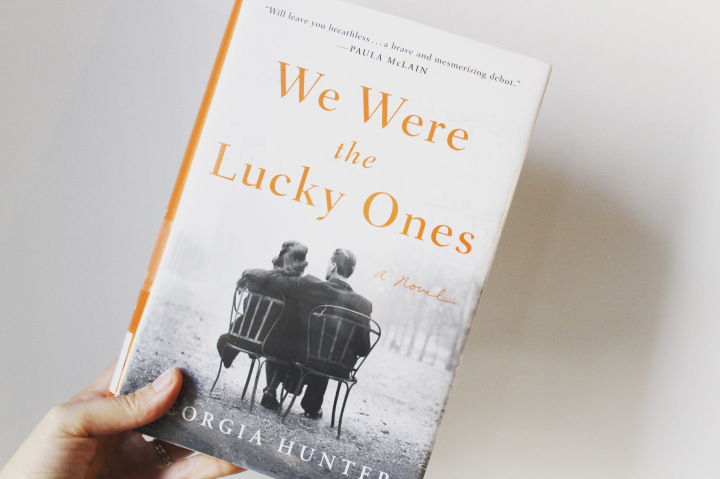
We Were the Lucky Ones by Georgia Hunter – Book


We Were the Lucky Ones Book and A View

We meet the Kurc (Kur-see) family in Rodam, Poland in 1939. Hitler is on the move and we know what is coming, but this close-knit family of middle class Jewish Poles does not. We Were the Lucky Ones by Georgia Hunter, covers familiar and dreaded ground, but this is a family of survivors. How did that happen?

Not one of these five siblings or their parents ended up at a concentration camp. They saw that Jews were being rounded up. They saw the railroad cars crammed with frightened humans supposedly going off to work in war factories. How is it that of the five (Addy, Halina, Bella, Genek, and Mila) and their parents only Mila ended up on such a train and she managed to escape a truly traumatic fate. They did not collaborate, they did not thrive; they worked almost to breaking in factories, subsisted on little food and sometimes no food. They often did not know where their other siblings were and they missed their family terribly, and worried about each other all the time.

The book skips between siblings and their spouses so we know where the Kurc’s are and how close they came to discovery and death, but they only learn this after the war when they all meet their son/brother Addy in Brazil. Georgia Hunter, the author, is Addy’s grandchild. He married a woman in Brazil who was from the American South. How did he get to Brazil?

Dumb luck and many delays, near capture, and the ability to anticipate and avoid being trapped helped Addy survive. He learned the name of a man who was supplying visas to Jews so they could leave Europe. He went to see this man and ended up on one of the last ships to Brazil. Even so all aboard the ship got rerouted to Casablanca and Addy almost ended up being caught there with an expired visa and sent back to Europe. This is just one of the family’s survival stories. The rest are just as compelling although told more as history than drama.

Georgia wrote a fictional story for the sake of flow and form and character development, but this is essentially a true story she researched for a decade, interviewing family, visiting museums and Holocaust data centers. Her family, whose stories she tells in We Were the Lucky Ones, may have only survived because they did not stay in one place and they were willing to learn new languages, buy papers that said they were Catholic, and because they were the recipients of favors from non-Jewish Europeans.

I don’t know why stories about WW II and the Holocaust keep falling into my hands, but this period in human history was a time when heroes and villains reigned. This was a time when what we learned about human nature was that we could succumb to a sickness of the spirit, to our most negative traits, envy, fear of others, national pride, genocide; or resist and become our better selves. Such books have special relevance in 2018 when we are in the midst of dealing with our fear of Muslims and “the others”, inclined to isolationism, and fomented to an exaggerated nationalism similar to what sent the German people so spectacularly and disgustingly awry in those WW II years.

Every time I read about WW II I learn something I did not know and feel things that I would not have felt otherwise. This may not be a perfect book; but it’s a very good debut and a great addition to the growing library of books about WW II for Jews in Europe.

Photo Credit: Book and a View

Love and Ruin by Paula McLain – Book

love-and-ruin-book-cover ohiomagazine.com

Paula McClain wrote about Ernest Hemingway’s first wife, Hadley Richardson in her novel, The Paris Wife and, this time, in Love and Ruin she writes about Hemingway’s third wife, Martha Gellhorn. I can understand the fascination with the women who married this literary giant. What kind of woman does such a legendary figure find himself attracted to? Hemingway was a handsome guy. Women found him desirable. It is almost tempting to wonder why only four women. But Hemingway sounds like he was not really a “ladies man”. He spent most of his social hours with men. He also seems to have seen women as occupying pretty traditional roles in a marriage, although he seems to have treated his wives as companions some of the time. Everyone in Hemingway’s world had a nickname.

Some readers do not value a fictional account of a Hemingway wife as they would a nonfiction one, but Paula McClain does do her homework, which she describes after the novel ends. So Love and Ruin is grounded in fact. But the day-to-day exchanges in a marriage are usually private business between husband and wife, although friends are privy to some of it, and can only be imagined in fiction.

Martha Gellhorn and her mother were recovering from the death of Martha’s father when they made a trip to somewhere as different and faraway as they could get without complicated travel arrangements. They fled to Key West and who should they meet in a bar almost immediately upon their arrival but Ernest Hemingway.

Both mother and daughter were pretty, long-legged and not at all shy. Ernest, married to Pauline Pfeiffer (Fife) with three boys (two from his first marriage) had his home, with his wife, right there in Key West. But he offered these two Gellhorn women a tour of the island. It was then he found out that Martha Gellhorn was a published writer. He began their relationship as her mentor. She was quite a bit younger. It seemed innocent enough.

If they had never gone off to report on the Spanish Civil War (Franco) at the same time (together) they might never have fallen in love and broken up Hemingway’s thirteen year marriage to Pauline. But Martha Gellhorn was not a “little wife” type of girl. She always wanted to be at the center of the biggest storm. She wanted to live life and she insisted that involved covering events like wars that only men generally wrote about. She and Ernest began as fellow war writers; she for Colliers, he making notes for a novel. Both felt more alive when death was everywhere around them.

When they needed to get away from the war they fled to Cuba, a place that Hemingway loved almost as much as Key West. They could not go to Key West because Hemingway was still married to Pauline. Martha found an old Cuban farm and when her book sold she used the money to restore it. It became the famous Finca where Hemingway still resided at the end of his life.

Martha imagined a sort of nirvana, with two writers living and sharing their craft, but Hemingway did not cooperate. He was demanding and selfish, and loving and ardent, and a partier and a hard drinker. Martha often found him exasperating. But just before World War II began Hemingway and Pauline divorced and Martha and Ernest married. They went to Hawaii for their honeymoon but trouble already was brewing. Martha had an independent streak that Hemingway despised and when she wanted to go off on her own to work or visit home he pouted and acted out. Although they both went off to London to cover the war they were more like rivals than sweethearts by then. Their marriage barely survived the war.

HEMINGWAY's wives France 24

Martha Gellhorn went on to have her own career as a writer of some fame and Hemingway wrote one of my favorite books Islands in the Stream. Hemingway remarried to Mary Walsh, a bond that lasted until they both died in a plane crash in Africa. We leave Martha behind when her marriage to Hemingway ends which belies the contention that this is a book about Martha Gellhorn. It is a book about a Hemingway wife, but one stamped out of such an independent and adventurous mold that the marriage was doomed to end in ruin. It made me aware of her as a writer and a dashing person who was ahead of history, and an admirable person in her own right.

You will have to decide about the fiction/nonfiction choice for yourself and also about whether or not this is a “chick” book. But Martha Gellhorn is worthy of our attention and Paula McClain made her quite real. A worthwhile read.

The Rembrandt Affair by Daniel Silva – Book

the Rembrandt Affair HubPages

Book 10 in the Gabriel Allon Series, The Rembrandt Affair by Daniel Silva, begins with Gabriel back in Cornwall, England by the sea and this time he is with Chiara. They have been released from the Israeli Secret Service, now being run by Uzi Navot from the “Office” on King Saul Boulevard. There is something quite romantic about Cornwall but also simple and rugged that seems appropriate to a man like Gabriel.

The problem with writing a long series of books with basically the same cast of characters is that accommodations must be made for readers who, perhaps, start with Book 10. This means that the author must describe characters that many readers already know, again and again. There are ways to do this but some people who have been with a series from Book 1 begin to find the repetition a bit tedious. However, in writing a series, readers also want the familiar characters to stay basically the same. Silva decides, in this case, to plug in old descriptions, sort of like boiler plates, to make the necessary introductions, or fill-in parts of the backstory. He has used more creative writing solutions to this dilemma in the past.

It took longer than usual to build to the action, but once the ride began, the thrill ride, Gabriel got called back into action, and since the mystery to be solved was about a painting, a Rembrandt, Gabriel and Chiara got sucked right out of Cornwall fast. It was Julien Isherwood’s fault, the Jewish/British art dealer. Where did a new Rembrandt come from? What was its provenance? Does this painting have any connection to the recent rash of art thefts museums are experiencing? Why is a man dead?

The hunt for this Rembrandt painting takes us back to the Nazi’s and the Swiss banks because there was no greater theft of a culture and a people than the possessions and the money stolen from Jewish families before they were railroaded off to concentration camps to be killed. A large part of what the Israeli Secret Service does is related to trying to restore things stolen from Jewish people and bringing those who stole and murdered to justice. This Rembrandt painting (not real, but symbolic of real paintings) has a sad, sad story to tell and conceals a secret that will help catch a greedy man posing as a very generous man.

This post war mishegas becomes entangled with Iran’s nuclear program because we are no longer dealing with the first generation of war criminals. We are now dealing with their children. How does the child of a father who was in the German SS turn out? Is he tainted by the sins of the father, or does he try to atone for the sins of the father?

What starts out slowly, gets very absorbing once it heats up. This time it is not Gabriel who takes a beating, and there is a new girl on Gabriel’s team. Will this be Zoe’s only appearance in a Silva book, or will she crop up again? What scary part of the world will Gabriel take us off to next time. Keep reading.

My Year of Rest and Relaxation by Ottessa Mesfegh – Book

my year of rest -You Tube

Do we act the way we do because of nature or nurture? Is our behavior inevitable, either genetically, or by upbringing, or do we always bear final responsibility for the way we behave? Don’t judge a book by its cover. Literally. If you consider the cover of My Year of Rest and Relaxationby Ottessa Mosfegh you might expect period fiction, but what you get is something quite of-the-minute, new and fresh right down to its bones. The young women our attention is focused on does not even have a name, perhaps because the book is written in the first person, but perhaps with some symbolic significance also.

We listen to a pretty, blonde, thin, 26-year-old who is already exhausted by life. She finds no authenticity anywhere, nothing to dedicate herself to, nothing to love, even, apparently herself. She nails the superficialities of various “cultural tribes” she is surrounded by at Columbia and in her neighborhood. The 40-something moms on the upper East Side come under her judgmental perusal as do the young males in the art history department at her college and the avant-garde artists who exhibit at the gallery where she works. She finds little to really admire in her handsome on-again, off-again boyfriend, Trevor, or her best friend Reva. Only Harrison Ford and Whoopi Goldberg escape her societal ennui.

When she is a junior at Columbia art school she loses both of her parents. Her parents were not exactly warm and fuzzy. About her mother she says: “She was not the type to sit and watch me draw or read me books or play games or go for walks in the park or bake brownies. We got along best when we were asleep.” “My father slept on the sofa in the den that year.” “None of us had much warmth in our hearts. I was never allowed to have any pets. Sometimes I think a puppy might have changed everything. My parents died one after the other my junior year of college – first my dad from cancer, then my mother from pills and alcohol six weeks later.”

Is our girl experiencing some kind of separation anxiety or does the loss of even bad parents cause us grief? Did her family’s inability to connect destroy her ability to feel empathy and affection? She decides that she will sleep for a year and then wake up a new person. Her inheritance from her parents allows her this option and she gets to sleep through the year in a very nice apartment on East 84thSt. which she owns outright.

But it is not so easy to sleep for an entire year. A psychiatrist must be found who has few compunctions about using a prescription pad. Dr. Tuttle is perfect, a real psycho-babble nut who knows her way around insurance rules. Pretty soon our blondie’s life becomes a long list of meds that she pops or guzzles whenever sleep is hard to find. Trazodone, Ambien, Nembutal, Solfolton, Xanax, Lithium, Haldol, Neuroproxin, Maxiphenphen, Valdignor, Silencior, Benadryl, Robitussin, NyQuil, Seconals, Libriums, Pacidyls, Noctecs, Miltowns, Lunesta, primidone and Risperdal, chewable melatonin…until she meets the ultimate sleep drug, Infermiterol. Too bad Infermiterol has one very worrisome side effect.

Even after a couple of months of chemical abuse our sleepy-head, catching sight of herself in the lobby mirror on one of her rare trips to the Egyptian bodega down the street says, “But I was tall and thin and blond and pretty and young. Even at my worst, I knew I still looked good.” But we wonder if anyone could actually survive on this much medication.

We have only covered two somnolent months of a long year. There is plenty more to this story. Do we care about this young lady? Should we care about her? Is there a message to this madness? Only you can decide. But for people who are tired of conventional fiction this certainly isn’t that. Just the gutsiness that comes up with fiction like this makes it well worth a read. Does it matter that our girl’s long sleep ends at a significant historical moment?

I keep thinking about this one, trying to care about this character. My admiration is more for form than any significance to the human condition at this point. Some books have to percolate. I also have a few caveats. One, don’t try this at home. Two, many of these scripts did not work as sleep aids. Three, as an experiment in rebirth, the outcome seems inconclusive.

Look for me on goodreads.com

Photo Credit: From a Google Image Search, You Tube

The Defector by Daniel Silva – Book

daniel_silva_thedefector_booksigning-520x390

In order to fully understand The Defector (Bk. 9, Gabriel Allon Series) by Daniel Silva it is helpful to recall the events at the end of Moscow Rules (Bk. 8, Gabriel Allon Series). Gabriel manages to escape from Russia (barely) with a Russian journalist, Olga Sukhova, whose colleagues have been assassinated, and with a man, Grigori Bulganov, who saved Gabriel’s life by making sure he did not die in Lubyanka, the Russian prison.

In The Defector we find out what Bulganov is up to in his new home, London. Silva, Daniel Silva, the author, calls London a Russian city because so many dispossessed Russians live there. Olga Sukhova, also in London with a new identity, is keeping a low profile. But Grigori is tempted out of hiding by another Russian who lives the high life in London.

When Grigori disappears on his way to a Chess game, Graham Seymour, head of British Intelligence, is not terribly upset. He decides that Grigori has become homesick and has “un” defected. However, when Gabriel Allon hears that Grigori is gone he has a different reaction. For one thing he knows that a very bad and powerful oligarch, Ivan Kharkov is still alive and well, although he has to stay in Russia for now. Gabriel also knows that he was able to help Ivan’s ex-wife Elena liberate some of Ivan’s money ($20 million) from a Swiss Bank. Since Elena is in protective custody in an unknown location with the couple’s two children, she needs that money. But you can imagine how much Ivan wants to get his hands on Elena, his children, and Gabriel. Since he can’t leave Russia right now, he must find a way to bring everyone to him.

Ivan Kharkov is a stone-cold bully boy who makes his money selling Russian weapons to people the rest of the world wants to keep weapons away from. Ivan’s hero is Stalin and he strives to model his behavior on the cruelty Stalin used as he purged (killed or tortured) any Russian citizen who he imagined might harbor sentients against his government (regime). Ivan managed to buy the dacha that once was Stalin’s summer home. Ivan uses his dacha to reenact Stalin’s bloody purges on a smaller scale.

When Gabriel doesn’t react right away to the disappearance of Grigori Ivan takes someone else and who he takes definitely gets Gabriel and his team moving.

Daniel Silva and his Israeli spy, Gabriel Allon, along with his team of Israeli operatives, expose bad actors all around Europe and the Middle East and offer up the satisfaction of giving them what they deserve in fiction, even though we often do not experience such justice in real life. When The Defector ends are we finally shut of Ivan Kharkov? My lips are sealed.

In notes at the conclusion of The Defector, Silva connects his fictional spy story to actual historical events that inspired it.

“There, from August 1937 to October 1938, an estimated twenty thousand people were shot in the back of the head and buried in long mass graves. I visited the recently opened memorial at Butovo with my family in the summer of 2007 while researching Moscow Rules, and in large measure it inspired The Defector. One question haunted me as I walked slowly past the burial trenches, accompanied by weeping Russian citizens. Why are there not more places like this? Places where ordinary Russians can see evidence of Stalin’s unimaginable crimes with their own eyes. The answer, of course, is that the rulers of the New Russia are not terribly interesting in exposing the sins of the Soviet past. On the contrary, they are engaged in a carefully orchestrated endeavor to airbrush away its most repulsive aspects while celebrating it achievements. The NKVD, which carried out the Great Terror at Stalin’s behest, was the forerunner of the KGB. And former officers of the KGB, including Vladimir Putin himself, are now running Russia.” -Author’s Note

Photo Credit: From a Google Image Search, Daemon Books

Warlight by Michael Ondaatje – Book


warlight big lawn gnome publishingMichael Ondaatje never writes an ordinary book, at least in my estimation. His books put me in a reverie of unique experiences lived in far off places and times. In his novel, Warlight he writes of some of the people of England and London who performed secret services all over Europe and the Baltic states during World War II. These services had to be kept so discreet that it is difficult for these members of the intelligence service to reenter their prewar lives.

Wars don’t end on the day that a treaty is made. The hurts, the resentments, the losses stay with people affected by wars. People swear to avenge their loved ones from cruel strikes perhaps necessitated by war, but still seen as desecrations. Strategy may deem it appropriate to level a village but the relatives and friends or absent residents cannot rationalize. They carry their shock with them and they nurse their anger and they vow they will seek retribution.

When first their dad and then their mom leave, Nathaniel and his older sister Rachel are in their early teens. They think their mom has gone to Singapore to be with their dad who was sent there by his company, until they discover her carefully packed trunk in the basement of the family home in London.

These two have been left in the care of a man called The Moth, a rather lackadaisical caretaker, and all that was orderly about their lives falls away. Rachel (nicknamed Wren by her mother) learns that she has epilepsy and of course she is a girl so what she experiences is quite different from what Nathaniel is allowed to get involved with. The Moth is soon joined by another character, The Darter.

Nathaniel is allowed to work with the immigrant staff overseen by Moth at Criterion’s Banquet Halls, setting up for events and washing dishes. Later he helps The Darter smuggle greyhounds into unsanctioned race tracks through keeping a schedule of nighttime pickups at various stops along a network of rivers and streams near London. Nathaniel is the narrator of Warlight but he does not know why his mom left him and his sister with these strange guardians.

As a grown man Nathaniel (who was nicknamed Stitch by his mother, Rose), is offered a job going through the archives collected during World War II, and although he has been reunited with his mother, her continued secrecy prods him to take the job. He begins to learn about what his mom did during the war and how it has followed her home, why she feels she endangers her own children. With great detail Ondaatje creates a world of lives lived outside the mainstream, interesting but slightly dodgy lives. Rose’s caretaker picks prove wiser than they seem.

Ondaatje reminds us that the human memory is long and that there are rarely clear demarcations between one event and the next, in fact the more complex and heartrending events leave traces that may never quite go away. He teaches us that life, like certain passages in music has moments that can best be described by a term Mahler uses to mark a passage that is difficult or heavy. Life can be schwer. I think you will love learning Rose’s story along with Nathaniel, and how it intertwines with that of Marsh Felon, a thatcher’s son who once fell off the family’s roof and had to mend on a cot in their kitchen. And just to add a bit more mystery, you will find out about Viola and many more ordinary heroes.

Find me at Goodreads at Nancy Brisson

Photo Credit: From a Google Image Search – Lawn Gnomes Publishing

The Secret Servant by Daniel Silva – Book

the Secret Servant by Daniel You Tube

The Secret Servant by Daniel Silva begins with a dead Jewish scholar, as Gabriel Allon books often do. Professor Solomon Rosner is “the first asset in the annals of Office history to have proven more useful to them dead than alive.” He is killed in Amsterdam in a normally a peaceful neighborhood. Rosner runs the Center for European Security Studies. “[T]he center had managed to produce a steady stream of authoritative reports and articles detailing the threat posed to the Netherlands by the rise of militant Islam within its borders.” Rosner had a lot of enemies both Islamic and Dutch. He is killed on the way to lunch by one of the painters who has been working across the street from his office. Obviously painting is not the man’s only job.

Gabriel Allon flies into Tel Aviv and is met by Uzi Navot. Once a katsaor western European undercover case officer, Uzi is now Chief of Special Ops. He had done jobs no one else wanted to do, executioner, kidnapper, bugger, blackmailer. Uzi is a bit bitter about Gabriel’s star status. Uzi to Gabriel: “Art restoration was your cover job, Gabriel. You are not an art restorer. You are a secret servant of the state of Israel and You have no right to leave the fighting to others.”

Shamron reveals that Rosner also worked for the Office. Rosner was to keep eyes and ears on Islamic extremism to give some early warning of possible terrorist targets. Rosen helped them stop and assassinate the members of an al-Qaeda affiliated “cell operating in West Amsterdam [when they] got their hands on a missile and were planning to shoot down an El Al jetliner.”

The painter who killed Rosen was named Mohammed Hamza and there was a videotape found in his apartment. Gabriel is to go get all of Rosen’s files which ends up being about 500,000 documents. Rosen started out as a sayan. “[S]ayanimare a worldwide network of volunteer Jewish helpers, Bankers are used to provide cash for Office agents, doctors treated them in secret, hoteliers gave rooms under false names, rental car employees gave them untraceable vehicles. Then Shamron recruited him.

Gabriel is given an assistant, Eli Lavon. He is described as small and bookish, with wispy unkempt hair and quick brown eyes – As usual he seems to be wearing all his clothes at once. And he is “the finest street surveillance artist the Office has ever produced.” He is an archeologist by training and has also been an ayinor tracker.

Gabriel and Eli Lavon meet Sophie Vanderhaus, Prof. Rosner’s assistant at the same café where Rosner was killed. At the end of a long day going over files Gabriel goes out for Thai food – and never comes back. Someone, an old Arabic man wearing keffiyeh and kufi, follows Gabriel and, after Gabriel almost kills him, the man says he has come to help them. He worked with Rosen. He is Ibrahim Fawaz.

Ibrahim tells Gabriel that, “Takfir was a concept developed by Islamists in Egypt in the nineteen seventies, a theological sleight of hand designed to give the terrorists a sacred license to kill almost anyone they pleased in order to achieve their goals of imposing sharia and restoring the Caliphate. To the Takfiri, democracy was a heresy, for it supplanted the laws of God with the laws of men.” “Muslim citizens of a democracy were apostates and could be put to the sword.

Fawaz also tells Gabriel about Samir al-Masri who is a dangerous man, and that Samir and four other young men have disappeared from Amsterdam. They go to search his room. In Samir’s room they find photos of Samir in Trafalgar Square, Samir with a member of the Queen’s Life Guard outside Buckingham Palace, Samir riding the Millenium wheel, Samir at the House of Parliament and the American Embassy in Grosvenor Square. Guess who’s going to London now?

As they part ways Eli says, “And so here we are again two nice Jewish boys, sitting on a European street corner at three o’clock in the morning. My God when will it end.” “It’s never going to end, Eli. This is forever.”

It can take a lot of build-up to get to the heart of the action in Silva’s popular spy thrillers. Back stories are long. Some readers run out of patience. But we are there now.

Gabriel is not exactly warmly welcomed in London and his cohorts there do not take the threat very seriously because they have been through so much. Gabriel narrows down the threat to Hyde Park and the American Embassy.

Robert Halton, the ambassador, waves his daughter, Elizabeth Halton, MD goodbye, not without trepidation, as she leaves for a run in the park. She is kidnapped in broad daylight by men dressed all in black and driving a park maintenance truck. Gabriel’s warning came too late, but he is in time to see the attack and shoot some kidnappers. Still, Elizabeth is gone.

Now Adrian Carter from the CIA, who is always a good partner joins the hunt since the American ambassador’s daughter is involved.

Who took her? What do they want? Will Gabriel get her back alive? What injuries will he sustain this time? Who is the mastermind of this plot.? How is Egypt involved? Who are the Swords of Allah? Who gets married?

Find me on Goodreads as Nancy Brisson.

Prince of Fire by Daniel Silva – Book

prince of fire big you tube

Most books in the Gabriel Allon series begin with violence; a murder or perhaps a bombing where someone who is Jewish or Israeli is targeted. In book five, Prince of Fireby Daniel Silva the catalyst to Gabriel’s newest investigation involves both. There is a bombing at the Israeli Embassy in Rome and then four terrorists arrive and target anyone who might have survived with automatic assault rifles. Both ambassadors who are present die.

Gabriel is an art restorer of some genius. He would be happy to do this full time, but he has also been trained as a skilled spy and assassin for the Israeli Secret Service. Shamron, his mentor, an irascible old survivor of the Palmach in the War of Independence in Israel, keeps suddenly appearing in Gabriel’s peaceful life in Europe, where the great cathedrals and paintings live. Suddenly Gabriel will get a whiff of a smelly Turkish cigarette and know his peace will be disturbed because someone else’s peace has been shattered.

A mysterious man rents a villa in Bracciano, Italy, a Monsieur Jean-Luc. He arrives in January and vanishes in late February. The owner of the villa remembers that he spoke French with an upper-class accent.

Near the Borghese Gardens in Rome with its “elegant boulevards and quiet leafy streets, on a cul de sac sits the Israeli Embassy in Rome.

“Survivors and witnesses would recall the perfection of that late-winter morning: bright and clear, cold enough in the shadows to bring on a shiver, warm enough in the sun to unbutton a wool coat and dream of an al fresco lunch”

This stellar late-winter day is disturbed by first the aforementioned truck bomb and then by the four men with automatic rifles who jump from a car to shoot any survivors.

Once the Intelligence service on King Saul Boulevard in Tel Aviv collects itself, the Roman katsa (Hebrew for a undercover foreign office manager) Shimon Pazner is located and the terrorists movements are traced. Forty-eight hours later investigators find a hurriedly abandoned room pointed out by a Tunisian informant. After a thorough search the investigators find a computer disc sewn into the lining of one piece of the abandoned luggage. Shimon takes the computer disc to Tel Aviv because they have had reason to develop excellent skills for decoding encrypted information.

What they find sends them off looking for Gabriel who happens to be away from the Bellini painting he was restoring in Venice. He is in London to see an old and useful friend, Julian Isherwood, an art dealer and friend of the Israeli Secret Service, and to visit his wife who had been badly burned and emotionally damaged in a car bomb incident in Vienna. Gabriel and Leah’s son was killed. Now Leah goes through her days in silence and seems unable to remember Gabriel.

“Leah had been punished for his sins. Leah was the price a decent man paid for climbing into the sewer with murderers and terrorists.”

Gabriel is at the sanitorium to let Leah know that he intends to marry Chiara who lives with him in Venice and also works for the Office on King Saul Boulevard, but he finds he cannot say the words to her.

Shamron finds Gabriel at last when Gabriel returns to Venice and Chiara and the Bellini. Shamron reveals that the computer disc they decoded contained a detailed dossier of Gabriel’s assassination activities for the Office. Fingerprints identified the holder of the dossier as Daoud Hadawi, a Palestinian refugee. The same computer disc also contained photos and security analyses for targets in Europe. Gabriel could not say no to Shamron. Chiara is coming too.

Gabriel is given an office in Room 456C at King Saul Boulevard and this time he has a team. Chiara is bat leveyha, Hebrew for a girl escort officer. Yossi comes from Research, Dina, from History, Yaakov from Arab Affairs is a shabak, a body guard, Rimona is from Military Intelligence and is Shamron’s niece. Using what they know, the name and national origin of Daoud Hadawi, they begin their investigation, which also seems to have a connection to Yasir Arafat, by interviewing all of their Arab informants.

“Gabriel began each day by posing the same series of questions. Who built the bomb? Who conceived and planned the attack? Who directed the teams? Who secured the safe houses and the transport? Who handled the money: Who was the mastermind? Was there a state sponsor in Damascus or Tehran or Tripoli?”

And who is Khaled al-Khalifa. “Khaled is a rumor. Khaled is a ghost story. He is the thing that is missing.”

The investigation will lead far and wide. How many times will Gabriel be wounded in the search for Khaled al-Kalifa? Who else will die? Will Gabriel ever get to finish working on the Bellini in Venice? Will he ever tell Leah about Chiara? So many questions I can’t answer because that would ruin this excellent spy story.

Photo credit: From a Google Image Search – You Tube