
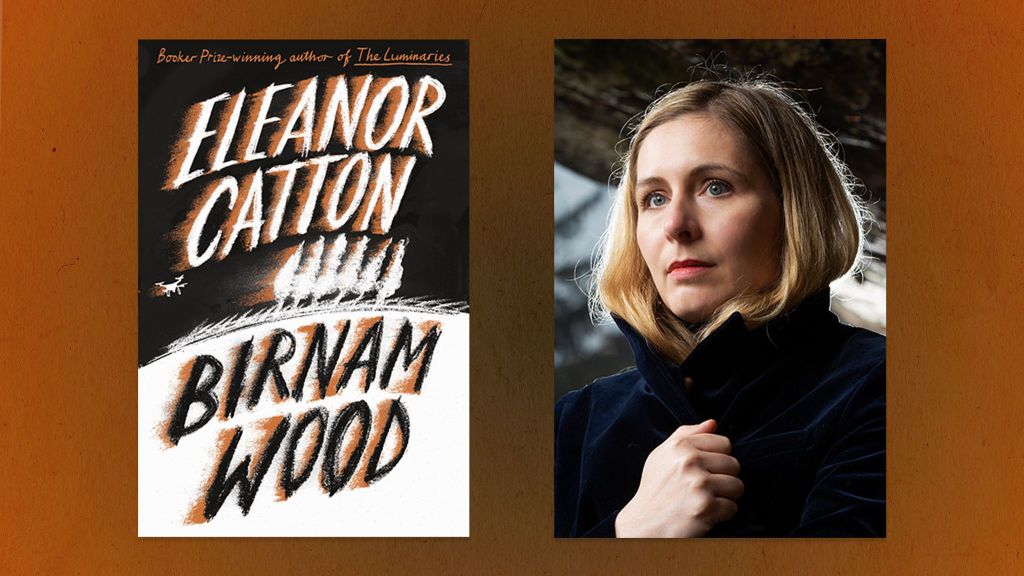
Birnam Wood by Eleanor Catton-Book

From a Google image Search – Shondaland.com

For me the jury is still out on Birnam Wood by Eleanor Catton. Our first impressions when we finish a book may change with time, either increasing or decreasing our favorability rating of the book. The title comes from the play Macbeth by William Shakespeare, and I must say that Shakespeare understood human nature and would most likely have not been shocked by these folks. I will also say that if you plan to be evil you should at least be good at it. 

Lady Jill Darvish and the newly knighted Sir Owen Darvish own the property and the farmhouse where Jill Darvish grew up. It is near the New Zealand town of Thorndike. A recent avalanche has made it more difficult to access the farm and the land, although not impossible if you go in through the national park land adjacent to the property. 

This hard-to-reach piece of land ends up hosting an astonishing array of people and machines. An American, Robert Lemoine, made an offer to buy the property, without the farmhouse, before the avalanche. He’s a billionaire who says he wants to build a bunker to survive the coming climate apocalypse. Some people are disgusted by this display of wealth, others feel that it’s a dumb plan because supply lines will become problematic, but almost all people who are aware of the project are curious about what the bunker will look like. But does a bunker project require armed security guards? What is Robert Lemoine really up to?

Birnam Wood is a collective of environmentalists. They are gardeners who plant crops on any untended land they can find, and they are sometimes guerilla gardeners, planting on land owned by others without their permission. The group attracts young idealists who travel light and live cheaply. They meet regularly to plan their stealth planting operations. They sell the produce they grow to help finance tools, seeds, and transportation. The group also accepts donations. We meet two young women who are the current leaders of the group, Mira, and Shelley. When they learn about the land at the Darvish farm, cut off as it is from the world, it seems an ideal place to do some real farming. When they meet Robert Lemoine, who still seems to want to buy the property, and who in fact says he has bought the property, he wants them to come to the land and farm it. He even deposits upfront money in the Birnam Woods account, ten thousand dollars. 

What could go wrong?

Of course, I cannot tell you the details, but a series of chain reactions is set in motion which would do justice to any book by George R. R. Martin. After all greed is one of the seven deadly sins and, in one way or another it affects every character in this novel. Again, I had to listen on Audible until my eyes get corrected, and the story flew by. The connection to Shakespeare I found rather tenuous although Macbeth and Robert Lemoine have a few things in common.

Did the author go overboard on the complications involved in her plot? Did it have to end the way it did? Was the ending much too abrupt? The way the author contrived to get the entire cast of characters all together on a property that was cut off by an avalanche should interest any fiction writer. I enjoyed it but did I love it? Time will tell.


The Covenant of Water by Abraham Verghese – Book

From a Google Image Search – Chicago Review of Books

There have been two books by beloved fiction authors published recently that are set in the same area in India, along the southwestern coast. Salman Rushdie’s offering, Victory City, is a mythic fantasy that is inspired by the site of an ancient and fallen civilization. The Covenant of Water by Abraham Verghese is set in the years from 1900 – 1977 as a family saga and an exploration of how the effects of a hereditary condition affect the fortunes of the family. Verghese, who also wrote the best-selling novel Cutting for Stone, is known for the medical stories he tells. 

The Covenant of Water takes place in the watery landscape that is known today as the state of Kerala. We begin in the years of British occupation, although this is not a story about imperialism and winning independence. India does win free of Britain during this period, but the novel is the story of a family living on a property known as Parambil. A very young woman is contracted to wed the owner of Parambil and we share her trepidation as she travels along the waterways that provide transportation throughout the area. She is a Christian woman and is marrying a man who belongs to the same church of St. Thomas. Her husband lost his wife to childbirth and the child lived. He gives his twelve-year-old wife time to grow into the relationship. 

Big Ammachi is the name that this child-woman becomes known by as she becomes the stable and enduring center of the family. She discovers that many of the members of this family she has married into suffer from an aversion to water. This is a big deal in the watery world they occupy. When those who are afflicted get into water they become disoriented, and grievous accidents and drownings cause beloved family members to die early. The family keeps a family tree that records the tragic path of destruction that “the Condition” has left behind. There is no science to explain this type of hereditary situation in 1900, and in fact the physical basis for this condition is not known until we arrive in 1977 near the end of this book. 

In a parallel story we have the promising doctor, Digby Kilgore, in India but from Scotland, who is beginning a career in surgery. He is partnered with a doctor addicted to alcohol who leaves all the Indian patients to Digby while he treats the very few white patients who are admitted into a separate ward. Digby falls in love with Celeste, the talented wife of this addicted surgeon who should have already lost his right to practice medicine. Their passion leads to a fire that changes Digby’s life forever. With his burned hands he knows his time as a surgeon is over. Connections he has made as a surgeon lead to the next chapter of his life which becomes intwined in the life of a man who builds a compound for lepers. He falls in love again with Elsiamma the beautiful wife of Philipose, Big Ammachi’s grandson. Eventually this connection leads to finding the cause of “the Condition.” Mariamma, who believes she is the child of Philipose and Elsie, learns about her true parentage when her life crosses the life of Digby Kilgore.

Besides offering glimpses into a part of the world we were basically unacquainted with, we get a sense of the slow development of our store of information about disease and the hereditary roots of it. Science cannot offer insight until the tools that allow observations inside the body have been invented. And the brain is almost impossible to study humanely while we are alive, at least this was true before modern imaging and is still true to some extent. It took three-quarters of a century to trace the origins of this one disease, which affected so few people that the discovery of its roots was almost stumbled upon by accident. If Mariamma had not decided to become a doctor the discovery may have been delayed even longer. 

There is an aspect of both Rushdie’s Victory City and Verghese’s The Covenant of Water that gives them common cause besides geography and that is the focus given to women, their victories, and their heartbreaks. Pampa Kampana, the woman who creates Victory City, ironically never gets to rule it. She does, however, establish that women will one day give up entering the fire, as her mother did, when their husband dies. Since the women in The Covenant of Water are rarely affected by “the Condition” and since Big Ammachi did not have this genetic defect she forms the backbone of her family and her village, offering warmth and love to all who inhabit her world including “Damo” the elephant who often visits and who Big Ammachi once caught looking into her kitchen with his big old elephant eye. Romance is also a part of Verghese’s story, although even the happiest of unions face tragic circumstances. Even the lepers are treated lovingly and the research on leprosy makes possible the research on “the Condition.” This is a long novel, but following at least three, possibly four generations of one family takes time and we learn that, simple or fancy, life makes unsung heroes and heroines irrespective of economics.

Victory City by Salman Rushdie – Book

From a Google Image Search – American Kahani

Salman Rushdie, prolific and celebrated author, was born in Mumbai (Bombay) India. He was born to Islamic parents but became an atheist. One of his early books was The Satanic Verses. It was considered sacrilegious by the Ayatollah Khomeini in Iran who issued a fatwa on February 14, 1989, requiring the faithful to seek out Rushdie and kill him. For many years Rushdie lived in hiding in London under the protection of the British government. The Ayatollah died without lifting the fatwa, so it was never rescinded but Rushdie felt secure enough to live freely in NYC for many years. On August 12, 2022, standing on the stage at the Chautauqua Institute in New York Rushdie was attacked by 24-year-old Hadi Matar who stabbed him multiple times with a knife before security and participants were able to apprehend him. Rushdie was severely injured and lost the use of one eye.

Victory City is the first book Rushdie has published since his near-death experience. Salman Rushdie is back on home turf with this book. His heroine, as a nine-year-old girl, sees her mother walk into a fire to die as custom required of widows. She is shocked that her mother would chose the fire rather than stay with her. But she is given a gift from the goddess Pampa who she is named for. She is given two gifts by the goddess. She is gifted with long life. She is also gifted with the magical ability to sow seeds and grow her own city.

The goddess tells her, “You will fight to make sure that no more women are ever burned in this fashion, you will live long enough to witness both your success and your failure, you will see it all, tell its story and then you will die immediately. Nobody will remember you for 450 years until they unearth your verses.” (not an exact quote). It turns out that knowing your future often brings both joy and pain.

First Pampa Kampana spends years reaching her maturity in the cave (mutt) of a spiritual teacher and sexual predator, Vidyasagar. Fortunately, Vidyasagar studies for long hours as he memorizes all the holy texts, but he occasionally finds time to rape Pampa. The monk seeks the answers to two questions. The first is whether wisdom exists or there is only folly. The second question is to find out if there is such a thing as Vidya or true knowledge, or only many different kinds of ignorance. His goal is (ironically) how to ensure the triumph of nonviolence in a violent age. Although grateful for learning the contents of the holy books, she never forgets the humiliation she suffered when she was helpless to fight back.

When Pampa Kampana is eighteen two cowherds arrive at the mutt. She sends Hukka and Bukka Sangama out to sow the seeds of her city. She names the city Bisnaga or Victory City. Since her city is peopled by people who have no personalities, who know no history, who don’t know their identities, Pampa Kampana whispers to fill the minds of each individual in Bisnaga. It is a city created by magic. 

Magic is one of the best aspects of Rushdie’s writing. The existence of magic allows him to be a great storyteller in the Eastern manner. This book does not have Islamic roots; it celebrates Hinduism but as myth more than religion. It’s interesting that Pampa Kampana’s life and the life of Victory City are exactly 247 years, the same as the life of the American Republic (probably not an accident). There is plenty of commentary on the rise and fall of great cities, or great empires. Why are empires successful and why do they fail? Is failure inevitable? 

In our world we have no magic that we know of. We live in non-magical times. We can’t blame the gods and goddesses for our failure. We have only ourselves to blame. Still, a good story entertains us and makes us think in new directions. Victory City is an engrossing tale of magic and life that centers around a female heroine who builds a great empire, which is quite rare. Salman Rushdie is writing again and that is cause for celebration.

Theresa, et al by Jean Hackel – Book

From a Google Image Search – Amazon – the ratings are from readers on Amazon

A rather chilling abortion story has been written by Jean Hackel in her book Theresa, et al. When Theresa decides to have an abortion the Dobbs decision has not yet turned abortion laws over to the states. Abortion is still legal. Theresa goes to the wrong clinic however, and winds up in the hands of some women who have formed an abortion vigilante group. Theresa’s mother, a very devout Catholic, who honors her religion above her children, allows a fanatic named Lucy Meyer to come into her home with some of the militant women from Maureen Haig’s church. Theresa is living in her family home while her husband is on active duty in the armed forces. Theresa is shocked that her mother pretends that she (Maureen) does not seem to see that these women plan to stop her daughter from completing a personal choice about her pregnancy. They eventually kidnap Theresa.

“Theresa sat on the bed, her back against an iron-spindle headboard. Both of her wrists were attached to the grillwork. Her feet were tied together with fabric to prevent kicking. Lucy sat down on a wooden chair at the edge of the bed.” (p. 132)

There are many repercussions from this violent and criminal act. Could this really happen? Perhaps it already has but this may also be a graphic way to discuss forced birth and the effect it may have on women, families, and even children. 

Where were the authorities in this situation? There were eventually many agencies involved, but Theresa got no justice. On top of all the pain of. being a victim, Theresa’s husband is injured by an IED on the way home to her and when he finally gets to a hospital in the states, he has a tough recovery ahead. Since the hospital is in Alabama, when Theresa is found in Minnesota where her own family lives, Woodrow (a great guy) takes her to stay with the Coles who are Charlie’s family. From her cold, judgmental mother she enters the sphere of a warm and loving family, and her life begins to normalize. Turns out though, that justice is far harder to come by given the strength of the “pro-life” movement. Quite a timely novel, which calls to mind The Handmaid’s Tale, although it is completely original.

Violeta by Isabel Allende – Book

From a Google Image Search – Houston Chronicle

Isabel Allende set some of her books in California, showing glimpses of the lives of Americans who migrated from Central and South America. Violeta, the main character in Allende’s eponymous book, lives in an unnamed country in South America, in a city that is named Sacramento, echoing her California stories. (The internet tells me there are 31 cities named Sacramento.) Violeta lived for one hundred years and is able to portray the instability of the government in her country against her own ability to stay successful in business. She never fell afoul of the various governments or regimes that ruled her country, especially the authoritarian or military governments, which often expressed their power by executing key figures and their supporters from the previous government. Violeta Del Valle and her family knew how to be invaluable to government while staying out of politics.

Violeta was also lucky with the people who surrounded her, her extended family. Violeta tends to turn those who are close to her into family members. Her governess from Scotland, Josephine Taylor and Josephine’s lover Teresa Rivas, a bohemian social activist, are loyal to Violeta. Teresa has family in Patagonia, Chili with a farm. When the country’s democratic government is overturned, Violeta escapes danger by going to the Rivas farm. Teresa’s family becomes Violeta’s second family.

Miss Violeta has a series of husbands and lovers. Her first husband is a German immigrant from a wealthy family who is so engrossed with the science of artificial insemination of farm animals that the relationship with his wife just kind of fizzles out without offspring. Although, when Violeta wants a divorce, it doesn’t prove easy to make that happen.

Julián Bravo, a swashbuckler, takes up quite a few of Violeta’s 100 years. If her last romance fizzled, this romance sizzles. It turns into more of an addiction than a love story. Julián lives at the edge of adventure, crime, and political disaster. He doesn’t want children and is irate when Violeta is pregnant with his son. Their relationship is tempestuous and toxic, but Violeta can’t give him up. They also have a daughter, Nieves. They never marry. After Violeta’s daughter moves to America with her father, Nieves falls into the traps many modern children have fallen into. Throughout the tragic moments of Nieves’ life, there is a man who steadfastly keeps Violeta informed about her daughter. Ray Cooper is an ex-convict; he is now a detective. He comforts Violeta and they enter into a calm long distance relationship that satisfies both of them.

Violeta is not a novel full of literary techniques and esoteric symbolism. Allende give us a woman who is simply telling the story of her 100 years to her grandson, Camilo, in a letter, a really long letter. Violeta’s story does not need literary poetics. She is a businesswoman. We get to live her life through her as she experiences a century of worldly events that are not so much history as events that touch her life and the lives of the people she loves. She is a strong woman, and she understands how to earn and keep money. At the end of her life, she meets another man, this time from Norway, who should be boring but isn’t. I always like where Isabel Allende takes me. This time she takes to a remarkable life of a remarkable woman. Does it have elements of autobiography? Hard to say unless you know Allende very well. 

Babel by R. F. Kuang – Book

From a Google Image Search – Orange County Register

Science fiction and social commentary are for all practical purposes in love and married to each other. Writers of sci-fi may build worlds but they generally have something to address in the actual world we occupy. In her book Babel: or, The Necessity of Violence: An Arcane History of the Oxford Translator’s Revolution, R. F. Kuang creates a new world right on the nineteenth century campus of Oxford University. England runs a bit differently than it does in our histories. In Kuang’s novel England runs on silver and language, and the whole system is run by translators.

The eight-floor high tower of Babel sits on the Oxford University Campus and only translators and their professors are allowed inside. Students enter on the first floor and work their way up to the eighth floor where their language skills allow them to make powerful decisions that keep the Empire running smoothly. 

Although the quality of people’s lives is affected by the silver/linguistics technology, England is otherwise the same colonial power as history records. Wealthy Brits believe that other nations on other continents are full of savages with primitive intelligence and backward customs, even in the case of a culture like China which existed for centuries before the English arrived. China opened its doors to trade for a brief period in the nineteenth century providing England with much coveted Chinese tea, but England is running out of the silver it needs to keep its wealthy citizens happy. China is not willing to mine silver for England or let England mine China’s silver. England plans to secretly flood China with opium to make it a quiescent nonentity. Surprise, surprise. China figures out this secret plan and does not agree with it.

Because the silver effect is controlled with word pairs from two different languages and by the etymological connections between the meanings of the paired words, this system does not work without the translators. All translators must have a firm grasp of Latin and Greek and at least two other languages. One of the languages must be English. Students must study for three years before they get to work in the silverworks on the eighth floor. 

In order for word pairs to function the words must not both be in common use. As the age of discovery and colonization begins to connect nations words that once belonged to a single geographic region become popular in common use across many nations. This makes it more difficult for England’s translators to come up with unique pairs. Suppose you want the sewer system throughout the country to function well and the rivers to stay clean, the drinking water to stay potable. Silver bars with the correct word pairs can make this happen if you happen to live in an elite neighborhood or an important village.

As England looks around the world for more esoteric languages, they find ways to parent children with native women, or they seek out talented children and they place them in the homes of wealthy sponsors or professors and offer them all the comforts of a wealthy life while they force these children to learn Latin, Greek, and English. They must also retain proficiency in their native language. What happens when these children grow up and attend Babel to become translators is the crux of this novel and the part where social commentary comes to the fore. How do you think children from nations Brits feel are inferior are treated at Oxford? Where does violence come into the picture? 

R. F. Kuang’s novel is complex, perhaps a bit too complex. The action should reach a crescendo at some point, but the intensity seems to be tamped down to a sort of monotone. The social commentary is clear, but it ends too abruptly in a simple epilogue. Will the actions the central characters finally choose have the desired effects? The author does not really answer that question. Does heroic sacrifice work as an alternative to violence? Will any of the voracious appetites of the wealthy be kept under control? The book is interesting, and the characters affect us much as the characters in Harry Potter do, but the book needs to go on to the aftermath for a bit. Perhaps there will be a sequel. It was an interesting read. The book has echoes of Neal Stephenson’s Quicksilver Trilogy, except that he is a small g “god” of sci-fi.

The Last Chairlift by John Irving – Book

From a Google Image Search – CBC

It took me a while to adjust to John Irving’s bizarre characters and plotting details in The Last Chairlift, but John Irving knows how to have his way with his loyal readers. Will new readers of Irving like this book? Can an old activist discuss the wide array of modern genders without being guilty of cultural appropriation? Well, he has his tricks but perhaps only true readers, celebrated in this book, will go the course, ski the diamond runs.

John Irving is from New Hampshire. Skiing and skiers are things he probably knows quite a bit about. In The Last Chairlift his mom is a ski instructor and Adam is her one and only (child). She begat him in Aspen at the Jerome Hotel from a boy just entering puberty. She lives in a sort of dorm full of raucous and fun-loving girl ski instructors with her partner, Molly, a trail groomer, and a big old reliable girl with a sweet spirit. A number of women in Irving’s book have a big problem with penises. Then there are the characters who see ghosts and those that don’t. Adam and Little Ray (his mom) both see ghosts, especially at the Jerome Hotel but several ghosts visit Adam in the attic bedroom at his grandmother’s house where he lives while is mother is busy at various ski mountains. 

Adam is from a family of small people. His father, who does not appear until late in his life is small, his mother is small, thus the nickname “Little Ray,” she marries the very small Elliot Barlow (not too small to be a good wrestling coach, just the right size for a man who should have been born a woman). Small size does not make these characters small in spirit. 

Adam has a big cousin, Nora, a lesbian, and a true activist, bold, creative, and outspoken and much admired by Adam. Nora’s girlfriend, with the legendary wild and loud orgasms, is actually mute. These two have a comedy act at a NYC club that resembles The Stonewall Inn, called Two Dykes, One Who Talks. Em doesn’t talk but she becomes a master of awkward pantomime. She’s the pretty one. Adam loves all these people, but it seems he is in unrequitable love with Em (McPherson).

Moby Dick plays a big role in this novel, perhaps similar to the role the dog, Sorrow, played in Hotel New Hampshire, as a source of literary content, social commentary and “dick” humor. Repetition is one of the ways Irving gets us to immerse ourselves in his mayhem. Irving plays his usual comic tricks that never fail to provide humor that makes us shake our heads because it is so outlandish and sick. Adam’s early sexual liaisons with injured women, one on crutches with twitchy nerves, one with a cast, one who is a bleeder, might prove as obstacles to normal sexual development to a young man who did not have Little Ray and Molly and his nonchalant grandmother in his corner. 

But love is all around, and it tempers all the many disasters in this long tale. It is typically Irving, over-the-top, endearing social commentary intended to change your views and make you suspend your disbelief. Who decides when a great writer is too old to write? It’s a thing between writers and readers. This may or may not be Irving’s last novel, but in this one he’s still got his writer mojo.

Lessons in Chemistry by Bonnie Gramus – Book

From a Google Image Search – Book Club Chat

A book about what befalls a woman in a field dominated by men doesn’t usually sound like much fun, but Bonnie Garmus cracked that code in Lessons in Chemistry. Elizabeth Zott is a chemist, a talented chemist. She has exactly the right character for scholarly experimentation. She doesn’t plan to marry or have children. But she is beautiful, and it has created no end of problems for her. She doesn’t have her doctorate because she was sexually abused by the professor who was advising her. She is hired by a lab but is given a space that is poorly equipped. She wants to study abiogenesis, trying to trace life to one organism, but the head chemist, Dr. Donatti, will not sign off on that. Might she have been left to her own devices if she had not been beautiful? Maybe, but it would have been a different story.

While stealing beakers from the lab of Calvin Evans, the chemistry star of the university, recognized in significant articles in science literature, she piques his ire and then his interest. Calvin is not handsome, but he is tall and lanky and authentic. Elizabeth Zott cannot help herself. They become a couple and they eventually live together with their dog, Six-Thirty. Calvin proposes but EZ stays true to her decision not to marry. Calvin keeps the jealous, unethical, and lecherous Donatti at bay. He offers balance in EZ’s life, and he gets her to try rowing. Then tragedy strikes. (That’s all I can say)

Elizabeth Bennet from Pride and Prejudice could have been Elizabeth Zott if she had been born in the twentieth century. Although this snapshot of a woman just trying to excel at something men usually do is from the 1950’s, before women’s lib, this dynamic has not changed as much as you might think. Once women are established or have worked for an enlightened organization, women can compete, but the path to the top is still littered with abuse and attempts to make a woman’s accomplishments less or her lifestyle unacceptable. In Lessons in Chemistry Dr. Donatti and his assistants plagiarize Elizabeth’s work, and he publishes it as his own. You may think this is despicable because it is, but this has certainly happened although sometimes in more subtle ways. Elizabeth is forced by circumstances to earn her props in a related field before she can get back to pure chemistry.

Bonnie Garmus has managed to make this story madcap and humorous, certainly without the heaviness you would expect from a description of the book’s subject. It’s a wonderful book and it is over all too fast. If you liked Where’d You Go Bernadette, by Maria Semple you will like this book too, perhaps finding it more realistic. In conclusion, I will simply suggest that you might want to get an erg for your living room. 

Desert Star by Michael Connelly – Book

Last summer (2022) I set out to do some recreational reading. I decided to read all the Harry Bosch books by Michael Connelly. I finished in early fall, but a new book was announced. Of course, I had to read it. The book is Desert Star, and it is also a Renée Ballard story. Since Harry Bosch has aged along with the books Connelly has written, Bosch has been retired from police work for some time. However, Harry Bosch has a life mission to rid the world of those who do evil. It is his frequently stated belief that “everyone counts, or no one does.” He despises the politics that infiltrates policing, and he runs afoul of those who occupy the tenth floor (the police commissioner and his staff) because when he is chasing someone truly evil, he cannot stop until he finds the guilty party or parties, even if he has to bend or break police department rules to do it.

In Desert Star, Bosch is invited to work with the Cold Case group which Renée Ballard has been authorized to set up. This division comes and goes with pressures from people outside the department. A pol who has a personal interest in an old case has put the pressure on the department to take another look at this case. 

The cold case division is also revisited when there is a new development in criminal forensics. This time the new developments are in DNA analysis. With the popularity of online genealogy websites and the family trees developed through these DNA analyses it is possible to trace crime scene DNA by using genealogical matches that are less than 100%. You can locate a criminal by locating relatives.

Bosch has agreed to volunteer with the new task force to solve a case that he cannot forget. Out in the desert are four cairns that mark the spots where an entire family (mother, father, young daughter, and son) are buried. They were shot and buried in the desert in a mass grave until a college class dug up their bones while completing a geology/paleontology project. Bosch has to find out what kind of evil human being would basically assassinate an entire family and why the evil one felt it was necessary.

We find Bosch torn between working on the case that the politician has ordered and the case he wants to solve. Ballard’s job is to rein Bosch in and keep him on task. Bosch has worked with Ballard before, and she has only the slightest edge on keeping him in line over any other police administrator because he likes her. This time Bosch goes beyond just breaking with police procedure; if anyone knew and could prove how he resolved the case that enraged him he would probably be charged with a crime. 

Can Harry Bosch ever work a case again? Is he too old to go rogue and become a vigilante? This time Harry may have to retire for real or become an evil one himself.

Mercury Pictures Presents by Anthony Marra – Book

From a Google Image Search – You Tube

Anthony Marra’s most recent book is called Mercury Pictures Presents. I decided to read his book A Constellation of Vital Phenomena first and that did give me a glimpse into his most important theme, war, its absurdities and dislocations. This time we are focused on a village in Italy, San Lorenzo in the time of Mussolini and Hitler, in World War II. Two young people from that village end up in Los Angeles, escaping the constant fear of a misstep that will inspire the local commissioner to put you in a box under the floor of the jail and force you to suffer a sentence of isolation and sensory deprivation.

We begin in the office of Artie Feldman, head of Mercury Pictures where we meet one of those young San Lorenzo escapees, Maria Lagana, daughter of Giuseppe Lagana, once an occupant of the San Lorenzo isolation cell. Maria is Artie’s extremely talented assistant, a woman in a man’s business who is trying to change her fate and produce movies. We also meet Artie’s varied collection of toupees, named and displayed on wooden mannequin heads. Nearby is a perfect model of the entire grounds of Mercury Pictures right down to the back lots, in miniature.

In San Lorenzo we meet the villagers whose lives, once placid and one might even say boring, have been turned chaotic because of a dictator who leads by fear and threats, creating rules that are impossible to keep track of and all too easy to run afoul of. Maria’s father lives in this village. He is a photographer who takes photos for visas. He always takes two photos. One he uses for the visa. The second is torn in half and one half is given to the customer. Giuseppe’s address is on the back. He asks the traveler to send the other half back to him when they arrive at their destination. He rejoins the two halves and mounts them in an album. 

Maria’s father takes in a young man who wants to learn photography. Although he was from San Lorenzo, he was a student for a law degree in Rome until he met Giuseppe, smelled the dark room chemicals, and saw the photo album of the travelers. With his first camera he was hooked. Through a complex set of circumstances this young man Antonio “Nino” Picone arrives in Los Angeles with a new name. He is Vincent Cortese, supposedly the son of Concetta Cortese. Maria knows his real name because the man who took him in is her father. She wants nothing to do with him. 

The motion picture industry in Los Angeles is competitive and unstable. Your studio can be popular and rich at one moment and in dire circumstances the next depending on the quality of the movies the studio produces and the acceptance of movie goers. Once Japan bombs Pearl Harbor America gets involved in war movies which are important as propaganda for the war effort. However, there is a problem with capturing war footage or photos that show the drama of modern warfare. Most battles happen at night and photography cannot film action at night beyond bursts of light from weapons. In the daytime everyone is asleep in a trench, unwilling to risk daylight exposure to the enemy. Nino, now Vincent Cortese, left his law studies to become a war photographer. He can document the preparations for battle and the aftermath of battle, but not the actual battle. The Japanese have been interned in camps and other foreign nationals from enemy nations have severe limitations on their movements. Since it is difficult to make a believable war movie given the current way war is waged Mercury Pictures uses the miniaturist who created the model in the front office, a refugee from Germany, to build a scale model of her old Berlin neighborhood so it can be bombed and filmed to look authentic. 

Eventually Nino does return to San Lorenzo, and he travels around Italy filming the aftermath of war. He is sent to a small Italian village to recreate the capture of the village using the techniques he learned at Mercury Pictures to make it look like he was embedded in the original battle. “Ninety percent of the shots the moviegoing public associated with war drama realism were physically impossible outside the sound stage. The other ten percent were only possible by sacrificing the cameraman,” the author tells us.

This is a plot-driven novel, and the plot is complicated. We do get attached to the characters although sometimes the San Lorenzo characters can get a bit confusing. Somehow at the end it all comes together. Thematically, since we are experiencing war through the lenses of cameras we are removed from the horrors of war and we are with the civilians, experiencing the war as it affected people “behind the scenes.” Our point of view does not make war any more palatable. The movie connection is what makes the novel interesting and unique. The commentary on war is the author’s passion. War permits humans to act in extremely inhumane ways, which are often horrific, and occasionally absurd. It took me a long time to read this one, but it was because life kept interrupting.