
The Bucharest Dossier by William Maz – Book

The Bucharest Dossier by William Maz is a spy story, although not in the classic style, as it takes place in a new era after the dissolution of the USSR and the key character is not exactly operating as a spy, but rather as a cultural attaché. Expert advice tells writers to “write about what you know.” William Maz, the author, was born in Bucharest, Romania and this is his debut novel, so he kept the conventional wisdom in mind.

Bill Hefflin, Harvard student, is a child of Greek parents, now American citizens, who were once residents of Bucharest. Hefflin is selected by Professor Pincus to join the Fly Club, an exclusive club at Harvard. Through the Fly Club he meets the mysterious, sophisticated, and lovely Catherine. Bill, who doesn’t realize that the Fly Club is a testing ground for future government operatives, is soon involved in the spy games the club specializes in. When Professor Pincus is killed the games turn real.

The CIA recruits and trains Bill and he is sent to Romania in the reign of the cruel authoritarian leader of Romania, who keeps himself wealthy and his people, who live in fear, poor. From his training in America Bill has a connection to a KGB asset he calls Boris. Boris also wants Hefflin in Romania.

Bill has been haunted by memories of his childhood in Bucharest. His father was a medical doctor. Next door to his family was a warm and loving neighbor whom he called Tanti Bobi, and his best friend, a little girl everyone called Pusha. Pusha and Fili (the young Bill) fell in love under an enormous apple tree until his parents left Romania and eventually ended up in the US, 

Bill has official duties which are so nebulous as to be questioned by nearly everyone in and outside of the American Embassy in Bucharest. The reign of Ceausescu is ending right before Bill’s eyes, but certain anomalies lead him to suspect that people close to him might be involved in a regime change scheme.

A good, if unusual spy story, but the sex scenes seemed awkward and not at all erotic, nor even the desperate coupling of war-torn lovers snatched from the jaws of death. These scenes did not work for me. So, I’m a bit mixed on this one, but it does give some insight into the struggles of Romania and the reasons why Ceausescu was a target of a push to show how democracy was better than communism. Of course, as with any capitalist nation, America had dreams of development and dollar signs in its eyes. The foreign involvement in the overthrow of Ceausescu is the kind of move that led to the cynicism of many younger Americans in the current age who question America’s supposed altruism. There is an actual dossier, and it is worthwhile waiting to learn the contents.

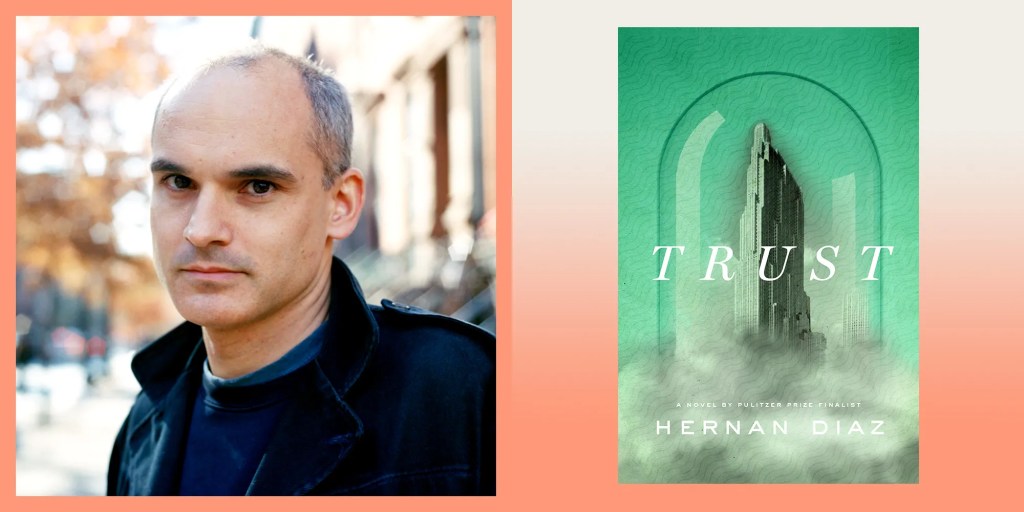
Trust by Hernan Diaz – Book

From a Google Image Search – Oprah Daily

This book is so unique that you might set it aside, but the departure from traditional story structure is an essential element of this novel of a man so private and yet so concerned with his legacy that just one version of his story will not suffice. Trust by Hernan Diaz will perplex you and engage you and deliver you up to an ending you will either love or hate.

This is a billionaire’s tale from before, during, and after the Great Depression. This is social commentary. It’s a glimpse into the roots of conservative American financial philosophy. It exposes the rationalizations for breaking financial rules for personal gains while assuaging guilt and, in fact, turning insinuations of crimes into a philanthropic set of actions that saved and preserved America. That’s some major league rationalizing. Andrew Bevel (aka Benjamin Rask) is practically on the autism spectrum with almost no social skills, but a clear understanding of markets, math, and the outputs of the ticker tape machine. We hear his story in four different versions from different fictional authors, Harold Vanner, Andrew himself, Ida Partenza, and Mildred Bevel. Similarly, we get four different views of Andrew’s wife, Mildred. 

The author does not say that Bevel’s stock shenanigans (short selling) may have contributed to (caused) the crash of the stock market in 1929, however it’s possible to draw such a conclusion. We see market machinations through Andrew’s eyes so any criticism is offered through tone or insinuation; commentary as dry as Andrew’s personality. There is also the contrast between Ida Partenza’s father, activist and typesetter, socialist/communist/lefty. Andrew’s contempt for American workers who became impoverished during the Great Depression is a subtle match for the “makers” and “takers” that are used to rationalize the financial rights of twenty-first century millionaires and billionaires.

Hernan Diaz’s novel Trust is both different; and good. If I say too much it will ruin all your fun.

Sea of Tranquility by Emily St. John Mandel – Book

Fully Booked – From a Google Image Search

Apparently living in virtual quarantine throughout a long pandemic leads to thoughts of traveling through time rather than through space. Emily St. John Mandel in Sea of Tranquility presents us with anomalies which end up coming to us by way of the Time Institute of Moon Colony Two. Detectives are trained and then travel in time to try to explain events that seem to operate against the rules of time travel. The rules of time travel have come down to us from science fiction writers and scientists, from Star Trek and Isaac Asimov, et al. The main rule of time travel is to have as little effect on the past as possible because it is impossible to predict the consequences of changing past events beyond the tiniest of adjustments. Penalties for breaking the rules of the Time Institute are severe. You could be killed. You could be banished in time.

There is the anomaly experienced by Edwin St. John St. Andrew who questioned the concept of British imperialism at the dinner table in his London family home, who suggested that meddling implied a responsibility to “civilize savages”. Edwin is banished to America where he experiences a strange vision under a giant American oak tree on an island off Vancouver. 

There is Olive Llewellyn, a few centuries later, on a book tour on Earth. Olive lives in Moon Colony Two with her husband and her child. Her homesickness follows her to characterless hotel rooms all over Earth. There is a threat of a spreading disease, but Olive is determined to complete her tour and the disease seems always far from where she is speaking and meeting readers. Her book is called Marienbad and is, ironically, about a pandemic.

There is the mysterious Gaspery-Jacque Roberts who keeps popping up in different eras. Is he from an entire family that names each boy in generation after generation with this unusual family name, or is there another explanation for his ubiquity? 

If you could save an innocent, restore a loved one to their family, but had to break the rules of time travel to do so, would you? The fear of what might be lost to history and what might be gained would be difficult to overcome. Would you accept your punishment, or would you rebel? 

There are evocative images in this novel and resonant questions about scientific speculations that may never become realities. Will time travel ever be possible? Can we use time travel to escape existential threats to humanity? Mandel brings a certain European sensibility to her books which seem sometimes shrouded in mists. Her mysteries are so mysterious that we can’t quite grasp what we learned and whether we want to know it. Even so she is marvelous at atmospheric fiction and in all her novels, even when travel in time is not the topic, her images and metaphors take us traveling in time.

Termination Shock by Neal Stephenson – Book

From a Google Image Search

How does a well-adjusted Queen of the Netherlands meet a half Comanche mourning Texas father on the autism spectrum who spends his days hunting for the wild hog that snatched his baby and ate it, and who still manages to be one of the sanest people in any room? What is the Queen of the Netherlands doing in Texas? These two unlikely characters meet as the Neal Stephenson novel, Termination Shock begins with a crash.

Neal Stephenson has been a favorite author of mine since I read The Quicksilver Trilogy, also a tale with keys scenes in Dutch cities. Stephenson writes unique science fiction, often long and complex, teaching me things that ignite my mind and entertain me. He mixes the plausible and implausible, always making running commentary on the human condition, buried in all that complexity somewhere.

Perhaps after seeing Kim Stanley Robinson publish The Ministry of the Future and Bill Gates publish How to Avoid a Climate Disaster the time seemed right to weigh in with a plot Stephenson had already been working on.

TR Schmidt (one of several names), a wealthy Texan, is the real reason Frederika Mathilde Louisa Saskia, the Queen of the Netherlands (familiar name Saskia) is in Texas. She has been invited to a Conference/Demonstration/Extravaganza. Apparently, in this not-so-distant future, America is the laughingstock of the world, but a wealthy Texan who owns an enormous tract of land can do just about what he likes. It turns out that TR is tired of the world’s inaction on climate change. The world is getting hotter, the ice at the poles is melting faster and the seas are rising higher. TR’s land is outside Houston. What he has in common with the Queen of the Netherlands is that they both live in low places along coastlines, as is true of all the other leaders invited to the conference (Singapore, Venice, certain island nations in the South Pacific). 

TR is a man of action. This conference is not about forming a think tank. He already has a plan based on one summer when Mount Pinatubo erupted and the whole world cooled off. TR has a way to use that model to cool the earth for a few years while more permanent solutions can be put into effect. His Pina2bo structure is finished. These people are here to witness activation of the apparatus. 

One problem with his new process is that it is a geoengineering approach, opposed by those who favor green solutions. Another problem is that this process has certain “knock-on” effects that some nations won’t like – namely China and India, two very large and powerful nations. China and India are rivals. China is trying to swallow India at the Line of Actual Control one gulp at a time. This parallel story line of a young Sikh man named Laks who comes to be known as Big Fish connects with the TR and Queen Frederika story line eventually. TR is trying to cover countries that will be left out of his original cooling scheme because of things like prevailing winds, and is using isolated locations perfect for building and employing his apparatus. Internet rumors say that if Pina2bo continues to function the Punjab, the breadbasket of India, could lose its monsoons making farming impossible. No one on the internet is showing the maps that describe TR’s plans to cover all areas on the planet with cooler temperatures, thus slowing the melting of the ice caps and the rising seas. TR knows that if he stops now there will be an equal and opposite reaction called termination shock.

This is not a climate change textbook lesson, but, as usual, Stephenson teaches us many things, including some esoteric geography and some ancient martial arts. Kim Stanley Robinson talked about geoengineering. He mentioned but did not stress using particles in clouds to reflect more of the sun’s cooling back into space. Neal Stephenson concentrates almost entirely on geoengineering. Stephenson is a great describer and explainer. You will get the picture. 

Crossroads by Jonathan Franzen – Book

From a Google Image Search – Goodreads

Crossroads by Jonathan Franzen took me back into my childhood. My large, unruly childhood family lived next door to a quaint and very tolerant Mennonite couple. Franzen’s main character in Crossroads grew up in a Mennonite family, living in a Mennonite community. These simple folks, similar to the Amish people, usually eschew modern machines and inventions, although Russ Hildebrandt’s family did have tractors. Mennonites are often farmers because other careers take them out of their spiritual comfort zone.

Russ leaves the Mennonite community in Lesser Hebron, Indiana where they practice simplicity “to make the Kingdom of Heaven manifest on earth.” He learned about serving others because it was a way of life. His father was the pastor for the community. His mother “made emulating Christ seem effortlessly rewarding.” Russ left because he was drafted in 1944 with five semesters of college completed. Because he could not shun his grandfather for living with his girlfriend, Russ’s family disowned him. He did his army service at a former CCC camp outside Flagstaff, Arizona, which is where he connected with the Navajo people who he continued to visit over the years. He was comfortable with the Navajos because he understood that they lived simply, also for spiritual reasons.

Because of Russ’s background sexual thoughts presented as a feeling of nausea. These thoughts were sinful. While still in the army he met Marion, his future wife, and learned that the way his body reacted, in his case, to women was natural but had to be governed and controlled by will. Marion was a Catholic girl with many secrets of her own and she carried with her the kind of guilt that caused monks to flagellate themselves or wear hair shirts constantly irritating their skin.

These two complicated people (and aren’t we all complicated) parented four children; Clem, Becky, Perry, and Judson and lived together peacefully until they all reached a sort of midlife crisis as three of their children entered puberty and a beautiful widow arrived at the First Reformed Church where Russ was the Associate Pastor. He was feeling low, having recently been replaced as the Youth Group leader by a younger hipper hiree. Marion was also at a crossroads. In fact, Crossroads was the name of the church youth group and clearly a symbol of one of the themes of the novel. 

It’s the 70’s, near the end of the Vietnam War. There are no cell phones; there is no social media, but there are drugs. When parent’s lives go off the rails even temporarily, families can suffer losses. As children begin to see the flaws in their parents and separation begins, children may make choices that dismay even the most distracted of parents.

Underpinning this story of an American family lies a nuanced conversation about God and Jesus, faith and religion, service to others and self-absorption. There is nothing preachy about it. Because Jonathan Franzen is able to entwine spirituality around the lives he depicts and the events he recounts, the exploration of spirituality is where the true value of this book lies. It reverberates in your mind and reminds you that you may indeed have a soul. 

Intimacies by Katie Kitamura – Book

From a Google Image Search – The New York Times

What an interesting novel – Intimacies by Katie Kitamura – an unexplored corner of the globe, a life previously uncontemplated. There is something new under the sun. Once again, we are presented with a first-person novel where the main character remains unnamed, perhaps because she represents a new reality. She is a child of our global world, Serbian mother, Ethiopian father. She lives in NYC while offering care to her father during a long illness. He mother has gone back to Singapore where the family used to live. After her father dies NYC holds too many sad memories. Because she knows several languages well enough to speak as a native speaker and others to at least understand, she applies for and is given a one-year contract for a job at the International Court of Justice at the Hague in the Netherlands.

After six months she has learned a bit of Dutch and has acquired a boyfriend, Adriaan. The intimacies a reader might expect to find in a book with this title are not what we find. There are no sex scenes. This author is exploring the intimacies of people bumping up against each other in ways that are not at all intimate and yet learning intimate things about virtual strangers. 

She is isolated from the city she lives in. She has made a few friends and there are the people she works with but they are separated by the nature of the work. She has no truly intimate connections. Her job as an interpreter at the court has her confined to a glass box, wearing headphones, translating from one language to another almost without listening to content, because she must switch languages quickly in her mind and remember the text of a witness or lawyer word for word.  

She has a boyfriend, and he invites her to live with him, but then he leaves to pursue his wife and children in Portugal. He tells her to stay until he returns, but then he stops communicating. Eventually she moves back to her own nondescript apartment. She admires the way her friend Jana has personalized her new home, she longs for the permanence of a place to settle, but she stays adrift. She arrives late for a dinner with Adriaan and Jana, and feels that some intimacy has taken place in her absence that is not shared with her. She makes another friend who turns out to support the unethical behavior of a brother.

What happens while she is in that glass box is intimate in an entirely different way. One of the trials involves a terrorist who has done unspeakable things but has a charming demeanor at odds with his horrendous acts. Another involves a deposed president of a nation in turmoil who bears no guilt for acts of genocide, torture and execution. But he doesn’t present as a monster. He presents as a victim of people who are crueler and more power-hungry than he is. “Although she knew there was nothing the man could do to her, she could not deny that she was afraid, he was a man who inspired fear, even while sitting immobile he radiated power.”

This is a look at intimacies that do nothing to expel loneliness. Our lady says, “increasingly I’d begun to think the docile surface of the city concealed a more complex and contradictory nature.” The book is layered and has captured the nature of the city and the Court, and indeed, modern life. There might be a veneer of civility, but beneath it the Hague was as complex as any city. Encountering evil in a place that takes great care to present a calm face is unsettling even though the one observing the evil is at a safe remove. In the end she says she felt, “not primarily fear, she felt guilt. I will watch out for books by Katie Kitamura. 

The Guide by Peter Heller – Book

From a Google Image Search – The Independent

The Guide by Peter Heller also features Jack from Heller’s book The River. In The River Jack loses his best friend, Wynn. Wynn was the poet of the pair, so we lose some of the cadence of the story of the canoe trip to Hudson Bay. Jack has been back at home helping his father on their ranch and things are caught up leaving Jack some time to take a guide job and earn some money. Not only was Jack practically born on a horse, but he is an excellent fisherman, kayaker, and canoeist. A lodge serving very wealthy clients has lost a guide mid-season so Jack takes the position. He regrets his decision almost as soon as he meets the man who runs the operation, Kurt Jensen, and learns all the strange rules about what he is and is not allowed to do. Jack feels that something about the place just doesn’t feel right. He immediately goes off fishing to learn the streams and because he feels better when he is smelling pine and tying flies and drifting his line into a spot full of the kinds of bugs fish loved to eat. 

He is assigned to be fishing guide and teacher for Alison K., who he intuits is someone famous. He doesn’t recognize her, but as they spend the days on the stream, he recognizes that she is a famous singer from the snatches of song she sings to herself as she fishes. The odd part of this place is all the prohibitions. You could not go past the bridge across the stream because the old man on the property next door would shoot you. There were cameras mounted in places where no cameras should be needed. Jack could not keep his guns with him, or his truck. You needed a passcode to go anywhere. Kurt seemed upset when Alison and Jack went into town for dinner one night. The people seemed odd also. They had bandages on their hands and circles under their eyes one day and the next they were perky and well. Fortunately, Jack finds an ally in Alison. They fish and snoop together.

This book is driven by plot much more than The River which was driven also by the style of the prose. The topic of The Guide is shocking and one that has not often come up in other books I have read. As a mystery, this story works very well. It also has an element of social commentary to give it heft. And our heroes come close to dying. Except for the lack of romance, which is sort of refreshing, it’s all very satisfying. And my mind foresees the possibility of future romance. I know, I am such a girl. Just ignore it if it offends.

The River by Peter Heller – Book

From a Google Image Search – Criminal Element

The River by Peter Heller took me back to my teen years when my brother and his best friend, if they had more money, could have easily been Jack and Wynn, the young men in this story. This is a tale that runs by as fast as a river current. Jack and Wynn love nothing better than being outdoors, adventuring in a canoe, fishing and hunting and smoking their pipes on a riverbank in front of a fire. They are both very experienced. Jack grew up on a ranch and lived on horseback from a very young age. He learned to accept both hardships and pleasures as normal occurrences. His judgment did not get clouded by adrenaline. Wynn grew up in the more tamed nature of New England in a loving family. He knew how to stay safe when away from civilization, but he did not have to develop the toughness that Jack’s life required.

These two friends, brought together by their interests, have planned to go on a canoe trip up to Hudson Bay. They have carefully collected their supplies and figured out how to stow them in the canoe to keep their craft balanced and to keep their supplies dry. But there are forces afoot on the river that leads to Hudson Bay over which they have no control. There are two other parties on the river. That should not have been a problem, but people are unpredictable, even adventurers do not all have trustworthy characters. Nature becomes a potent adversary in this river equation as these folks all try to outrun a forest fire to make it to Hudson Bay to get a plane out. The one thing Jack and Wynn decided not to bring with them, a sat phone, would have been the most essential tool to have on this expedition. What ensues is one nail-biting situation after another. You may be able to trust your boon companion, but you cannot trust other people and you cannot predict what nature will throw at you. (And, perhaps, you don’t want to be a woman on the river.)

The voice of the narrator, with its Hemingwayesque short ‘illegal’ sentences suits the backwoods adventure and these young men who approach life, if not grammar, with planning and almost reverence for form and well-practiced routines. Frequent literary references show that these boys are more than just hicks. This is a voice I have heard before, but my brain won’t remind me of exactly what author it resembles, perhaps Mark Twain. Poetic descriptions are drawn without effort, never overdone. 

“The canoe moved this morning as if greased. North again toward the top of the lake where it became a true river. They let their eyes rove the shore looking for the colors of a tent or tents, the shape of a boat on a beach, but saw only more patches of yellow in the trees and a swath of orange black-eyed Susans on the shore. They watched a skein of geese fly over that end of the lake, just one side of the V, an uneven phalanx that curved and straightened as they flew in constant correction. The distant barks drifted down.” (Pg. 36)

“They got hot. They paddled hard. Almost thirty miles on a flat-water current was a long way even for them. Because the river slowed and expended itself in unexpected wide coves. From which loons called as they passed—the rising wail that cracked the afternoon with irrepressible longing and seemed to darken the sky. The ululant laughter that followed. Mirthless and sad. And from across the slough or from far downstream the cry that answered.” (Pg. 1160

There is a new book The Guide by Peter Heller which features Jack once again. Can’t wait.

Hummingbird Salamander by Jeff VanderMeer – Book

chireviewbook.com

Jane Smith, is a mom and a wife, with a job in the security business in Jeff VanderMeer’s novel Hummingbird Salamander. Jane lives a normal American life, constantly questioning if this is the best life she could be living. She is a big woman, a wrestler who no longer wrestles, but does work out at a strip mall gym, not the designer variety. Her boss has named her giant hand-bag ‘Shovel Pig,’ signaling to her that she is not exactly a dainty woman, which she already knows. She decides to keep the name. She is in the American game, working to get ahead, trying to avoid office politics. Until one day someone hands her an envelope outside her favorite coffee shop with a cryptic message – an address and a key, and a message that says if Jane receives this envelope the sender is probably dead.

Would you bite? Would you get more and more distracted from your fairly normal life, lose everything to solve an increasingly twisted and dangerous mystery pathway, somehow related to either ecoterrorism or solving climate change? Can anyone embrace a cause fully without having it take over their life? Can you be a true activist without putting your family in jeopardy, without losing your job, perhaps even your home, your reputation, your clean criminal record? Would living a life on the run make you feel rootless and disoriented? Could you keep your focus on your target goals until you reached your own personal endgame? 

Silvina, the woman Jane never meets, the woman who sent her the note, who leads her to a hummingbird, and eventually a salamander, the woman who puts Jane in mortal danger, is just such a committed activist. She seems, for some reason, to pick Jane as her successor. Will Jane ever solve the mystery of who Silvina is, how she is connected to Jane, and what she wants Jane to see and do. Entering this book is like entering an Escape Room where clues keep leading you to an exit that seems to recede into the distance just when you think the riddle is solved. You don’t get out of this Escape Room unless you finish the novel. Halfway through I got so frustrated, so angry at what Jane was doing to her life that I wanted to quit, but I could not put the book down. 

There are no plans for stopping climate change in this book that would ever have worked. But we do learn if Silvina was a fraud or a true activist and she does present us with a result, sort of, maybe. As the story moves along the climate worsens, the color of the sky is a sickly gray-green and weather conditions are erratic – rain alternating with snow and sleet, excessive warmth replaced by freezing cold. Life doesn’t stop in an instant. The world goes on and people adapt to each new climate change as best they can. There are refugee ships full of climate migrants out on the oceans with nowhere to land. 

There will be a hummingbird, and a salamander? What happens to them? What do they represent? Hummingbird Salamander is a conundrum because of the clues Jane follows and the threats she faces. It’s a thriller.

The Vanishing Half by Brit Bennett – Book

From a Google Image Search – Vanity Fair

Twin girls born in a town that isn’t even on any map, black girls with skin so light who, in any fair world, would not have to worry about how society would classify them are at the center of this story – twin girls who see their father dragged from home and lynched in the middle of a traumatic night. This is the world that Brit Bennett describes in The Vanishing Half. It is a world where skin color is an issue and not just with white people but also with black folks. Desiree and Stella find their small eerily segregated town, confining. They graduate from high school and run away to the big city. Desiree is the twin with the inclination to wander, but Stella is the one who disappears.

Good characters and an interesting concept introduce us to a world most of us cannot inhabit. Even to talk about the issues presented in this novel makes it far too easy to stray from political correctness. Before slavery was there a skin color hierarchy? When we acknowledge that skin color is used as a kind of class indicator even among black folks does that indicate that the superficial judgments of slave owners were passed on to their human “property”? These are things I can perceive but cannot pass judgment on. But Bennett gives us a peek behind the curtain.

This is not a heavy tome full of academic discussions of these matters. This is basically the story of a family and the traumas that determine their futures. It is a story of separation and a sort of reconciliation. It is a story of secrets kept and finally half revealed. But behind the story is that undertow that makes us think deeper thoughts. Interestingly, it is a wanderer who becomes the glue in this family of woman who were robbed of their father/husband. I wouldn’t mind having my own Mr. Early.