Of Blood and Bone by Nora Roberts – Book

of blood and bone Characters Wanted

Of Blood and Bone by Nora Roberts is the second book in a trilogy called Chronicles of the One. This is a dystopian saga, but it is not Cormac McCarthy’s The Road. Roberts pits wholesomeness, the sweetness of summer sunshine, bees, honey, family, children, love—life lived simply and communally—against lives that feature hate, fear, intolerance, and brutality.

When Mr. McLeod cracked the shield and dark Magick was loosed on the world, two-thirds of the world’s population died of an incurable virus which became known as the Doom. Many survivors found themselves with magical talents. Some became faeries, some elves, and some witches. The world split into the light and the dark and war was in the air. Humans who survived with no magical talents also split between good and evil. Some humans felt that magical creatures were an abomination and they tortured, killed, or executed them whenever they got the chance. What was left of governments captured magical creatures ostensibly to save them and to study them, but they imprisoned them and strapped them to metal tables so they could learn what they could and then eliminated them. And gangs bent on chaos and mayhem killed anyone who was vulnerable.

The child of Lana and Max, two witches who had to flee NYC in the worst days of the Doom (Book 1),  Fallon Smith, was known to be “the One” who would set things right before she was even born. Fallon has lived quietly on an isolated farm with her family but now, on her thirteenth birthday, Mallick comes to take Fallon away for training. From here on the story resembles the King Arthur story, except this time the King is a woman. Mallick is her Merlin and when she successfully finishes her training she wins the sword and the shield from the sacred well. During her training she also wins three unusual and powerful companions.

It’s a great tale even if Fallon is a bit like heroic Barbie and the young man, Duncan that she meets in New Hope is a bit too much like Ken. Fortunately, although the novel holds out the promise of romance at some point in the future, for now it stays focused on war and setting the world to rights. This seems as if it would make a great YA fantasy series depending on where it goes in Book 3.

I liked Of Blood and Bone. Apparently, in real life, there was a little issue about two similar titles between two authors, but it was settled amicably I believe. I look forward to the third book. But if we find ourselves in a truly dystopian world I don’t expect that Magick (or even magic) will save us. There is too much fantasy in this to put it in the category of dystopian literature. Still when you need entertainment this trilogy could be a fun choice for a quick break from more serious fare.

Photo Credit: From a Google Image Search – Characters Wanted

Unsheltered by Barbara Kingsolver

Unsheltered floral KUOW

Unsheltered by Barbara Kingsolver is not the first book by this author that I have read. I have enjoyed her writing since her first book, The Bean Trees, appeared in 1988. I have also read Pigs in Heaven, Prodigal Summer, Flight Behavior, and The Poisonwood Bible (although I think I read all these books before I joined goodreads.com).

Kingsolver is an environmentalist who likes to use fiction to call attention to the havoc human excesses wreak on nature. She does it subtly, but unmistakably in very readable novels, that reflect the changing zeitgeist of the 30 years she, and we, have lived through since she started writing.

Her inspiration for Unsheltered came when she learned of a woman scientist named Mary Treat and she was given access to her notes and correspondence. Dr. Treat was a woman ahead of her time, a wife who thrived when her husband left her. She was fascinated by the plants and insects that lived in the Pine Barrens that were near her home. She filled her living room with small jars that look like terraria, but each contained a tower-building spider (small variety of tarantula).

Mary Treat wrote letters to Charles Darwin, who had recently published his Origin of the Species, a book that seemed to refute God, and set the world on fire, and he wrote back. She wrote to Dr. Asa Gray and he also answered her letters. Mary Treat is real, and a truly interesting woman. Thatcher Greenwood is also real. When he married his wife Rose, her family owned the house next door to Mary Treat. Thatcher Greenwood was hired to teach science in a high school run by a man who believed Darwin to be an abomination. The house he is living in was poorly built and is falling apart, as is his life.

A parallel story 150 years after Darwin’s book was published, gives us a family of the Trump era, living in the second incarnation of Thatcher Greenwood’s house, which was rebuilt by a second someone, equally without regard for sound building principals. A twice-unlucky house. When Willa’s family inherits the house in New Jersey from her Aunt, it is at a time when the economy is changing for everyone. Willa, a writer, loves her solid career footing but then the magazine she writes for folds. If she stays in New Jersey she will have to accept freelance writing jobs. Iano, her husband, a professor of political science cannot find a path to tenure, and in middle age is still working as an adjunct.

Their son, Zeke, is left, tragically, with a baby son, who he leaves with Willa to try for a tech startup with his college roommate. He owes $110,000 in college loans which he must pay off. Tig, their daughter, is an enigma as a member of what seems to be a whole new generation. She is a dynamic, pint-sized activist with dreadlocks who lived in Cuba for a year and took part in the Occupy movement. Tig (short for Antigone) may have the best grasp on our new shifting social landscape.

The house is what ties the two eras together and the two “evolutionary” women, Mary Treat and Antigone Tavoularis (Tig). As the house falls down around the inhabitants some find it extremely unsettling and others find it strangely freeing.

Kingsolver is a queen of dialogue, which makes her novels flow easily along, in spite of how dense the content seems after the fact. It was interesting that she never mentioned the modern folks who still deny Darwin and the sneaky tactics they often employ to make it mandatory to teach “Creationism” in 21st century schools. She may not have wanted to focus on something more political than environmental. The literary device that has us skipping back and forth over 150 years in every other chapter makes the reader look forward to getting back to the story line that will be taken up in the next chapter.

We have wandered pretty far from nature and I wonder how many of us would feel comfortable without a home base. Is there a generational divide, or will that disappear as mature responsibilities must be met? Will we have to learn to respect nature and live in greater harmony, without many of the creature comforts that we have convinced ourselves prove that we are above other living things. Will we ever be able to overcome our sense of superiority and separateness which allows us to believe that our survival trumps (sorry) theirs? Will we ever learn to feel our organic connection to every living and nonliving thing on this planet?

Engaging our thoughts is a hallmark of a skilled author. I can’t decide if the separation in time is so large that this felt more like two stories that blinked on and off like lights or if the connections are powerful enough to unify the novel. However this is a relatively insignificant flaw which was not jarring enough to ruin my enjoyment of Barbara Kingsolver’s book, Unsheltered.

Photo Credit: From a Google Image Search – KUOW (cropped)

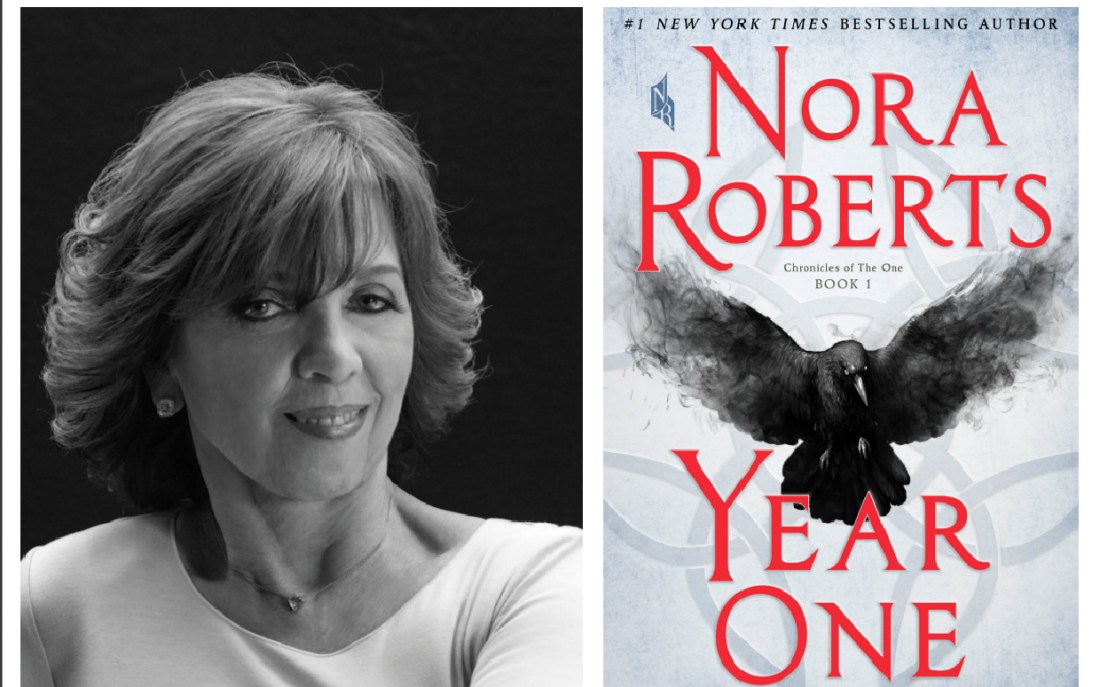
Year One by Nora Roberts – Book

nora-roberts-year-one-ftr

Nora Roberts, author of Year One usually writes romance novels. I do enjoy a good romance novel. It doesn’t necessarily give your brain a workout but it sends you on an emotional journey that often ends in a happy sigh and a temporary uplift in your spirts. Lately I forgo the brief jolt of endorphins offered by fake joy for books with a more mental punch. But I will say that I think even fake joy can make your day. This time Nora Roberts goes off the chart and gives us an apocalypse. Even if it still encompasses a good deal of romance, there is also suspense and grief and magic and black magic, and this is only the first book of a trilogy, The Chronicles of the One. One of my sisters passed this book on to me.

The story begins in Scotland where Ross MacLeod, who now resides in NYC, visits the family farm in Dumfries, Scotland which has been in the family for over two hundred years. Ross goes for a walk on his land and changes the world when he shoots a pheasant that lands in a magic circle and activates an old blood sacrifice he accidentally contributed to fifty years earlier, simply by tripping and scraping a hand on a stone that sits in that ancient stone circle on the property. Ross is a bit freaked by the circling of crows above the site but he is no believer in magic. When he gets very ill he thinks it is a flu virus. Then he dies. Soon this untreatable and incurable disease, named the Doom, begins to spread as rapidly as people move around the globe these days.

The grief people feel is enormous. Max and Lana, newly in love and experimenting with some talents they seem to possess which indicate they might be witches, do not sense the enormity of the escalating depopulation right away. For a moment they are a spot of joy in a city that is being devastated by disease and looting and violence. Lana is a chef, Max a writer. Arlys, a newscaster on a popular NYC stations has been promoted to the main news desk by default. She offers daily news to anyone who is still listening. Fred is an intern who works with Arlys and who has a secret which might help explain her effervescent personality. One day Arlys is given reasons to tell her listeners the real news, which is far more frightening than what she is used to offering. Rachel is a doctor, Jonah an EMT. They are trying to run a hospital with fewer and fewer staff, and patients they are unable to save.

When these New Yorkers finally accept that they must leave their beloved city and travel to more rural areas we see them depart in pairs to look for more people who have survived the Doom. Why some people survive while others do not is something that has no satisfactory answer. Some survivors have found that they now have magical talents. Fred’s secret is that she is a faerie with wings and a sprightly spirit that makes her quite lovable. Max and Lana find that they have become more talented witches than they ever were before. Some people find they are elves. And yet some people like Rachel and Arlys have no discernible magical talents and yet they survive.

Getting out of New York is not an easy thing for anyone. It turns out that magical people, like normal people can use their talents for good or for evil. Many survivors have turned to evil and can harm magical people who strive to be good if they catch them off guard or if their talents are unequal. There are also the usual gangs that thrive on chaos. Traveling is scary and dangerous and there is more safety in numbers. Eventually all these New Yorkers meet, not quite by accident in a new community that is taking shape in New Hope, Virginia.

There is social commentary here. The Uncanny, as the magical humans are named, become “the other” and are feared by intolerant humans who cannot accept people with magical talents as neighbors. They taunt them and troll them and make sharing a community uncomfortable and sometimes worse things happen when the intolerants do more than use their words.

As soon as the internet is partially restored this message is posted:  “If you are reading this, you are one of the chosen. No doubt you have lost those dear to you and have felt, many still know, despair. No doubt you have witnessed firsthand the abominations that have desecrated the world Our Lord created. You may believe the End Times are upon us. But take heart! You are not alone! Have faith! Have courage! We who survived this demonic plague wrought by Satan’s Children face a Great Test. Only we can defend our world, our lives our very souls. Arm yourselves and join The Holy Crusade.” – The Purity Warriors

The Purity Warriors pretend to save the world in the name of religion but they actually spread terror and violent rape and death, especially targeting the Uncanny. But Lana is carrying The One. Will she bear the child in safety to grow to her full powers? How will she change the sad equation in a ruined world? Good stuff for real, even if a bit too much sugar on occasion.

Photo Credit: From a Google Image Search – Parade

Find me on goodreads.com as Nancy Brisson

Transcription by Kate Atkinson – Book

kate-atkinson-running in heels

Kate Atkinson’s new novel, Transcription, joins a spate of World War literature coming out of Great Britain. All these books talk about what British citizens who were not soldiers did during wars. People wanted to help with the war effort and since many of the adults who were still in British cities were women, the tasks women took on often affected them in ways similar to the way soldiers are affected. The end of the war found women who had done unlikely, dangerous and heroic things, having to assimilate their war time behavior into the person they would be moving forward in peacetime. Other recent novels include: The Alice Network by Kate Quinn which I have not read yet, Dear Mrs. Bird by AJ Pearce, and Warlight by Michael Ondaatje.

Why is this the moment when so many writers were moved to write about such very similar experiences? Are people feeling an instability in political institutions these days that could lead to war? Are people rushing to offer us some patriotic roles that we could play? Is this a creative brain meld? Is this just an odd coincidence or nostalgic moment? With all the authoritarian figures rising in nations that once flirted with democracy does this feel somewhat similar to the rise of “you know who” before WWII? Are authors feeling the same fears we all feel that we may be called upon to defend our freedoms in the very near future, or to keep them alive for what could be decades of darkness?

Transcription is an absorbing book all on its own, but I recommend giving all these books a read because each takes a different tack on the same subject. In Transcription our heroine Juliet Armstrong is recruited by MI5 to help keep an eye on Hitler lovers and want-to-be Nazi’s living in England. British intelligence rents two adjacent apartments. In one a rather convincing Godfrey Toby, a spy of course, makes friends and collects important data about England’s defenses. These friends of Hitler think Gordon will pass this strategic data on to Germany. Of course this is simply a way for Britain to keep this information away from Germany and keep potential British traitors from doing real damage to the allied side in the war.

The second apartment is filled with recording equipment and a typewriter where a very young Juliet listens to what Gordon’s unwary informants reveal and then types a transcript that tries to give a word-by-word script of who is talking and what they reveal. Not all of the dialogue comes across clearly but Juliet does the best she can. Then Juliet is embroiled further into spying when she is asked to adopt a new persona and join a more upscale right wing group of traitors. This is how a girl who simply types gets deeply into something that is so unforgettable that she will never be free of either her memories or her handlers.

Do books make the future and the culture happen, do they predict what will come, or do they just reflect the present and the culture of the times in which they are written? It seems that books can do all of these things, and they can sometimes do all of them at one and the same time, which is probably one of the aspects of reading great books that keeps readers hooked. So what will turn out to be true of this little cluster of intellectual doppelgangers?

I am happy to read every book that Kate Atkinson writes and I feel the same way about Michael Ondaatje. I don’t know the other two authors as well but I may eventually be adding them to my long list of beloved authors. However, I would much prefer that these novels be reflective rather than predictive. You may find that you begin asking yourself how you would have performed under similar circumstances. One more point, possibly a #metoo point, although all of these books feature female characters, not one of them is a “chick” book. But because they all happen in the past, all these women work for men. However war seems to blur the lines between women’s work and men’s work as you will see. Don’t forget to spend a few moments thinking about why this book is called Transcription rather than Transcriptions. Thank you Kate.

Photo Credit: From a Google Image Search – Running in Heels

Fallen Angel by Daniel Silva – Book

the fallen angel You Tube

Fallen Angel by Daniel Silva is Book 12 in the Gabriel Allon series, the fictional, but famous spy for the Israeli Intelligence Service at the Office on King Saul Boulevard in Tel Aviv Israel. Gabriel is an unusual person to be an assassin for justice, world peace, and the survival of Israel. He is an artist who gave up an artist’s life (his own) when recruited by Shamron, the aging hero of Israel, to pursue the terrorists who killed athletes from his beloved homeland at the Olympics in Munich.

Since that op he has trained with a talented art restorer and has become one of the best restorers of classic religious art in Europe. He is a bundle of contradictions but his strong values tie the whole package together. Gabriel’s family was, for the most part, killed in the Holocaust, except his mother who never really recovered from the horrors she experienced. Gabriel lost his first wife and his son to a car bomb, probably targeted towards Gabriel. Terrorists blew his life away right before his eyes. And even though they failed to kill the one the car bomb was designed to kill this became a sorrow he had to carry with him always. It hardened his heart in a more personal way and made him more lethal, more determined to fight evil in the world.

Through the first 11 books there have been plenty of evil actors to stop in their tracks, tracks which always are about either power and world domination or money or both. Eventually Gabriel remarried to the beautiful Chiara, daughter of a Rabbi, who also does intelligence work for the Office. Sometimes she is with him on ops and sometimes she stays home. Putting her at risk brings back old memories for Gabriel. After a while Allon is joined by a team, each person with different strengths and we become concerned about their safety in these rather impossible-seeming, risky, but usually successful operations they undertake. Gabriel is frequently wounded because he cannot let a villain get away. He retires every time he completes a mission as if he has beaten evil once and for all. But he knows this war is endless and he up-ends his life over and over again to do battle when he must. After a while we begin to wish there really was a Gabriel Allon and a Chiara, et al out there in the world, abolishing amorality and immorality.

So in Fallen Angel we have a lovely young woman who agrees to inventory antiquities in the Vatican collection who is found artistically dead after a fall from a balcony in the Sistine Chapel. At first her death is ruled a suicide. But Gabriel is a friend of the Vatican’s top two people, the Pope and his constant companion Father Donati, because he saved the Pope’s life and unraveled one of the plots that live in the competitive Vatican culture. Gabe is restoring a Caravaggio in some basement on the Vatican grounds and Donati has him summoned to tap into his expertise. Gabriel (also a fallen angel) does not believe this is a suicide. But when he pulls a couple of strings he opens a Pandora’s box of illegal trading in antiquities. These thieves never preserve provenance and this represents a huge loss of historical data about ancient sites and people. Once again what begins in Italy leads Gabriel all over the world and eventually home to Israel.

Photo Credit: From a Google Image Search – You Tube

Find me on goodreads.com as Nancy Brisson

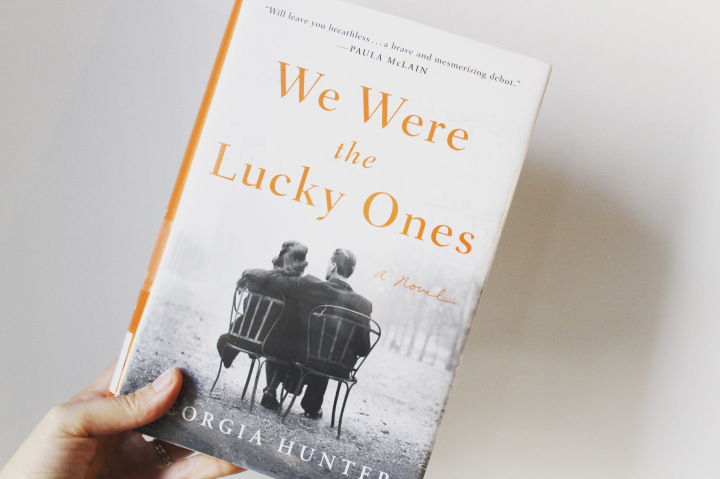
We Were the Lucky Ones by Georgia Hunter – Book


We Were the Lucky Ones Book and A View

We meet the Kurc (Kur-see) family in Rodam, Poland in 1939. Hitler is on the move and we know what is coming, but this close-knit family of middle class Jewish Poles does not. We Were the Lucky Ones by Georgia Hunter, covers familiar and dreaded ground, but this is a family of survivors. How did that happen?

Not one of these five siblings or their parents ended up at a concentration camp. They saw that Jews were being rounded up. They saw the railroad cars crammed with frightened humans supposedly going off to work in war factories. How is it that of the five (Addy, Halina, Bella, Genek, and Mila) and their parents only Mila ended up on such a train and she managed to escape a truly traumatic fate. They did not collaborate, they did not thrive; they worked almost to breaking in factories, subsisted on little food and sometimes no food. They often did not know where their other siblings were and they missed their family terribly, and worried about each other all the time.

The book skips between siblings and their spouses so we know where the Kurc’s are and how close they came to discovery and death, but they only learn this after the war when they all meet their son/brother Addy in Brazil. Georgia Hunter, the author, is Addy’s grandchild. He married a woman in Brazil who was from the American South. How did he get to Brazil?

Dumb luck and many delays, near capture, and the ability to anticipate and avoid being trapped helped Addy survive. He learned the name of a man who was supplying visas to Jews so they could leave Europe. He went to see this man and ended up on one of the last ships to Brazil. Even so all aboard the ship got rerouted to Casablanca and Addy almost ended up being caught there with an expired visa and sent back to Europe. This is just one of the family’s survival stories. The rest are just as compelling although told more as history than drama.

Georgia wrote a fictional story for the sake of flow and form and character development, but this is essentially a true story she researched for a decade, interviewing family, visiting museums and Holocaust data centers. Her family, whose stories she tells in We Were the Lucky Ones, may have only survived because they did not stay in one place and they were willing to learn new languages, buy papers that said they were Catholic, and because they were the recipients of favors from non-Jewish Europeans.

I don’t know why stories about WW II and the Holocaust keep falling into my hands, but this period in human history was a time when heroes and villains reigned. This was a time when what we learned about human nature was that we could succumb to a sickness of the spirit, to our most negative traits, envy, fear of others, national pride, genocide; or resist and become our better selves. Such books have special relevance in 2018 when we are in the midst of dealing with our fear of Muslims and “the others”, inclined to isolationism, and fomented to an exaggerated nationalism similar to what sent the German people so spectacularly and disgustingly awry in those WW II years.

Every time I read about WW II I learn something I did not know and feel things that I would not have felt otherwise. This may not be a perfect book; but it’s a very good debut and a great addition to the growing library of books about WW II for Jews in Europe.

Photo Credit: Book and a View

Love and Ruin by Paula McLain – Book

love-and-ruin-book-cover ohiomagazine.com

Paula McClain wrote about Ernest Hemingway’s first wife, Hadley Richardson in her novel, The Paris Wife and, this time, in Love and Ruin she writes about Hemingway’s third wife, Martha Gellhorn. I can understand the fascination with the women who married this literary giant. What kind of woman does such a legendary figure find himself attracted to? Hemingway was a handsome guy. Women found him desirable. It is almost tempting to wonder why only four women. But Hemingway sounds like he was not really a “ladies man”. He spent most of his social hours with men. He also seems to have seen women as occupying pretty traditional roles in a marriage, although he seems to have treated his wives as companions some of the time. Everyone in Hemingway’s world had a nickname.

Some readers do not value a fictional account of a Hemingway wife as they would a nonfiction one, but Paula McClain does do her homework, which she describes after the novel ends. So Love and Ruin is grounded in fact. But the day-to-day exchanges in a marriage are usually private business between husband and wife, although friends are privy to some of it, and can only be imagined in fiction.

Martha Gellhorn and her mother were recovering from the death of Martha’s father when they made a trip to somewhere as different and faraway as they could get without complicated travel arrangements. They fled to Key West and who should they meet in a bar almost immediately upon their arrival but Ernest Hemingway.

Both mother and daughter were pretty, long-legged and not at all shy. Ernest, married to Pauline Pfeiffer (Fife) with three boys (two from his first marriage) had his home, with his wife, right there in Key West. But he offered these two Gellhorn women a tour of the island. It was then he found out that Martha Gellhorn was a published writer. He began their relationship as her mentor. She was quite a bit younger. It seemed innocent enough.

If they had never gone off to report on the Spanish Civil War (Franco) at the same time (together) they might never have fallen in love and broken up Hemingway’s thirteen year marriage to Pauline. But Martha Gellhorn was not a “little wife” type of girl. She always wanted to be at the center of the biggest storm. She wanted to live life and she insisted that involved covering events like wars that only men generally wrote about. She and Ernest began as fellow war writers; she for Colliers, he making notes for a novel. Both felt more alive when death was everywhere around them.

When they needed to get away from the war they fled to Cuba, a place that Hemingway loved almost as much as Key West. They could not go to Key West because Hemingway was still married to Pauline. Martha found an old Cuban farm and when her book sold she used the money to restore it. It became the famous Finca where Hemingway still resided at the end of his life.

Martha imagined a sort of nirvana, with two writers living and sharing their craft, but Hemingway did not cooperate. He was demanding and selfish, and loving and ardent, and a partier and a hard drinker. Martha often found him exasperating. But just before World War II began Hemingway and Pauline divorced and Martha and Ernest married. They went to Hawaii for their honeymoon but trouble already was brewing. Martha had an independent streak that Hemingway despised and when she wanted to go off on her own to work or visit home he pouted and acted out. Although they both went off to London to cover the war they were more like rivals than sweethearts by then. Their marriage barely survived the war.

HEMINGWAY's wives France 24

Martha Gellhorn went on to have her own career as a writer of some fame and Hemingway wrote one of my favorite books Islands in the Stream. Hemingway remarried to Mary Walsh, a bond that lasted until they both died in a plane crash in Africa. We leave Martha behind when her marriage to Hemingway ends which belies the contention that this is a book about Martha Gellhorn. It is a book about a Hemingway wife, but one stamped out of such an independent and adventurous mold that the marriage was doomed to end in ruin. It made me aware of her as a writer and a dashing person who was ahead of history, and an admirable person in her own right.

You will have to decide about the fiction/nonfiction choice for yourself and also about whether or not this is a “chick” book. But Martha Gellhorn is worthy of our attention and Paula McClain made her quite real. A worthwhile read.

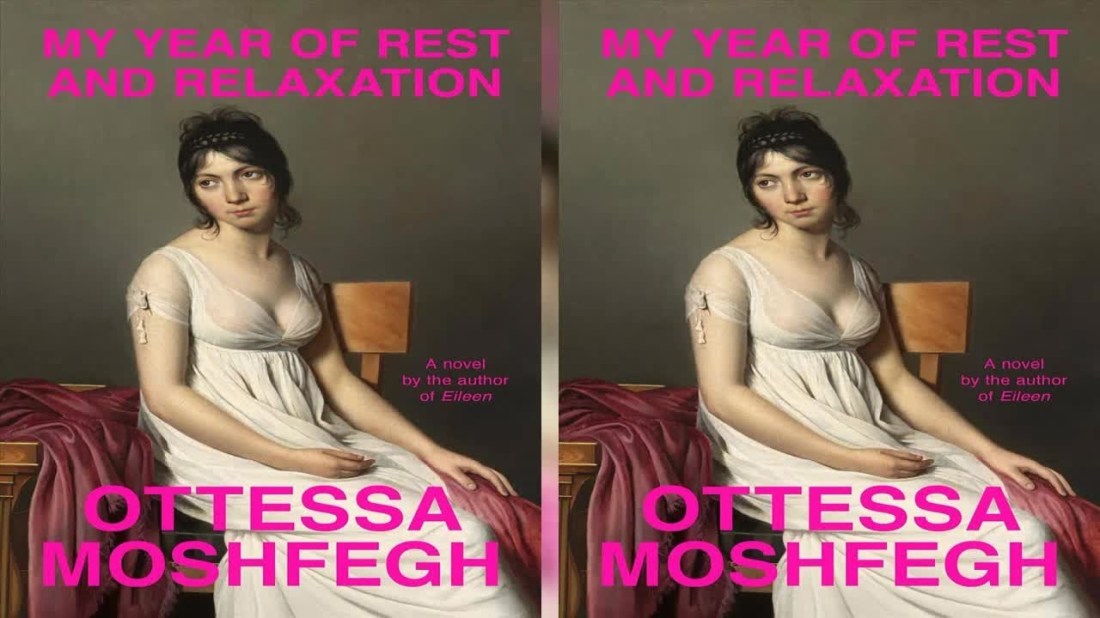
My Year of Rest and Relaxation by Ottessa Mesfegh – Book

my year of rest -You Tube

Do we act the way we do because of nature or nurture? Is our behavior inevitable, either genetically, or by upbringing, or do we always bear final responsibility for the way we behave? Don’t judge a book by its cover. Literally. If you consider the cover of My Year of Rest and Relaxationby Ottessa Mosfegh you might expect period fiction, but what you get is something quite of-the-minute, new and fresh right down to its bones. The young women our attention is focused on does not even have a name, perhaps because the book is written in the first person, but perhaps with some symbolic significance also.

We listen to a pretty, blonde, thin, 26-year-old who is already exhausted by life. She finds no authenticity anywhere, nothing to dedicate herself to, nothing to love, even, apparently herself. She nails the superficialities of various “cultural tribes” she is surrounded by at Columbia and in her neighborhood. The 40-something moms on the upper East Side come under her judgmental perusal as do the young males in the art history department at her college and the avant-garde artists who exhibit at the gallery where she works. She finds little to really admire in her handsome on-again, off-again boyfriend, Trevor, or her best friend Reva. Only Harrison Ford and Whoopi Goldberg escape her societal ennui.

When she is a junior at Columbia art school she loses both of her parents. Her parents were not exactly warm and fuzzy. About her mother she says: “She was not the type to sit and watch me draw or read me books or play games or go for walks in the park or bake brownies. We got along best when we were asleep.” “My father slept on the sofa in the den that year.” “None of us had much warmth in our hearts. I was never allowed to have any pets. Sometimes I think a puppy might have changed everything. My parents died one after the other my junior year of college – first my dad from cancer, then my mother from pills and alcohol six weeks later.”

Is our girl experiencing some kind of separation anxiety or does the loss of even bad parents cause us grief? Did her family’s inability to connect destroy her ability to feel empathy and affection? She decides that she will sleep for a year and then wake up a new person. Her inheritance from her parents allows her this option and she gets to sleep through the year in a very nice apartment on East 84thSt. which she owns outright.

But it is not so easy to sleep for an entire year. A psychiatrist must be found who has few compunctions about using a prescription pad. Dr. Tuttle is perfect, a real psycho-babble nut who knows her way around insurance rules. Pretty soon our blondie’s life becomes a long list of meds that she pops or guzzles whenever sleep is hard to find. Trazodone, Ambien, Nembutal, Solfolton, Xanax, Lithium, Haldol, Neuroproxin, Maxiphenphen, Valdignor, Silencior, Benadryl, Robitussin, NyQuil, Seconals, Libriums, Pacidyls, Noctecs, Miltowns, Lunesta, primidone and Risperdal, chewable melatonin…until she meets the ultimate sleep drug, Infermiterol. Too bad Infermiterol has one very worrisome side effect.

Even after a couple of months of chemical abuse our sleepy-head, catching sight of herself in the lobby mirror on one of her rare trips to the Egyptian bodega down the street says, “But I was tall and thin and blond and pretty and young. Even at my worst, I knew I still looked good.” But we wonder if anyone could actually survive on this much medication.

We have only covered two somnolent months of a long year. There is plenty more to this story. Do we care about this young lady? Should we care about her? Is there a message to this madness? Only you can decide. But for people who are tired of conventional fiction this certainly isn’t that. Just the gutsiness that comes up with fiction like this makes it well worth a read. Does it matter that our girl’s long sleep ends at a significant historical moment?

I keep thinking about this one, trying to care about this character. My admiration is more for form than any significance to the human condition at this point. Some books have to percolate. I also have a few caveats. One, don’t try this at home. Two, many of these scripts did not work as sleep aids. Three, as an experiment in rebirth, the outcome seems inconclusive.

Look for me on goodreads.com

Photo Credit: From a Google Image Search, You Tube

Warlight by Michael Ondaatje – Book


warlight big lawn gnome publishingMichael Ondaatje never writes an ordinary book, at least in my estimation. His books put me in a reverie of unique experiences lived in far off places and times. In his novel, Warlight he writes of some of the people of England and London who performed secret services all over Europe and the Baltic states during World War II. These services had to be kept so discreet that it is difficult for these members of the intelligence service to reenter their prewar lives.

Wars don’t end on the day that a treaty is made. The hurts, the resentments, the losses stay with people affected by wars. People swear to avenge their loved ones from cruel strikes perhaps necessitated by war, but still seen as desecrations. Strategy may deem it appropriate to level a village but the relatives and friends or absent residents cannot rationalize. They carry their shock with them and they nurse their anger and they vow they will seek retribution.

When first their dad and then their mom leave, Nathaniel and his older sister Rachel are in their early teens. They think their mom has gone to Singapore to be with their dad who was sent there by his company, until they discover her carefully packed trunk in the basement of the family home in London.

These two have been left in the care of a man called The Moth, a rather lackadaisical caretaker, and all that was orderly about their lives falls away. Rachel (nicknamed Wren by her mother) learns that she has epilepsy and of course she is a girl so what she experiences is quite different from what Nathaniel is allowed to get involved with. The Moth is soon joined by another character, The Darter.

Nathaniel is allowed to work with the immigrant staff overseen by Moth at Criterion’s Banquet Halls, setting up for events and washing dishes. Later he helps The Darter smuggle greyhounds into unsanctioned race tracks through keeping a schedule of nighttime pickups at various stops along a network of rivers and streams near London. Nathaniel is the narrator of Warlight but he does not know why his mom left him and his sister with these strange guardians.

As a grown man Nathaniel (who was nicknamed Stitch by his mother, Rose), is offered a job going through the archives collected during World War II, and although he has been reunited with his mother, her continued secrecy prods him to take the job. He begins to learn about what his mom did during the war and how it has followed her home, why she feels she endangers her own children. With great detail Ondaatje creates a world of lives lived outside the mainstream, interesting but slightly dodgy lives. Rose’s caretaker picks prove wiser than they seem.

Ondaatje reminds us that the human memory is long and that there are rarely clear demarcations between one event and the next, in fact the more complex and heartrending events leave traces that may never quite go away. He teaches us that life, like certain passages in music has moments that can best be described by a term Mahler uses to mark a passage that is difficult or heavy. Life can be schwer. I think you will love learning Rose’s story along with Nathaniel, and how it intertwines with that of Marsh Felon, a thatcher’s son who once fell off the family’s roof and had to mend on a cot in their kitchen. And just to add a bit more mystery, you will find out about Viola and many more ordinary heroes.

Find me at Goodreads at Nancy Brisson

Photo Credit: From a Google Image Search – Lawn Gnomes Publishing

A Death in Vienna by Daniel Silva – Book

book-death-vienna-lg

Three of the books I have read in the Gabriel Allon series, Daniel Silva tells us in the end notes of A Death in Vienna, are thematically related. They each are “dealing with the unfinished business of the Holocaust.” In The English AssassinSilva looks at “art looting” and the “collaboration of Swiss banks”. In The Confessorhe looks at the “role of the Catholic Church in the Holocaust and the silence of Pope Pius XII. In A Death in Viennahe looks into Aktion 1005 which was “the real code name of the Nazi program to conceal and destroy the remains of millions of Jewish dead” and the activities of Bishop Aloïs Hudal “rector of the Pontificio Santa Maria dell’Anima, who helped hundreds of Nazi war criminals flee Europe.” He tells us that the Vatican still maintains the Bishop acted without the knowledge of the pope. It is unusual for a thriller to have an Israeli subtext, and it takes skill on the part of the author to expose real wrongs while his novel still unfolds as an exciting puzzle for a spy, or spy organization, to solve.

This tale begins with a bomb at the Wartime Claims and Inquiry Office. Eli Lavon, who runs this office is critically injured. His employees, Reveka and Sarah are killed. Eli Lavon is an Israeli but he has a closer connection to the Israeli Secret Service known as the Office. In the early 70’s he worked for them and the skills he possesses are legendary. Gabriel, art restorer and Israeli spy, leaves another Bellini in another Venetian Cathedral to find out why the Wartime Claims and Inquiry Office was bombed and why his friend Eli Lavon is lying unconscious in a hospital in Vienna.

Clues lead Allon to a Nazi hiding under a new name in Vienna. At least he seems to be this certain Nazi, but research is necessary to confirm it, even involving travel to South America. This hidden Nazi basically worked for the Germans as an eraser. Mass graves full of dead bodies were beginning to show signs of what had been hidden under too little earth. It was this man’s job to uncover these putrefying mass graves full of Jewish people who had been gassed or executed and to sanitize them by burning the remains and scattering the ashes. Of course this would also erase any evidence of what the German’s had been doing. This particular Nazi had value because he had devised a way to make a fire that was hot enough to do the sad job. He used Jewish prisoners to do the macabre work and the ashes and bones were moved to local rivers and streams. He never got to erase all of the evidence because the German’s ran out of time and lost the war.

This eraser man, like many Nazi’s saw himself as culturally sensitive because he loved great art and music. Since he did not actually get his hands dirty he apparently did not feel that the inhumanity of what he did compromised his elitism. He accompanied Gabriel’s mother on the Death March out of the “camps”. He killed survivors on the way out if they gave the wrong answer to the question “What will you tell the world and your children?” He once spent on day on a railroad platform forcing a Jewish man to play a classical piece of music over and over again. This Nazi on the rise asked arriving prisoners if they knew the name of the music. If they didn’t know he shot them.

Does such a man deserve to be stalked and taken off to prison in Israel? Almost any human being would say yes. But for Gabriel this one is very personal.