Wandering Stars by Tommy Orange-Book

From a Google Image Search – MPR News

Tommy Orange continues the story of the Red Feather and Bear Shield offspring from his book There There in his new novel Wandering Stars. We have already learned of the Trail of Tears from history class (maybe). We are removed in time from these sorrowful events, but we still bear the shame of our ancestors’ cruelties. Jude Star’s story opens the novel as the most distant traceable ancestor of the children in this story. 

We are reminded that wars are always cruel and colonial wars are even crueler because they will always erase or reduce the powers of one party or the other. Jude Star ends up in a prison-castle in Florida from which he eventually escapes. Jude and Hannah Star’s son Charles Star and Opal Bear Shield have a daughter, Victoria Bear Shield. From one partner Victoria gives us Opal Viola Victoria Bear Shield, and from another partner Victoria gives up Jacquie Red Feather, the grandmother of the four children in the Red Feather clan who are being cared for by Opal Viola Victoria Bear Shield who is not their grandmother but who shares a mother with Jacquie.

Orvil, our focal character, has recovered from being shot by a terrorist. This happened the first time he went to a Native American celebration where he danced in public. Of course, even when you physically recover from a near-death experience, your spirit may not heal. It could take time, or it could be psychologically fatal.

Jude Star is the name chosen for Orvil’s ancestor when he is imprisoned in Florida and attempts are made to force former member of tribes to “assimilate” and forget their traditional lifestyles and beliefs. The Star men are wanderers who cannot find their place in an America captured by white folks, white folks who cannot see a way to live beside the people they fought with over this land.

Opal, who now heads Orvil’s family, has changed the fate of the Star offspring. She has purchased a house in Oakdale, California where Orvil, Loother, and Lony can find some stability as a created family. The grandmother Jacquie lives nearby and helps when she can. Opal pays tuition to send Orvil to a good school. The family is about to learn that stability is always in danger from outside forces over which they have little control. Orvil needs pain meds. He is on opioids for pain but when they are no longer prescribed, he must find other sources. He is addicted. This leads the whole fragile little family down a sad path that makes it hard to believe that even the best of intentions can turn some lives around. 

Things turn out better than you might ever think, but the family loses its nascent cohesiveness. Colonialism has consequences and Tommy Orange wants us to know that.

Tommy Orange’s books have a historical and cultural significance quite apart from their literary bona fides. They are authentic expressions of a person and a people trying to preserve their culture whose values were expressed by the way they lived lightly on the earth and by rich spiritual traditions. Placed alongside the materialism and power struggles of a culture that is so antithetical to the lived beliefs of America’s indigenous people the contrasts and challenges are clearly exposed in Orange’s novels. Here is a young voice we don’t often hear from illuminating the torn souls of a proud people or set of people with much to offer, especially the way to live lightly on the earth part.

The Blueprint by Rae Giana Rashad – Book

From a Google Image Search – Paper Literary

Imagine if Martin Luther King never existed, or if the Civil Rights movement came too late to prevent a second Civil War. It’s not hard to imagine if you just find old videos of Strom Thurmond on You Tube. In Rae Giana Rashad’s book The Blueprint, we meet Solenne and Bastien, who sound like characters in a romance book. But this is no ordinary romance. Bastien is a Councilman headed to become President of the new America known as The Order. Solenne is a young Black woman, fifteen years old, headed to become a ‘concubine’. Since this book is written by a Black woman, I will use her words to offer insight into her story. In the Author’s Note, Rashad refers to female slaves in real America as “forgotten handmaids,” so here is another handmaid’s tale, every bit as chilling as the original, except it explains how Atwood’s tale of the handmaids is even more fraught for Black women.

Page 13

“Then he was gone, ballroom lights tunneling the dark, the hush of champagne on my tongue. THE PATH WE WALKED TO BECOME Black women wasn’t straight; it was a loop. Starting from nowhere, it brought you back to nowhere. A man at one end, a man at the other, humming the same song. ‘It’s just a body. Nothing special.’ If that were true, why did they want it? Why couldn’t it belong to me.”

Page 25

“I would never know how it felt to walk boldly because this world wasn’t mine…There was no protection for me, a Black girl, no tender touch, no consideration for a delicate exterior. No space to scream.”

Page 31

“They bragged about their accomplishments in private, boasted about the difference between them and their brother. But skin quality and quantity of sleeve emblems aside, from neck to ankle, the men were identical.”

“Councilmen were the Order’s most decorated men. The talented, skilled, brilliant. Engineers, physicians, cryptographers, developers. But fundamentally they were soldiers. Killers.

Page 104

“And still, this country is better than it was when it was the United States. An economy outpaced by the rest of the world, the racial unrest, the increasing crime and abortion rates, no, we couldn’t go on with so much death.”

Page 133

“From his frame above the fireplace, Thomas Jefferson watched me. What had Sally seen in him? He brought her to France at fourteen, where she worked, lived, and earned money as a freed woman. When he decided to return to America two years later, she didn’t stay like the French urged her. She returned to America, where she remained enslaved, and the babies followed like footsteps.

Page 214

“Seven years of militias, fragmented state governments, and millions of deaths. We’re fortunate the Founders of the Order had a vision for the country. Their sacrifice ended the war.”

(Solenne’s great-grandfather wounded, and in the hospital, talks about that war and the aftermath.)

“In that unseasonably warm January of 1960 in Metairie, Louisiana, he witnessed a military dictatorship seamlessly replace the civil government. Where did these men come from, he asked his nurse. She couldn’t have been more than thirteen. Nobody knows, she said. They came from nowhere. But that wasn’t true, they were military officers police officers, senators, governors, a World War II veteran like Bastien’s grandfather. While my great-grandfather slept, Black and white men stood in offices letting the ink dry on treaties. In those documents women had fewer rights than they did before the war, and Black women caught the worst of it.”

[Black men were given the state of Louisiana as a free state, but they had to relocate by 1962 or accept the new Constitution]

Page 249

“They knew that once you get that taste of freedom nothing will keep you in line. Lucas [Bastien’s rival] knew it. I’d already seen the sunset over Sanibel Island in pink and orange. Seeing something like that makes you feel like somebody created something just for you. It was like unwrapping a present every time I blinked. I wanted to keep it forever. Not a piece of it. All of it.

Page 277

“Pleading. This was the only system designed for us. We were girls, fifteen, sixteen, seventeen. We were our ancestors, forbidden to read or write while lying under the arms of men who drafted legislation.”

Page 293 Author’s Note

“It was difficult to read these stories of forgotten handmaids and their forced reproduction. Though the United States outlawed the international slave trade in 1808, slaveholders found a way to increase the slave population by exploiting the domestic slave trade. They forced Black women into men’s beds, punishing those who didn’t have multiple children by their teens and rewarding those who did.”

Who wins, Bastien or Solenne? Find out how they both win, and both lose. Clearly this book connects to the America that we live in now, in 2024. There is talk from time-to-time about the possibility of a second Civil War when discourse heats up or when rights are lost. Women’s rights recently experienced a setback in the Supreme Court, a setback that will figure in the upcoming election and that could escalate depending on the results of the next election. The fears of Black women, that they might become “concubines” if the right-wing wins must be quite real and harrowing. Throughout Rashad’s story of Solenne, she is writing a book about a slave from 100 years ago, Henriette (Kumba) drawing parallels between the two women’s lives, reminding us that Black women are not property or sexual objects and warning us about the dangers of allowing racism to rule ever again.

I feel a kinship to Rae Giana Rashad because I wrote a similar book about losing freedoms if America becomes an authoritarian state. She did a better job than I did since she had to create all her characters from scratch, and I used both real and fictional people. My attempt in this genre is entitled 2028: The Rebellion. Rashad is offering fair warning to everyone. You should read the book.

The Fox Wife by Yangsze Choo-Book

From a Google Image Search – NPR

China is an ancient land with some ancient superstitions leading to tales to tell, either delicious or horrific depending on the storyteller. Although we are wary of foxes here in America, we haven’t built up a mythology about them. They are predators and it’s hard for domesticated humans to coexist near predators. Sometimes that is also hard in China since foxes are not considered good neighbors. 

The Fox Wife by Yangsze Choo has us mixed up in the business of three foxes. Unusually this is a love story and a mystery. Snow is a fox who can shape-shift and live in human form. In human form foxes are quite beautiful and have charisma that almost tips off the humans around them that something supernatural is afoot, Some humans become obsessed with their foxy friends.

Snow had a baby fox, a girl, that was dug from her snug hole in the ground and then died. There is guilt since mother and father had both left the baby alone but who would have thought anyone would dig in that spot. Snow is grieving the loss of her lovely child, and she is out for revenge. A photographer from Mongolia is involved and she must find him and kill him for what he has done. Her sad passions are so deep that she is not rational. Fortunately for Snow, the man is difficult to find. We follow her (human name -Ah San) on her wild journey to find Bektu Nikan, the photographer. On the way, we run into two more foxes, two males, both known to Snow. One is Shiro, the white fox, the other is Kuro, the black fox. 

Two concubines have been found dead with brilliant smiles on their faces, one propped at a restaurant’s back door, frozen. The owner of the restaurant, familiar with Bao’s (Bao is a human) reputation as a detective asks him to find the dead woman’s name so that she can be buried properly by her family. Bao takes the case.

Bao has carried an old love in his heart for years and perhaps a curse, or a cure gone bad, that has affected his luck in business and in life for decades. He had a childhood friend, Tagtaa, from Mongolia and they built a fox shrine together. He fell in love with her, but this family would not allow the relationship. When Snow takes a job with Tagtaa as a companion, we realize that Bao’s path will cross that of his old playmate and young love once again. Because of his childhood experiences with the fox shrine, he knows that foxes are involved in this somehow.

Snow reunites with Shiro and Kuro but she is angry with both of them. Three foxes, all in human form is a lot. Tagtaa’s grandson and his friends also get involved in this mess which somehow has the photographer at the center. Fables are not my normal reading fare, but this one was entertaining, full of sorrow and also hope. Snow brought sweetness and her loss of her child, her beauty and her anger to pull us into the story. 

Snow speaks.

“I wept bitterly then. Because I was the one who told Kuro to get out. To never come back or speak to me again. I hope you die, I’d said, snarling and furious. Because you can never bring our child back.Sometimes our wishes come back in the darkest, most twisted ways, like a thorn that pierces and grows through your flesh. A tree that drinks blood and blocks out the sun. The sin was mine; I had watered it with hatred and tears of rage, and it had grown to cast a monstrous shadow.” (p. 346) 

In the Epilogue, Kuro speaks.

“I was very sad without you,” he said simply.

“There’s not much one can say to declarations like that. It’s my fault for having married someone who makes me blush with his seriousness.”

I enjoyed the story immensely.

Outline, Transit, Kudos: Rachel Cusk Trilogy – 3 Books

From a Google Image Search – Literary Hub

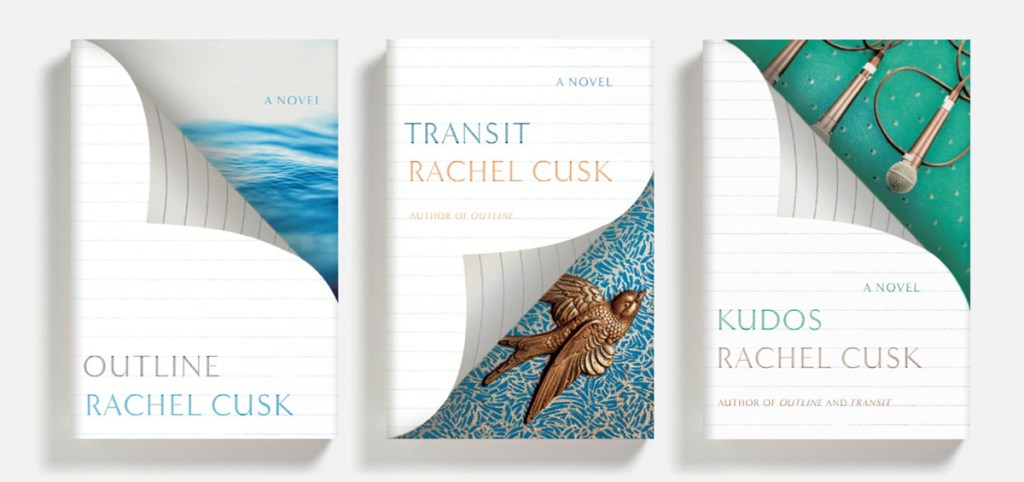
Rachel Cusk’s trilogy encompasses books entitled Outline, Transit, and Kudos. In every case Cusk presents character stories of people met in chance, or occasionally planned, encounters. In Outline, the author, Faye, (characters are typically unnamed or given only first names) is on a plane headed to a Book fair in Greece where she will sit on a panel and be asked to speak. Her seatmate on the plane gets in-depth treatment as we learn the story of his life and his marriage. Even at the book panel, the event runs out of time before the author speaks, but one outgoing male author has plenty to say.

Hardly any of the characters in these books have names, or they might have a first name, as already mentioned. This seems to be a new trend in fiction which probably has a purpose, as in allowing us to relate to the character, not wanting to create a character that jumps off the page and becomes an icon or to make it easier for the reader to imagine that s/he is the main character. The main character in this case is an author who has been through a crushing divorce. She and her husband have two sons. But her writing career is taking off, first literally to the Book Fair in Greece. 

Rachel Cusk has a talent for telling stories of the people who meet this author as she travels, renovates an apartment, and goes to a second writer’s convention where awards are being given. But we know little about the author or her book. We are treated to an in-depth exploration of all the people she sits next to or interacts with. She seems to have no close friends, but this story is not really about the author. It is about men and women and the difficulties of intimate male-female relationships, especially in marriages in the twenty-first century. 

Even as she fights off the bile of her new downstairs neighbors in Transit, she finds out the details of the life of the contractor who spends the most time on her renovation. Her neighbors are a nasty pair who knock on the ceiling with a broom as they follow her footsteps through her new flat. The downstairs couple seem to be bound together by their hatred for whoever lives upstairs, and they delight in intimidation. These are people I would want to run away from, but she stands her ground (without a rifle). When they realize that she is soundproofing the floor their hatred knows no limits but never gets physical. It is all bluster, an act to drive her away. The author has sent her sons to stay with their father while the reno is undertaken and although they beg and cry to come home to her, she encourages them to be independent. Is she a bad mother?

In the last book, Kudos, the author has obviously had some success and is attending a conference where she is supposed to be interviewed on television. Although she learns the life story of the interviewer, the technicians are never able to make the electrical hookups and the interview is called off. She meets another interviewer, a book critic, and he never learns a single fact about her, but we learn all about him. Almost all the people we meet are men and what they have to say about marriage is not encouraging. She also meets a wealthy woman who has given up on men and now invites writers and artists to come stay in her mansion where they can be warm all year long and enjoy more sun than the author has ever enjoyed in England where she lives with her sons in her redone flat over her miserable neighbors. Will she take Paolo up on her offer? Although this exploration of modern relationships is relevant this is a literary book than many readers are likely to skip. Rachel Cusk, however, has earned much praise from those critics who know and love well-written fiction.

Tom Lake by Ann Patchett – Book

From a Google Image Search – The Harvard Crimson

Tom Lake by Ann Patchett is a pandemic book of sorts. Lara and Joe Nelson own a farm, rows of cherry trees, some plum trees, some pear trees. The cherries are the money makers. Sweet cherries must be hand-picked. The tarter cherries for pies and cooking can be shaken from the trees onto tarps and they can be frozen.

The pandemic has made it difficult for their usual pickers to arrive. Lara and Joe’s three daughters, all grown but not yet married, come home to ride out the pandemic and to help pick the cherries. When Lara’s daughters find out that she dated Peter Duke, a famous and handsome movie star, Emily, Maisie, and Nell enliven a tedious repetitive task by prying the story of their mom and Peter Duke out of their reticent mother.

Once upon a time a local presentation of the play Our Town finds Lara and her friend registering local actors for the upcoming production in their New Hampshire town where Lara’s mother and father live. Our Town is a big deal in New Hampshire. If you have read the play, you know why. If you haven’t read it, you should. After a failure to find an “Emily” to play that important role, Lara ends up trying out. Turns out she is a natural. Her Emily is so well done that she is invited to go to Hollywood to test for a movie. Lara feels a connection to the Emily character but is she a great actress she wonders. After she wins the part in the movie playing another Emily-style character the film is shelved for several years. Lara is packed off to play Emily in Our Town again, this time in a professional summer theater in Tom Lake, Michigan.

Lara’s daughters, picking cherries and prodding their mother to get to the part where she meets Peter, find that they are finally there. But they want more, they want details. Because these daughters did not come home to tend to their mom on her deathbed (as in some novels and movies), this is a far lighter novel with only a few tragic elements. It’s basically a book that would make a great Nora Ephron movie. Do we have a new Nora Ephron? If Ephron was a product of her times, then we may never have another Nora Ephron, nor another Ann Patchett. 

The challenges of being an independent farmer are braided through the other elements in the book and the specter of all those cherries which represent the farm’s income rotting on the trees with no one to pick them is a pressure as intense as our desire to hear about Lara and Duke and why Lara is a farmer’s wife rather than a movie star. Readers also get an interesting peek into what it’s like to work in a summer theater.

Tom Lake was a good read, but it’s also a trip to more carefree, innocent days even though it is during the COVID pandemic. Perhaps people envy America these days in the 21st century because some people still get to live such a life. How much longer? How many of us? Although it is a new novel it already feels nostalgic. The orderliness of a well-run farm, the lines of heavily laden cherry trees under blue, blue skies. You might enjoy spending some time in a place that seems so fragile so in danger of disappearing altogether. I borrowed this book from my local library.

The Secret Hours by Mick Herron-Book

From a Google Image Search – Audible

The Secret Hours by Mick Herron is a sort of spy story, but it’s not James Bond. No loveable Moneypenny or Q here. No clever devices that look ordinary but have magical abilities to save an agent in dire straits. In fact, half of the characters are not even spies, but their story begins when the Berlin Wall falls and an actual spy comes out of the East and meets a grieving wealthy man who lost his sister and who knows what happened to her and who did it. Who is Max and why is he being chased down the Green Lanes as the book begins by people who seem intent on killing him?

You will have to spend some time in the Regent Park Office in London where a group has been set up to find what kinds of unethical business the hired hands in the spy business have been up to. The committee’s remit is called Monochrome, which perfectly describes how Griselda Fleet and Malcolm feel about being assigned to this investigation. Both thought they were headed up the ladder to plum assignments and both are unhappy and worried to have been shunted sideways. They did not even have access to documents from Regent’s Park where actual scandals might have been expected to lurk. If you happened to read any bits from David Foster Wallace’s unfinished book, The Pale King, which takes place in the IRS, then you feel right at home in the home office.

Don’t get too bored because you are going to have all the action you can handle in Berlin (the spook’s zoo). They are a depraved bunch who have seen it all and are jaded and deep in the aftereffects of WWII. Myles has been embedded in East Berlin and has experienced the peak moments of postwar Soviet spying, the dossiers, the imagined crimes, the real crimes, the Stassi, the paranoia, the tattling, and the terrible repercussions of the tattling. Into this foreign office enters Allison, a young intelligent innocent who had expected to work at a desk and now finds herself pretending to complete assigned paperwork. At the same time, she does the real work assigned her which is to spy out what is going on in Berlin. However, the crux of this matter is personal, not professional. So, not about true spying at all, although it feels exactly the same. It’s about people, people who will surprise you. I can’t tell you; it’s a spy story, sort of.

Clearly wars do not end when treaties are signed, when spoils are divided, when horrendous war crimes are turned up, when revenge is planned and eventually taken. Names change, years pass, people age and disguise themselves and become unrecognizable. Justice gets done but not in a court. First Desk proves to be not all talk and no action. The author knows how to set a scene. Don’t you just love a good spy story. This one is very good while you are reading and great after contemplation. Don’t just move on to your next book until you have sat with this one for a bit. 

Stella Maris by Cormac McCarthy-Book

From a Google image Search – Alta Journal

Stella Maris by Cormac McCarthy is so immersive; it’s like having a conversation with that person you could talk to all night. It’s one of those conversations that discusses little that is trivial. It goes deep and explores the human condition, the universe, the meaning of life, the nature of families and love. Stella Maris – could that translate to sea of stars? Apparently, it refers to a saint called star of the sea. Stella Maris in this case is the name of the fictional mental institution that Alicia Western has checked herself into as the novel begins. 

Alicia is a genius who began college in her early teens. Her parents worked for the Manhattan Project and moved with it to Oak Ridge Tennessee. They helped produce the atomic bombs dropped on Hiroshima and Nagasaki. Her father was a physicist and her mother worked in a factory setting to separate U235 from U238.  There is guilt, lots of guilt. Alicia’s genius is in mathematics. Apparently true genius only occurs among mathematicians. 

Why did I so enjoy reading a book that I can’t pretend to totally comprehend? It made me feel both brilliant and sadly lacking in intellect at one and the same time. The names of famous physicists and mathematicians offer a fair bibliography of the work in these fields. 

Can mathematics solve the riddle of life and the universe? Does the pursuit of answers drive Alicia’s insanity, or just complicate it? It seems as if she was born to contribute to and expand on the work that comprises the field of math, but then why is she also born with a gene for schizophrenia and probably autism?

She spends her life in rare libraries and esoteric pursuits when her demons leave her periodically alone. She has no friends. She computes in notebook after notebook and in her mind when no paper is available. These are the things she discusses with her therapist, who seems able to follow her intellectually, although not mathematically. Having worked my way through advanced algebra with great difficulty, it is hard for me to imagine how math leads to so much philosophy but there it is, and its deep. You won’t like her conclusions about “life, the universe, and everything” as Douglas Adams put it, so I won’t tell you that part.

Alicia has a brother, Bobbie Western. He is the subject of the first book in this series (The Passenger). I believe that it helps to read them in order. Bobbie could not follow his sister to the heights (or depths) of her mathematical pursuits, so he studied physics and threw it all over for speed. He became a race car driver. 

Alicia is in love with her brother, despite society’s biological taboo against incest. He is the only one who understands her and loves her. He seems to also be in love with his sister, but he will not break the taboo on sexual intercourse. His sister’s broken heart contributes to her psychological burdens and to her worldview. 

If Cormac McCarthy is having his midnight conversation with his readers, which I think he is, then these books show unplumbed depths. But I warn you, at 89 his own worldview is perhaps not one that is designed to cheer you up, or even wake you up, as all human efforts seem to lead us to conclude that there is no powerful being or force watching out for us puny humans. I would still love to read both books, The Passenger and Stella Maris all over again and if I have the time I will. Is it that one book to take with you to a desert island? Not unless you also bring a math tutor. However, you can grasp the gist of this book without doing the math.

The Marriage Portrait by Maggie O’Farrell – Book

From a Google Image Search – Amazon

Maggie O’Farrell, of Hamnet fame, gives us a look at sixteenth century Italy, divided into various small Duchies, in her newest book, The Marriage Portrait. Her great talent is to bring eras and famous figures alive, much like the painting of her main character in this novel. She describes a restless young woman raised in a loving family who must leave her home to marry a young handsome man from Ferrara, a place across the mountains. It is fortunate that Lucrezia was not a biddable child, because the family she marries into is modeled on the De Medici family. Is it the fault of her beautiful mother whose mind wandered while her husband took his pleasure in the map room?

“Picture Eleonora in the autumn of 1544: she is in the map room of the Florentine palazzo, a chart held close to her face (she is somewhat short-sighted but would never admit this to anyone). Her women stand at a distance, as near to the window as they can get; although it is September, the city is still suffocatingly hot. The well of the courtyard below seems to bake in the air, wafting out more and more heat from the stone rectangle. The sky is low and motionless; no breeze stirs the silk window coverings and the flags on the palazzo’s ramparts hang limp and flaccid…Eleanora’s eyes rake over the silverpoint rendering of Tuscany: the peaks of hills, the eel-like slither of rivers, the ragged coastline climbing north. Her gaze pauses over the cluster of roads that knot themselves together for the cities of Siena, Livorno, and Pisa. Eleanor is a woman all too aware of her rarity and worth: she possesses not only a body able to produce a string of heirs, but also a beautiful face, with a forehead like carved ivory, eyes wide-set and deep brown, a mouth that looks well in both a smile and a pout. On top of all that she has a quick and mercurial mind. She can look at the scratch marks on this map and can, unlike most women, translate them into fields full of grain, terraces of vines, crops, farms, convents, levy-paying tenants.” (pg. 16)

Lucrezia is a painter. Painting techniques of sixteenth century artists play a big role in this story. The art of the underpainting is used by the painter of the time to record disparate truths; and it is used as a nice piece of symbolism by O’Farrell.

Lucrezia leaves Tuscany with her new husband and soon learns that he is not always the sanguine whimsical partner that he has pretended to be. He is desperate for an heir and Lucrezia’s mother is called by many La Fecundissima. She soon sees that her husband has two faces, and one is neither patient nor loving. When women did not produce children in the sixteenth century it was never the fault of the man. Lucrezia is not with child after nearly a year of marriage. Alfonso, Duke of Ferrara, her husband, takes her to a hunting lodge at the edge of a forest to have her marriage portrait painted. A kind act based on a piece of acquired knowledge may have a profound effect on Lucrezia’s fate. 

“Lucrezia is taking her seat at the long dining table, which is polished to a watery gleam and spread with dishes, inverted cups, a woven circlet of fir. Her husband is sitting down, not in his customary place at the opposite end but next to her, close enough that she could rest her head on his shoulder, should she wish; he is unfolding his napkin and straightening his knife and moving the candle towards them both when it comes to her with a peculiar clarity, as if some coloured glass has been put in front of her eyes, or perhaps removed them, that he intends to kill her.” (pg. 12)

Obviously, the rest of the story is told in flashback, a common element of story structure these days. The contrast between the lovebirds in Tuscany and the darker stuff of Ferrara gives scope to O’Farrell’s descriptive talents and offers a sense of real drama. I found the ending both satisfying and shocking, but I cannot tell you why without giving the outcome away. This quick read is also immersive, a way to spend a day half in light and half in shadow.

The Rabbit Hutch by Tess Gunty – Book

From a Google Image Search – Milwaukee365.com

Tess Gunty took me to The Rabbit Hutch. My first thoughts as I read the novel were how much novels have changed in the twenty-first century. The story structure wasn’t new. There have been stories about the tenants of apartment buildings in other books. But characters have changed a lot and the culture has changed a lot. Everyone seems to be more unhinged. The deep flaws in the characters are reflected in our real-world examinations of the deep flaws in our societies and in ourselves. Perhaps it is that we feel more crowded as population nears 8 billion souls on the earth and it is far easier to feel lost. At one time an apartment building may have been a small community, but the inhabitants of The Rabbit Hutch hardly exude communal spirit. 

We have Joan in C2, a woman who keeps to herself, has no friends except the people she knows at work. She scans the comments people make on obituaries and weeds out any negative content. That’s her job. When Elsie Blitz dies, the famous star of Meet the Neighbors, and her son writes scathing remarks, Joan eliminates them. The son of Blitz, now in his forties will soon pay her a luminescent and scary visit without violent intent.

In C8 we have a new mom named Hope who is afraid of her new baby’s eyes, obviously fighting post-partem depression. She has a loving and patient husband. Will that help?

And in C4 we have 3 teenage boys and one teenage girl, recently released from foster care to take part in an early release program, turned loose from woefully few role models, bad foster parenting, and without mentors. The teen girl in apartment C4 is our heroine, Blandine née Tiffany Watkins, a beautiful girl, abused in the way women are abused by someone who makes them believe they are loved, in this case her high school music teacher. Blandine refuses to accept a view of herself as a victim, although she cannot face going back to the private school where she was a scholarship student, and she gives up the promising future the school had opened to her. 

Blandine loves her hometown, Vacca Vale and one reason she loves it, and one reason for all the animals that appear in this story is that the town fathers had created a green space they call Chastity Valley. Developers want to build expensive homes in place of this park. The town of Vacca Vale is on a river which has 100-year floods that are not always 100 years apart. Chastity Valley protects Vacca Vale from the worst effects of this flooding. Blandine does not know this fact, she just wants her town’s best feature left alone. Blandine seems unaware of her beauty, but the boys and men around her are not unaware. 

When a load of dirt and bones and sticks falls out of the ceiling of the Vacca Vale Country Club during a meeting between the town and the developers no one knows who could have done such a thing. It is a statement of environmental activism and a sign to us that one young woman has not lost her sense of personal power and agency. Blandine has been studying the lives of the mystics.

However, back at The Rabbit Hutch, we have three teen boys with little education, access to social media, and too much time on their hands, living with a beautiful mysterious teen girl. These boys have made a wrong turn.

The flaws in our society are reflected in the tenants of The Rabbit Hutch in way that points out the lack of a center in our culture. Historical novels often  are centered on royalty or a hierarchical social order. War novels focus on ways that war is full of terror and uncertainty which tends to make humans closer and give them a purpose. We live in times where we seem to have lost our center, where individuals go it alone and where life does not offer people much satisfaction or many clear goals. Tess Gunty’s book reflects our times very well, but it is disconcerting to read new authors when your best reads are from the twentieth century. Don’t avoid modern novels. Although depressing they are quite honest. 

“…so Blandine exits herself – she is all of it. She is every tenant of her apartment building. She’s trash and cherub, a rubber shoe on a sea floor, her father’s orange jump suit, a brush raking through her mother’s hair. The first and last Zorn Automobile factory in Vacca Vale, Indiana, a nucleus inside a man who robbed her body when she was fourteen, a pair of red glasses on the face of her favorite librarian, a radish tugged from a bed of dirt. She is no one.” (pg 10)

Michael Connelly’s Bosch Books

I set a course to read all the Bosch books by Michael Connelly this summer. Well, I didn’t quite make it before fall set in but, except for the newest book, which is not available yet, I finished all of them. I did not review each book as I finished it because I decided to classify them as recreational reading, but characters like Bosch deserve a few words. Harry or Hieronymus Bosch is a police detective in the homicide division when Connelly’s series begins. He has a sad past as he was born to a single mother who did not share the name of his father with him. They lived in run-down apartments in poor neighborhoods and his mother sometimes prostituted herself to earn enough money to live. She was found murdered in an alley; a victim of a crime Bosch eventually solves. Bosch is sent to a home for orphaned children, a place that locked defiant children away in a dark cubbyhole in a time when there were no laws about such abuse. Bosch was a defiant child and a frequent runaway.

But Bosch developed an anathema to the evil side of people, people whose acts create the dark corners of our society, its dark hidden alleys, and the twisted actions of those who are damaged. So, despite Bosch’s obvious issues with authority and his contempt for the politics of policing he is a detective who doesn’t quit. He breaks rules only if they prevent him from pursuing a case using rules he deems trivial. If his current LT (Lieutenant) happens to be a stickler for rules or in cahoots with the big wigs on the tenth floor, he is likely to be suspended once he solves a case (sometimes even before he solves the case). In some of the Bosch books he is a private detective. In later books he works to solve cold cases or volunteers at the San Fernando police department, gets hired there, gets suspended from there and finally retires for good, but still mentors Renee Ballard, a smart young policewoman.

Bosch’s house, where he spends far too little time, is an oasis above the city, a legacy of a movie that was made about a case he solved. It sits high above the city cantilevered out over scrubland and coyotes with a wall of windows and outside an open deck with a convenient railing. Jazz music fills the space which is somewhat minimalist and rather shipshape as if floating in air is like floating at sea. It does have three bedrooms however, which is fortunate when Bosch discovers that he has a daughter from his only wife and only love, the former FBI agent and very successful gambler, Eleanor Wish. Wish and Bosch do not work as partners but their daughter, Maddie, is a great addition to the series. She plays a more prominent role in the TV series, but she and Harry have an easy and positive relationship even though or perhaps because Harry is hardly ever home. Maddie understands what drives her father and she finds herself driven by the same desire to rid the world of evil doers. She humanizes Harry.

Michael Connelly creates a thinking detective, not an action hero, and he takes us through cases that come out of the news of the moment. This gives his books a historical perspective on what different eras have brought to life in Los Angeles and to the world. 

I thoroughly enjoyed my summer of Bosch. It offered a nice break from the ever more chaotic politics of America and everywhere else. To go along as a hero follows the trail of a criminal murderer or rapist, an arsonist who burned up children to cover a crime, or people who committed ‘all the sins that flesh is heir to’, to use a “murder book” to catch a criminal, brought a sense of balance back into my life. Seeing wrongs righted offers satisfaction even if the heroics are fictional. I also find, whenever I read a book set in LA, that we are given lots of highway routes in case we ever want to follow in Bosch’s footsteps. Don’t bring a gun; bring some Charles Mingus and some good fast food. You won’t need a GPS. Just take the 405 to Mulholland

From an SNL skit:

Yes, Californians yak about traffic the same way Oregonians talk about the weather, effortlessly working it into conversations.

A hilarious example from jealous boyfriend Fred Armisen during Saturday’s SNL skit “The Californians”:

“I think you should go home now, Devin! Get back on San Vincente. Take it to the 10. Switch over to 405 North and let it dump you into Mulholland…where you belong.”

Thank you, Michael Connelly. You provided a great bridge to take me out of COVID isolation and sorrow, back to fighting the good fight to save democracy and enjoying life.