Atmosphere by Taylor Jenkins Reid – Book

From a Google Image Search – ABC News

Atmosphere by Taylor Jenkins Reid is a novel that has several themes. It begins in the 1950’s in America, but it mainly takes place in the 1980s. Joan Goodwin grew up loving the stars in the sky. She watched when Americans first walked on the moon in 1969. As a grownup she earns degrees in astronomy and is teaching at a college, but she dreams of going to space. When the space-shuttle-years begin an era of multiple space launches and flights, Joan, in a hopeful moment, fills out an application for NASA. The space program is hiring women for the first time. Since Joan is an expert in the field of astronomy, since she knows the constellations, knows the myths by which the ancients delineated them, and can steer by the stars, she is hired by NASA.

The people she meets at NASA become her co-workers and her social cohort. Eventually they learn to accept each other’s eccentricities, and they bond, some better than others. Everyone wants to be included in a shuttle mission and there is some competition and even some backstabbing. Joan’s calm demeanor and social common sense are important assets at NASA.

Joan’s sister, Barbara, is a hot mess. She got pregnant too young, and she is a reluctant single mother to Frances. Barbara’s selfish lifestyle keeps Joan involved in Frances’s live and they grow close. Frances can rely on Joan. She visits her at her NASA apartment often. Circumstances arise that make Joan escalate her involvement in Frances’s life.

Joan, who has never been in love before, falls in love with fellow astronaut, Vanessa Ford. It’s a relationship they must hide because it isn’t accepted anywhere, but especially not at NASA. It’s a love story that shouldn’t make any reader uncomfortable.

I recently read Orbital by Samantha Harvey which took me to the space station. It gave me a detailed view of a place I will never go, but that I value as a place that today’s risk-takers go to support tomorrow’s space adventures. However, Reid’s book, Atomosphere is peopled with emotional connections, human interactions, and historical realities that are more important than the mere technology of space flight, and more universal. These human interactions enrich the experience of NASA but do not put you right in space as Orbital does. Both are fine books about human space adventures, but offer different experiences. I enjoyed reading both books. You might also enjoy this pair of space odysseys.

We live in times when women’s rights are once more in question. LGBTQ+ folks just won the right to love who they love in the 21st century. Now those rights are in danger of being overturned by conservatives and evangelicals. Since Atmosphere takes place when women were just being accepted as astronauts, NASA expects women to match their exacting moral standards which are not like women’s rights outside the program. Women in the program feel that they must outperform their male counterparts. There are parallels here with Bonnie Garmus’ book, Lessons in Chemistry. Sadly the rights of women are once again being targeted, giving this book currency in 2025.

The Oligarch’s Daughter by Joseph Finder-Book

From a Google Image Search – AP News

The Oligarch’s Daughter by Joseph Finder is a thriller that brings Russia to America. Arkady Galkin lives large and seems to be wired into power in two nations that we usually think of as enemies. However, when Paul Brightman falls in love with and marries the oligarch’s daughter, Tatyana, it becomes quite clear that the Russian is somehow connected to powerful people in America and that Paul is at risk. Paul had a job at a hedge fund, a job he liked with people he also liked. Galkin pressures Paul into working for him in his “investment firm”. As Paul learns that Galkin’s business involves illegal financial moves, Paul becomes aware that his new father-in-law will not tolerate any disloyalty. He decides that he needs to run.

The book opens with a man with two names fighting for his life. Grant Anderson/Paul Brightman wins this battle, but it’s just the beginning of a war for his own survival. Paul’s father was a survivalist who lived much of his life in the deepest forests of America. Paul, who lost his mom at sixteen, thinks his father is a nut. He finds him embarrassing. Little does he realize that the survival skills his father taught him are about to come in handy. 

As we switch back and forth from Paul’s past with Tatyana to his present life as Grant Anderson, we find Paul caught up in running from dangers he should have been aware of as he courted Tatyana. Why are the FBI and CIA involved in all this, and why are they not on Paul’s side.

It’s a good thriller, although a bit offbeat from a classic one. We share Paul’s anxieties and his controlled panic. We travel to Moscow and back in the years of Paul’s marriage and then we run with him through the woods chased by people who should not be chasing him in the present. Of course, people die. 

There is a section in the middle of the story which gets a bit bogged down in complexities and details. slowing our fevered dash from danger. It’s complicated. But soon it’s a headlong adventure in survival and Paul learns to take new pride in his father’s lifestyle. Who survives and who doesn’t? What happens to Paul’s wife Tatyana and Grant Anderson’s girlfriend, Sarah? It’s a good read, but not on my best thriller’s list.

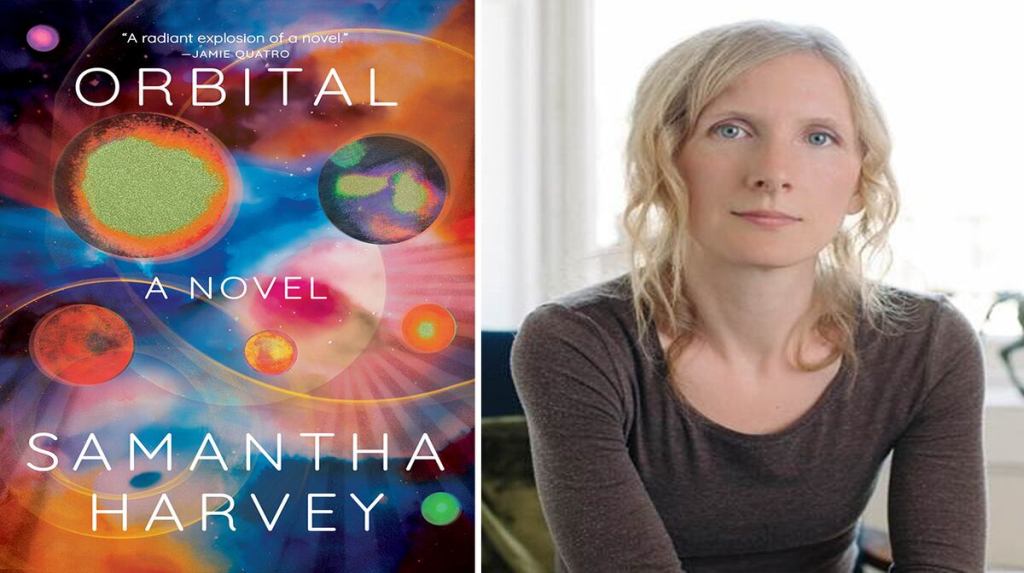
Orbital by Samantha Harvey – Book

Being a physical chicken made me realize that I could never be an astronaut although I love science fiction stories that take place in space. No Blue Origin for me. No Mars on the Space X Starship. However, it no longer matters because Orbital by Samantha Harvey will allow even the most cowardly human to travel in space for a too-brief time. We travel with Anton, Roman, Pietro, Shaun, Chie and Nell, a diverse six pack of astronauts, aboard the space station. 

No plot, no conquest of space and time, no spin-out into emptiness, only small dramas. Just the day-to-day minor miracles in the lives of these six people, eating, sleeping, conducting experiments in space science, their travels across time zones, across dawns and evening and nights. The earth in daylight appears unpopulated – at night the clusters of lights from cities and towns makes life visible from space, but the stars glowing in inky space outshine the city lights. 

These astronauts have been through years of training to sleep in sleeping bags that hang without gravity. The descriptions reminded me of the way whales sleep, hanging vertically in the salty ocean, sleeping together in pods. 

“Outside the earth reels away in a mass of moon-glow, peeling backward as they forge towards its edgeless edge; the tufts of cloud across the Pacific brighten the nocturnal ocean to cobalt. Now there’s Santiago on the South American coast in a cloud-hazed burn of gold. Unseen through the closed shutters the trade winds blowing across the warm waters have worked up a storm, an engine of heat. (p. 2)

“They retreat inside their headphones and press weights and cycle nowhere at twenty-three times the speed of sound on a bike that has no handlebars, just a set of pedals attached to a rig, and run 8 miles inside a slick metal module with a close-up view of a turning planet. 

Sometimes they wish for a cold stiff wind, blustery rain, autumn leaves, reddened fingers, muddy legs, a curious dog, a startled rabbit, a leaping sudden deer, a puddle in a pothole, soaked feet, a slight hill, a fellow runner, a shaft of sun. Sometimes they just succumb to the uneventful windless humming of their sealed spacecraft.” (p. 16)

“How the earth drags at the air. See how the clouds at the equator are dragged up and eastward by the earth’s rotation. All the moist warm air evaporating off the equatorial oceans and pulled in an arc to the poles, cooling, sinking, tugged back down in a westward curve. Ceaseless movement. Although these words – drag, pull, tug – they describe the force of this movement but not its grace, not its what? It’s synchronicity/fluidity, harmony.” (p. 83)

“And when the ocean comes again you think, oh yes, as if you’ve woken up from a dream in a dream until you’re so dream-packed that you can find no way out and don’t think to try. You’re just floating and spinning and flying a hundred miles deep inside a dream.” (p. 189)

“You are looking now straight into the heart of the Milky Way, whose pull is so strong and compelling that it feels some nights that the orbit will detach from earth and venture there, into that deep dense mass of stars. Billions upon billions of stars that give off their own light, so that it’s no longer true to speak of darkness.” (p. 191)

In this space station, “far from the earth” they watch two earth events – an enormous typhoon and a moon launch. Although they think about what will happen to the humans in the typhoon’s path and they envy the astronauts going to the moon, they are not sorry they chose this mission. These events, in the end, do not change life aboard the space station. You should go on this mission. I doubt that Samantha Harvey ever went to space, but she nailed it – the beauty, the possibility for disaster, the tedium, the homesickness. The full-color-palette beauty of earth overrides all. Orbital is a trip.

**I have a Space playlist. It begins with Space Oddity by David Bowie, then Major Tom (Coming Home) by Peter Schilling, Rocketman by Elton John, Starman by David Bowie, Shooting Star by Bad Company, Drops of Jupiter by Train, and A Sky Full of Stars by Coldplay

Intermezzo by Sally Rooney – Book

From a Google Image Search – Chicago Review of Books

Sally Rooney wrote Intermezzo, a story of two brothers, the Kubek brothers. An intermezzo is an intermission. We meet the younger Kubek brother first. Ivan is in his twenties, and he considers himself socially awkward. All his previous encounters have not gone well. He would become filled with anxiety and unable to approach social situations with an acceptable level of poise. He used his alone time, and it was considerable, to become an expert chess player. When he goes to a small town to play some chess against amateur players, he meets a beautiful 36-year-old woman, and he becomes involved with her. She does not find him the least bit awkward.

Peter is Ivan’s brother. He’s 35 and dating the 20-something Naomi. Peter is also involved with Sylvia, who he intended to marry. She was in a terrible accident, and although he still loves her, she can’t be there for Peter as a wife because she lives with constant pain.

Ivan and Peter recently lost their father and have not yet dealt with the pain of their loss. Their parents were divorced when Ivan was quite young, and the boys lived with their father. Since Peter is so much older than Ivan, he soon went off to college. There is that dynamic of who did Dad love best. Losing their father throws them temporarily off balance. Does the title refer to the time spent adjusting to this major change in their lives?

Rooney add in some Wittgenstein, a physicist I find quite abstract (pg. 399). Schrödinger’s box makes an appearance. Conversations between Sylvia, a professor, and Peter were too esoteric for me, a reflection, I imagine, of their level of intellectual sophistication, and a contrast to Naomi, who is needy, pretty, good company and surprisingly wise for someone so young but no intellectual. I usually like brain puzzles to unravel but this time I will have to go back over that part of the book to see if it is worth trying to grasp what these two characters are saying, or if the author is just showing off her erudition. (Sally Rooney wouldn’t do that.)

“Something about fascism he says, and they go on walking, talking about fascist aesthetics and the modernist movement. Neoclassicism, obsessive fixation on ethnic difference, thematics of decadence, bodily strength and weakness. Purity or death. Pound, Eliot. And on the other hand, Woolf, Joyce. Usefulness and specificity of fascism as a political typology in the present day. Aesthetic nullity of contemporary political movements in general. Related to, or just coterminous with, the almost instantaneous corporate capture of emergent visual styles. Everything beautiful immediately recycled as advertising. The freedom of that, or not. The necessity of an ecological aesthetics, or not. We need an erotics of environmentalism.” (pg. 393)

Since the story takes place in Dublin and small towns nearby, the odd sentence structure may reflect local dialect. Sentences often seem to be written backwards to avoid the use of conjunctions. Is this a Rooney thing or an Irish thing. I do not know. I found it interesting but not annoying.

“Terribly childish wish he feels once in his life to do as he’s told.” (pg. 410)

Sally Rooney gives us characters who seem like real people we could meet and know. Ivan and Margaret, Peter, Sylvia, and Naomi could be friends of ours. How they deal with traumas in their lives, how they deal with nontraditional relationships, how they come of age, regardless of their age in years; these are the interactions that hold our interest. If the ending seems a bit too happy, I don’t mind.

The Queen’s Fool by Philippa Gregory – Book

From a Google Image Search – Flickr – (C)KIM BECKER

A friend gave me the book The Queen’s Fool by Philippa Gregory for Christmas. I had read several Philippa Gregory books, but not this one. Gregory writes period fiction, usually about English history, especially royalty. These books are very readable and immersive. In The Queen’s Fool Gregory focuses on the short reign of Edward, too young to be king and too ill to rule for long and the sisters who followed him on the throne of England. 

Many readers know this story well because two half-sisters were waiting to be queen. Mary was first in line. Mary was the daughter of Henry VIII’s first wife, Catherine Parr. He divorced her mother to marry Anne Boleyn. Elizabeth was the child of this marriage. Although she was declared illegitimate when Anne Boleyn was executed, she was later declared legitimate.

Mary was not the queen most of the English people wanted. Henry, her father left the Catholic church (and the authority of the Pope) when he wanted a divorce, and the church would not grant it. England was turned upside down as Henry closed the monasteries, took the riches that had been amassed, and executed formerly powerful church officials. He eventually founded the Church of England which was closer to Protestantism. Mary was a devout Catholic who, once she became queen, turned England upside down again by restoring the Catholic church and punishing prominent Protestants. Subjects who wanted to stay alive had to return to behaving like loyal Catholics. Mary’s half-sister was not old enough when Edward died to be queen, but she was a Protestant who had no fixed ideas about God or the Church. 

The Queen’s Fool, threading her way through all this religious upheaval, was Jewish, a religion that was unwelcome in almost every nation at the time. Jews had to pretend to be Protestants when that was expedient and Catholics when nations were loyal to the Pope. Hannah became the queen’s fool because she had the “sight.” If you remember your history of Mary and Elizabeth, then you remember that Lord Robert Dudley and Elizabeth were an item for a while. Hannah Green once saw Robert Dudley in the street and behind him she saw the angel Uriel. Dudley was the one who recommended her to be a fool for the Tudors. Lord Dudley’s protection kept Hannah alive through many tense moments.

Reading books about royalty is a guilty pleasure that I don’t often indulge anymore but I was happy to enjoy this book. Adding the Jewish faith into this mix, at this time when religions were matters of life and death, was a new twist. Hannah lived with her mother and father in Spain until her mother was burned at the stake by the Inquisition. Hannah and her father kept moving around Europe trying to find somewhere they could live in safety. It was dangerous for Hannah to be involved with the Catholic reign of Mary. 

The Jewish people have been hunted throughout history until they found safety in America and Israel, but they realize that this safety could be ephemeral once again. We all live with some religious uncertainties in the twenty-first century, but no people have been as consistently hounded as those of the Jewish religion. Exploring a historical moment we have explored in other books, as seen through the lens of religious turmoil and of one Jewish girl at the mercy of fate, kept me reading and reminded me of how fraught the Jewish diaspora has been for believers in the Jewish faith. Gregory took a timeless story we are familiar with and added another layer.

This book may be out of print.

Playground by Richard Powers-Book

From a Google Image Search – NPR

Did you know that fish go to cleaning stations under the ocean and other sea creatures vacuum them and clean their teeth? I didn’t. Did you know that fish and other sea denizens like to play, even sometimes with humans if they come around often enough. The ocean/s come alive in Richard Powers book Playground. The enormous variety of sea life, the bioluminescence divers see that we landlubbers don’t, the coral reefs, the way sea critters turn human trash into new coral reefs-it’s all fascinating and beautiful as Powers describes it.

But what antics creatures get up to underwater is not the only thread in this novel. Playground is also the name of a social media platform designed by Todd Keane that allows users to play and chat online, for a fee. And with the arrival of AI, the site gets more popular until Todd Keane is a billionaire.

But, before Keane earns his billions he meets Rafi Young in school. Rafi is a young black man. Both are from Chicago. Both love games. At first, they play chess. When they discover Go, the infinite variety of moves, the complex strategies lead them to replace chess. They play for hours and years before gaming even begins on the internet.

Todd Keane’s father worked in the pit at the Chicago Board of Trade:

“…a warrior of the open-outcry system, he stood in the heart of the octagon as the furious waves of capitalism crashed all around him.” (pg. 9)

Since Todd’s parents fought and made up loudly and often, he sought solace under Lake Michigan. “When I was young, I could breathe underwater.” (pg. 12) Todd and his father played a series of classic games until they got to Backgammon. Eventually Todd could beat his father every time. Todd came from a wealthy family.

Todd’s father lets him choose a book. He chooses “Clearly It Is Ocean” by Evelyne Beaulieu. Eva’s dad helped invent the first aqualung and he had his daughter take it for a test in the pool. Eva learns to dive, even meets Jacques Cousteau, and travels to coral reefs until she ends up on Makatea. 

Rafi Young’s father was a Chicago firefighter. When his mom worried about him walking to school through a tough neighborhood, she made him wear a bright orange coat and hat which solved the mom’s problem but made Rafi’s life worse. When his father heard about all this, he punched Rafi’s mother in the face. Divorce followed, and poverty. 

While Todd pursues a degree in math and excels with computers, Rafi earns a PhD in educational psychology. They meet Ina Aroita, born in Honolulu to a Navy family and raised on naval bases in Guam and Samoa. For a while it seems that both men fall in love with Ina. It is Rafi who marries her and becomes a teacher on the island of Makatea where he and Ina adopt two orphaned children and Ina becomes an artist. Todd is the only character not living on Makatea. In fact, Todd and Rafi have had a falling out and Rafi doesn’t speak to Todd. Will there be a reunion? My lips are sealed.

Here’s what Todd has to say about the picture book, “Clearly It Is Ocean.” “Thirty thousand kinds of fish. Fish that migrated their faces across to the sides of their bodies as they grew. Fish whose barrel heads were transparent, revealing their brains. Fish that changed from male to female. Fish that grew their own fishing rods out of their heads. Fish that lived inside the bodies of other living creatures.” (pg. 24)

Makatea, a French colony, was found at one time to be a major source of phosphates, most often used in fertilizer. The discovery of phosphates multiplied the amount of food farmers could produce. Given the exploding population on Earth, the demand was huge and the island was exploited for years. Then the mining companies left, and the island’s population fell to 82 humans. Two of these humans were Rafi and Ina. Evelyne Beaulieu, now 92, lives there also, still diving.

Now, a mysterious company wants to build a “seasteading” community at Makatea, throwing the residents into a panic because they remember what happened in the phosphate situation. It will bring jobs, a new clinic, and a high school. What will it do to the reefs around Makatea? How will the people vote? Is constant growth necessary and healthy for our societies and our planet? Here we have a mashup between AI and the health of Earth’s oceans and the whole wonderful, barely experienced, watery environment and all the living creatures in it. What will it be like to live on a planet whose oceans are no longer teeming with life, a dead ocean? What choice does the island make, and how is Todd Keane involved? What choice would you make?

“In the last chapter (of “Clearly It Is Ocean”), the woman I crushed on with all my ten-year-old heart told of a research trip she had made off the coast of Eastern Australia. She stopped one day in the middle of a dive to watch a giant cuttlefish near the mouth of its den. This tentacled mollusk, kin to squid and octopus, was performing a long wild color dance for no one.” (pg. 34)

It is not easy to talk about extinctions and the destruction of biomes when everyone is madly striving to be a millionaire or billionaire. Taking care of declining habitats and populations of creatures that are basically invisible to us and are dying off doesn’t get much viral attention on social media. Powers’ book does a good job of focusing on our choices between capitalism’s drive to perpetual growth, which is pursued mostly to feed people’s greed, and the importance of play to all living things. He reminds us that the oceans surrounding us are full of fascinating life forms and that we need to help them stay that way. This is not a preachy book. It’s especially great when Eva is underwater.

This Strange Eventful History by Claire Messud – Book

From a Google Image Search – NPR

Claire Messud’s book This Strange Eventful History tells the fictionalized life of her extended family. Not quite a memoir, it resembles an Ancestry test result, fleshed out with familial and historical details, that resurrects the essences of a family’s life. Gaston and Lucienne live in Algeria, a colony of France which promises residents that they are French citizens, equal in every way to Frenchmen. As the Nazi’s are beginning their occupation of France, Gaston, a civil servant climbing the ranks, thinks about volunteering for the French navy. He ends up going to Beirut where his bosses direct him, which is not into the French navy. His family, living in France at the time, leaves France to return to Algeria. There are two young children in the fleeing family of Gaston and Lucienne; François and Denise. When the war ends, the Cassar family is still living in Algeria. Messud describes Gaston’s decision and his relationship with his wife in her elegant prose:

“Back and forth, Gaston had argued all possible permutations in his head in the forty-eight hours since hearing the broadcast. He’d considered the choice before him while walking, while packing, while lunching with Cotigny, though he didn’t speak of it to his adjunct. He wished above all that he could speak to Lucienne; in the night he spoke aloud to her untouched pillow, as if she lay beside him, though it smelled only of laundering. How could he know what to do without knowing her mind? He thought of them as joined by an invisible thread, always united, one heart in two bodies. The two halves of Plato’s Symposium, who had found each other and their life’s purpose.” (p. 58)

In possession of her grandfather’s notes (all 1000 pages), Messud offers us views of a man’s life and his inner thoughts as he moves from the public sector back to the private sector and becomes as successful as he will become. Then we follow his son François to school in America and to his life with his wife, Barbara. Denise’s life is portrayed just as believably. The Cassar family expands as family members age and have children. 

Messud describes a time after WWII when Algeria wins its independence from France and the family has to leave the country they know best to return to France. Many countries gave or were forced to give independence to their colonies in the twentieth century. Gaston’s upheaval was experienced by plenty of others and led us all to many discussions about the colonizing motivations of our forebears. Despite our negative judgements, if we go to space, I think we will be colonizers once again.

Although this book may be considered too literary for some readers, Messud creates for us the various places where these characters reside and immerses us in lives that we can comprehend but which are most likely dissimilar to our own lives. It reminded me of the biography of Winston Churchill, although without the degree of historical significance of Churchill. Walking with Destiny by Andrew Roberts shows us Churchill living through some of the same historical eras as the Cassars, and similarly takes us to geographic locations we may never have visited with much discussion of Britain’s colonies.

Now I will apologize in advance for expressing maudlin thoughts, but I am at an age where my demise could be imminent. Messud not only covers the lives of these family members; she also covers their deaths. She doesn’t dwell on biological details, just on the way a full life dwindles and becomes circumscribed as we age, or if we have a fatal illness. We die alone, she does not pull her punches about this, but our deaths do affect those who love us. The details of the care we receive as life leaves us (or we leave it) may not resemble those enjoyed by the Cassar’s who lived in different times and who did not have to worry about financial matters, but still Messud has us contemplating the possible details of our own dying moments. I appreciated time spent with Claire Messud’s family, fictionalized or real. Good stuff. In fact, Messud’s book is shortlisted for the Booker Prize, 2024.

The Husbands by Holly Gramazio – Book

From a Google Image Search – Holly Gramazio’s author website

Lauren, Lauren, Lauren. OMG. Or should I say Holly, Holly, Holly because Holly Gramazio wrote the very bizarre book, The Husbands. Her book is unique, a real trip to modern culture, to reality – to somewhere. Lauren and her sister Nat own a pair of flats in London. Lauren lives in one and her sister, mother of Magda lives elsewhere. When the bulb in Lauren’s attic is replaced, it triggers some kind of electric wormhole in the universe or an anomaly in the space-time continuum. From that time on Lauren’s attic seems to offer her an endless supply of husbands.

Lauren is single, but one day when she comes home from work and finds a guy in her flat who says he is her husband, Michael. Lauren plays along. She even finds pictures of their wedding in her phone. Her apartment is painted in different colors. There are other changes – furniture and layout. One day she sends Michael into the attic, and he disappears. But a new husband climbs down. Who remembers husband’s names? We are simply fascinated as Lauren temporarily lives with each new husband or sends him immediately back to the attic. While it’s interesting to meet some of the 200 plus husbands Lauren meets and discards, it becomes somewhat repetitive and then unnerving. How many examples does one need to learn a life lesson? Is there such a thing as a perfect husband? 

Lauren gets attached to a couple of these guys. She falls for Carter, but he does not fall for her. She learns, eventually, that these are real guys who exist in her world. She sees what happens in some of their lives after she discards them. Lauren decides to fly to Denver, Colorado when she learns that Carter lives there. She also meets someone (the name is unusual so it’s hard to grasp it on Audible – perhaps Vorhees) who is experiencing the same anomaly, only with wives. They correspond. 

The great thing about discarding husbands (not always great) is that her financial circumstances, her jobs, her decor all change with each new husband. Sometimes these circumstantial changes help her decide whether a husband should be instantly discarded or kept around for a while. One really useful change is that debts disappear with each new adventure in husbands.

The book is too long. There are a few too many husbands. But it is entertaining and in the end there is a point, which I will leave it for you to figure out. If someone tells you there is nothing new under the sun, Holly Gramazio will make you rethink.

Lucky by Jane Smiley – Book

From a Google Image Search – New York Times

In Lucky, a novel by Jane Smiley, the author gives us a whole life – the life of fictional folk singer Jodie Rattler. Sadly, Smiley, describes what sounds like an exciting life in a rather monotone and unemotional way. Written all in first person, Jodie rattles off what she did first and what she did then, offering up the tick-tock of her life.

She’s an adventurous character who takes money from a successful day at the races and squirrels it away as a good luck talisman. She writes songs, tours with bands, cuts records but never reaches rock star status, seemingly by choice. Jodie lives in New York City, London, in a cabin she buys in the Hudson Valley, and on and off in St. Louis. Her Uncle Drew helps her recording royalties grow from one to 8 million dollars. Lucky. Jodie, like many women who are freed by the pill has sexual adventures. Unlike many a brokenhearted real live girl, she chooses her men wisely. Although left with many fond memories she decides to stay single and not have children. She meets many people at her concerts, at her gigs, and as she travels but does not keep them as close friends, something she comes to regret and works to change.

Smiley also offers us a love story to a city, the city of St. Louis. Jodie loves to walk around the neighborhoods she admires in St. Louis and repeats the names these neighborhoods are known by. She stops her musical travels and comes back to St. Louis to take up parental caregiving duties as many of us have been called on to do. Caregiving teaches many lessons. In the end Jodie weighs in on current political anxieties and her own gratitude and regrets.

It’s a slow book, but Jodie lived through times familiar to many of Jane Smiley’s readers. Jodie’s lyrics did not connect with me, but it seems there could be many worse lives than that of a musician. I liked the novel but didn’t love it. (OK, perhaps spending too much time on Facebook.)

The Armor of Light by Ken Follett-Book

From a Google Image Search – Lit Stack

Ken Follett’s fifth book in the Kingsbridge series is The Armor of LightThe Pillars of Earth is the most famous book in the series covering the era when the cathedral was built in Kingsbridge in fascinating, if fictional, detail. Reading this book enticed me to finish the rest of the books. Although not quite as good as The Pillars of Earth, all the books in this series tackle different eras in British history. The Evening and the Morning tells a story of the Middle Ages. World Without End brings readers to Kingsbridge two centuries after the building of the cathedral. A Column of Fire immerses us in the period of the Reformation. The Armor of Light focuses on the ways progress in the textiles trade affected the residents of Kingsbridge along with the involvement of England in the war against Napoleon Bonaparte. 

In each case Follett writes about the injustices that arise from having only two classes, the wealthy who control government, laws, and the courts, and the worker class at the mercy of the rich who show little or no compassion. He uses real historical moments and peoples them with fictional characters we can relate to. In Part I, The Spinning Engine, 1792-1793 we meet Sal Clitheroe, her unfortunate and beloved husband, Harry, and their son Kit. They are picking turnips and loading a cart under the watchful eyes of the Squire’s son Will Riddick, a coldly entitled and incompetent overseer. They are serfs who are paid tiny wages for hard physical labor. The workers can see that the cart is overloaded and not safe, so they are not surprised when a wheel breaks and Harry is trapped underneath. When Harry dies a distraught Sal has to fight for Poor Relief, she has to let her six-year-old son go to work polishing boots at the Manor House. Sal’s challenges are unending because she must stick up for herself and Kit, usually unsuccessfully as employers would rather fire injured workers than pay them, and the courts are manned of the powerful aristocrats or church officials. One church official says, “I’m not in the business of feeding other people’s children.” (An Anglican church leader talking of Methodists) (p. 49) 

Here we have the moment when cottage industries must give way to machines, in this case a spinning jenny that spins 8 threads at a time, and right on its heels, a machine that spins 48 threads at a time. Housewives in cottages tend to produce 3 threads per day.

In Part 2, The Revolt of the Housewives, 1705, when inflation arrives because of war with France bread becomes very expensive. Eventually, the housewives who don’t have enough grain to make their own bread become an angry crowd when they find that Kingsbridge has not bid high enough to stop their grain from going to another town. Local bread will be costly, and supplies will run out quickly. The housewives do not want the flour to go to another town when they will be left with no grain. Again, there is Poor Relief, but it is difficult to get enough to live on as Harry’s widowed wife Sal learns. Bread has become unaffordable just as people are losing jobs because of the new machines at the mills, a conjunction of events that can lead to social pandemonium. The militia is called to stop the insurrection of the housewives, but these local boys won’t fire on their neighbors. Steam machines are more reliable than those that run on the water from the river so workers must adjust to new methods and new job insecurities once again.

In Part 3, when workers try to form groups to be able to force owners and gentry to inform workers when more efficient machines continue to replace workers Parliament passes The Combination Act in 1799 which makes it illegal for workers to gather to try to get protections from owners who tend to keep advances in technology secret (to unionize). One owner imported “scab” workers from Ireland when workers tried a strike. In Part 4 we meet The Press Gang, 1804-5. As the war escalates England needs more and more soldiers. “My guess is that about fifty thousand men have been forced into it (the military),” Spade (David Shoveller) said. “According to the Morning Chronicle there are about one hundred thousand men in the Royal Navy and something like half of them were impressed. Part 5 finds Britain at war with the French led by Napoleon Bonaparte and most of the men and older boys from Kingsbridge go off to war. Wars are often social levelers. When the war is won Parliament passes workers’ rights reforms begin to create fairer conditions.

There are plenty of characters whose lives intertwine with the events related to the workers’ rights battles exposed in Follett’s book. Some marry, have affairs, have children, and form same-sex pairs which must be kept secret. Some run afoul of the gentry or the factory owners and suffer out-sized consequences because the same people that own and run the factories also control the courts. If you like to learn history while enjoying the literary presentation of fictional characters affected by that history, Ken Follett is someone who does a great job with both.