The Confessor by Daniel Silva – Book

The Confessor by Silva audiobookstorelcom

Not my favorite book of the Gabriel Allon series, The Confessor  by Daniel Silva should not be skipped if you want to do justice to the chronology. In Munich a Jewish professor and scholar, Benjamin Stern, is murdered and the manuscript he is working on is stolen. In Rome a Pope is elected who is not well loved by some of the Cardinals. He chooses the name, Paul VII. What is the connection between a Jewish professor/doctor and the Vatican in Rome? That is the business of this Silva thriller.

The Catholic Church is full of power politics and holds both traditionalists and reformers. We learned this in real life when Pope Francis was chosen, and the tug of war keeps emerging from time to time in the news. Wherever power is possible people will conspire to attain it. Investigation exposes a secret conservative cabal within the Catholic Church called Crux Veraand we get whiff of possible scandal, that the Roman Catholic Church (some of it) has things to hide, things left over from WWII that link the church to the Nazi’s and also to the Jews. Whatever happened could be so harmful to the image of the church that there are those who will kill to keep it a secret. Gabriel has a friend in the Vatican though, the Pope’s right hand man and bodyguard, Father Donati.

Gabriel, an Israeli man, not religious but definitely Jewish in his soul, is often to be found restoring religious art painted by now famous artists whose work adorns cathedrals all over Europe. Currently he is restoring a Bellini painting in Venice. He has many aliases but is known in the art world as Mario Delvecchio. With the death of Dr. Stern he will put down his paint brush and pick up his gun because his mentor, Shamron, the tough old Israeli is almost impossible to say no to. Here is one reason to read this book – you learn more of Shamron’s past.

We also learn more of Gabriel’s back story. We learn that an aleph in the Israeli Secret Service is an assassin. Gabriel is an aleph. Gabriel also meets the Rabbi’s lovely daughter Chiara, who becomes important to Gabriel and in this series of books.

Once Gabriel begins to follow the trail backwards from Dr. Stern’s murder it becomes clear that wherever Gabriel goes he is clearly being watched. That is how he knows that his investigations are poking the hornet’s nest hidden in the Catholic Church. Crux Verahas their own assassin, The Leopard. Guess what his assignment is? As I said, The Confessor is not my favorite, and it may not please Roman Catholic readers, but it gives you key information to put future sagas in context. And it is still a thriller of that cerebral variety that keeps readers returning to Silva’s novels.

The English Assassin by Daniel Silva – Book

The_English_Assassin_Cover big

I have just finished reading the second book in the Gabriel Allon series, The English Assassin by Daniel Silva. One of the things that separates the Gabriel Allon series from other spy thrillers is that Gabriel works for Israeli intelligence. He is often considered such a good spy because he can kill without getting too emotional about it. In fact, critics say he may not have blood in his veins, which, I guess, is a way to say he is too robotic, or workmanlike. In the spy thrillers I have read, the best agents are not necessarily warm, cuddly individuals. Gabriel actually seems, to me, a bit more human than some agents who use a more military model. But he is a loner, and does not ever put together a permanent team. He actually has an adversarial relationship with many of the other members of the Office. Gabriel doesn’t create an ersatz family, unless a bunch of old curmudgeons qualify.

Another thing that separates the Allon series from other thrillers is Allon’s talent as an art restorer. Gabriel always says that he would like to restore art and not be a killer of bad guys. He blames the man who turned him into his protégé in the spy trade – Ari Shamron who runs the Office on King Saul Boulevard in Tel Aviv. Gabriel has some affection and plenty of hostility for Shamron. Shamron changed the path of Gabriel’s life, made him a spy instead of a painter. Gabriel always fools himself into believing that each case is his last. However, his conscience convinces him to take on project after project. But even more often Shamron convinces (bribes) him to take a case. In the case of Augustus Rolfe, Anna Rolfe, and the missing Impressionist paintings, Shamron gets Gabriel to investigate the matter using false pretenses.

We are made aware of the role bankers in Switzerland played in a war where they allegedly remained neutral. Because they were the world’s bankers, with accounts guaranteed as secret, they accepted money, art, jewels, gold, and anything valuable from German leaders who were members of the Nazi government – Jewish valuables stolen from citizens they knew they intended to gas. When the Nazi’s lost the war, the Swiss did not give the valuables back because the transactions were still supposedly protected by privacy laws. But the banks, Silva contends, often came to believe that these spoils of genocide and war were theirs. When one such Swiss banker, Augustus Rolfe, the very one Shamron sent Gabriel to meet, is found dead, Gabriel is arrested and thrown into a cell in Zurich even though logistically he could not be the murderer. Shamron hears of this and gets him out. He sends Gabriel off to meet Anna Rolfe, a famous violinist, whose father is the dead banker. Through Anna, Allon finds out about the large and illegal collection of Impressionist paintings owned by her father. Anna needs to be protected. After all, her father was murdered in his own salon. The paintings must be found. A secret group in Switzerland (the Council of Rütli) exists solely to make sure these paintings are not found.

A second assassin, one who trained under Gabriel for a while, is killing anyone connected with this painting chase. Christopher Keller, who most people think died in the SAS, is very much alive, living on Corsica and killing whoever the Orsati family wants him too. (The Orsatis do believe in justice but this time they are on the wrong side. Keller switches side, and stops killing the good guys.) He decides he wants to kill the same awful men that Gabriel kills. This may explain how Gabriel gets out of the clutches of Otto Gessler alive so he can retire to Cornwall to recover from his injuries and restore works of art until Shamron intervenes once again.

The English Assassin has a fairly convoluted plot with lots of traveling involved. But there is satisfaction in the possibility that the recovered works of art will be returned to the original owners or their offspring, if anyone in the owner’s family is still alive. While this thriller is fictional, art stolen by Germans in WWII really has been found and returned when possible. This amazing story has been told again and again since some of the caches of paintings have been found, and it always feels like justice.

Whether there is really a shadowy group of Swiss bankers whose key goal is to keep the cruelly appropriated wealth stored in the vaults and cellars in their banks, or even in their houses, I do not know. It certainly fits with what we know of human greed.


Be sure to look for me on goodreads.com as Nancy Brisson.

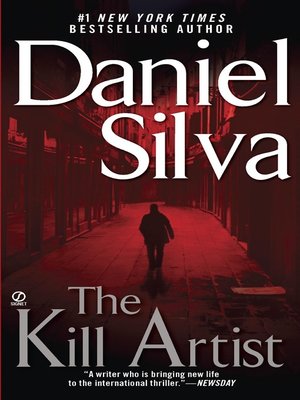
The Kill Artist by Daniel Silva – Book

The Kill Artist by Daniel Silva- big OverDrive

I finally managed to find the first book in the Gabriel Allon series, only to find out that this book refers back to three prequels, including one about an operation to avenge the deaths at the Munich Olympics. These books are not in the Allon series but they offer explanations for the events in The Kill Artist which is considered the first book in the series. In 1996, Silva wrote The Unlikely Spy, in 1998 he wrote the Mark of the Assassin, and in 1999, The Marching Season.

The events that caused the death of Gabriel’s son and the maiming of his wife – events that haunt Gabriel’s dreams and inform his current activities, happened because Allon had killed two members of a family of Palestinian terrorists who killed Israeli athletes at the Munich Olympics. Tariq al-Hourani, Gabriel’s target in The Kill Artist, is the man who placed the bomb that blew up Gabriel’s family, as he watched helplessly. Tariq is also a Palestinian, related to the two terrorists killed for their murders in Munich, his car bombing an act of revenge.

(Many readers, sympathetic to the needs of Palestinians, find this plot line unpalatable. It is true that readers of thrillers don’t want to dwell on the Israeli-Palestinian divide. But after these early books, Silva is not always focused on righting wrongs (imagined or real) of Palestinian “terrorists” against Jews. If this was the axe that was ground by the author through every book, his work would not be so popular. Silva chooses to address diverse forms of the terror humans perpetrate against each other.)

Another interesting element to note in Silva’s books is his female characters. They are usually strong, beautiful, and driven by some injustice or injury in their past. Silva creates his spy, Gabriel, who trusts women to be as talented and ruthless as men, given the proper training, and using their existing motivations to exact justice. Although he sometimes sleeps with these talented beauties, they know he doesn’t love them and they know he will not let them be victimized if he can prevent it. These women bear no grudges against the handsome spy who has lost his family, although considering how almost every operation ends, they would, if they knew, probably be less inclined to cooperate.

Tariq al-Hourani is a brutal guy but he is dying. Gabriel uses a woman, born Jewish but raised by a French family; a woman whose parents were murdered by the Nazis at Sobibor. She is Sarah Halévy, but her French name is Jacqueline Delacroix. She has her own reasons to help Gabriel assassinate al-Hourani. Things, as usual, go terribly awry but Gabriel is the one who ends up with a bullet in his chest. This is not really a spoiler because we never wonder if Allon will be hurt, only how it will happen. Roaming around the best bits of Europe with Gabriel Allon is always a nerve-wracking adventure. But this book begins and ends in one of my favorite Gabriel locations, an isolated cottage in Cornwall, England.

Moscow Rules by Daniel Silva – Book

Moscow-Rules-by-Daniel-Silva-big-PIcClick

In Moscow Rules by Daniel Silva, when a Russian journalist dies in the arms of Gabriel Allon, an Israeli operative, at the Basilica in Rome, Gabriel’s highest level friends in the Vatican are not thrilled. Gabriel had a meeting with this, now dead, reporter who had something to tell him. Gabriel is not thrilled either. He was on his honeymoon in Umbria and he does not want any part of this. But it’s a mystery that involves injustice, assassination, and perhaps more; clarion calls that Allon can never fail to answer. Gabriel immediately knows his honeymoon is over.

Ops inside Russia, especially in Moscow, are rarely undertaken by any nation’s spy agency, let alone the Israelis. Moscow plays by its own rules. What is supposed to be a quick in and out excursion, under a false identity, to talk with Olga Sukhova, another journalist, goes badly awry when Gabriel decides to outstay his team. Moscow rules say, “Assume every room is bugged and every telephone monitored. Assume every person you encounter is under opposition control. And don’t look back. You are never completely alone.” And yet he defies his boss and friend Ari Shamron and stays. Guess how that turns out.

In these days when we talk about Russia every day, the information the author gives us about Russia is very familiar to us. Olga tells Gabriel, “To understand Russia today, you must understand the trauma of the nineties. Everything we had, everything we had been told, was swept away. We went from superpower to basket case overnight. Our people lost their life savings, not just once but over and over again. Russians are paternalistic people. They believe in the Orthodox Church, the State, the Tsar. They associate democracy with chaos. Our president… uses words like ‘managed democracy’ and ‘State capitalism’ but they’re just euphemisms for something more sinister, fascism.”

Gabriel’s Russian op does not stay in Russia. He learns that the man our reporters were so worried about is a very wealthy Russian oligarch who is very well guarded. Olga tells Gabriel exactly why this particular oligarch is so dangerous and exactly how he has stepped over a “red line” to pursue a business deal that must be stopped.

In Moscow Rules you can read about the plan Gabriel comes up with to flush him out. Since we know that Gabriel’s plans do not go smoothly, find out how he messes up this time. Find out if his new wife is still speaking to him after he never gets back to the honeymoon. It’s a very satisfying Gabriel Allon book. It has all the characteristic parts of the pattern readers expect when they throw in their lot with the Israeli Secret Service and their painterly operative, who manages, despite the powerful people he chases down, to get some of the worst players off the world  stage. I think you will find that it also resonates with the situation we find ourselves in today, vis a vis Russia. Serendipity.

The Messenger by Daniel Silva – Book

The Messenger horz you tube big

I seem to have summer fever. Instead of reading nonfiction with serious content, I have wandered back to lighter fare. Since I am of the firm conviction that even fiction that entertains is not necessarily cheerful and may even encompass some social commentary, my idea of a frivolous summer book may not be the same as yours. I often click on lists of summer reading suggestions that other people love to post online and their choices almost never conform with mine.

I had previously read two books by Daniel Silva in the Gabriel Allon series. I decided to try to finish up that series this summer. What I discovered is that there are 17 books in this series so far. Silva has written one a year since 2000, only missing 2001 and 2012. It was my idea to read them in order but I am finding that that is difficult if I want to use the library, so out-of-order it is. I will include a list of all 17 books at the end of this post, however. The Messenger was first on my summer agenda. A few words about Gabriel Allon. Mr. Allon may be a stone killer when necessary but he never kills without good reason. He is a good guy, a rescuer, a green-eyed weapon trained by the Israeli Secret Service at King Saul Boulevard and he is at the peak of his talents. He might have been a world class painter if he had not been recruited by his mentor Shamron. Instead he is a first class restorer of famous paintings when he is not following up on intel about some criminal who intends to wreak havoc on whatever part of the world that the miscreant perceives as an enemy.

The villain in The Messenger is a terrorist behind the 9/11 attacks on the World Trade Center and a man who has managed to stay hidden in plain sight by changing his appearance (which has rarely been glimpsed and almost never photographed) and by being under the protection of the very rich Zizi al-Bakari, who funds terrorists but has never been caught at it. Gabriel hates terrorists and, even when he promises his wife he will not get involved he cannot help himself. Gabriel has a whole team of operatives who we also get to know, although not in any great detail. In this particular book we meet Sarah, an American girl who lost her fiancé on 9/11. Sarah has a degree in art and she is no trained operative but she agrees to take part in this plan to catch Zizi and the terrorist he hides. Gabriel’s team is not on board with using Sarah in this dangerous op.

Gabriel’s plans are often quite audacious because the people he is after are so good at evading capture. His plans often center around what he knows best, famous works of art. And Gabriel’s plans almost never go smoothly. They go awry in often spectacular fashion and people get hurt and they die. Gabriel takes a beating in every one of these adventures in keeping the world safe from really bad guys that I have read so far. Sometimes he is not even completely recovered from the last op before it is time for a new one, but he is no bruiser. He is a thin guy approaching middle age who strikes people he meets as very sincere and serious, and who relies on guns more often than his fists. He’s likable but it’s hard to pin down why. When each plan goes off the rails and Gabriel is roughed-up or nearly killed once again I get angry at him for being unable to plan and execute a perfect op. However it is good to see someone who is human in scale beat some of the super bad actors that Gabriel pursues and he always wins in the end, although he never gets much credit. Governments are happy with his results but not with the chaos and mayhem that precedes the rough justice. Gabriel is not a rule follower and that is why he is always in trouble.

2000  The Kill Artist

2002  The English Assassin

2003  The Confessor

2004  A Death in Venice

2005  Prince of Fire

2006  The Messenger

2007  The Secret Servant

2008  Moscow Rules

2009  The Defector

2010  The Rembrandt Affair

2011  The Fallen Angel

2013  The English Girl

2014  The Heist

2015  The English Spy

2016  The Black Widow

2017  House of Spies

2018  The Other Woman

The Orphan Master’s Son by Adam Johnson – Book

01-The-Orphan-Masters-Son big pulitizer prize edition guide

In Adam Johnson’s book The Orphan Master’s Son, winner of the Pulitzer Prize in 2013, you immerse yourself in the North Korea of Kim Jong-Il. You will often want to leave but, as awful as the story is, it is fascinating as well. Adam Johnson did not grow up in North Korea or have any special knowledge of North Korea. He had a grant, and he used his time to read all the best books on the matter. He reads his essay about this to us at the end of the Audible version of this book. He tells us that while this research gave plenty of detail about Korean principles of economics, farming, militarism, and governing, there was little in these references about the people of North Korea. So the book is fiction. The people are characters Johnson has created. How close to the realities of life in North Korea this novel comes I cannot say, but there are defectors from North Korea and yet there have been no denouncements of the general truthfulness of this book. It seems that readers can put some faith in the descriptions of the fear we suspect lies at the heart of this strange, secretive nation.

We meet Pak Jun Do, reared in Long Tomorrows with the orphans, but not actually an orphan. He is the son of the Orphan Master and a beautiful singer who is taken away to the capital to serve the Dear Leader. Jun Do seems to have a lucky life for a while, avoiding assignment to hard labor, or being sent to a prison camp. He is taught English. He listens on a radio aboard a fishing boat, the Junma, he is chosen, as a hero of the people (a lie) to go to Texas with a group of North Koreans, perhaps because he speaks English. He goes to Japan (to kidnap Japanese people to bring to North Korea). He travels to South Korea to kidnap an opera singer for the Dear Leader. Why doesn’t he ever defect, we wonder. There is more. He has been tattooed with the image of the lovely Sun Moon, Kim Jong-Il’s favorite actress. She was stolen from the Dear Leader by the ferocious martial arts champion Commander Ga.

Jun Do loses his lucky life (or gets really lucky) when he ends up killing Commander Ga and when Kim Jong-Il makes him the new Commander Ga, replacement husband to Sun Moon. His Captain on the Junmaonce said to him, “It’s not because no one ever taught you about a family and sacrifice and doing whatever it takes to protect your own.” He reminds Jun Do that the Captain and crew are his family. When he is assigned a real family we will see what sacrifices he is willing to make.

For some unknown reason we find that Jun Do as Commander Ga is also in a prison interrogation unit and we hear this part of his story in flashbacks and flashforwards. How did he get there? What happened to his luck? Did love make the difference?

Every day in Pyongyang and throughout N. Korea loudspeakers give encouragement and tell pretty lies to Koreans. The speaker also tells each day a new installment in the best story of the year. This year they are telling the love story of Commander Ga and Sun Moon – not the real one – the Dear Leader approved one.

“Citizens, we bring good news! In your kitchens, in your offices, on your factory floors – wherever you hear this broadcast, turn up the volume! The first success we have to report is that our Grass into Meat Campaign is a complete triumph. Still, more soil needs to be hauled to the rooftops, so all housing-block managers are instructed to schedule extra motivation meetings. …Finally, the first installment of this year’s Best North Korea Story begins today. Close your eyes and picture for a moment our national actress Sun Moon. Banish from your minds the foolish stories and gossip that have lately swirled our city about her. Picture her the way she will live forever in our national consciousness.” (pg. 218)  On Audible these announcements are read in a voice that is perfect for the role.


We meet Jun Do’s/Commander Ga’s interrogator. He is a creature more typical of North Korea, determined to do his assigned job of producing “biographies”/confessions from his subjects to file in the “library” and hooking subjects up to the autopilot (now that lobotomies are out of style) for electric shock treatments. He is opposed by the old-school pubyok (pu-bi-oks) who are more thuggish and who learned to perform lobotomies with #20 nails. They laugh at the idea of biographies and make our unnamed interrogator’s life complicated. Cans of peaches play a big role in the dark side of Johnson’s story.

The Orphan Master’s Son is a detailed and layered story of a place run by a truly pathological (bipolar) autocrat, where life has no stability, no predictability, and no sweetness (except for one lucky Orphan Master’s son). It would be poignant but we are not allowed to dwell on that. It would be horrific, but we are not allowed to dwell on that either. It was strange to read this novel at a moment in time when the newest Dear Leader is trying to rejoin the community of nations. It’s a novel, but it speaks to everything we suspect about the “Hermit Kingdom.” Perhaps it will be disappearing forever. We can only hope.

Ready Player One by Ernest Cline – Book


Ready Player One horz Good e-Reader

Yes, Ready Player One by Ernest Cline is a YA novel, but why should kids have all the fun? Here we have a Steve-Jobs-type, James Donovan Halliday, and a Woz (Steve Wozniak) type, Ogden Morrow. We have an America that has disintegrated into poverty for most people. In fact the world is so gritty, gray and depressing that most people spend a good part of their days in the VR (virtual reality) world created by Halliday, a world called the OASIS.

We visit the OASIS with Parzival (the avatar of Wade Owen Watts) and we meet his best friend Aech (H). We also visit Wade in the real world where he lives in a mobile home parked by a crane in the “stacks” outside of Oklahoma City. He also has found an intact van buried in a car junkyard where he gets away from his Aunt Alice’s cranky boyfriend. He attends a VR high school in the OASIS.

Ernest Cline has enshrined in this novel the pop computer/movie culture of the 80’s. This is a nerd book, but one that can still be enjoyed by those of us who are not so nerdy. Parzival has memorized the movie War Games, for example, but I also confess to having watched the movie a few too many times.

When Halliday dies he creates a quest, that all in the OASIS can try to win, to determine who will be the heir to his billions and his creation. This quest is at the heart of this story. It involves challenges, deep knowledge of the computer games and movies of the 80’s, and takes us across much of the “landscape” of the OASIS. James Halliday was socially awkward, perhaps on the autism spectrum. His friend Og wins the woman Halliday was in love with. This drives a wedge between these two friends. There is a love interest for Parzival in the form of Art3mis and there are plenty of villains under an arch-villain Nolan Sorrento and his company the IOI.

This book can be devoured in one afternoon which is something I rarely experience these days. I found it thoroughly entertaining, full of “easter eggs” (read the book), and with a light running commentary on the ways that VR and AI (artificial intelligence) may affect the social aspects of societies if we are not careful. You can find critiques of this novel as a literary endeavor but I see no reason to be quite so adult and judgmental about it. I enjoyed the book enough to go see the movie (in RPX). The book, for me, was better than the movie.

If you want the in-depth nerd skinny you might enjoy this article:

http://readyplayerone.wikia.com/wiki/Ready_Player_One


How Democracies Die by Levitsky and Ziblatt – Book

How democracies die big Chicago Humanities Festival

Steven Levitsky and Daniel Ziblatt wrote How Democracies Die. They were challenged to complete this book project by their agent Jill Kneerim. They did so with help from their student research assistants who are listed in the acknowledgments. It is a book that tries to analyze how much danger we are in of losing our democracy at this current moment in time. It begins with a story about Benito Mussolini and ends with references to the goings-on in the Trump/Republican administration, the 2016 primaries, and in the campaign of 2016. In the middle the authors look at a number of “political outsiders” who “came into power from the inside via elections or alliances with powerful political figures.” They take us through the rise of Adolf Hitler, Getúlio Vargas in Brazil, Alberto Fujimori in Peru and Hugo Chavez in Venezuela. They say, “in each instance, elites believed the invitation to power would containthe outsider, leading to a restoration of control by mainstream politicians. But their plans backfired. A lethal mix of ambition, fear, and miscalculation conspired to lead them to the same fateful mistake: willingly handing over the keys of power to an autocrat-in-the-making.”

Although the authors remind us that America has had no shortage of authoritarian personalities in politics we also, they explain, have had “gatekeepers”, first in the form of powerful men in smoke-filled rooms and later in the form of political parties, conventions and the electoral college which kept authoritarianism in check, possibly with the sacrifice of some of the “will of the people”. They go on to explain that the primary system opened elections up to “outsiders” who had not come up from the ranks of government. Two factors weakened the gatekeepers, one being the availability of outside money (Citizen’s United) and two being the “explosion of alternative media”. “It was like a game of Russian roulette: The chances of an extremist outsider capturing the presidential nomination were higher than ever before in history.”

There were signs as early as the primaries that Trump might represent dangers for our democratic government.

  1. He would not say whether he would accept the results of the election
  2. He denied the legitimacy of his opponents
  3. He show a tolerance for and encouragement of violence
  4. He exhibited a readiness to curtail civil liberties of rivals and critics

The authors tell us that “No other major presidential candidate in modern U.S. history, including Nixon, has demonstrated such a weak public commitment to constitutional rights and democratic norms.” They offer evidence for each point they make. They also say that Republicans closed ranks behind Trump and normalized the election results.

Throughout their interesting and well-researched book we are shown examples of instances when outsiders have gradually and, sometimes, almost invisibly, sometimes rather violently taken the reins of power from the “referees” such as the courts, or the congresses of government, bought off their opponents, subverted the media, and have ended up with absolute control, thus ending a democracy. We can see where the authors are headed. They want to warn us that our democracy also could die such a death, just sliding into authoritarianism one baby step at a time. Here we look at Erdogan in Turkey and the Orbán government in Hungary and many more.

“Even well-designed constitutions cannot, by themselves, guarantee democracy,” say the authors. Successful democracies rely on informal rules, they add. “Two norms stand out as fundamental to a functioning democracy: mutual toleration and institutional forbearance.” The rest of the book shows us how these two norms are no longer functioning or are being eroded. In the end they explore our possible futures under Trump, but even if he is not the one who destroys our democracy it seems as if it has never been more threatened and it is good time to have a blueprint of what cues we should look for. Knowing when to put on the brakes or when the brakes will no longer functions could be very important either in the near or the more distant future.

Although this book seems scholarly and is constructed according to academic principles it is very readable. The language is not at all obscure and the examples of other nations who have lost their democratic government to a dictatorial government are interesting with easy-to-draw parallels. How Democracies Die should, perhaps, be required reading given where we find ourselves right now in America. It is the very best kind of thriller, the real kind.

An American Marriage by Tayari Jones – Book


An American Marriage horz. Parnassus books big

Oprah chooses book club books that explore social and cultural issues, sometimes very graphic abuses. Her choices can be quite literary and even somewhat gritty. I have not always kept up with Oprah’s book choices because I have my own lists that I can never seem to keep up with, but I did decide to read her latest choice, An American Marriage by Tayari Jones. We meet Roy Othaniel Hamilton in the first chapter and right away his language patterns make him unique and interesting. In the next chapter we meet his wife Celestial (nicknamed Georgia). Roy comes from a country family, not farmers, but a family from a small rural town in Louisiana. Celestial grew up in Atlanta, Georgia in a more upscale family, although her parents have divorced and her father has married the woman he was having an affair with. Both Roy and Celestial have attended classic African American colleges, Morehouse and Spelman. They meet through Celestial’s friend, and neighbor since childhood, Andre.

These two are only married for moments (about one year) before something awful drives them apart, something that is terrible because it is so racist and unexpected. Although this might happen to a white couple the odds against it are astronomical. However, if even one person in a marriage is black this can and does still happen in America. Roy is accused of raping a woman at a motel where he is staying with Georgia. His wife knows he is not guilty because they were together all night but the woman is so emotional and so certain that he is the one that he is sentenced to twelve years in prison.

Celestial has a career, she has a way to survive. At first she writes Roy every day and sees him as often as possible. But life happens. She makes sure he has money in his prison account and an uncle works on Roy’s appeal. When Roy gets out of prison after only five years, Celestial has already moved on but has not told Roy because she is so conflicted about it. There are some very emotional moments when Roy is released from prison that I cannot tell you about.

Although this book speaks to the dynamic in a marriage especially when a geographical separation takes place in a marriage, it also speaks to the overwhelming imbalance between incarceration for Americans of African Descent and other Americans. It is entirely possible that this is something many marriages in the black community have to deal with. The book doesn’t make a big deal of this demographic anomaly, but if you are aware of it then it is there in the back of your mind.

An American Marriage is much more than a classic novel about a marriage. It does not push the issue of racism, but it’s in there. It doesn’t push the fear that many people of color carry with them that they could be falsely arrested or even killed just for being black, but we feel it. It doesn’t go into detail about the way law enforcers sometimes go nuts if they think a black man has committed a crime against a white woman (in fact we do not even know for sure if the woman at the motel is white) but we are witnesses to it.

However Tayari Jones’ novel also stands as a story about a man and a woman and a marriage. In this sense it can be read at more than one level. So if you tend to avoid fiction that is loosely disguised social commentary you don’t have to eliminate An American Marriage by Tayari Jones. I believe that most likely you will enjoy it as much as any other offbeat love story.

Still I don’t think Oprah chose it because it is just a uniquely American love story, or a uniquely modern love story. It should shock us all that what happened to Roy and Celestial is still a thing that could happen in America in the 21stcentury, along with other racist actions perpetrated in the name of law and order but having little to do with the subject. It will be very telling when a romance between people of color does not need to come with an undercurrent of social injustice, if that ever happens.

Leonardo Da Vinci by Walter Isaacson – Book

Leonardo horiz big the Malta Independent

If your eyes and heart were opened to a whole new world filled with oil paints, and tempura, gouache, symbolism, and the subject matter of artists you were probably in your first art history class. It was a revelation that you could watch slides and listen to a professor speak about them and come away with a head full of images that lit up your mind, slapped a smile on your face and made you long for the great museums of NYC and Paris.

This is the place that Walter Isaacson takes you to in his book Leonardo Da Vinci. He puts us back in that art history class as he walks us through the details of Da Vinci’s paintings. There are color plates (even on a Kindle).

However, Leonardo was not first and foremost a painter, although that is certainly one way we remember him. After all, he did paint the Last Supper and the Mona Lisa. Leonardo, it seems, was not in love with painting and left many works unfinished. His mind saw all the components of the physical world that needed to be comprehended at great depth in order to make someone a great artist. He spent years dissecting cadavers and made exquisitely detailed anatomy drawings. He wanted to see inside eyes, brains, hearts and he drew very sophisticated conclusions about how bodies work. He studied rocks, birds (to learn about flight) and, in excruciating detail, the movements of water. He studied optics and perspective.

Yes, all of these things relate to art, but they relate even more to physics and engineering. I will leave it to Isaacson to tell you some of the other unique things Da Vinci wanted to know. Leonardo also loved theatrics and building machines for special dramatic effects. In this way he entertained kings and rulers and participated socially in the entertainments of the times, while always searching for a patron to help support his activities, his household, and the students who came to work in his workshop. He was not wealthy, being the illegitimate son of a notary.

Sadly for us, Leonardo was so often enticed by ever newer areas of exploration that he never published his enormous treasure trove of notebooks and he left it to others to receive credit for his discoveries. Perhaps it was because he was left handed and all his notations were made in mirror writing (he wrote from right to left). The idea of ancient aliens who came to earth when men were still quite primitive is now the subject of the Ancient Aliens television series, but I remember running across it years ago. Several times as I read about Da Vinci I thought he might be a distant offspring of such a technologically advanced alien visitor. Walter Isaacson is a true academic though and he said no such thing. He does not deal in conjecture and gives attributions for almost every point he makes in a fairly extensive set of footnotes at the end to the text. There is also a useful index to take you back to sections you want to review.

Isaacson is both a biographer and an art critic, as well as a fan of Leonardo and his book is not at all difficult to read. He doesn’t get bogged down in academia and he clearly wants us to share his admiration for Leonardo Da Vinci. It is a book to read in quiet moments with a nice cup of something warm or on a park bench with your bottled water while taking a break in your daily walk. A chance to dawdle in the 14th and 15th century as Leonardo pursues his life and his art, while wandering Italian towns in his rose colored robes, is the gift that Walter Isaacson gives us.