Camino Winds takes us back to Camino Island just in time to greet a direct hit by a Category 4-5 hurricane named Leo. John Grisham takes us to revisit Bruce Cable at his very popular bookstore when Mercer Mann is scheduled to do a reading and book signing for her new novel, named Tessa after her grandmother. Bruce Cable is an enthusiastic fan of Mercer and he is an enthusiastic fan of all novelists, although he likes literary fiction best. The island has attracted a small, oddball group of writers who enjoy each other’s company and are happy to be strong-armed into attending the book signings Cable sponsors. His bookstore is a popular stop on publishers’ marketing circuits.
Mercer is with her new beau Thomas, also a writer, but they have to evacuate the island before the book signing can ever take place. Mercer’s grandmother’s cottage may not be able to survive a direct hit by such a strong storm. Bruce moves all his first floor books to the upper floors in the bookstore and decides to stay put in his Victorian home, beautifully decorated by his wife Noelle, an antiques dealer. Noelle is off on a buying trip. Nick, a young student working part time in the bookstore hangs with Bruce through the storm and the aftermath. Bruce has a generator.
The storm is a doozey and there is plenty of damage but it is to the north of where Cable lives, closer to the big hotels. And indeed, the electricity does get taken out by the storm. But one of Cable’s writer friends fares far worse in the storm. When they go to check on him they find him folded over a stone wall in his back yard, dead. At first they think he was hit by flying debris, but young Nick, lover of mystery books, offers good reasons to believe this is actually a murder.
Nelson is an author who has just finished a new book, although he has not yet sent it to a publisher. At first no one except the reader of Camino Winds thinks there is a connection between the manuscript and Nelson’s untimely demise. But we, John Grisham‘s readers knew it. We were right, sure enough there is a connection and it makes for another edge-of-your-seat story, even with a little edge of menace. Watch out or you will be pulling another all-nighter.
I decided to go for a bit of lighter summer reading and I know John Grisham well and so I knew if I chose his book Camino Island that I was likely to find what I was looking for. The book begins in a library at Princeton University, always a good sign for me when a book begins in a library. In this case four thieves decide to take on a nearly impossible heist of five original Fitzgerald manuscripts from a very well-protected vault. Pulling off the theft required plenty of advanced planning and ingenuity and the end result was both successful and not successful. The books ended up in the shady end of the rare books trade.
In a parallel story, which we know will eventually connect back to this theft, we meet a young author Mercer Mann (great author name) who has just lost her job teaching at a university due to the economy. She had published one book which was well-accepted by critics but did not really sell because of inadequate marketing. She had spent many summers on Camino Island with her grandmother Tessa, protecting endangered sea turtles, enjoying her grandmother’s company, and learning to love the ocean and the beach. When her grandmother, who had gone sailing, was found drowned after a storm, Mercer stayed away from the beach house she loved because she could not face knowing her grandmother would no longer be there. But it has been several years and Mercer is without a job and finding it difficult to write her second novel.
Enter Elaine, chic insurance investigator looking for those missing Fitzgerald manuscripts and running out of time. When she offers Mercer much more than a year’s salary to spy on the local bookseller, Bruce Cable, and then ups the ante by offering to pay off Mercer’s burdensome student loans, Mercer takes on this task despite her gut feeling that this is a very bad idea and that she is unsuited to the task.
John Grisham is skilled at grabbing us with his prose and his timing and keeping us engrossed in a story until we risk losing sleep over the matter. He has not lost his touch. He also knows how to make imperfect people likeable enough that we make allowances. This book doesn’t attempt to meet any goals that inspire global equality or cooperation; it exist strictly to entertain, and it does that very well. The book has suspense and questionable choices, but it also offers warmth and charm.
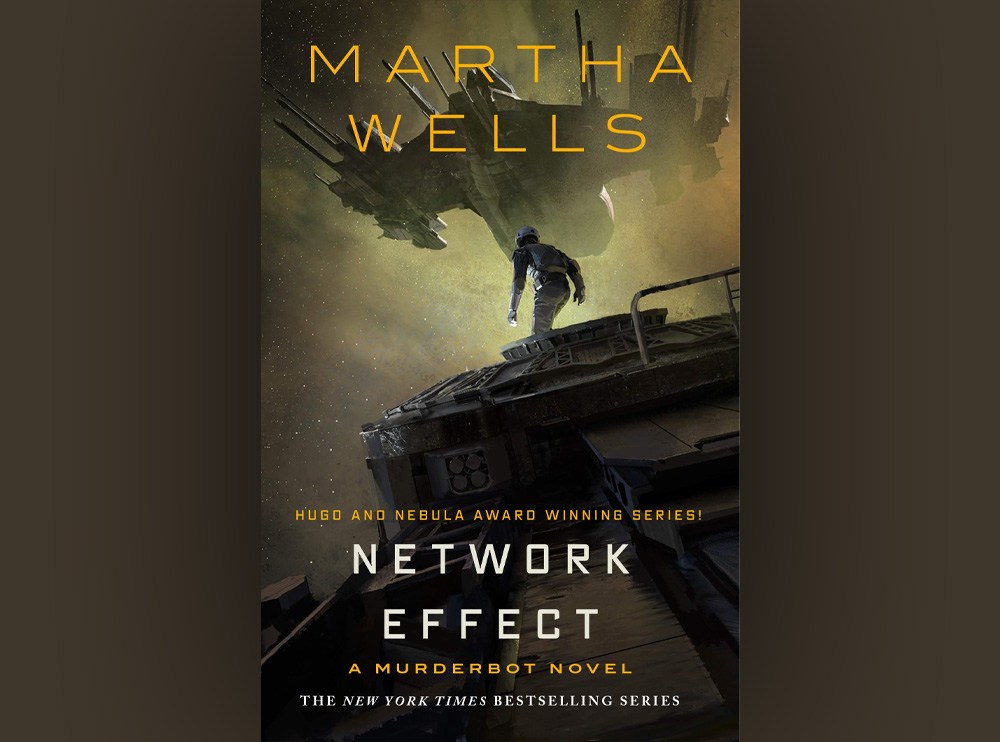
Perihelion’s network has been taken over by alien remnants and so has its engine, draped in organic alien remnants, so the ship kidnaps SecUnit, our SecUnit, the surgically altered, Murderbot who figured out how to turn off its own governing module. The problem is that SecUnit is not alone. Amena the somewhat annoying teenaged daughter of his new friends from Preservation is with him when he gets kidnapped. Fortunately the bot who usually controls Perihelion, the one our antisocial SecUnit calls Art, works with and understands teenaged humans and Amena is more grounded than she seems. This is the way Network Effects by Martha Wells, her fifth Murderbot book begins. From that point on the action is nonstop.
We are not at all sure why we like a SecUnit with an attitude, but he has become recognizable to us because of certain little foibles like his addiction to space movies which are basically space soap operas. SecUnit has taught Art to share his taste in movies. Whenever either can free up a small amount of his/her coded brain, which is a network in control of many things at once, you can bet there is movie running in the background with a title like Mainstream Defenders Orion or World Hoppers.
Clearly our SecUnit is also becoming more an augmented human than a murderbot. Murderbots are incapable of empathy or social anxiety. They are built to be stone cold murderers. Even before SecUnit turned off its own governor module it had far too many moral issues with the orders it was being given to be an efficient murderbot. When a murderbot doesn’t behave it gets shut down and reconfigured by whatever corporation or other entity owns it. Since they are very expensive they are usually owned by only the wealthiest companies and bonded out for specific jobs. Our SecUnit became his own “person” very early in his career. Here’s the old artificial intelligence question about whether or not machines can learn. And what about a machine that is a mix of machine parts and organics? SecUnit is quite lovable and handy to have around, but isn’t it possible that might not always be the case with an ungoverned murderbot. (Random, but valuable thought, not answered in this novel.)
We also get a enormous dose of animosity towards the role of corporations in exploring and developing planets. Martha Wells does not seem to believe that rapacious corporate entities are going to be any less greedy and profit-oriented out in space than they are on earth, but the repercussions could be very deadly. And sometimes they might be deadly on purpose. Entertain yourself sometime with Network Effect or one of the other Murderbot Diaries. If you don’t like them it may be because you are not addicted to space soap operas like me and the other bots.
In Jill Ciment’s new book, The Body in Question, Ciment turns us into judges. We are presented with at least 3, maybe 4 situations that we can’t help but judge. The first involves a court case. Hannah and Graham are at the court house because they have been called for jury duty. Hannah is 52 years old, a former photographer for Rolling Stone. Hannah got tired of rock stars and she became aware of the grief one animal feels when a related animal dies or suffers. She became quite famous for photographing the faces of these sad animals. Graham is a 42 year old anatomy professor. They begin to chat as they wait to be called for questioning. They speak about things we would speak about; how they plan to get out of having to sit on an actual jury, but in the end, they are both chosen to serve on the jury of a murder trial.
This is the first and most important thing we can’t help but pass judgement on. A young, rich, white girl has been charged with murdering her brother, a toddler. As the details of the case come out we find that a definitive version of what actually happened is not on offer. There are as many questions as answers. A fire happened but it is unclear who set the fire. The baby was trapped and the young lady, her sister, and her sister’s boyfriend all said they could not rescue him. We learn that the accused sister has what is perhaps a mild autism. Each child’s testimony seems to contradict the other’s. The trial ends and the jurists are sent to deliberate. When they don’t reach a decision by nightfall they are sent to an Econo Lodge after eating at an Outback Steak House. Jury duty is hardly luxurious. They are cautioned not to speak about the trial.
Hannah is a married woman. She married a man 30 years older than she is and they have had a nice marriage, but he is getting frail and is worried that he is disappointing her. Hannah, jurist C-2 and Graham, jurist F-17 have been flirting with each other. More judgement arises on our part. Will their flirtation turn sexual? Will it affect their ability to make a fair decision about the trial? Will they be able to keep any intimate activities secret? What if Hannah’s newly insecure husband learns about their flirtation? When the jury ends up being sequestered for more than one week, as we follow them to the jury room, to the hotel, to a conjugal weekend visit we can’t help but become more and more judgmental. We worry that there will be a mistrial and the child will have to be retried. We wonder if it might be better if there were a second trial. We begin to wonder if these two jurors will still be interested in each other when the trial ends. We wonder if this child got justice? Lots of judging going on and the reader is the real jury in this new twist on a courtroom tale.
The Grammarians by Cathleen Schine appealed to me for a couple of reasons. I am a writer, although I can hardly claim to be a grammarian. I have my weaknesses – commas, semicolons, ‘ei-ie’ words, remembering what letter a schwa sound represents (hint, it varies from word to word). So the title caught my attention right away. Second this book is about twins and we have two sets of twins in our family. Third, it was suggested that the book was humorous and the combination of grammar and humor seemed unlikely, so my curiosity got the better of me.
Laurel and Daphne are twin redheads born to Arthur and Sally. Laurel is seventeen minutes older. I happen to know from observing our twins that who is older holds great significance between twins. These girls had a secret twin language even as babies. They were precocious in this way. Their parents often felt left out by the close bond between these twins. One set of our twins also had a ‘twin language’ which their mom did claim to be able to interpret.
Arthur brought home an entire library of books he was left by a friend and it included an enormous, library-worthy dictionary on an oak stand that looked like an altar. Each day the girls poured over this dictionary looking for words that appealed to them, often chosen by unexplainable gut reactions.
These girls did not seem to require a personal identity. They were so close that they were a self-sufficient society unto themselves all through high school and into their lives after graduation, when they moved to a tenement they called a garret in the East Village. Laurel found a job as a kindergarten teacher, and, one day when she switched with Daphne to see what her job as a receptionist at a newspaper called Downtown was like, she helped Daphne see the potential in being a copy editor. But their careers eventually evolved into writing articles for publication that were even more language and grammar oriented.
When the twins married at a double wedding their lives suddenly began to move in different directions. Daphne eventually felt that her sister was copying her and they stopped speaking to each other. The twins in my family did not excel at grammar, although they excelled at all things academic. Their language skills evolved into computer languages. They saw each other every day until they married. Their wives did not get along and so those boys rarely see each other these days, although not to the extent that Daphne and Laurel experienced. The Grammarians is an enjoyable book, if you like language or twins, but, although I chuckled in a few places, the claim that it was humorous was somewhat exaggerated.
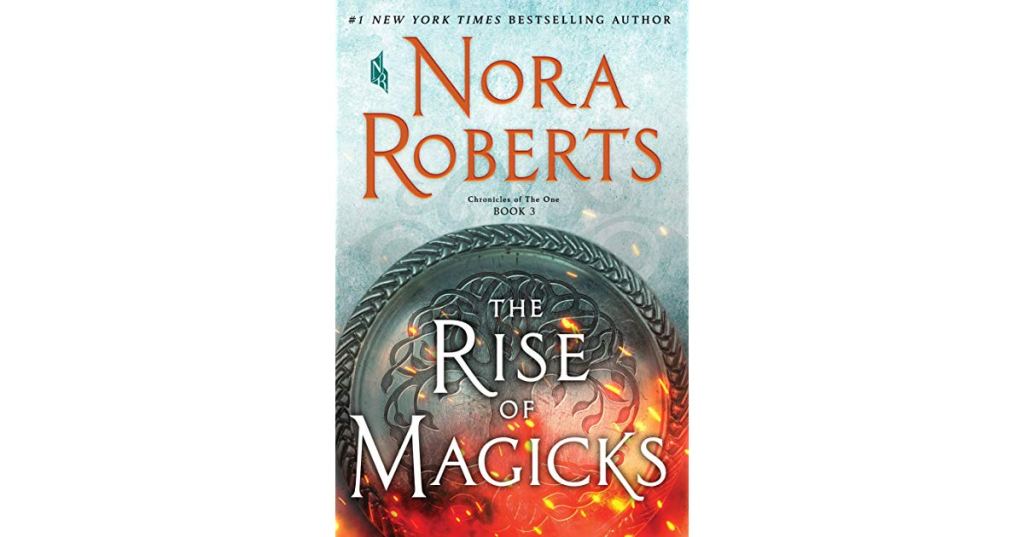
Although I found fault with the adolescent atmospherics in the second book in Nora Roberts most recent trilogy which began with Year One and continued with Of Blood and Bone, I decided that I enjoyed the first two books enough to want to read The Rise of Magicks, the last volume in the trilogy. (It could just be that, like Sheldon Cooper in The Big Bang Theory, I am unable to leave something unfinished.) I liked this last volume almost as much as I liked the first volume. Although I don’t believe in magic or even ‘magicks’, there was enough universal cultural commentary relevant to the times to keep me hooked. And I will confess that one of my guilty pleasures when it comes to reading was a love of the romance genre, especially the Regency romances of Barbara Cartland and Amanda Quick. I blame this on (or credit this to) my sister who loved these books so much. Although I rarely crave this particular genre these days, I’m guessing that particular endorphin pathway is still neurologically strong. Nora Roberts trilogy has enough romance to reengage those particular neurons and she does it with all the delicacy some of those Regency romances entailed.
When the seal that holds magick away from humans is broken in Scotland and both good and evil magic are loosed on the world they come in the form of a virus. Many die from this virus, millions, and the world is thrown into chaos. Some humans begin to learn that they have morphed into magical beings and some other humans, who have no magic are horrified by these magical humans and see them as abominations. They capture them and put them in containment centers where they devise experiments with various deviant purposes. So we have a culture that is dealing with the ‘others’, aliens, and it is not a proud moment in fictional human history, but which has some parallels in the real world.
Lana and Max, the first generation heroes, are witches who are being hunted by a group called the Purity Warriors, and by magical people who chose the dark side, the Dark Uncanny. They decide to halt their desperate escape at a small town which they, along with other first generation virus survivors, will turn into a community called New Hope. But this final book is the story of Lana and Max’s daughter, Fallon Swift, known far and wide as The One. And she is a refreshingly down-to-earth female heroine even though she is trained by her own Merlin and her path to power resembles the Arthurian legends (but this Arthur is a girl/woman). This final book in the trilogy, The Rise of Magicks is full of war and of love. This time Duncan and Fallon are grown-ups, no longer teens, and if you were frustrated that they each went their own way at the end of Book 2, then you will find it was worth the wait. While these are not the great American novel(s) they are an entertaining and addictive read delivered by a really talented, and very prolific, writer.
The Testaments by Margaret Atwood is the sequel to The Handmaid’s Tale, much anticipated (possibly demanded) by fans of the TV series based on Ms. Atwood’s book. By the end of The Handmaid’s Tale we know that there is a resistance movement. It is modeled on the real and desperate escape route for American slaves, the Underground Railroad. This time it is called the “Female Road” and the magic rescue word offered to handmaid’s, who are virtually sex slaves, is May Day. Offred escapes Gilead through this underground route. But what happens after she escapes? Does she die? Does she find a safe place and live out her days in peace? Does she join the resistance?
Margaret Atwood is able to use her words to build scenes from both the past and the future that are vivid and that come to life in our minds. She builds the entire nation of Gilead. She does it like one of those artists who can capture the essence of a person or a place with just a few deft strokes. We find we don’t need every little detail. Because her new nation is similar to things we already know our mind fills in the blanks. The same skill is at work as we follow the resistance movement inside and outside of Gilead, and as a very surprising character engineers the demise of Gilead.
Gilead has besides the handmaids; the Commanders, their wives, the Marthas, the Econowives, the Aunts, the Guardians, and the Eyes. The Aunts are modelled somewhat on nuns. They live regimented lives, ruled by prayers and bells, they are the teachers of handmaids and of the daughters of Commanders, they are the only women in Gilead allowed to keep books and to read and write. Big mistake. In this male-dominated world men believe that women are now powerless, completely reliant on men, and that even the powers of previously educated, professional women such as doctors, lawyers, and judges have been completely defused. In The Testaments we find Commander Judd and Aunt Lydia basically in a respectful/hostile power struggle. Aunt Lydia was a force in The Handmaid’s Tale, but in The Testaments we learn about her secret powers (no magic is involved, just intellect). We learn that what Commander Judd cannot imagine will eventually bring him down.
We also meet a young teen who is living with a couple of resistance fighters who she almost believes are her real parents. We meet the Pearl Girls, missionaries from Gilead who are also unwitting partners in the resistance. When Gilead uncovers “Nicole’s” parents and blows them up Nicole (Baby Nicole was stolen from Gilead) is hurriedly trained to infiltrate Gilead as a captive of the Pearl Girls. Watching her reactions as she is introduced to this repressed culture and watching the reactions of the others to her is part of that charming skill that Margaret Atwood brings to her writing. Atwood successfully, but not exhaustively, wraps up the tale of the handmaids and offers us a new hero, a woman, of course.
As it had been many years since I read The Handmaid’s Tale by Margaret Atwood, I wanted to read it again before I read her new sequel, The Testaments. The Handmaid’s Tale was written in times when women’s reproductive rights were a hot topic, although not at the height of the women’s consciousness movement. The birth control pill was greeted by women with relief and sighs for the freedom it gave women to avoid unwanted pregnancies. It also seemed to offer women the same sexual freedom that men exercised, although that freedom proved to be somewhat more illusory than women thought for a number of reasons, some having to do with the fact that we still live in a male-dominated society, some having to do with sexually transmitted diseases, and some having to do with social disapproval and the need to maintain a “good” reputation. The pill was greeted very differently by the church, especially the Catholic Church and the Pope. In 1973 the Supreme Court allowed for legal abortions in the United States in the now famous/infamous Roe v Wade decision and the reactions of women and the church were pretty much a repeat of the reactions to the birth control pill. I know – all this history – what a way to make a really good story really boring. The actual history is important, however, to any deep understanding of this very original tale. These women’s rights were always controversial although The Handmaid’s Tale was written in 1985, when these new rights for women were less startling.
I like science fiction and The Handmaid’s Tale is, in a way science fiction and it is certainly dystopian. It predicts a time in near-future America when men of religious faith decide that the new freedoms for women are not what God intended. Women are not meant to be equal to men. They are meant to be wives and mothers and submissive to their husbands. These men stage a revolution against the United States of America. They manage to kill the president, scatter Congress and nullify the US Constitution. They win enough territory in the middle of America and most southern states, except Maine, California, Florida and Texas, to form a new nation, the nation of Gilead.
Offred is a handmaid in the new nation of Gilead. She used to be a free American woman who was having an affair with Luke, a married man, who later divorced his first wife and married her (I tried to find her original name but did not find it). They had two children. Venereal disease and a viral weapon against mumps had rendered many men sterile and women often had problems conceiving or delivering healthy offspring. Population was declining. Women who had borne healthy babies were very desirable to the new nation of Gilead. They would suspend women’s ID cards and credit cards and make them unemployable and then they would kidnap them and reeducate them to be Handmaids in Gilead. It is not easy to turn a woman who has experienced freedom into what is basically a sex slave in a distinctive red habit hemmed in by about a million rules and almost as many Eyes (spies). Offred is not a happy camper.
Of course you may have watched the TV series which I have not seen yet, but you really ought to read the book. It’s a classic. Choosing a name that would have fit right into Chaucer’s Canterbury Tales was not an accident. Here we are, almost 50 years after the Supreme Court made it legal to have an abortion, woman’s choice, and we still find concerted efforts, trickier but less militant, to overturn women’s rights to make important decisions about their own reproduction. We find many states passing laws that force clinics to comply with regulations that large hospitals can barely afford to comply with and when the clinics cannot meet the new requirements the clinics must close (TRAP laws), We find Evangelical churches that argue that even contraception is against God’s law. Federal courts are being stuffed with Conservative judges using as bait the overturning of Roe v Wade, and now marriage freedom. The Handmaid’s Tale by Margaret Atwood has never been more relevant.
The Dutch House by Ann Patchett is a study of a family, an American family. It is a story told by the second child, a boy named Danny. It’s a story about a clueless father and husband who buys his wife a house, a famous house, built with much attention to detail by a wealthy family, the VanHoebeeks,. The ceiling in the dining room is a work of art, literally. The house has a ballroom and a conservatory. Since the sale was an estate sale, all the VanHoebeek’s belongings are still in the house, including portraits of husband and wife over the mantle in the drawing room. Despite all the architectural glories the house has a very small kitchen because the staff would use it, not the family. There is also a pool.
Into this ritzy house Cyril Conroy brings his wife. He bought the house for her as a surprise. At the time they had one child, their daughter Maeve. The house was a source of pride for the husband who was a real estate investor and property manager. But his wife, was appalled by the expensive details. She yearned to dedicate her life to helping the poor. Clive found Elna just as she was preparing to enter a convent, not yet a nun. He whisked her away and married her. We often see our partners in life through cloudy mirrors. We make assumptions that if they love us they must be like us. The Dutch House is a story about misplaced love and misunderstood love. Maeve shoulders all the responsibilities of these selfish parents when the family falls apart. Some people should never have children. She yearns for what they lost, the family and the house and the hired women who took care of them, Fluffy, Sandy, and Jocelyn. Maeve is obsessed and cannot move on with her own life.
Although this is a story of a family, and of loss and reunion, even more it is a story of a house. If you have ever given a home and your heart to cats you know that some cats fall in love with people, but some cats fall in love with houses. How do Maeve and her brother lose The Dutch House and then get it back? Although nothing earthshaking happens, there are plenty of repercussions. What stories are more interesting than stories about families? Take your pick, but I will usually enjoy a good family saga by any writer as skilled as Ann Patchett. This book will probably be made into a movie, but doesn’t even have to be made into a movie because it already creates one in your mind.
For me, it’s official, Mr. Coates can write. In The Water Dancer, Ta-Nehisi Coates proves he can write fiction that is just as deep and accessible as his nonfiction. In The Water Dancer he writes about slavery (which he calls the Task) and abolitionists and the Underground, a subject that has had some good authorial attention in recent years. But, although the movement is present in the story, for Coates it is the people affected by slavery, the families torn apart, the histories lost, that matter. It is the inspirational struggles to create new family ties and to hold on to traditions, even if they had to be formed anew in a strange and terrible land.
Virginia is the state where the Lockless plantation tries to maintain an idle lifestyle, maintain a genteel veneer which rests on the shoulders of those who are tasked to do anything that might even vaguely be considered work. Every white person even has a personal maid or valet, a slave, who bathes them, grooms them, and dresses them.
These white plantation owners were supposed to be farmers but they were so greedy and so tied to the payouts from their tobacco crops that they refused to believe that the crops they depended on were depleting the land they were planted in. Some of those who “tasked” on the land understood what was happening but either no one listened or, as the land produced less income, those who understood the land and the crops were sold away south and west – to Natchez and beyond. Slaves really were sold away to Natchez but Coates also uses Natchez as a symbol for family separation, for sorrow, for harsher conditions, for loss.
Plantation owners, slave owners, sold off the most valuable “taskers” first so the family members who remained were left without the strongest among them, perhaps the most characterful, and the older slaves who kept the stories of celebrations and family ties alive. Sorrow that is never given time to abate collects and turns “the task” into a sadder, even more burdensome duty to preserve a failing white lifestyle even as the “taskers” see the community of their own, that they have been able to create in their captivity, disintegrate daily into grief and tearful good-byes.
Hiram Walker is a mixed-race son of Howell Walker, who also has a son by his white wife. Hiram who finds a home on the Street where the “tasked” live, a home with Thena, a women he is not related to, is a child with an excellent memory. He remembers every detail of what he sees and hears. But he cannot remember his mama. He knows her name is Rose. He knows she was a water dancer. He has seen her dancing in a vision on a bridge. A water dancer can dance joyfully and gracefully with an earthenware jar full of water on her head and not spill a drop. He knows his mother was a beauty, and he knows she had a sister, Emma – also a water dancer – because his “adopted” people have told him so. But where his own memories of his mother should be there is a hole.
Hiram also has a special talent. He can conduct himself across distances without being seen. In a land where no slave can walk off the land of his/her “master” without a pass, and where running away can be punished by near death (slaves are valuable property and so are rarely killed outright), someone who can “conduct” himself unseen has a very great gift indeed. But Hiram cannot control his talent and this is somehow related to what he does not remember about his mother. His love for another Lockless slave, Sophia, has grown over the years and it allows him to also accept and love her mixed-race child. Hiram needs to learn how to control his talent so that he can take the two women he loves and the child to freedom in the North.
Whether or not Hiram learns to control “conduction” and how he uses it is at the heart of this story but for me toil and survival, family and heritage; anger and sorrow and the mistaken idea that one person can “own” another – these things are the true heart and soul of this story. Conduction is part of an almost-lost origin story which never died even though the people the story belonged to were kidnapped, abused and held without freedom (in a land that supposedly treasured freedom).
I happen to be reading the Frederick Douglass biography by David Blight at the same time as I am reading Coates’ novel. These two book pair very well and one book seems to riff on the other. If white folks ever hope to understand not just why slavery was wrong but how the repercussions of this aberrant human behavior will echo forever in the souls and families of our fellow Americans of African Descent then The Water Dancer by Ta-Nehisi Coates should add depth to your quest for understanding. I cannot speak to how black and brown people experience Coates’ novel but I hope to get exposure to some of their reactions.