I love to read. BA from SUNY Potsdam, MEd from University of Arizona at Tucson. I write about books to remember them and to share my memories of them. After you read hundreds of books it is nice to be able to have a reference to refer back to that reminds you of how the book affected you.
For me, it’s official, Mr. Coates can write. In The Water Dancer, Ta-Nehisi Coates proves he can write fiction that is just as deep and accessible as his nonfiction. In The Water Dancer he writes about slavery (which he calls the Task) and abolitionists and the Underground, a subject that has had some good authorial attention in recent years. But, although the movement is present in the story, for Coates it is the people affected by slavery, the families torn apart, the histories lost, that matter. It is the inspirational struggles to create new family ties and to hold on to traditions, even if they had to be formed anew in a strange and terrible land.
Virginia is the state where the Lockless plantation tries to maintain an idle lifestyle, maintain a genteel veneer which rests on the shoulders of those who are tasked to do anything that might even vaguely be considered work. Every white person even has a personal maid or valet, a slave, who bathes them, grooms them, and dresses them.
These white plantation owners were supposed to be farmers but they were so greedy and so tied to the payouts from their tobacco crops that they refused to believe that the crops they depended on were depleting the land they were planted in. Some of those who “tasked” on the land understood what was happening but either no one listened or, as the land produced less income, those who understood the land and the crops were sold away south and west – to Natchez and beyond. Slaves really were sold away to Natchez but Coates also uses Natchez as a symbol for family separation, for sorrow, for harsher conditions, for loss.
Plantation owners, slave owners, sold off the most valuable “taskers” first so the family members who remained were left without the strongest among them, perhaps the most characterful, and the older slaves who kept the stories of celebrations and family ties alive. Sorrow that is never given time to abate collects and turns “the task” into a sadder, even more burdensome duty to preserve a failing white lifestyle even as the “taskers” see the community of their own, that they have been able to create in their captivity, disintegrate daily into grief and tearful good-byes.
Hiram Walker is a mixed-race son of Howell Walker, who also has a son by his white wife. Hiram who finds a home on the Street where the “tasked” live, a home with Thena, a women he is not related to, is a child with an excellent memory. He remembers every detail of what he sees and hears. But he cannot remember his mama. He knows her name is Rose. He knows she was a water dancer. He has seen her dancing in a vision on a bridge. A water dancer can dance joyfully and gracefully with an earthenware jar full of water on her head and not spill a drop. He knows his mother was a beauty, and he knows she had a sister, Emma – also a water dancer – because his “adopted” people have told him so. But where his own memories of his mother should be there is a hole.
Hiram also has a special talent. He can conduct himself across distances without being seen. In a land where no slave can walk off the land of his/her “master” without a pass, and where running away can be punished by near death (slaves are valuable property and so are rarely killed outright), someone who can “conduct” himself unseen has a very great gift indeed. But Hiram cannot control his talent and this is somehow related to what he does not remember about his mother. His love for another Lockless slave, Sophia, has grown over the years and it allows him to also accept and love her mixed-race child. Hiram needs to learn how to control his talent so that he can take the two women he loves and the child to freedom in the North.
Whether or not Hiram learns to control “conduction” and how he uses it is at the heart of this story but for me toil and survival, family and heritage; anger and sorrow and the mistaken idea that one person can “own” another – these things are the true heart and soul of this story. Conduction is part of an almost-lost origin story which never died even though the people the story belonged to were kidnapped, abused and held without freedom (in a land that supposedly treasured freedom).
I happen to be reading the Frederick Douglass biography by David Blight at the same time as I am reading Coates’ novel. These two book pair very well and one book seems to riff on the other. If white folks ever hope to understand not just why slavery was wrong but how the repercussions of this aberrant human behavior will echo forever in the souls and families of our fellow Americans of African Descent then The Water Dancer by Ta-Nehisi Coates should add depth to your quest for understanding. I cannot speak to how black and brown people experience Coates’ novel but I hope to get exposure to some of their reactions.
Here’s my October 2019 Book List compiled from the Amazon front page for books, NYT Books, and Publisher’s Weekly Tip Sheet. Fiction and political nonfiction are probably the winning categories on this list with the most contenders for our attention. If you like crime books NYT always gives good crime. And there are plenty of thrillers. I imagine myself sitting in a chair surrounded by stacks of books. As soon as I am done with one the next one is close at hand. Of course the needs of the human body must still be met but I do so reluctantly and wish for a robot to at least bring me foodstuffs to graze on. Hint: Don’t give in to a fantasy like this. Our bodies deteriorate if we sit all the time. You still need fresh air and walks in the park. This is what books read aloud for our listening pleasure are for.
Amazon
Literature and Fiction
All This Could Be Yours by Jami Attenberg *
The Man Who Saw Everything by Deborah Levy *
Frankissstein by Jeanette Winterson *
The Topeka School: A Novel by Ben Lerner *
Cilka’s Journey: A Novel by Heather Moss *
Sarah Jane by James Sallis *
Olive Again: A Novel by Elizabeth Strout
Metropolitan Stories by Christine Coulson *
Divide Me By Zero by Lara Vapnyer *
Mysteries and Thrillers
The Guardians: A Novel by John Grisham
Empire of Lies by Raymond Khoury
The Deserter: A Novel by Nelson DeMille
The Night Fire by Michael Connelly
The Butterfly Girl: A Novel by Rene Denfeld
Agent Running in the Field: A Novel by John le Carré
Ninth House by Leigh Burdugo
Blue Moon: A Jack Reacher Novel by Lee Child
Sarah Jane by James Sallis
Nonfiction
The Body: A Guide for Occupants by Bill Bryson
Dreams of El Dorado: A History of the American West by H. W. Brands
Catch and Kill: Lies, Spies, and a Conspiracy to Protect Predators by Ronan Farrow
The Infinite Game by Simon Sinek
The End is Always Near: Apocalyptic Moments, from Bronze Age Collapse to Nuclear Near Misses by Dan Carlin
Civilized to Death: The Price of Progress by Christopher Ryan *
On the Plain of Snakes: A Mexican Journey by Paul Theroux
Movies and Other Things by Shea Serrano, Arturo Torres
Letters from an Astrophysicist by Neil deGrasse Tyson
Running with Sherman: The Donkey with the Heart of a Hero by Christopher McDougall
Biographies and Memoirs
How We Fight for Our Lives: A Memoir by Saeed Jones
Face It by Debbie Harry
Horror Stories: A Memoir by Liz Mair
Wild Game: My Mother, Her Lover and Me by Adrienne Brodeur *
Homework: A Memoir of My Hollywood Years by Julie Andrews and Emma Walton Hamilton
Me: Elton John: Official Autobiography by Elton John
Life Undercover: Coming of Age in the CIA by Amaryllis Fox
I Will Never See the World Again: The Memoir of an Imprisoned Writer by Ahmet Altan
Edison by Edmund Morris
Beautiful on the Outside: A Memoir by Adam Rippon
Things We Didn’t Talk About When I was a Girl by Jeannie Vanasco
Unfollow: A Memoir of Loving and Leaving the Westboro Baptist Church by Megan Phelps-Roper *
Science Fiction and Fantasy
Supernova Era by Cixin Liu, Joel Martinsen
The Girl With No Face: The Daoshi Chronicles by M. H. Boroson
Ormeshadow by Priya Sharma
The Grace Year by Kim Liggett
Salvaged by Madeline Roux
The Library of the Unwritten by A. J. Hackwith
Steel Craw Saga by Paul Keueger
The Future of Another Timeline by Annalee Newitz
How Rory Thorne Destroyed the Multiverse – Book One of the Thorne Chronicles by K. Eason
New York Times Book
Sept. 6
Quichotte by Salman Rushdie F – see my review on goodreads.com
Overthrow by Caleb Crain F
The Memory Police by Yoko Ogawa F
If You Want to Make God Laugh by Bianca Marais F
The Warlow Experiment by Alix Nathan F
Travel Light, Move Fast by Alexandra Fuller Memoir
The Optimist’s Telescope by Bina Venkataraman NF
Audience of One by Gene Shteyngart NF
Learning from the Germans by Susan Neiman NF
Floating Coast by Bathsheba Demuth NF
Silver, Sword, and Stone by Marie Arana NF
First You Write a Sentence by Joe Moran NF
Karl Marx: Prophet of the Present by Shlomo Avineri Biography
Year of the Monkey by Patti Smith Memoir
4 Books about CIA
Black Site: The CIA in Post-9/ll World by Philip Mudd NF
The Targeter: My Life in the CIA, Hunting Terrorists and Challenging the White House by Nada Bakos with David Coburn NF
The Moscow Rules: The Secret CIA Tactics that Helped America Win the Cold War by Antonio J. Mendez and Jonna Mendez with Matt Baglio NF
Surprise, Kill, Vanish: The Secret History of CIA Paramilitary, Armies, Operators, and Assassins by Annie Jacobsen NF
All the Powers of Earth: The Political Life of Abraham Lincoln, Vol. 3 by Sidney Blumenthal NF
The Nature of Life and Death: Every Body Leaves a Trace by Patricia Wiltshire Autobiography
Our Dog: Ourselves: The Story of a Singular Bond by Alexandra Horowitz NF
Defending Israel: The Story of My Relationship with My Most Challenging Client by Alan M Dershowitz NF
Editor’s Choice
Human Relationships and Other Difficulties: Essays by Mary-Kay Wilmers Essays
Faber and Faber: The Untold Story by Tony Faber NF
The Grammarians by Cathleen Schine F
Drive Your Plow Over the Bones of the Dead by Olga Tokarczuk F
Reasons to be Cheerful by Nina Stibbe F
The Lie: A Memoir of Two Marriages, Catfishing and Coming Out by William Dameron NF
And How Are You. Dr. Sacks? A Biographical Memoir of Oliver Sacks by Lawrence Weschler Biographical Memoir
Buzz, Sting, Bite: Why We Need Insects by Ann Sverchup-Thygerson, trans. by Lucy Moffatt NF
Sept. 13
The Institute by Stephen King
Crime (4)
Heaven My Home by Attica Locke F
What Rose Forgot by Nevada Barr F
Missing Person by Sarah Lotz F
Three Hours by Anders Roslund and Gorge Hellstrom, trans. by Elizabeth Clark Wessel F
We the Survivors by Tash Aw F
Ducks, Newburyport by Lucy Ellman F
The Outlaw Ocean by Ian Urbina NF
Inconspicuous Consumption by Tatiana Schlossberg NF
The Many Lives of Michael Bloomberg by Eleanor Randolph NF
Savage Appetites by Rachel Monroe NF
Love Falls on Us by Robbie Cory-Boulet NF
A Good Provider is One Who Leaves by Jason De Parle NF
Maoism: A Global History by Julia Lovell NF *
New Dystopian Novels
The Diver’s Game by Jesse Ball F *
The Warehouse by Rob Hart F *
The Nobody People by Bob Proehl *
Sept. 20
The Testaments by Margaret Atwood F *
Dominicana by Angie Cruz F *
A Door in the Earth by Alice Waldman F
Hard Mouth by Amanda Goldblatt F
Coventry by Rachel Cusk Essays
She Said by Jodi Kantor and Megan Twohey NF
The Education of Brett Kavanaugh by Robin Pogrebin and Kate Kelly NF
Gender and Our Brains by Gina Rippon NF
See Jane Win by Caitlin Moscatello NF
Nobody’s Victim by Carrie Goldberg NF
Consent by Donna Freitas NF
YA Crossover
Who Put This Song On? By Morgan Parker
Juliet Takes a Breath by Gabby Rivera
American Royals by Katharine McGee
The Beautiful by Renée Ahdieh
Sept. 27
The Dutch House by Ann Patchett F
Red at the Bone by Jacqueline Woodson F
Now We Shall Be Entirely Free by Andrew Miller F
Night Boat to Tangier by Kevin Barry F
Cold Storage by David Koepp F
Bottle Grove by Daniel Handler F
How to Be An Antiracist by Ibhram X Kendi NF
The Education of an Idealist by Samantha Power NF
How the Other Half Learns by Robert Rondiscio NF
The Years that Matter Most by Paul Tough NF
The Geography of Risk by Gilbert Gaul NF
How to Fight Anti-Semitism by Bari Weiss NF
On Fire: The (Burning) Case for a Green New Deal by Naomi Klein NF
The Green New Deal: Why Fossil Fuel Civilization Will Collapse by 2028, and the Bold Economic Plan to Save Life On Earth by Jeremy Rifkin NF *
Oct. 4
The Topeka School by Ben Lerner F
How to Fight Anti-Semitism by Bari Weiss NF
Crime (4)
Sarah Jane by James Sallis
Bloody Genius by John Sanford
Gallows Court by Martin Edwards
The Bird Boys by Lisa Sandlin
Cantoras by Carolina DeRobertis F
Akin by Emma Donoghue F *
Talking to Strangers by Malcolm Gladwell NF
A State at Any Cost: The Life David Ben-Gurion by Tom Seger NF
What was Liberalism? The Past, Present and Promise of a Noble Idea by James Traub NF *
The Stakes: 2020 and the Survival of American Democracy by Robert Kuttner NF *
The Accusation by Edward Berenson NF
Scarred by Sarah Edmondson NF
Super Pumped by Mike Isaac NF
The Anarchy by William Dalrymple NF
Publisher’s Weekly
Sept. 6
Clear My Name by Paula Daly – Thriller
Animalia by Jean-Baptiste Del Amo, trans. from French by Frank Wynne – F
Ducks, Newburyport by Lucy Ellman “challenging but undoubtably brilliant”, 750 Pages, Short-listed for Man Booker Prize F *
The Institute by Stephen King F *
Transaction Man: The Rise of the Deal and the Decline of the American Dream by Nicholas Lemann NF *
Don’t Forget About Me by Mhairi McFarlane – rom com
Guest House for Young Widows: The Women of ISIS by Asadeh Moaveni NF *
Tinfoil Butterfly by Rachel Eve Moulton (horror) F *
A Season on Earth by Gerald Mumane F *
A Song for a New Day by Sarah Pinsker F *
The Education of an Idealist: A Memoir by Samantha Power NF
Ruby and Roland by Faith Sullivan F *
Sept. 13
A Little Hatred by Joe Abercrombie – Thriller
Gamechanger by C. X. Beckett – Science Fiction
The Undying: A Meditation on Modern Illness by Anne Boyer – Memoir
Opioid Indiana by Brian Allen Carr F
Gallows Court by Martin Edwards – Mystery
Think Black: A Memoir by Clyde W. Ford – NF *
The Paris Orphan by Natasha Lester (based on a real story) F *
Heaven, My Home by Attica Locke (Aryan Brotherhood storyline) – Mystery
Wildhood: The Epic Journey from Adolescence to Adulthood in Humans and Other Animals by Barbara Natterson Horowitz and Kathryn Bowers
The Secrets We Kept by Lara Prscott (Women in the CIA) – F *
Pittsburgh by Frank Santoro – Memoir
Snowflake, AZ by Marcus Sedgwick – YA 14+
Imagined Life: A Speculative Journey Among the Exoplanets in Search of Intelligent Aliens, Ice Creatures, and Super Gravity Animals by James Trefil and Michael Summers NF
Red at the Bone by Jacqueline Woodson “this is a wise, powerful, and compassionate novel” F *
Sept. 20
Mycroft and Sherlock: The Empty Birdcage by Kareem Abdul-Jabbar and Anna Waterhouse F
The Water Dancer by Ta-Nehisi Coates (currently reading) F *
Baron Wenckheim’s Homecoming by Lászió Krasznahorkai, trans. from Hungarian by Ottilie Mulzet F *
The Shadow King by Manza Mengiste (“a slice of Ethiopian history”) F
The Future of Another Timeline by Annalee Newitz Science Fiction
The Dutch House by Ann Patchett F
The Fool and Other Moral Tales by Ann Serre, trans. from French by Mark Hutchinson – Short stories
Exile from Eden by Andrew Smith – Dystopian F – YA
Year of the Monkey by Patti Smith – Memoir
Rusty Brown, Part 1 by Chris Ware – Graphic Novel
Sept. 30
I Will Never See the World Again: The Memoir of an Imprisoned Writer by Ahamet Altan, trans. from Turkish by Yasemin Congar NF
A Tall History of Sugar by Curdella Forbes (Jamaica) F
The Shape of Night by Tees Gerritsen – Thriller
The Library of the Unwritten by A. J. Hackwith – Fantasy
Qualifications: A Graphic Memoir in Twelve Steps by David Heatley (addicted to rehab) Memoir
Dry Country by Jake Hinkson F
Whisper of Shadow and Flame by L. Penelope – Fantasy
Sarah Jane by James Sallis F
Frankissstein by Jeanetter Winterson F *
Oct. 6
Salt Slow by Julia Armfield – Short stories
Ninth House by Leigh Burdugo – Fantasy
Ordinary Hazards: A Memoir by Nikki Grimes – Memoir in verse
Older Brother by Mahir Guven, trans. from French by Tina Kover F
American Radicals: How Nineteenth Century Protest Shaped the Nation by Holly Jackson NF *
Fake Bingo by Jac Jemc – Short Stories
How We Fight For Our Lives: A Memoir by Saeed Jones – Memoir
Passing: A Memoir of Love and Death by Michael Korda (wife with brain cancer) NF *
Anti-Social: Online Extremists, Techno Utopians, and the Hijacking of the American Conversation by Andrew Marantz NF *
Tuesday Mooney Talks to Ghosts by Kate Racculia F *
Grand Union by Zadie Smith – Short stories
Commute: An Illustrated Memoir of Female Shame by Erin Williams – Memoir
Quichotte, Salman Rushdie’s most recent book is chock full of India-Indian Americans who seem as at home and doomed, with lives as empty as any American whose family has lived here for decades, or even centuries. Why are we here, not in America, but on this planet? Why are we intent on destroying the planet that is our home? What do we want? What does it all mean? We seem, in Rushdie’s tale as aimless as five dice in a Yahtzee cup.
Thematically Rushdie covers a lot of territory. Immigration or at least transplantation is in there, as are journeys, tilting at windmills, nostalgia, despair, guilt, hate, love, forgiveness, human failings, cultural failings, Planet B, apocalypse, dystopia and more, sort of an I Ching of modern pathologies.
This is a story loosely based on the Don Quixote story and Quichotte (Key-shot) is on a journey from Motel 6’s to Red Roof Inns across America peddling meds for his distant relation, Dr. Smile. Our Quichotte is a man with a big hole in his memory, a retrieval problem. He follows meteor showers from one magical western rock formation to another as he distributes his samples. Dr. Smile and his wife Happy Smile don’t think of themselves as drug dealers, but they are – so is Quichotte although he can barely be considered as capable of peddling anything.
Dr. Smile has created a new form of fentanyl to help cancer patients with breakthrough pain. It is sprayed under the tongue killing pain instantly. But it is very seductive and dangerous, the perfect pairing to make it beloved by those who abuse drugs. It is opioids on mega-steroids. Of course the drug escapes the medical boundaries of its designers and gets prescribed to just about anyone who wants it.
Quichotte does not know he is a drug dealer. He is just working for his relative and fortunately he gets fired before his job becomes an issue, fortunate because he has many other issues, one of them being that he is in love. Dr. Smile and Quichotte cross paths again though.
If you have seen a mirror that reflects the same scene back to a vanishing point, mirror after mirror, then you have some idea of Rushdie’s story structure. Or perhaps it’s like a set on nesting dolls. We have brothers, sons, fathers, sisters, all over the place, all estranged, all seeking to reconcile. Everyone is questing to bind wounds from the past. Everyone is looking for love, mostly of the sibling variety, except for Quichotte who has fallen in love inappropriately with a young TV star, and has created a son (Sancho) from a fervent wish on a meteor shower. Also, the world is starting to flicker around the edges like an old film that is fading in spots or dying from overexposure to light or heat in others.
I always say that India and America are soul mates but it is perhaps more likely that the people of our two nations are the actual soul mates. Thanks for the trip Salman Rushdie. I hope this story, Quichotte, which seemed to say farewell, will be followed by more Salman Rushdie productions in the future. Maybe despair is our present and our future, but maybe not. Perhaps we can turn our own planet into Planet B and soon, before we destroy each other along with the planet.
My September booklist is a bit late this month. No apologies because I am into reading Frederick Douglas: Prophet of Freedom by David W. Blight and, although it is not at all difficult to read, it is long and I have not had as much time to read (because I subscribed to Netflix, very naughty). I have been tempted away from print media for a while. But I will be back and I already have other books clamoring for my attention. Salman Rushdie has a new book and it is calling to me along with all the new fiction on the Amazon list this month. The New York Times Book Review has changed it’s format and I will have to get used to the new setup, so I did not include those books on this month’s list. I will have to get with the new program.
Amazon
Literature and Fiction
Dominicana: A Novel by Angie Cruz *
Quichotte by Salman Rushdie *
The Secrets We Kept: A Novel by Lara Prescott *
Gun Island: A Novel by Amitov Ghosh *
The World That We Knew: A Novel by Alice Hoffman *
The Water Dancer: A Novel by Ta-Nehisi Coates *
The Grammarians: A Novel by Cathleen Schine *
The Dutch House: A Novel by Ann Patchett *
Red at the Bone: A Novel by Jacqueline Woodson *
Opioid, Indiana: A Novel by Brian Allen Carr *
Mysteries and Thrillers
The Nanny: A Novel by Gilly Macmillan
The Institute by Stephen King
A Better Man (a Chief Inspector Gamache Novel) by Louise Penny
Land of Wolves (Walt Longmire Mystery) by Craig Johnson
The Secrets We Kept: A Novel by Lara Prescott
Mycroft and Sherlock: The Empty Birdcage by Kareem Abdul Jabbar, Anna Waterhouse
The Glass Woman: A Novel by Caroline Lea
Cold Storage: A Novel by David Koepp
The Chestnut Man: A Novel by Sören Sviestrup
The Girl Who Lived Twice by David Lagercrantz
Biographies and Memoirs
Make it Scream, Make it Burn (Essays) by Leslie Jamison
Over the Top: A Raw Journey of Self Love by Jonathan Van Ness
The Soul of Care: The Moral Education of a Husband and a Doctor by Arthur Kleinman
High School by Sara Quin, Tegan Quin
The Ride of a Lifetime: Lesson Learned from 15 Years as CEO of Walt Disney Company by Robert Iger
Year of the Monkey by Patti Smith
Call Sign Chaos: Learning to Lead by Jim Mattis, Bing West
Permanent Record by Edward Snowden
Sontag: Her Life and Work by Benjamin Moser
Prisoner in Chief: Sidney Gottlieb and the CIA Search for Mind Control by Stephanie Kinzer
Nonfiction
We Are the Weather: Saving the Planet Begins at Breakfast by Jonathan Safran Foer
Talking to Strangers: What We Should Know About the People We Don’t Know by Malcolm Gladwell
She Said: Breaking the Sexual Harassment Story that Helped Ignite a Movement by Jodi Kantor and Megan Twohey
How to Raise a Reader by Pamela Paul and Maria Russo
How to: Absurd Scientific Advice for Common Real-World Problems by Randall Munroe
Will My Cat Eat My Eyeballs? Big Questions from Tiny Mortals About Death by Caitlin Doughty, Dianné Ruz
Indistractable: How to Control Your Attention and Choose Your Life by Nir Eyal
The Only Plane in the Sky: An Oral History of 9/11 by Garett M. Graff
Something Deeply Hidden: Quantum Worlds and the Emergence of Spacetime by Sean Carroll
Super Pumped: The Battle of Uber by Mike Isaac
Science Fiction and Fantasy
Last Ones Left Alive: A Novel by Sarah Davis-Goff
The Testaments: The Sequel to the Handmaid’s Tale by Margaret Atwood
A Little Hatred (The Age of Madness) by Joe Abercrombie
A Song for a New Day by Sarah Pinsker
The Nightjar by Deborah Hewitt
Gideon the Ninth by Tamsyn Muir
The Ten Thousand Doors of January by Alix E. Harrow
Publisher’s Weekly
Aug. 5th
Without a Prayer: The Death of Lucas Leonard and How One Church Became a Cult by Susan Ashline – NF
King of the Court by Travis Dandro – Memoir
Haben: The Deafblind Woman Who Conquered Harvard Law by Haben Girma – Memoir
The Wolf Wants In by Laura McHugh – Thriller
Gods of Jade and Shadow by Silva Moreno-Garcia – F
City of Windows by Robert Pobi – Thriller
The Right Swipe (Modern Love #1 by Alicia Rei – F
Say You Still Love Me by K A Tucker – F
The Turn of the Key by Ruth Ware – Thriller
The Remainder by Alia Trabucco Zerán trans. From Sp. By Sophie Hughes
Aug. 12
Rule of Capture by Christopher Brown – Science Fiction Thriller
The Last Ocean: A Journey through Memory and Forgetting by Nicci Gerrard (dementia) NF *
Gods with a Little g by Tupelo Hassman – F *
Unbreak Me by Michelle Hazen – F – Romance
The Downstairs Girl by Stacey Lee – YA *
Kochland: The Secret History of Koch Industries and Corporate Power in America by Christopher Leonard – NF *
The Perfect Son by Lauren North – F
Inland by Téa Obreht
The Memory Police by Yoko Ogawa trans. from Japanese by Stephen Snyder – F
Texas Flood: The Inside Story of Stevie Ray Vaughan by Alan Paul and Andy Aledort – NF
The Plateau by Maggie Paxson NF
The Retreat by Sherri Smith – Thriller
Drive Your Plow Over the Bones of the Dead by Olga Tokarczuk trans. from the Polish by Antonia Lloyd-Jones – F
Catfish Lullaby by A C Wise – Horror novella
Aug. 19
The Cruel Stars by John Birmingham – Science Fiction
The Second Biggest Nothing by Colin Cotterill – F
Coventry: Essays by Rachel Cusk – Essays
A Good Provider is One Who Leaves: One Family and Migration in the 21stCentury by Jason De Parle – NF or based on a true story
Going Dutch by James Gregor – F
Tidelands by Phillippa Gregory – F
The Warehouse by Rob Hart – F
Meet Me in the Future by Kameron Hurley – Short Stories
The Whisper Man by Alex North – Thriller
The World Doesn’t Require You by Rion Amilcar Scott – Short Stories
Machine by Susan Steinberg – Thriller
This Poison Will Remain by Fred Vargas trans. from Frenchy by Siân Reynolds – Mystery
Aug. 23
Everything Inside by Edwidge Danticat – Short Stores
From the Shadows by Juan José Millas trans. from Sp. By Thomas Bunstead and Daniel Hahn – F
A Better Man by Louise Penny – Mystery
The Ventriloquists by E R Ramzipoor – F
Gender and Our Brains: How New Neuroscience Explodes the Myths of Male and Female Minds by Gina Rippon – NF
Aug. 30
Unbreakable: The Woman Who Defied the Nazis in the World’s Most Dangerous Horse Race by Richard Askwith – NF
We the Survivors by Tash Aw – F
Women War Photographers from Lee Miller to Anja Niedringhaus by Anne-Marie Beckmann and Felicity Korn – NF
Dominicana by Angie Cruz – F *
Quichotte by Salman Rushdie – F *
The Art of Statistics: How to Learn From Data By David Spiegelhalter – NF
The Bone Fire by S D Sykes – Whodunit
Fashionopolis: The Price of Fast Fashion and the Future of Clothes by Dana Thomas – NF
When Neal Stephenson takes on a subject he does not fool around, or he does but with purpose. In Fall, Neal Stephenson takes on the small topics of our times like how to fix the internet, immortality, artificial intelligence, and the Singularity. He even gets in a prolonged jab at modern American culture when he takes us with Sophia to Ameristan for a quick and terrifying visit (hint: the border is made up of WalMarts).
Who is Sophia? She’s Dodge’s great niece. Dodge, also known as Richard Forthrast, is the key character in this sprawling novel. One of Dodge’s last acts before entering a clinic for a simple procedure (which proves fatal) is to be distracted by a red leaf that he catches on the palm of his hand before it hits the pavement (Fall). He asks “if we lived on as spirits or were reconstituted as digital simulations” would things still have “quale” (for example) ‘the subjective experience of redness’.
Dodge, although his demise is premature, has made legal arrangements to have his brain frozen (a legal dilemma since the cryonics company has folded, but also not a dilemma because Forthrast is a very wealthy man with relatives who love him). So his brain is separated from his body until those at the forefront of using computers to scan brains and preserve them in digital form can progress. Once this is accomplished Dodge awakens in an empty digital simulation, a digital afterlife. But Dodge earned his fortune as the inventor of a popular world-building game called T’Rain. He begins to build a world to give the afterlife form. Back on earth living people can watch Dodge’s simulation unfold (he remembers his name as Egdod)
Dodge’s cohorts and rivals are Corvallis Kawasaki (cohort) and Elmo Shepherd (rival) and, of course his niece Zula, mother of Sophia (loyal family). A fake nuclear incident which leaves many people believing that the town of Moab, Utah was attacked points out some of shortcomings of the internet. “The Internet – what Dodge used to call the Miasma – had just gone completely wrong. Down to the molecular level it was still a hippie grad school project. Like a geodesic dome that a bunch of flower children had assembled from scrap lumber on ground infested with termites and carpenter ants. So rotten that rot was the only thing that was holding it together.”
Our intrepid computer wizards and coders invent a new way to protect an individual’s identity by using their actual “lifeprint”, called a PURDAH (Personal Unseverable Designation for Anonymous Holography). The internet needs to keep expanding to keep Dodge and all the new souls being scanned into the afterlife alive. Then Dodge, creator of the land mass of the afterlife from his Palace to the Knot, decides to see if he can bring forth new souls in the Landform Visualization Utility (LVU). When he is ultimately successful his old rival El (Elmo) Shepherd feels the entire design has been taken in the wrong direction. He decides to end his own life (he has a fatal disease anyway) and get scanned into Dodge’s creation. He ousts Dodge and takes over.
Eventually, of course, all the friends and enemies of Dodge die (or are murdered) (bots are no better than their owners). The population of Earth is declining. Who will be left to make sure the afterlife is supplied with enough energy to continue to exist? How do we get to the Singularity?
It’s a long strange trip (from the Grateful Dead song ‘Truckin’). Neal Stephenson is always amazing and Fall might just be the quintessential gamer fantasy novel/or you might think it is just past weird. As for me, although it lagged in a few parts, it worked. That does seem like one way we could get to the Singularity and leave the Earth to its own devices to recover from humans. On the other hand, I have not signed up for any tech leading to a digital afterlife, and as far as I know, no such tech exists. I don’t think the afterlife looked all that appealing unless you were a member of the ‘Pantheon’. We may find out if books copy life, or if life copies books. Keep your ears open.
Here is my list of books published in July, available in August. Lots of fiction, not as much nonfiction. If you are someone who loves crime books or thrillers and these kinds of books top your summer reading list then you are all set. There is also quite a bit of interesting science fiction and fantasy for you if that is your taste. And there are several good biographies and memoirs that were published recently. The ones that struck me when I read the summaries are starred. If you Google a book you will get a very short summary of what it’s about. Go to Amazon or your library for a longer description if you’re not sure what to pick. Don’t worry, you can’t keep up. Just dive in and carve out a little niche for yourself. Happy reading.
Amazon
Best Books of August
Literature and Fiction
Things You Save in a Fire by Katherine Center
American Saint by Sean Gandert *
Chances Are…by Richard Russo *
Tidelands by Philippa Gregory *
Inland by Téa Obreht *
The Beekeeper of Aleppo by Christi Lefteri *
Drive Your Plow Over the Bones of the Dead by Olga Tokaczuk, Antonia Lloyd-Jones *
Summerlings by Lisa Howorth *
Gods with a little g by Tupelo Hassman
Mysteries and Thrillers
The Escape Room by Megan Goldin *
The Bitterroots by CJ Box
The Turn of the Key by Ruth Ware
The Whisper Man by Alex North
The Last Widow (Will Trent) by Karin Slaughter
The Whisperer (13) (Inspector Sejer Mysteries) by Karin Fossum, Kari Dickson
True Believer (2) (Terminal List) by Jack Carr
The Perfect Wife by JP Delaney
A Keeper by Graham Norton
Don’t Drive Your Plow Over the Bones of the Dead by Olga Tokaczuk, Antonia Lloyd-Jones
Biographies and Memoirs
Haben: The Deafblind Woman Who Conquered Harvard Law by Haben Girma
Idiot Wind: A Memoir by Peter Kaldheim
Alexander the Great: His Life and His Mysterious Death by Anthony Everitt
Barnum: An American Life by Robert Wilson
Natural Rivals: John Muir, Gifford Pinchot, and the Creation of America’s Public Lands by JohnClayton
Texas Flood: The Inside Story of Stevie Ray Vaughan by Alan Paul, Andy Aledort
Nights in White Castle: A Memoir by Steve Rushin
The Sober Diaries: How One Woman Stopped Drinking and Started Living by Clare Pooley
Nobody’s Victim: Fighting Psychos, Stalkers Pervs and Trolls by Carrie Goldberg
Into the Planet: My Life as a Cave Diver by Jill Heinerth
Nonfiction
Chaos: Charles Manson, the CIA, and the Secret History of the Sixties by Tom O’Neill, Dan Piepenbring
Ludicrous: The Unvarnished Story of Tesla Motors by Edward Niedermeyer
Strange Harvests: The Hidden Histories of Seven Natural Objects by Edward Posnett
The Deep History of Ourselves: The Four-Billion-Year Story of How We Got Conscious Brains by Joseph Le Doux *
How to Be an Antiracist by Ibram X Kendi
The Mosquito: A Human History of our Deadliest Predator by Timothy Wineqard
The Intelligence Trap: Why Smart People Make Dumb Mistakes by David Robson *
The Ghosts of Eden Park: The Bootleg King, the Woman Who Pursued Him, and the Murder that Shocked Jazz-Age America by Karen Abbott
The Outlaw Ocean: Journeys Across the Last Untamed Frontier by Ian Urbina
Science Fiction and Fantasy
The Gurkha and the Lord of Tuesday by Saad Z. Hossain
Do You Dream of Terra-Two? By Temi Oh
Blood of an Exile (Dragon of Terra by Brian Haslund)
Shrouded Loyalties by Reese Hogan
The Dragon Republic (The Poppy War) by R F Kuang
Cry Pilot by Joel Dane
Hollow Kingdom by Kira Jane Buston
Turning Darkness into Light by Marie Brennan
The Gossamer Mage by Julie E Gernada
The New York Times Book Review
Crime
Conviction by Denise Mina *
More News Tomorrow by Susan Richards Shreve *
The Island by Ragnar Jonasson
Finding Mrs. Ford by Deborah Goodrich Royce
Fiction
Last Day by Domenica Ruta *
Fall; or, Dodge in Hell by Neal Stephenson *
The Body in Question by Jill Ciment *
Nonfiction
The Guarded Gate by Daniel Okrent *
The Way We Eat by Bee Wilson *
Big Business: A Love Letter to an American Anti-Hero by Tyler Cowen
A Thousand Small Sanities by Adam Gopnik (defense of liberalism) *
The Buried by Peter Hessler
The Shortlist (books on mental illness)
The Edge of Every Day: Sketches of Schizophrenia by Marin Sardy
Mind Fixers: Psychiatry’s Troubled Search for the Biology of Mental Illness by Anne Harrington
Tyrannical Minds: Psychological Profiling, Narcissism, and Dictatorship by Dean Haycock *
Having read all of Daniel Silva’s spy novels that feature Gabriel Allon and his team of talented Israeli intelligence specialized spies, I could not resist getting to The New Girl as soon as possible. None of the other books (there are 18 of them) deals with a global situation that is quite as recent as the one we find here. Silva always uses his spy Allon, now the head of the Israeli Intelligence Service to make sure that bad actors pay for the mayhem they cause and that the activities of the bad actors cease and desist. Often evil doers must die to insure that they will not eventually practice their crimes and terrors at some other point in the future.
This time Daniel Silva wants to remind us of how important journalists and journalism are to maintaining the freedoms that people treasure. We are reminded that one of the first things dictators often do is shut down the free press and support a press that is merely a mouthpiece for the leader. The most shocking recent example involved the murder and dismemberment of Jamal Khashoggi by a Saudi assassination team sent into a Turkish embassy, perhaps by Mohammed bin Salman (MBS) the heir to the throne in Saudi Arabia, although he denies it. In a way this novel attempts to do the same thing that Quentin Tarantino did in his most recent movie Once Upon a Time in Hollywoodby righting a wrong, although in both cases we know that a fictional revision of history cannot really right a past wrong. However revenge fiction can offer some personal satisfaction.
The names have been changed of course, MBS becomes Khalid bin Mohammed bin Abdulaziz Al Saud. who is buying a painting in NYC from our old friend Sarah Bancroft, occasionally part of Gabriel’s team, when his daughter at a exclusive private school in kidnapped. She is only twelve. Who would know where she was? Who would abduct her? The reasons are not as mysterious. There could be many reasons why Khalid might attract violence. Stealing a child is a low-life way to get the attention of someone this powerful and it is probable that it involves a hope to get Khalid out in the open in order to kill him.
Omar Nawwaf is the name of the fictional character who faces the same fate as Khashoggi and whose murder disgusts people around the world and causes us to stop noticing that MBS is handsome and to just remember that he is ruthless. The world reacts similarly to the killing of Omar Nawwaf in Silva’s book but people who know about the kidnapping of his daughter (very few people) do not believe in punishing the child for the sins of the father. Omar was trying to give Kahlid information about a plot against him by his uncle when he was assassinated. Omar’s wife, Hanifa Khoury, eventually shares what Omar learned with Gabriel, but only to help save the child.
How does it all end? Well, as usual, bummer, I can’t tell you. All the other Gabriel Allon books deal with history that is further in the past. You may feel that this particular piece of global terror is too fresh to qualify for Silva’s fictional treatment of it. People’s reactions will probably be personal and varied. Although many of my favorite characters appear and there is the beginning of a romance that readers should like (but Gabriel does not think will work), I can’t help but feel that it may have been too soon to approach this subject.
Photo Credit: from a Google Image Search – Houstonia
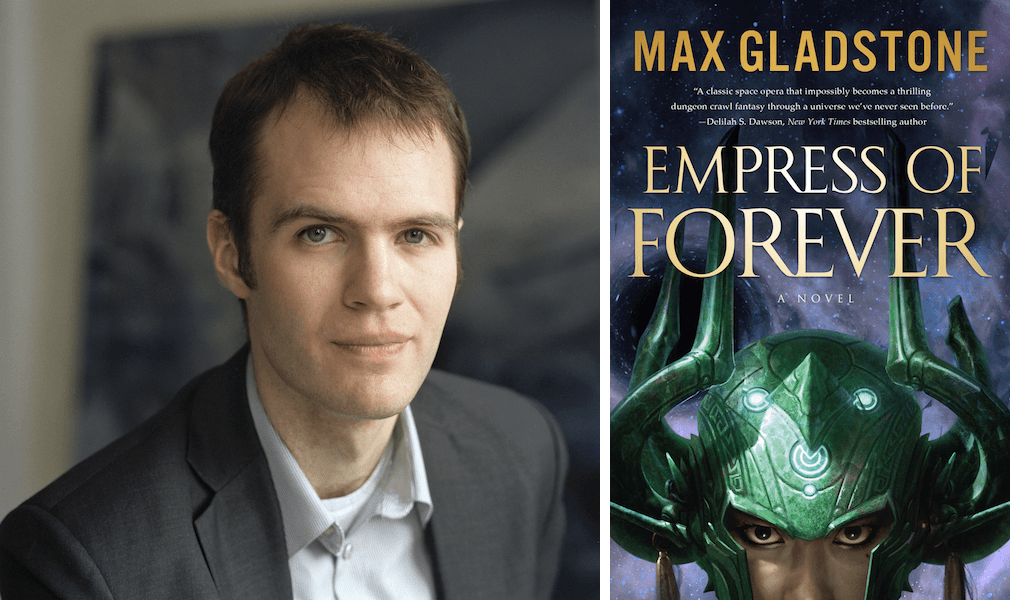
A space opera of world building, world destroying, planet eaters, strange goddesses who stride across space, like the Suicide Sisters, and a “ragtag” group, united by a mission – Empress of Forever by Max Gladstone is a mashup of Star Wars and a complex video game, all brought to life with words rather than actual graphics.
Viv knows only Earth. She is a businesswoman. She has not been truly ruthless, but she has been heedless of other’s feelings as she climbed her way to the top of the business world. Just as she is in an enormous server room about to finish uploading a program which could give her dominion over her world, the Empress of Forever, very green and powerful in ways Viv has never even imagined reaches in and grabs ahold of Viv’s heart and zaps her into a place in space called High Cacereal. How is Viv still alive? How will Viv get home? How will she get back to Magda to make sure she is safe? How will she find out what happened when she sent out her virus before it was completely loaded?
Well the answers to those questions will not be quick in coming. Viv first saves the Empress’s enemy Zanj, a feisty space pirate who has been imprisoned for 3,000 years, one of the once-famous Suicide Sisters. Zanj, never one to sit still can use the Cloud to travel through space. The first of the group hunting the Empress that Zanj and Viv meet is the loveable Hong, a monk with lots of courage and common sense. Then Xiara of the piloting Ornclan is added, and Gray of the Grayframes. Of course our band of Empress-haters must travel to every corner of Max Gladstone’s and Zanj’s world to see the damage the Empress has wrought.
Since Viv arrives in this world from the world of business she brings with her the wisdom success in business has taught her. This blend of How-to-Succeed-in- Business book lore, self-help psychological teachings, warcraft, and science fiction is kind of dazzling. How do people think up this stuff? It’s Linked in, Instagram, and World of Warcraft all rolled into one.
Despite this odd marriage of disciplines, Max brings his fantasy-built world richly alive for us. The novel is fun to read and as Viv learns the lesson that would have sealed her success as a businesswoman or made winning irrelevant, so do we. There is no I in team, but having the support of a truly connected team allows you to realize the very best version of yourself. Empress of Forever introduced me to a whole other kind of fantasy/science fiction novel for the computer age, perhaps intended for younger readers. Still, I found it fascinating to see how the genre is being transformed, and I made some new fictional friends.
Mrs. Everything by Jennifer Weiner is a sort of a “cover” of the classic book Little Women by Louisa May Alcott. This time there are only two girls in the Kaufman family who live in a little “Dick and Jane” house on Alhambra Street. They are named Jo (Josette) and Beth (Bethie) – the mom is Sarah and the dad is Ken.
My initial negative reactions to Mrs. Everything were decidedly generational. In Alcott’s book Jo and Beth didn’t have sex. Jo had ambitions that were not considered feminine, and she was aware that she would find it difficult to fulfill those ambitions, but she did not seem to struggle with her sexual identity, hardly an acceptable topic when Alcott wrote her novel.
However I got over myself. After all I am a child of the sixties. I did not find Bethie’s “rebirth” odd. I heard more than a few primal screams in my time. What bothered me more was the stereotypical presentation of the two sisters differing prepubescent personalities. Not every girl who likes sports and doesn’t care to play with dolls or wear dresses will be lesbian or have a sexual identity anywhere on the LGBTQ spectrum. The only saving grace for the lack of research into the subject can be found in the fact that the characters were intended to parallel the character differences between Alcott’s Jo and Beth.
Modern Jo knew that she was attracted to girls when she was in high school and she had quite a long relationship with her best friend. Her heart was broken for the first time when her first love got married to her high school sweetheart, a boy. Jo could never have pleased her mother by being as feminine as her mother wished her to be, and once her mother learned of Jo’s true sexual orientation, Sarah’s constant disapproval insured that Jo would be happy to leave for college.
Bethie (Beth) was every bit as feminine as her mother would wish her to be. She got lots of positive reinforcement. However, the lives these sisters actually lived most likely will not match the trajectory you think they are on. They were born into a decade of radical change. Trite but true, life happens.
Mrs. Everything by Jennifer Weiner is about identity and reality, bravery and duty, social pressure, love, and broken hearts. It did not push the button in me that said “eureka, this is a great book”, but perhaps the way readers experience the quality of this book will turn out to be generational.
Photo Credit: From a Google Image Search – Chicago Tribune
Look for me at thearmchairobserver.com and on goodreads.com as Nancy Brisson
If you are a fan of real space travel, there is a list of books related to the Apollo 11 moon landing, which happened around the same time as Woodstock, 50 years ago this year. I also found both interesting fiction and nonfiction available in June, enough titles to make me wish I could read faster. Print the list out, mark it up. Remember you can almost always find a summary on Amazon and at your library or your library’s web site. Some people get a lot of reading done in the summer. Happy 4 th of July.
Amazon
Literature and Fiction
Evvie Drake Starts Over by Linda Holmes *
Deep River by Karl Marlantes
The Last Book Party by Karen Dukess *
Stay and Fight: A Novel by Madeline Ffitch*
Very Nice: A Novel by Marcy Dermansky *
The Great Unexpected: A Novel by Dan Mooney *
The Nickel Boys by Colson Whitehead *
The Lager Queen of Minnesota: A Novel by J. Ryan Stradel
The Most Fun We Ever Had: A Novel by Claire Lombardo *
In the Full Light of the Sun by Clare Clark *
Mysteries and Thrillers
Lock Every Door: A Novel by Riley Sager
Lady in the Lake: A Novel by Laura Lippman
Whisper Network by Chandler Baker
A Nearly Normal Family by M. T. Edvardsson
The Possession (The Anomaly Files) by Michael Rutger
The Chain by Adrian McKinty
The Friend: A Novel by Joakim Zander
The Need by Helen Phillips
Wanderers: A Novel by Chuck Wendig *
The New Girl (Gabriel Allon) by Daniel Silva *
Big Sky (Jackson Brodie) by Kate Atkinson *
Biographies and Memoirs
Stronghold: One Man’s Quest to Save the World’s Wild Salmon by Tucker Malarkey
Dapper Dan: Made in Harlem: A Memoir by Daniel R. Day
Hitler: A Life by Peter Longrich
This is Not a T-shirt: A Brand, a Culture, a Community – A Life in Streetwear by Bobbie Hundreds
The Vagabonds: The Story of Henry Ford and Thomas Edison’s Ten-Year Road Trip by Jeff Guinn
Casting into the Light: Tales of a Fishing Life by Janet Messineo
They Called Us Enemy by George Takei, Justin Elsinger, Steven Scott, illus. Becker – Memoir
The Lie: A Memoir of Two Marriages, Catfishing and Coming Out by William Dameron
George Marshall: Defender of the Republic by David L. Roll
The Life of John F Kennedy Jr.: America’s Reluctant Prince by Steven M. Gillon
Nonfiction
Hungry: Eating, Road-Tripping, and Risking It all with the Greatest Chef in the World by Jeff Gordinier
Three Women by Lisa Taddeo
Drive-Thru Dreams: A Journey through the Heart of America’s Fast Food Kingdom by Adam Chandler
American Predator: The Hunt for the Most Meticulous Killer of the 21stCentury by Maureen Callahan
The Last Leonardo: The Secret Lives of the World’s Most Expensive Painting by Ben Lewis
The Story of the Deadliest Ebola Outbreak in History and of the Outbreaks to Come by Richard Preston
Range: How Generalists Triumph in a Specialized World by David Epstein *
I Like to Watch: Arguing My Way Through the TV Revolution by Emily Nussbaum
Because Internet: Understanding the New Rules of Language by Gretchen McCulloch
In the Valleys of the Noble Beyond: In Search of the Sasquatch by John Zada
Science Fiction and Fantasy
This is How You Lose the Time War by Amal El-Mohtar, Max Gladstone
Gods of Jade and Shadow by Silvia Moreno-Garcia
Salvation Day by Kali Wallace
Wanderers: A Novel by Chuck Wendig *
The Unlikely Escape of Uriah Heep: A Novel by H. G. Parry
The New York Times Book Review
June 7
Fiction
City of Girls by Elizabeth Gilbert
Loudermilk by Lucy Ives
Bakhita by Véronique Almi
Spring by Ali Smith
Crime
This Storm by James Ellroy
The Sentence is Death by Anthony Horowitz
Murder in Bel-Air by Cara Black
The Body in the Castle Well by Martin Walker
The Shortlist
The Selected Works of Abdullah The Cossack by H. M. Naqvi
There’s a Word for that by Sloane Tanen
Cheer Up, Mr. Widdicombe by Evan James
Nonfiction
The Queen by Josh Levin
No Visible Bruises by Rachel Louise Snyder
Generation Wuss by Bret Easton Ellis
The Pandemic Century by Mark Honigsbaum
The Pioneers by David McCullough
Range by David Epstein
Gropius by Fiona MacCarthy
Moneyland by Oliver Bullough
June 14
Nonfiction
Underland by Robert Macfarlane
L.E.I.: The Lost Life and Scandalous Death of Letitia Elizabeth Landon, the Celebrated Female Byron by Lucasta Miller
The Death of Politics by Peter Wehner
The Right Side of History by Ben Shapiro
Clear and Present Safety by Michael A. Cohen and Micah Zinko
Women’s Work by Megan Stack
The Conservative Sensibility by George Will
Love Your Enemies by Arthur C. Brooks
The Case for Trump by Victor Davis Hansson
Fiction
On Earth We’re Briefly Gorgeous by Ocean Vuong
Greatest Hits by Laura Barnett
Machines Like Me by Ian McEwan
Where We Come From by Oscar Cásares
The Short List (from France)
Life of David Hockney by Catherine Cusset, trans. by Teresa Lavender Fagan
Exposed by Jean-Phillippe Blondel, trans. by Alison Anderson
Lie With Me by Philippe Besson, trans. by Molly Ringwald
June 21
50th Anniversary of Apollo 11
Hasselblad and the Moon Landing by Deborah Ireland
Apollo’s Legacy: Perspectives on the Moon Landing by Roger Launius
Shoot For the Moon: The Space Race and the Extraordinary Voyage of Apollo 11 by James Donovan
Apollo To The Moon: A History in 50 Objects by Teasel Muir-Harmony
Chasing the Moon: The People, the Politics, and the Promise that Launched America Into the Space Age by Roger Stone and Alan Andres
American Moonshot: John F. Kennedy and the Great Space Race by David Brinkley
One Giant Leap: The Impossible Mission that Flew Us to the Moon by Charles Fishman
Nonfiction
The Plaza by Julie Satow
War and Peace by Nigel Hamilton *
Autumn Light: Season of Fire and Farewells by Pico Iyer
The White Devil’s Daughters by Julia Flynn Siler
Assad or We Burn the Country by Sam Dagher
Fiction
Original Prin by Randy Boyagoda
Orange World by Karen Russell (Short Stories)
Strangers and Cousins by Leah Hager Cohen
Big Sky (Det. Jackson Brodie) by Kate Atkinson *
Murder in the Crooked House by Soji Shimada
The Poison Thread by Laura Parcell
The Last House Guest by Megan Miranda
Children of the Ghetto by Elias Khoury
Walking on the Ceiling: A Novel by Aysegül Savas
The Seven or Eight Deaths of Stella Fortuna by Juliet Grames *
All the Good Things by Claire Fisher
How We Disappeared by Jing-Jing Lee
June 28
Fleishman is in Trouble by Taffy Brodesser-Akner *
The Electric Hotel by Dominic Smith
My Life as a Rat by Joyce Carol Oates
America Was Hard to Find by Kathleen Alcott
Juliet the Maniac by Juliet Escoria
Riots I Have Known by Ryan Chapman *
Nonfiction
Democracy May Not Exist But We’ll Miss It When It’s Gone by Astra Taylor
The Problem of Democracy by Nancy Isenberg and Andrew Burstein
The America: The Case for The Nation by Jill Lepore
Never Lovely So Real (Nelson Algren Biography) by Colin Asher
People, Power, and Profits by Joseph E. Stiglitz
Ill Winds by Larry Diamond. *
Spying of the South by Tony Horwitz
Once More We Saw Stars by Jayson Greene
Bottle of Lies by Katherine Eban
Picnic Comma Lightning by Laurence Scott
Publisher’s Weekly
June 7
Elderhood, Redefining Aging, Tranforming Medicine, Reimaging Life by Louise Aronson (NF)
Bunny by Mona Awad (F) *
Recursion by Blake Crouch (Thriller)
Honestly We Meant Well by Grant Ginder (F)
Natalie Tan’s Book of Luck and Fortune by Rosalie Lim (F)
The Darwin Affair by Tim Mason (Thriller)
The Stonewall Riots: A Documentary History by Marc Stein (NF)
Paris, 7 A. M. by Liza Wieland (Based on life of poet, Elizabeth Bishop) (F)
Mrs. Everything by Jennifer Weiner (F)
The History of Living Forever by Jake Wolff (F)
June 14
The Body Lies by Jo Baker (F)
Fake Like Me by Barbara Bourland
The Tenth Muse by Catherine Chung (F) *
Roughhouse Friday: A Memoir by Jaed Coffin (F)
Empress of Forever by Max Gladstone (Science Fiction). *
The Capital by Robert Menasse (F)
Eyes in the Sky: The Secret Rise of Gorgon Stare and How It Will Watch Us All by Arthur Holland Michel (NF)
Conviction by Denise Mina (Thriller)
The Last House Guest by Megan Miranda (Thriller)
Patron Saints of Nothing by Randy Ribay (F) (YA to Adult)
Flash Count Diary: Menopause and the Vindication of Natural Life by Darcey Steinke (NF)
June 21
Drive-Thru Dreams: A Journey Through the Heart of America’s Fast Food Kingdom by Adam Chandler (NF)
Happiness, As Such by Natalia Ginzberg, trans from Italian by Minna Zallman Proctor
Evvie Drake Starts Over by Linda Holmes (F) *
The Maze of Transparencies by Karen An-hwei Lee.(F) *
Chaos: Charles Manson, the CIA, and the Secret History of the Sixties by Tom O’Neill with Dane Piepenbring (NF) (True Crime)
Murder in the Crooked House by Soji Shimada, trans. from Japanese by Louise Heal Kawai (puzzle mystery)
The Friend by Joakim Zander from Swedish by Elizabeth Clark Wessel (Thriller)
June 28
American Predator: The Hunt for the Most Meticulous Serial Killer of the 21 st Century by Maureen Callahan (NF)
The Best Science Fiction of the Year, Vol. 4 by Neil Clarke (Science Fiction Short Stories)
Second Sight by Aoife Clifford (Crime Novel)
Very Nice by Marcy Dermansky (F) *
Betrayal. In Time: A Kendra Donovan Mystery by Julie McElwain (F)
Shadowlands: Fear and Freedom at the Oregon Standoff by Anthony McCann (NF) Cliven Bundy and Son) *
Maggie Brown and Others by Peter Omer (Character Sketches)
The Me I Used to Be by Jennifer Ryan (F) *
Lock Every Door by Riley Sagar (Thriller)
The Public Option: How to Expand Freedom, Increase Opportunity, and Promote Equality by Genesh Sitaramen and Anne L Alstott (NF) (Favors public opinion)








 So Many Books, Choose Wisely