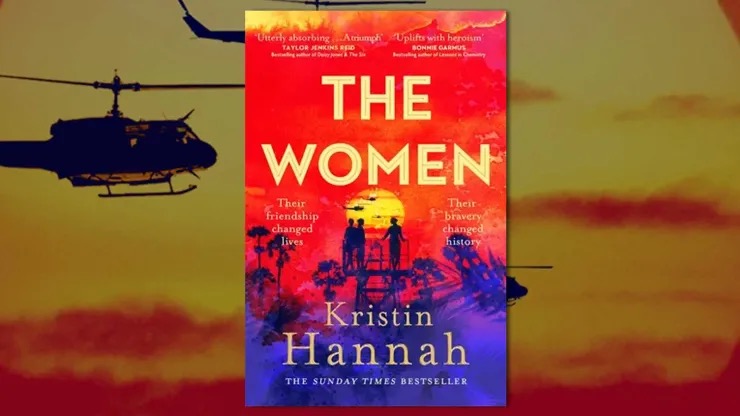
“There were no women in Vietnam.” When Frankie McGrath comes home from two years of nursing soldiers wounded in Vietnam, she is not thanked for her services. Her father doesn’t add her photo to his wall of heroes. Of course, coming home from Vietnam was nothing like coming home from WWII. America’s role in the war was hotly contested at home. Because Americans felt it was not our war, some of their anti-war emotions were displaced onto our soldiers who had few choices and usually could not avoid being sent off to the war.
Kristin Hannah’s account of the war and the roles of women in it is not a dainty matter. She did not withhold the gore or the emotional turmoil army nurses experienced in Vietnam. Her book may be fictional, but that allows her to include us in the devastation as we identify with the characters in her book.
Frankie’s much beloved brother joined the Navy but was killed in action almost as soon as he arrived in-country. Helicopters played a huge role in the Vietnam War, both taking soldiers in and out of combat and in and out of medical camps, some of them MASH units, located near the front lines of the battle. Frankie’s decision to join the army to become a nurse was motivated by a desire to please her father, but also it was for Findley, her brother.
The soldiers Frankie treats gave proof of the fragility of human bodies when confronted with weapons of war. Their wounds are terrible. Experience eventually replaced her nerves with skill. She earns a place as an excellent surgical nurse, and she finds friends who will have her back for life.
However, Frankie is young and soldiers flirt, especially helicopter pilots. Frankie falls in love and despairs when she learns her sweetheart is dead. And, what Frankie faces when she gets home does not meet any of her expectations. Finally, after PTSD, addiction, and other heartaches we leave Frankie in Washington, DC at a ceremony dedicating the wall honoring the veterans who died in Vietnam, and a ceremony honoring the nurses and doctors and the soldiers and sailors who didn’t die in Vietnam.
I have left out many important events from this story because I recommend that you read the book and I don’t want to spoil it. In a meaningful coincidence I finished reading The Women by Kristin Hannah about the women who served in Vietnam on our designated Memorial Day.
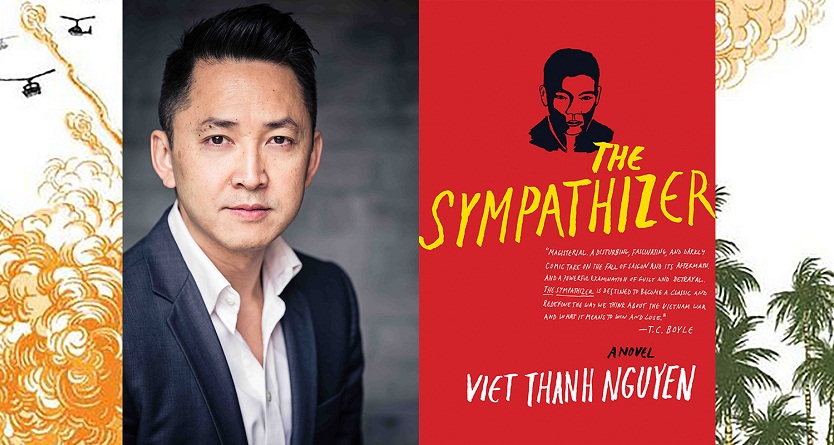
The Sympathizer reads as if the author was there at the fall of Saigon, except that the author, Viet Thanh Nguyen, although born in South Vietnam, was born after those events. His parent were there, the authors of the source materials he read either were there or had used journalistic methodologies to research Vietnam history, the Vietnam War, the fall of Saigon and the aftermath. He may have learned about the war second hand, but he writes about it very much as a first hand observer/participant.
Others have written about those harried days when the U. S. admitted defeat and had to get out of town fast, but here is a new voice. And, although the book is fiction, it is immersive. Until I read the end notes I was convinced that V. T. Nguyen had been in Vietnam throughout the war. Our narrator remains unnamed and the use of first person is consistent throughout. This novel offers us an expert’s use of point of view.
Our unnamed main character is both simple and complex. He is the “man with two faces,” “the man with two minds.” The child of a culturally unacceptable liaison between his Vietnamese mother and a French priest, he’s reviled by villagers–his mother shunned and very poor–he is labeled a bastard. He is also handsome and bright and is sent to a Californian college where his views become more global. He has made a blood pact with two other guys, Man and Bon, and they are the only two who command his loyalty. They are communists.
Back in Vietnam during the war years, our narrator is imbedded in the South Vietnamese Army, but he is a spy who sends off reports to Man in North Vietnam. He appears to be a shallow, somewhat cynical guy, his voice is irreverent and politically ambivalent. He works as an aid and driver to the Commandant of the Vietnamese troops in the South. His grasp of English makes him valuable to both the Vietnamese and the Americans. He doesn’t seem to have any real ideological attachment to communism and certainly, given his deceptions, doesn’t even think in revolutionary rhetoric. He tells us on the very first page that he can see both sides.
Our narrator escapes the fall of Saigon with a General and others, including his sworn brother Bon, whose wife and child are killed during the escape. Our narrator may not have many values that demand his absolute allegiance but he is determined to keep Bon from despair and suicide.
The book is masterful, so well-written, evocative of what we already understand as the senselessness of war, combined with the truth that we seem unable to end our apparent love affair with wars.
“…our revolutions had gone from being the vanguard of political change to the rearguard of hoarding power. In this transformation we were not unusual. Hadn’t the French and the Americans done exactly the same? Once revolutionaries themselves, they had become imperialists, colonizing and occupying our defiant little land, taking away our freedom in the name of saving us…Having liberated ourselves in the name of independence and freedom—I was so tired of saying those words!—we then deprived our defeated brethren of the same.” (pg. 326)
Nguyen dazzles as he traces the occupations of Vietnam back to its origins, starting from the origins of his character.
“…if history’s ship had taken a different tack, if I had become an accountant, if I had fallen in love with the right woman, if I had been a more virtuous lover, if my mother had been less of a mother, if my father had gone to save souls in Algeria instead of here, if the commandant did not need to make me over, if my own people did not suspect me, if they saw me as one of them, if we forgot our resentment, if we forgot revenge, if we acknowledged that we are all puppets in some one else’s play, if we had not fought a war against each other, if some of us had not called ourselves nationalists or communists or capitalists or realists, if our bonzes had not incinerated themselves, if the Americans hadn’t come to save us from ourselves, if we had not bought what they sold, if the Soviets had never called us comrades, if Man had not sought to do the same, if the Japanese hadn’t taught us the superiority of the yellow race, if the French had never sought to civilize us, if Ho Chi Minh had not been dialectical and Karl Marx not analytical, if the invisible hand of the market did not hold us by the scruffs of our necks, if the British had defeated the rebels of the new world, if the natives had simply said, Hell no, on first seeing the white man, if our emperors and mandarins had not clashed among themselves, if the Chinese had never ruled us for a thousand years, if they had used gunpowder for more than fireworks, if the Buddha had never lived, if the Bible had never been written and Jesus Christ never sacrificed, if Adam and Even still frolicked in the Garden of Eden, if the dragon lord and the fairy queen had not given birth to us, if the two of them had not parted ways, if fifty of their children had not followed their fairy mother to the mountains, if fifty more had not followed their dragon father to the sea, if legend’s phoenix had truly soared from its own ashes rather than simply crashed and burned in our countryside, if there were no Light and no Word, if Heaven and earth had never parted, if history had never happened, neither as farce nor as tragedy, if the serpent of language had not bitten me,…” (pg. 307-8)
Nguyen leaves us, like Bon, in despair that we will ever find ways to suppress the flaws in our blighted human condition. It’s depressing but the narrator’s rather amoral and insouciant patter takes some of the sting out of some really dreadful things. Viet Thanh Nguyen is an excellent new voice in both American and global fiction.