

From a Google Image Search – Amazon
Indirectly, with several degrees of separation, Thomas Wolfe’s book Look Homeward, Angel was recommended to me by Dustin Hoffman. My literary education did not extend to the Southern authors, although William Faulkner is also considered a classic American author, so he made the cut. Thomas Wolfe is an amazing writer, writing dense prose descriptions that, in this case, tended to emphasize the seasons. The seasons mirror the moods of the characters. The book is a tome. It’s long and the small print was tough on my old eyes, so I read along while I listened to the book on tape.
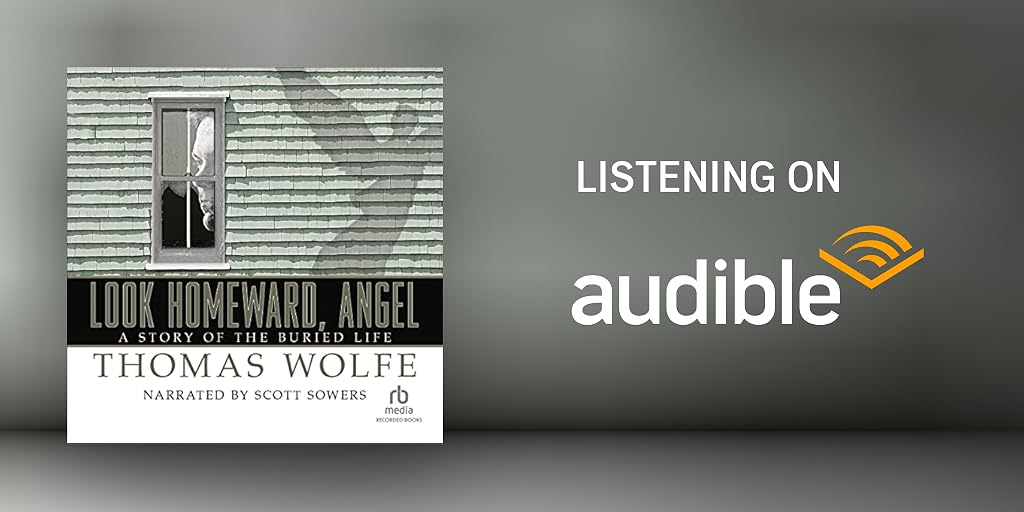
Look Homeward, Angel was published in 1929 when the author was 29. He was born in 1900 and grew up in Asheville, North Carolina, which Wolfe called Altamont in his book. It was sad to read this as a flood was devastating Asheville in 2024. Wolfe died when he was 37 years old of tubercular meningitis which the internet tells me was too advanced to treat. The book is not as popular today as it probably should be because of the presence of African Americans in terms that we have learned to avoid as culturally hurtful and therefore inappropriate. If you can ignore the outdated historical elements and concentrate on the other content, you will find a master of prose writing and the legacy of an education in the classics.
The novel is considered autobiographical in nature. William and Eliza are the parents of Daisy, Steven, Ben, Grover, Luke, Helen, and Eugene. Eugene is the character who represents the author. He is a brilliant kid and gets special attention from his teachers who recommend a private school for him. This is not an easy choice for his frugal parents who are also rather laissez-faire parents. Mary Leonard runs the school that sees to it that Eugene is treated like the gifted child he is.
Wolfe attributes these sensory memories to Eugene at the age of five:
“He had heard already the ringing of remote church bells over a countryside on Sunday night; had listened to the earth steeped in the brooding symphony of dark and the million-noted little night things; and he had heard thus the far retreating wail of a whistle in a distant valley, and faint thunder on the rails; and he felt the infinite depth and width of the golden world to the brief seductions of a thousand multiplex and mixed mysterious odors and sensations, weaving, with a blinding interplay and aural explosions, one into the other.
He remembered the East India Teahouse at the Fair, the sandalwood, the turbans, and the robes, the cool interior and the smell of India tea; and he felt now the nostalgic thrill of dew-wet mornings in Spring, the cherry scent, the cool clarion earth, the wet loaminess of the garden, the pungent breakfast smells and the floating snow of blossoms. He knew the inchoate sharp excitement of hot dandelions in young Spring grass at noon; the smell of cellars, cobwebs, and built-on secret earth; in July, of watermelons bedded in sweet hay, inside a farmer’s covered wagon; of cantaloupe and crated peaches; and the scent of orange rind, bittersweet, before a fire of coals. He knew the good male smell of his father’s sitting room; of the smooth worn leather sofa, with the gaping horsehair rent; of the blistered varnished wood upon the hearth; of the heated calfskin bindings; of the flat moist plug of Apple tobacco, stuck with a red flag; of woodsmoke and burnt leaves in October; of the brown tired autumn earth; of honeysuckle at night; of warm nasturtiums; of a clean ruddy farmer who comes weekly with printed butter and eggs and milk; of fat limp underdone bacon and of coffee; of a bakery oven in the wind; of large deep-hued stringbeans smoking hot and seasoned well with salt and butter; of a room of old pine boards in which books and carpets have been stored, long closed; of Concord grapes in their long white baskets.
Yes, and the exciting smell of chalk and varnished desks; the smell of heavy bread sandwiches of cold fried meat and butter; the smell of new leather in a saddler’s shop, or of a worn leather chair; of honey and of unground coffee; of barrelled sweet pickles and cheese and all the fragrant compost of the grocer’s; the smell of stored apples in the cellar, and of orchard-apple smells, of pressed cider pulp; of pears ripening on a sunny shelf, and of ripe cherries stewing with sugar on hot stoves before preserving; the smell of whittled wood, of all young lumber, of sawdust and shavings; of peaches stuck with cloves and pickled with brandy; of pine sap, and green pine needles; of a horse’s pared hoof; of chestnuts roasting, of bowls of nuts and raisins, of hot cracklin’, and of young roast pork, of butter and cinnamon melting on hot candied yams.” (pg. 69)
Wolfe occupied a world far richer in smells than our own, but still, you can almost smell it all, and there is more on the next page. But as Eugene grows up his thoughts become concerned with deeper considerations such as “why are we here,” “does it matter what we do”, and as many have wondered, “is there anything after this.
In a last imaginary conversation with his (dead) brother Ben:
“And in his vision he saw the fabulous lost cities, buried in the drifted silt of the earth–Thebes, the seven gated, and all the temples of Daulian and Phocian lands, and all Oenotria to the Tyrrhene gulf. Sunk in the burial urn of earth he saw the vanished cultures: the strange sourceless glory of the Incas, the fragments of lost epics upon a broken shard of Gnossic pottery, the buried tombs of Memphian kings, and imperial dust, wound all about with gold and rotting linen, dead with their thousand bestial gods, their mute unwakened ushabtii, in their finished eternities.
He saw the billion living of the earth, the thousand billion dead: seas were withered, deserts flooded, mountains drowned; and gods and demons come out of the South, and ruled above the little rocket flare of centuries, and sank–came to their Northern Lights of death, the muttering death-flared dust of the completed gods.
But, amid the fumbling march of races to extinction, the giant rhythms of the earth remained. The seasons passed in their majestic processionals, and germinal Spring returned forever on the land–new crops, new men, new harvests, and new gods. (pg. 506)
…
“And rising from his vision he cried: I am not there among the cities. I have sought down a million streets, until the goat cry died within my throat, and I have found no city where I was, no door where I had entered, no place where I had stood.
Then from the edges of moon-bright silence, Ben replied: Fool, why do you look in the streets?
Then Eugene said: I have eaten and drunk the earth, I have been lost and beaten, and I will go no more.
Fool, said Ben, what do you want to find?
Myself, and an end to hunger and the happy land, he answered. For I believe in harbors at the end. O Ben, brother, and ghost, and stranger, you who could never speak, give me an answer now!
Then, as he thought, Ben said: There is no happy land. There is no end to hunger.” (pg, 507)
The book is a trip, a trip to another time, the mind of another person, yet has a familiar humanness we can understand. There are angels but I will let you discover them for yourselves. Families play an enormous role as we are “coming of age.” Eugene Gant is no exception. His parents are quite unique, and it’s easy to see the connection between how parents treat children and life’s challenges and how their children grow and develop. If there had been shrinks as available as today in the late 1920s, would Wolfe’s confessions and philosophical digressions have been expressed with such depth? Would there be angels?
 So Many Books, Choose Wisely