
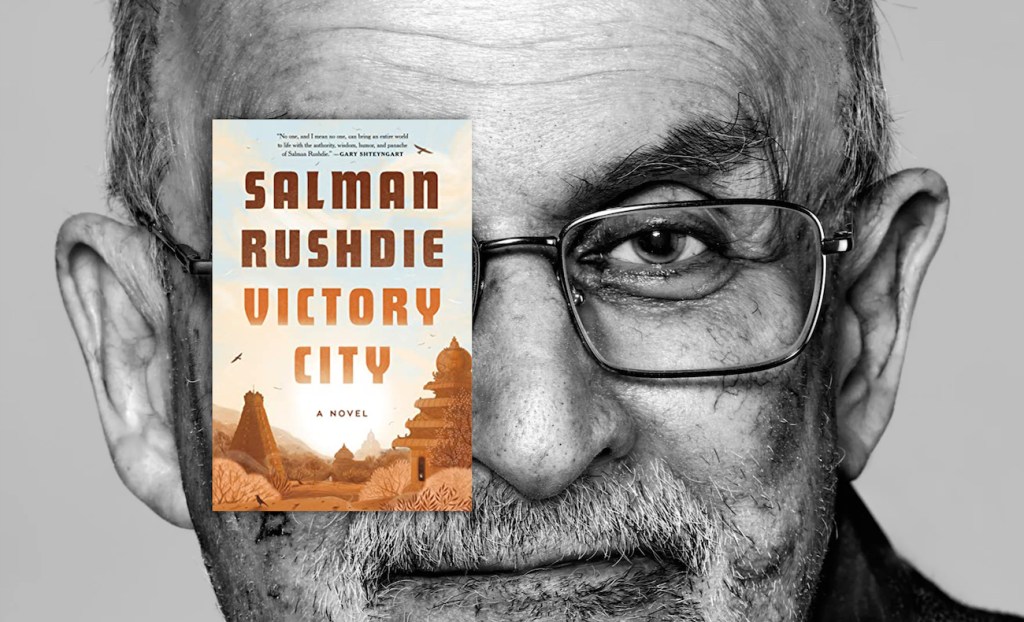
From a Google Image Search – American Kahani
Salman Rushdie, prolific and celebrated author, was born in Mumbai (Bombay) India. He was born to Islamic parents but became an atheist. One of his early books was The Satanic Verses. It was considered sacrilegious by the Ayatollah Khomeini in Iran who issued a fatwa on February 14, 1989, requiring the faithful to seek out Rushdie and kill him. For many years Rushdie lived in hiding in London under the protection of the British government. The Ayatollah died without lifting the fatwa, so it was never rescinded but Rushdie felt secure enough to live freely in NYC for many years. On August 12, 2022, standing on the stage at the Chautauqua Institute in New York Rushdie was attacked by 24-year-old Hadi Matar who stabbed him multiple times with a knife before security and participants were able to apprehend him. Rushdie was severely injured and lost the use of one eye.
Victory City is the first book Rushdie has published since his near-death experience. Salman Rushdie is back on home turf with this book. His heroine, as a nine-year-old girl, sees her mother walk into a fire to die as custom required of widows. She is shocked that her mother would chose the fire rather than stay with her. But she is given a gift from the goddess Pampa who she is named for. She is given two gifts by the goddess. She is gifted with long life. She is also gifted with the magical ability to sow seeds and grow her own city.
The goddess tells her, “You will fight to make sure that no more women are ever burned in this fashion, you will live long enough to witness both your success and your failure, you will see it all, tell its story and then you will die immediately. Nobody will remember you for 450 years until they unearth your verses.” (not an exact quote). It turns out that knowing your future often brings both joy and pain.
First Pampa Kampana spends years reaching her maturity in the cave (mutt) of a spiritual teacher and sexual predator, Vidyasagar. Fortunately, Vidyasagar studies for long hours as he memorizes all the holy texts, but he occasionally finds time to rape Pampa. The monk seeks the answers to two questions. The first is whether wisdom exists or there is only folly. The second question is to find out if there is such a thing as Vidya or true knowledge, or only many different kinds of ignorance. His goal is (ironically) how to ensure the triumph of nonviolence in a violent age. Although grateful for learning the contents of the holy books, she never forgets the humiliation she suffered when she was helpless to fight back.
When Pampa Kampana is eighteen two cowherds arrive at the mutt. She sends Hukka and Bukka Sangama out to sow the seeds of her city. She names the city Bisnaga or Victory City. Since her city is peopled by people who have no personalities, who know no history, who don’t know their identities, Pampa Kampana whispers to fill the minds of each individual in Bisnaga. It is a city created by magic.
Magic is one of the best aspects of Rushdie’s writing. The existence of magic allows him to be a great storyteller in the Eastern manner. This book does not have Islamic roots; it celebrates Hinduism but as myth more than religion. It’s interesting that Pampa Kampana’s life and the life of Victory City are exactly 247 years, the same as the life of the American Republic (probably not an accident). There is plenty of commentary on the rise and fall of great cities, or great empires. Why are empires successful and why do they fail? Is failure inevitable?
In our world we have no magic that we know of. We live in non-magical times. We can’t blame the gods and goddesses for our failure. We have only ourselves to blame. Still, a good story entertains us and makes us think in new directions. Victory City is an engrossing tale of magic and life that centers around a female heroine who builds a great empire, which is quite rare. Salman Rushdie is writing again and that is cause for celebration.

 So Many Books, Choose Wisely