Autocracy, Inc. by Anne Applebaum, Ch. 4, Changing the Operating System/Hegemony

From a Google Image Search – What’s so bad about multipolarity? – Al Majalla

When we look at politics in America at this moment, poised as we are to go to the polls to elect a new president, and when we realize that one candidate wants to change America’s operating system while the other candidate will stay within the parameters our founder’s and previous administrations have designed for us, we can’t help looking ahead and imagining what American governance will be like in the future. The world seems to be slowly converting to autocratic governments run by dictators who pay loyalists by turning them into oligarchs to ensure their continued loyalty. These oligarchs steal money from citizens, stashing it away in tax shelters or secret bank accounts allowing kleptocracy to exist together with autocracy. How grim life becomes for people who are not part of these governments depends on the temperament and ideology of the “dear leader.”

Autocracy is not as shocking in a country that has never been a democracy, which perhaps evolved from a monarchy to a communist government and then to a dictatorship. But it is shocking to hear autocratic echoes in America which has always been a democracy since it won the right to be a sovereign nation rather than a colony. (We could take a moment to bemoan our imperialism, but it won’t help us in this instance.)

“Sovereign” is a key term that autocrats like to use, Anne Applebaum tells us in Chapter 4 of her book, Autocracy, Inc. As in, we are a “sovereign” nation. Keep your laws out of our country. Mind your own government. Your human rights are not necessarily our human rights.

In a review of Timothy Snyder’s new book, On Freedom, in the New York Times, the reviewer reminds us that

“On Nov. 9 it will be 35 years since the Berlin Wall fell. The exhilaration of that moment was followed by high hopes for the spread of democracy throughout Eastern Europe, then in Russia itself when the Soviet Union imploded. Gradually hope gave way to frustration, disappointment and then dismay. Russia did not become a liberal democracy, and nor did a number of its former satrapies.”

Sovereignty means keep your mitts off my country, hegemony means my country belongs at the top of the heap because it has the strongest economy, government, and military. If America held the hegemony in the twentieth century, other nations, autocratic nations, are competing for hegemony in the twenty-first century and beyond. We didn’t necessarily need Anne Applebaum to tell us this. As humans, we understand human nature. Competition seems hardwired in humans and all living things. What Anne Applebaum is telling us is that autocrats might be uniting to woo underdeveloped countries with aid and support for their autocratic leaders to create a world-wide-web of autocratic nations for the strength in numbers that might shift hegemony from America and the West to China and/or Russia.

Where once (after WWII) human rights became a goal of the nations that beat the Nazis and did not end up behind the “Iron Curtain” of Stalin’s Russia, all bets are now off. Where once nations declared that “recognition of the inherent dignity and of the equal and inalienable rights of all members of the human family is the foundation of freedom, justice and peace in the world. It is also acknowledged that ‘disregard and contempt for human rights have resulted in barbarous acts which have outraged the conscience of mankind.’…everyone has the right to life, liberty, and security of person. Applebaum continues to remind us of what was said in the shadow of Nazi genocide, “No one should be subjected to arbitrary arrest, detention, or exile. Torture and slavery should be banned.” (p. 99)

Applebaum speaks of what has been collectively known as “the rules-based order.  She goes on to say that how the world ought to work is not how it actually works, that many signatories have violated these rules, but that (for now) they still influence behavior in the real world.”(p. 100)

She warns us that powerful autocracies like China or Russia want to get rid of the language of these old agreements. Xi Jinping said this while addressing the Communist Party in 2017, “China seeks to take an active part in leading reform of the global governance system.” She tells us the remarks of Andrea Worden, a legal scholar and China expert, “For the CCP to attain the moral legitimacy, respect, and recognition it needs for leadership of a new world order, it must remove the threat of Western universal human rights.” (p.101)

She tells us what Putin has to say about sovereignty. “Sovereignty includes the right to abuse citizens at home and to invade others abroad. This privilege is available to only a very few large nations. There are not many countries in the world that have sovereignty.” (p.102)

Another term that is popular with autocrats right now according to Applebaum is the term “multipolarity” because it telegraphs an organization of autocratic states, banded together for greater power, stronger economics, and hegemony.  Of course, hegemony is not up for grabs. As in Putin’s view on sovereignty, hegemony belongs to very few nations, or perhaps only one and that would be whatever country wins the hegemony competition, takes hegemony away from the US.

What does this have to do with America? A lot. We have an autocrat running to be our president right now and he has a passionate cult following. You might also want to read this article from today’s New York Times about what liberals may not realize about MAGAs.

If you are paying any attention to politics, then you must have heard that this is an existential election. Donald Trump is not only not a Democrat, but he also doesn’t put much stock in democracy. He likes strong men and sees himself as one of these alpha males. He wants to head America and go steady with other autocrats. He may even think that his presence alone will ensure America’s hegemony among autocratic nations.

Perhaps inciting your followers to violence is something strong leaders do, but Trump doesn’t like to take responsibility for the violence he incites. Other autocrats have no difficulty showing that they don’t just intimidate, they act (although often they still delegate violent actions to others). Donald Trump believes that by changing the rules he can change our minds. He believes his propaganda is more effective than 240 years of living in a democracy. Americans have no experience living in an autocratic state. Even if he wins one, it might be hard to keep it. How will it feel if he actually sends troops out to round up immigrants (both legal and illegal) and spends our tax dollars to deport them or puts them in “camps” which are nothing like sports camps or computer camps but more like the Japanese Internment camps.

China, Applebaum says, wants to change the language, to throw out “political rights” or “human rights” and replace it with squishy language like “win-win cooperation” and “mutual respect.” (pp. 102-3)”

When I read the book To Paradise by Hana Yanagihara (which was not an easy book because of the way it skipped around in place and time while focusing on one family and its descendants) the book offered glimpses of an America under the thumb of the Chinese government (the UK was still a free nation). The America she depicts bears little resemblance to our beloved democracy/republic. Applebaum’s careful discussion and her evidence for a future united autocratic institution (the anti-UN) is a warning that we are in danger of losing our access to whatever human rights we still treasure and that many nations around the world will rejoice if we choose autocracy, if we replace “the rule of law” with “rule by law” (or whatever the leader says).

“A world in which autocracies work together to stay in power, work together to promote their system, and work together to damage democracies is not some distant dystopia. That world is the one we are living in right now,” says Anne Applebaum. (p. 121)

Autocracy, Inc. by Anne Applebaum, Ch. 3, National Security and Government Control

From a Google Image Search – Politico

Anne Applebaum’s book has a subtitle, The Dictators Who Want to Run the World. From her perch in Poland, she has a nearer view of all the players, Russia, China, Syria, Iran, and Africa. Nations that are run by autocrats are using new technologies not only to spy on other countries (especially democracies) but also to spy on their own citizens. You might argue that nations need to know what their enemies, both foreign and domestic, are up to but there are more sinister motives at work here too. Chapter 3 in Autocracy, Inc. has the title, “Controlling the Narrative”. 

The author begins by reminding Americans that our NSA is collecting data about US citizens as we were informed by Edward Snowden, a whistleblower or traitor, depending on your point of view, who is living as an exile in Russia. She also mentions Pegasus spyware in Poland which was eventually exposed and investigated. 

“If no parallel scandal has ever unfolded in China, Russia, Iran, or North Korea, that’s because there are no legislative committees or free media that could play the same role.” (p. 71)

Applebaum reasons that when democracies use spyware it helps autocracies justify their abuse. If there are fewer objections to using spyware outside of China, then there will be fewer objections to using it inside of China. 

In fact, we all expect that surveillance inside nations, even democracies, will escalate as new tech advances are developed. Why develop spyware if you won’t use it.  Americans objected to the intrusions of the Patriot Act after the attacks on 9/11 but were so shaken by these brazen attacks on America that we accepted these rules while also believing that they would be temporary. They have been replaced by the USA Freedom Act which curtailed the government’s authority to collect data in 2015. Democrats in Congress strongly objected whenever Trump wanted to collect names of people in a group he wanted to target. 

In China, objections can be deadly, as in Tiananmen Square in 1989. China, says Applebaum, first tried to eliminate the activists (people), then set out to eliminate the ideas such as the rule of law, the separation of powers, the right to free speech and the right to assemble which are described as “spiritual pollution”. (p. 66)

While Americans still believe, or say they believe that the internet would lead to a cultural renaissance, Applebaum predicted in 2012 that the internet would become a tool of control. China was designing “the Great Firewall of China” (p. 67) which used an “elaborate system of blocks and filters to prevent users from seeing particular words and tools. She tells us that foreign companies rushed into the new security market in the same way companies had rushed into the post-Soviet financial market. (Yahoo, Microsoft, Cisco Systems all made software that complied with China’s rules.) These companies were eased out once China had access to their software. (p. 68)

The security network was expanded by combining online tracking with tools of repression such as security cameras, police inspections and arrest. Other tools might include “nanny apps” on phones, monitoring book purchases, picking up on unusual behaviors, voice recognition, and even DNA swabs. All these tools have been used on the Uighur population in China. Now add in facial recognition and AI and you have a state that can truly control the narrative.

Anne Applebaum did not just write her book to expose state surveillance tactics. Perhaps she felt we needed to understand what might be coming to a place near you. These systems can be copied and have been copied by many nations including Pakistan, Brazil, Mexico, Serbia, South Africa and Turkey. 

“The more China can bring other countries’ models of grievance into line with China’s own,” argues Steven Feldstein, an expert in digital technology, “the less these countries pose a threat to Chinese hegemony.” (Am I nervous about writing these words without a powerful husband such as Applebaum’s to make her a public figure and hard to attack – yes, I am sometimes paranoid.) 

Russia plays a different game says Applebaum. Lie constantly and blatantly and when exposed offer no counterarguments. (p. 78) Blame everyone but yourself. This “fire hose of falsehoods” makes citizens question how you can possibly know what really happened and so they avoid politics altogether. Autocrats spread hopelessness and cynicism because it works to their advantage. This is not Russia’s only game. Russia is also a surveillance state.

Surveillance was a thing we worried about in the post-WWII world. We had all read Orwell’s 1984. We expected our freedom to include privacy. After the events of 9/11 we saw the need for some spying, both domestic and foreign, but we still hoped to not invade the homes of private citizens. Now, we are in an age where we live with hacking, with having our data stolen regularly, and with who knows how much surveillance because we can’t imagine our lives without the internet and cell phones. 

Many American fully believe that if Trump and the right-wing MAGA’s win in 2024 all aspects of surveillance will be expanded and private citizens may be pursued because of the things they think and what they write or have written. Even without the MAGA’s in power, surveillance will most likely expand given all the autocracies that have cropped up everywhere. We may not be able to keep it focused on only foreign countries. This is one of our great fears of AI that it will be used by our government to control our behavior, regardless of what party you are registered with or the fact that you choose to not belong to a party. 

“In seeking to create, these new propagandists, like their leaders, will reach for whatever ideology, whatever technology, and whatever emotions might be useful.”…Only the purpose never changes, Autocracy, Inc. hopes to rewrite the rules of the international system itself.” (p. 97)

Chapter 3 also goes into, in some detail, the changes in print and social media that are accompanying this rise in “spying”. Project 2025 will give MAGA carte blanche to spy on all Americans. Anne Applebaum’s book is a warning. Soon she will offer some remedies.

The Fifth Risk: Undoing Democracy by Michael Lewis-Book

From a Google image Search – Facts.net

Michael Lewis’ book The Fifth Risk is nonfiction. It examines what happened in several government agencies when Trump won the 2016 election. Presidents usually put their own people in as heads of our government agencies, and they tend to do it quickly and strategically. A team is generally sent in to make a smooth transition in services that benefit key groups which in turn benefit American citizens.

When Trump took office several department/agencies saw no transition team arrive and if a new head of agency had been appointed, they tended to arrive alone and late and to ignore the transition materials prepared by outgoing staff.

By now Americans have heard plenty about the Heritage Foundation’s agenda for the RNC if Trump wins in 2024 in the nearly 1000-page Project 2025 pdf. Lewis in his book The Fifth Risk takes a deep dive on a few areas where Republicans already showed us what changes they plan to make in programs that Americans rely on, programs that Republicans want to shut down. Trump, in his first term as President, tended to replace career people who were experts in their fields with loyalists who planned to deconstruct the departments they led.

One of these departments was the Department of Energy. Trump and Republicans are climate deniers. They do not want to implement alternative energies; they would rather rely even more heavily on fossil fuels. Employees in the Department of Energy expected people to be sent by the new administration to the department for the transition. They had all the transition notebooks ready to bring the new staff up to date on things like how to stop a virus, how to take a census, how to tell if a foreign nation has nuclear capability. No one showed. A man named Pyle finally showed up but would not listen to experts in the department. He suggested weekly meetings but never attended them. He sent a list of 24 questions which asked for lists of attendees to energy meetings. All DOE scientific experts were told to leave despite the need for national nuclear security.

Chapter II tells the story of Ali Zaidis whose parents moved him from Karachi to a small American town with no Muslims. Ali became a Republican until he traveled with the America’s Promise Board to help in New Orleans after Katrina. He was shocked by the poverty he saw. He asked himself how anyone could “lift themselves up by their own bootstraps” when there were no bootstraps. This question also came up – “If you’re a store owner after a weather crisis, should you hike up the cost of flashlights.” Members of the Republican Club said yes. Ali said no. So, Ali joined the Obama campaign and took a job at the White House. He was using data from the Department of Agriculture. It was a month before anyone showed up in 2016 from the Trump administration. The appointee was a hunter and gun enthusiast. He wanted a list of employees who worked on climate change. The Trump administration sent in employees with little or no agriculture experience and everyone was instructed not to say “climate change”. Sonny Purdue finally arrived in April.

The USDA had a particularly complicated budget. They oversaw food services and school lunch programs and WIC. Trump cut food stamps over 25%. People are convinced that food stamp recipients buy things that are not acceptable and sell their food stamps for cash. Since the EBT cards were put into use cheating was rare. Hungry people are not always fed. The states get the money, but they don’t have to use it to feed people. “We are proud to do the absolute minimum,” said one state leader. I haven’t told you all the sad anecdotes. It’s the Department of Agriculture after all and we haven’t even talked about farms yet. Changes in ag-science drive changes in society.

The third department discussed by Lewis is the department that keeps track of the weather. Before the technology developed and computers were able to handle complex data, there was very little data available about the weather. After a deadly hurricane hit Joplin, Missouri it was noted that tornado warnings often came too late. We have seen the improvement in weather data since early days. When the Trump team came in to the agency employees were not allowed to say the word “tornado”, because I guess if you don’t say it then it won’t happen? (Ridiculous) Since the arrival of weather channels like AccuWeather people tend to think that their weather reports come from private endeavors, and they don’t realize the role of government and science in supporting the collection of weather data. Republicans want to stop sending out weather data for free and to sell it to private enterprises that will then sell it to us.

Although this book is about the first Trump administration the author warns us of what might happen in a second Trump term. Michael Lewis covers information that many citizens don’t have access to in his book The Fifth Risk. Be informed.

Revolution Song: The Story of American Freedom by Russell Shorto – Book

From a Google Image Search –

Some books get under our skin, and we credit the author for being such a spellbinding writer. We become a fan, and we want to read every book that author has written and any future books s/he writes. That is what happened to my friend when he read Revolution Song: The Story of American Freedom by Russell Shorto. He was so excited that I agreed to read Shorto’s book. Not long ago I read George Washington: A Life by Ron Chernow so I expected that I would just find Shorto covering familiar ground. But the Chernow book was published in 2011 and Shorto’s book was published in 2018. The latter book is informed by a whole lot of recent political scrutiny. 

Shorto’s history does not just cover the role of George Washington in the American founding. He invites some less well-known Americans into the mix (along with a few Brits and Washington’s great friend, Lafayette, a Frenchman). 

We follow a slave stolen from his native land and brought to America, going by his slave’s name, Venture until he finds his way to freedom, the raison d’etre for the Revolutionary War and a common thread among the characters in Shorto’s book. It is a long time before most African Americans achieve freedom. 

We follow a Native American, member of the Six Nations, Cornplanter, who treats with leaders who are French, British, and American and who temporarily finds his little piece of freedom. 

Margaret Coghlan stands in for all the women whose freedom was ignored in this war for freedom and individual liberty. 

“Margaret Coghlan felt this pull of freedom that was in the air in the eighteenth century, but she realized, too late, that it did not apply to half of the human race. History does not record what became of Coghlan’s children, the poor waifs she dragged around with her as her tragic life wound down, but her ideological descendants span the history of the women’s movement, from Elizabeth Cady Stanton to Gloria Steinem, and for that matter includes people like Amelia Earhart, Ellen DeGeneres and every woman who broke a gender barrier.” (p. 506)

Abraham Yates was a conservative who felt that America should be a loose affiliation of states without a strong federal government. He began with almost nothing and had to work very hard to win whatever personal power he could fight his way in society for. He eventually became a lawyer and then a public servant and he had gathered enough clout to be included in the Constitution Convention to rewrite the Articles of Confederation. He had better reasons to back state’s rights than slave owners had but George Washington and his rival Alexander Hamilton favored a strong central government, taxation, and a federal bank. Yates was able to force the inclusion of the Bill of Rights in the US Constitution

Our founders saw the mismatch between promising to honor the belief that “all men are created equal” and the belief of many slave owners that slavery was necessary for the economy and that black men were savages and therefore not equal to white men. No one even considered for a minute the rights of women. They worried that this philosophical lie that lay at the heart of our government would one day destroy the nation. 

“At the outset of the war they had gotten a proper scare when news reached them that hundreds of slaves in Jamaica had attempted an uprising. Even more troubling, the Jamaican slaves had apparently been inspired by the very ideals of freedom that Washington and his fellow rebels proclaimed. The Jamaican rebellion had been crushed, its leaders executed and either burned alive or had their bodies displayed as a public warning. For a man like Washington, the affair underscored the dangerous double-edged nature of the ideology the Americans espoused. Uprisings were a nightmare that all southern slaveholding families lived with. To give weapons to people they had been systematically abusing for generations was beyond his comprehension. Freedom was what Washington was fighting for, but not for them. Not now. It was an irony, an incongruity, a flaw in the American project of bringing true individual liberty into being: he did not deny that. But he couldn’t solve it. He was not a philosopher. (p. 352)

We are still dealing with the aftermath of this founding dilemma, and it seems to be tearing the nation apart even though slavery is no longer legal. Racism, the news shows us, is still alive and well in America to our shame and it may yet end our long flirtation with liberty.

Washington was also conflicted about whether America should have a strong central government or give autonomy to the several states. We are still fighting about which of these governmental designs would offer the most freedom and individual liberty. Washington chose to use his reputation and fame to back a strong central government, but he was not at all sure that it was the correct choice.

“In June, Washington wrote a circular letter “to the army,” but really to the leadership of the state governments. He had spent the entire war enraged at Congress’s mismanagement of finances and the underfunding of the army. There had been a power vacuum in the American government throughout the war; now it threatened to open into a chasm. In the letter, he expressed his happy astonishment that what they had fought for had actually been achieved: that Americans were now “possessed of absolute freedom and Independency.” But he stressed that the structure for maintaining that freedom was lacking. Taking his cues from Madison and Hamilton he suggested that what was needed was “an indissoluble union of states under one Federal Head.” This required that the individual states “suffer Congress” to exercise authority. Without this “everything must rapidly tend to Anarchy and confusion.” (p. 402)

Washington shows his prescience when, as the author reports, he says,

“Sounding much like Yates, Washington said he now saw that periods of turbulence would “gradually incline the minds of men to seek security & repose in the absolute power of an Individual and sooner or later the chief of some prevailing faction more able or more fortunate than his competitors, turns this disposition to the purposes of his own elevation on the ruins of Public Liberty.”

My friend was right. Russell Shorto nonfiction book was a worthwhile addition to books that cover the era of the American Revolution, and it is important because it discusses the challenges we face right now as we decide anew whether to choose freedom, even if it is only relative freedom, over autocratic rule. (Even those unusual characters in Shorto’s book are real people and there were documents telling the stories of their lives, with attributions given in the end notes.) 

[John McHenry’s journal echoes Washington’s statement, “A Republic, if they can keep it.”]

Tyranny of the Minority by Levitsky and Ziblatt – Book

From a Google Image Search – KALW

Sadly, not many Americans will read Tyranny of the Minority by Levitsky and Ziblatt. It’s not difficult to understand, but it is dense with historical evidence/proofs to back up the authors’ points. Still, this is an important book, and all citizens ought to read this treatise or at least read a summation of the points these two now-famous authors make. They are neither revolutionary nor extremist, but rather scholars who study democracies – why democracies work, how they work, and what dismantles them or makes them less democratic.

Americans revere the founders and our documents, the authors say, but our founders knew our Constitution would need to be revised and updated. Certain antique features that have remained as facets of our republic, which democracies that formed later did not include in their founding documents, have allowed a minority party to exploit these anti-majoritarian features to keep power even though their numbers are in the minority.

Chapter 1: Fear of Losing opens with a lesson from Argentina and the Peron family. This is a discussion of the peaceful transfer of power. At the time when our nation was formed handing over power was not the norm anywhere in the world. Also discussed is the struggle between John Adams and Thomas Jefferson when the Federalists wanted to hold on to power and Jefferson contemplated the use of violence. “Outsized fear of losing turns parties against democracy,” says one source. Examples from the German terms in office  of Angela Merkel and from modern Thailand are also discussed.

Chapter 2: Banality tells the story of the crisis of a French party in 1934. What are the expectations of those who are loyal to democracy? 

1. To respect the outcome of free/fair elections.

2. To reject the use of violence to stay in power.

3. To always break with undemocratic forces and watch out for semi-loyal democrats who play a passive role in democratic collapse.

“When mainstream parties protect authoritarian leaders, democracy dies.”

Those who back democracy must:

1. Expel anti-democratic members.

2. Sever all ties with groups that back anti-democratic behavior.

3. Loyal democrats must unambiguously decry violent acts and condemn them publicly. Semi-loyalists try to have it both ways.

4. Join forces with rival democratic parties to defeat authoritarianism.

Examples from Spain in 1936 are used to make their point along with Joe McCarthy’s Unamerican Activities campaign in America.

The authors list four ways to subvert laws:

1. Exploiting gaps or loopholes (Ex. denying Obama chance to name a Supreme Court Justice – had never happened before)

2. Excessive or undue use of the law (Ex. presidential pardons meant to be used sparingly, also impeachment).

3. Selective enforcement of laws.

4. Law-fare (as in warfare) – laws are used to target the opposition.

Orbán’s journey towards illiberal democracy in Hungary is summarized:

1. Voting system was changed

2. Purged and packed the courts.

3. Expanded numbers of judges in their supreme court.

4. Passed a law changing retirement age for justices. By 2013

 the judiciary was a puppet of the government.

5. Media became a government propaganda arm.

6. Used constitutional hardball to change the way seats were filled on Electoral committees and retained control of parliament regardless of the popular vote.

Chapter 3: It Has Happened Here brings to our attention a time after the Civil War when freed Black men began to fill important positions in the government of Wilmington, NC. This seemed to open the door to multiracial politics until a group of prominent white Democrats launched a violent crusade to restore white rule (remember those Democrats are now Republicans as the parties switched in the 1960’s). It’s not a pretty story but you should know about it. The prospect of multiracial rule angered the South in part because it upended social and racial hierarchies. 

Chapter 4: Why the Republican Party Abandoned Democracy

During the term of Lyndon Johnson and the passage of the 1964-65 Civil Rights Bills these reforms passed with votes from both parties. 60 years later, the authors say, the Republican party has become unrecognizable. He reminds us that Republican Mike Lee called for “liberty, peace and prosperity” but not democracy. They inform us about VDEM which issues an annual illiberalism score. The GOP’s illiberal score soared after 2000. Examples include the Republican’s “Southern Strategy” and State’s Rights and the added White Christian strategy of the “Moral Majority.” Once again the rise of multiracial society threatens the White party, the Republicans.” This chapter offers up the current situation in America.

Is the entire Republican Party anti-democratic? Answer these questions to determine their Democracy grade. 

1. Did they sign on to the amicus brief to nullify votes in 2020?

2. Did they accede to manipulations of the Electoral College votes?

3. Did they cast doubt on the legality of the election?

4. Did they vote against Trump impeachment?

5. Were they against an independent commission to investigate 1/6?

6. Did they refuse to hold Steve Bannon in contempt for ignoring a subpoena?

Chapter 5: Fettered Majorities begins with a discussion of the disemboweling of the Voting Rights Act pre-clearance section in Shelby County v Holder and the 26 states that subsequently passed restrictive voting laws. Although Dems had total control when the John Lewis bill came to the floor the bill died again and again and finally two Democrats, Joe Manchin and Kirstin Sinema, killed it. A partisan minority is currently blocking majority power the author tells us. It can’t be too easy to change the rules in a democracy and it can’t be too difficult to change the rules either. We protect minority rights, but we are learning that there can also be a tyranny of the minority. In addition, one generation can tie the hands of future generations far into the future.

Chapter 6: Minority Rule begins with a discussion of German “bread lords” and the urban/rural divide in Germany at that time. Political institutions were frozen in place despite demographic and social changes. We are experiencing that same situation in 21st century America. Only in the 21st century have counter-majoritarian rules benefited a single political party. This is due to the same urban/rural divide encountered by the Germans in the 20th century. We now have a rural state bias in the US Senate, the Electoral College, and the Supreme Court. As a result, say the authors, “we run the risk of descending into ‘minority rule’.” They explain in some detail. 

Chapter 7: America The Outlier explores how a country (America) that set out to find an audacious new idea for government has now fallen behind other democracies on scores determined by Freedom House. Most countries dismantled undemocratic sections of their constitutions. Elections would no longer be determined by “first past the post” rules. Upper chambers of government were no longer elitist, but either more representative or no longer existed at all. Cloture rules were simple as opposed to our filibuster rules which allow minorities parties to delay cloture altogether. Judicial review which allows Supreme Courts to overrule legislative laws is an area that has not been reformed. Other nations have laws about term limits for judges or specify a retirement age, which we do not. We have made some changes to rules to make them less counter-majoritarian as with the laws that allow direct elections of Senators, but we have kept most of the laws mentioned above. “The US” the authors say, is a democratic laggard.” We have the hardest constitution to change and are now the least democratic of the world’s democracies.

Chapter 8: Democratizing Our Democracy is necessary because in America majorities do not really rule. Remedies are offered up by the authors and most of them have to do with upholding the right to vote. I should not steal the author’s thunder by offering potential readers a comprehensive list. You really should read the book. However, here are a few of the suggestions: 

1. Establish automatic voter registration.

2. Expand mail-in and early voting

3. Schedule elections on weekends or holidays.

4. Restore national voting rights with federal oversight.

5. Ensure that elections results reflect what people want.

6. Abolish the Electoral College

7. Reform Senate to be proportional to the population.

8. Eliminate partisan gerrymandering.

9. Abolish the Senate filibuster, etc.

10. Make it easier to amend the Constitution.

This is an important book, and it is well-researched. I did not get to read a print version because I was having cataract surgery (which has turned out well). Listening to an academic book that reads like a text is not ideal. Page numbers to give attribution for direct quotes are not available and some quotes get missed because they go by too fast. This is a book that would be best added to your library in print so that you could refer to it as necessary. I had to take notes. These two authors will most likely not be heard by those who need to hear/read these truths because of our current partisan divide but Levitsky and Ziblatt are fighting along with many of us to save our democracy. Their academic approach adds gravitas to the points those of us who love democracy are trying to make. 

How to Prevent the Next Pandemic by Bill Gates – Book

From a Google Image Search – Twitter

Whenever Bill Gates’ name comes up in conversations on social media these days it calls forth mostly haters who probably only know whatever social media tells us about him. We know he’s a billionaire. We know he co-founded Microsoft. We know his wife Melinda left him because of some behavior she could not tolerate. We know that when she left it was revealed that Bill Gates had been to Jeffrey Epstein’s island where Epstein allegedly trafficked underaged girls to rich and famous men. We do not know if Gates did anything disgusting but Melinda Gates sure sounded disgusted when she made her public announcement about the divorce.

Should we all shun Bill Gates because he might have gone beyond the pale? Perhaps once again we should take our cues from Melinda who is staying active in the Bill and Melinda Gates Foundation. Bill Gates, whatever his sins, still possesses one of the most rational minds of our era and his logical solutions to modern problems seem unclouded by a political agenda, very rare in an era of divided and passionate politics.

When Bill Gates wrote about climate change in his book, How to Avoid a Climate Disaster, he used terms like “net zero” and “carbon neutral” to lower the heat on discussions of environmentalists and to erase blame. This objective approach allowed him to discuss lowering carbon emissions as a universal problem that we all have a stake in.

In How to Prevent the Next Pandemic, Bill Gates once again avoids politics and recriminations, although he does try to draw logical conclusions from contrasting public health choices. The Bill and Melinda Gates Foundation has been involved with public health in developing nations for years and has worked to control diseases like polio, AIDs. Ebola, and malaria by funding vaccination teams in remote areas. Polio has been almost completely eradicated worldwide in locations where vaccines have been allowed which seems to be everywhere except a small area in Pakistan. 

Gates’ combination of logical thinking, access to experts, his long involvement with research and treatment of diseases, and his name recognition may help us take public health measures out of control of politics and allow us to use reasoned, unemotional steps to address future pandemics more efficiently. It could take America decades to heal our political divisions especially with so many conscious efforts being made to widen gaps between political parties.

Gates tells what worked and what didn’t for an airborne infection. He’s not saying anything new, just summarizing what worked with COVID and what turned out to be not as important. Masks worked, social distancing worked best with masks, worrying about germs on surfaces or on our hands and face were not as important in controlling this airborne virus. Gates advocates a global body to keep track of outbreaks and a GERM team – Global Epidemic Response and Mobilization team, which already seems problematic in today’s political environment since it contains the word “global.” Gates likes contact tracing but admits that it is also a problem given American politics, and he admits that this worked better in authoritarian societies. Even then it was still not perfect and there were definitely some human right’s issues. 

Should we throw out the wisdom of Bill Gates because he is possibly flawed in ways that may be morally unacceptable? I see nothing earthshattering in Gates’ well-informed and realistic suggestions except that people may not be so willing to accept wisdom from a man they perceive as “damaged.” We cannot expect Melinda to air her objections to Bill in public, but we may be thinking the worst when the actual situation is quite different.

There is another problem with offering such rational solutions to us at a moment when we seem anything but rational. Looking at what we have managed to do to stop climate change we see that we seem to be moving backwards due to the war in Ukraine and its effect on gas and oil supplies from Russia, broken supply chains, an oil industry that underproduced in the pandemic and now claims that it can’t get up to speed as fast as we would like, and because of inflation. Currently we are talking about producing more oil and gas, opening old wells, and drilling new ones. The oil and gas industry argues that we do not have enough alternative energies to end our dependence on fossil fuels and clearly that is true at this moment. It is possible that fossil fuel companies are doing things, or not doing things, to make that so. The same may be true for pandemics. If we tried to take Bill Gates’ advice and use his well-reasoned approach to staying ahead of future pandemics the public health culture wars would make it impossible to apply public health initiatives throughout America, let alone throughout the world. In either the case of climate change or pandemics we may have to look for approaches that are not quite so reasonable, that in fact are greater challenges to individual freedom than telling people to wear a mask, or to stay home..

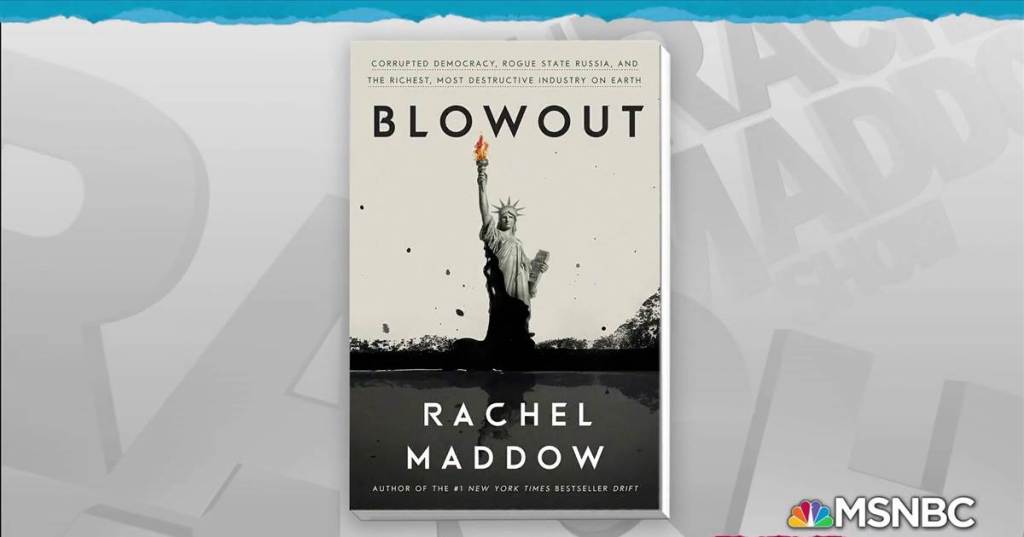
Blowout by Rachel Maddow – Book

Never would I have imagined that I would, by choice, read a book about oil and gas, but I found Blowout by Rachel Maddow both readable and sort of gripping. Except for a brief visit with Putin, as the title telegraphs the book begins with the BP Deep Water Horizon blowout and the oil leak which made it clear that while the industry has plenty of tools for drilling, it has almost none for clean-up. Rachel expresses incredulity that even now, in 2020, we still have only giant paper towels, dish detergent, and booms.

Once the Deep Water Horizon gusher is finally capped, Maddow has us shuttling back and forth between Putin’s Russia and Oklahoma City, In Russia Exxon Mobil under the leadership of Rex Tillerson signs a deal with Putin to drill using horizontal drilling techniques (fracking) in the Arctic releasing billions of gallons of oil and gas trapped in the ancient shale under the Arctic Ocean. 

In Oklahoma we follow the rather excessively risky Aubrey McClendon in his quest to frack every inch of Oklahoma and put Oklahoma City on the map. It is hard to say if Aubrey loves oil or Oklahoma City most, but he loves money over both. He is a wildcatter who somehow talks banks into allowing him to carry enormous debts, and he talks with government officials and the powers that be at Oklahoma University to hush up the emerging evidence of a connection between fracking and the numerous earthquakes rocking Oklahoma.

There are so many good oil and gas stories (all true) in Maddow’s book that I can’t begin to tell them all. The Russia saga alone has so much corruption and thuggery that it reads like a thriller, but it is not a thriller. It’s an actual chunk of world history that reveals how chasing oil and gas resources and profits is destroying our democracy every bit as much as the Republicans, the Fundamentalists, and Trump. 

Oil and gas are so tied to money and power that it becomes clear that the power people around the globe never had any plans to stop using fossil fuels. In fact nations were competing to tap oil reserves far under earth in difficult to reach places and either control the global flow of petroleum or have an independent long term supply. Putin even has dreams of getting Exxon Mobil to use their technical drilling knowledge to tap enough Russian oil and gas that Putin can become the sole supplier of oil and gas to the EU and thus be able to pull strings in as many EU countries as desired. He seems to dream of a mighty Russia, with imperialistic expansion back to the old boundaries of the Soviet Union (or even beyond) on his mind. Fascinating and frightening.

And we learn how money and powerful oil companies bought the Republican Party and turned them into the climate deniers they are, and why any attempts to bring alternative energies to the forefront and turn America into an engine of production in the emerging alternative energy markets were facing enough headwinds to keep them very small indeed. The book ends with notes on attributions for the information contained in each chapter. Blowout by Rachel Maddow is a very informative nonfiction offering by an Oxford scholar who also hosts an hour of news each night on MSNBC.