
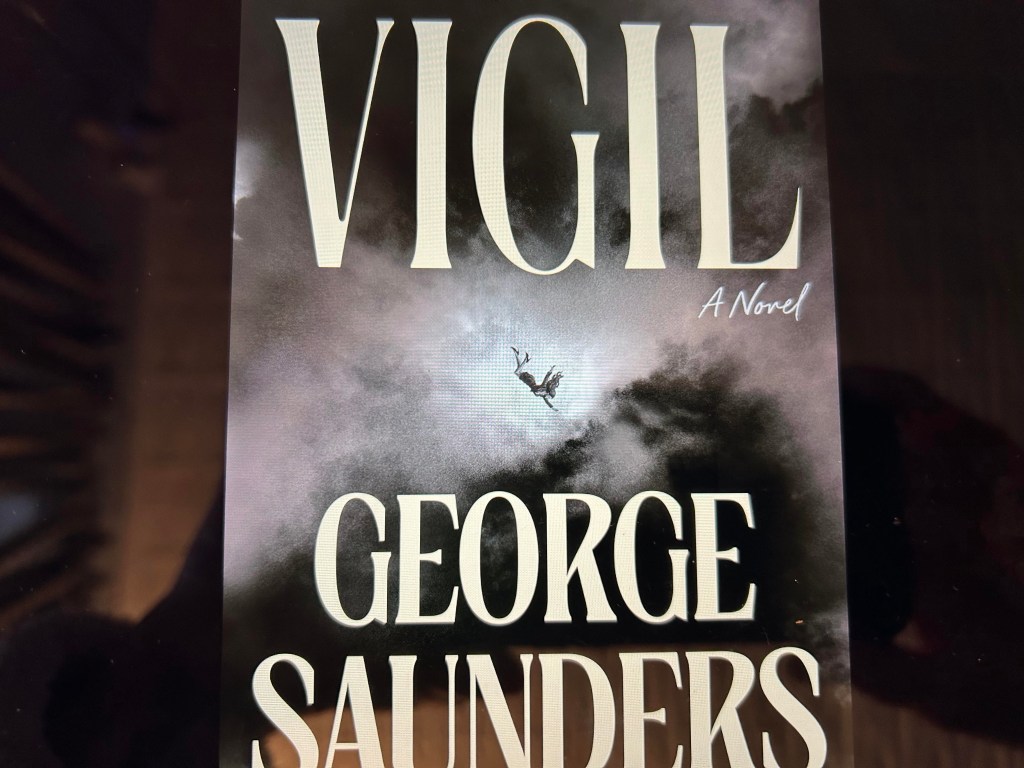
Vigil by George Saunders is full of death and ghosts, at least these eternal figures, many continuing to inhabit the site of their death and only able to see others who have died, seem to be ghosts. Some ghosts can travel, can “refresh” themselves. If they agree to perform a task assigned by God and become “elevated” they have many powers, but they must give up who they were in life.
Jill ‘Doll” Blaine is elevated, and she has been assigned the task of comforting people just before they die. She has comforted almost 340 people, but K. J. Boone looks to be the most difficult assignment she has had. Plus, she is suddenly wondering whether she wants to be elevated or not because she misses being Jill. Other ghosts who are not elevated remember their lives. She was very young when she got blown up by accident (when she turned the key in her husband’s car).
Of course, the whole ghost thing is just a conceit for some high-level philosophical thinking. K. J. Boone rose from humble beginnings to become a wealthy and powerful man. He and his wife Vivian, daughter Julie, traveled extensively when he became the owner of a large gas and oil company. It took skills to locate the best places to find oil and gas, to arrange to have it brought to the surface, and to refine and deliver it. Of course, he knew that people came to believe that pollution from burning fossil fuels was harming life on the planet. But he believed that oil and gas offered the best energy sources and that not using these fuels would cost him and his rivals profits. So what if he faked some science to convince the peons that burning fossil fuels had nothing to do with climate change and that men were too puny to affect nature on such a grand scale.
Now he lay dying and here was this young lady, this nobody, in her pink blouse, beige skirt and black shoes trying to get him to admit that he has been selfish, greedy, and mean, and that he had hurt the earth and everyone on it with his lies. Then there was that pesky Frenchman, the one who invented the engine that jump-started the Industrial Revolution, who kept popping in and out of his bedroom, who also wanted him to confess and admit that he was wrong to have inverted the scientific method. The ‘Mel’s came and went, toadies and rivals, long dead, who kept spawning new ‘Mel’s in unconventional ways.
There was a wedding going on next door in this upscale neighborhood and when the stench of the dying man’s sins became too great Jill would observe the party or even mingle unseen with the guests. This is how she became homesick for simple things she had enjoyed like lipstick. This is how she started to wonder if she had made the right choice to be elevated. This is when she begins to see that perhaps how people turn out is inevitable because of their birth and the events in their life. The world was certainly declining from its former beauty and the weather offered little certainly that houses would stand or there would be enough to eat. But what good did it do to try to get Mr. Boone to change his mind as he lay dying?
Plenty to think about in Vigil by George Saunders. (I did not realize that we reside in the same city, just a side observation.) Did I like the book as well as Lincoln in the Bardo? That story was so poignant, and so clever with all the ‘ibids’ and ‘opcit’s. We feel no grief for the dying K. J. Boone. We may feel some for Jill ‘Doll’ Blaine, but that’s not the point of the story. Perhaps placing blame for climate change is not important unless we can change the minds of powerful people who are living and can still do something about saving the tiny planet where we all live.
NB
My cousin William (Bill) Goodenough, now deceased, wrote a book that offered fake evidence intended to disprove climate change, so I was well prepared for Boone’s backwards science. (The Three Concepts of Climate Change: Is AGW Politics or Science?) If you begin with your conclusions (although you call these statements your hypotheses) and then set out to collect evidence that backs up your conclusions and ignores evidence that negates your conclusions, that is cheating. That isn’t science at all. It’s propaganda.

 So Many Books, Choose Wisely