From a Google Image Search – Chicago Review of Books
Sally Rooney wrote Intermezzo, a story of two brothers, the Kubek brothers. An intermezzo is an intermission. We meet the younger Kubek brother first. Ivan is in his twenties, and he considers himself socially awkward. All his previous encounters have not gone well. He would become filled with anxiety and unable to approach social situations with an acceptable level of poise. He used his alone time, and it was considerable, to become an expert chess player. When he goes to a small town to play some chess against amateur players, he meets a beautiful 36-year-old woman, and he becomes involved with her. She does not find him the least bit awkward.
Peter is Ivan’s brother. He’s 35 and dating the 20-something Naomi. Peter is also involved with Sylvia, who he intended to marry. She was in a terrible accident, and although he still loves her, she can’t be there for Peter as a wife because she lives with constant pain.
Ivan and Peter recently lost their father and have not yet dealt with the pain of their loss. Their parents were divorced when Ivan was quite young, and the boys lived with their father. Since Peter is so much older than Ivan, he soon went off to college. There is that dynamic of who did Dad love best. Losing their father throws them temporarily off balance. Does the title refer to the time spent adjusting to this major change in their lives?
Rooney add in some Wittgenstein, a physicist I find quite abstract (pg. 399). Schrödinger’s box makes an appearance. Conversations between Sylvia, a professor, and Peter were too esoteric for me, a reflection, I imagine, of their level of intellectual sophistication, and a contrast to Naomi, who is needy, pretty, good company and surprisingly wise for someone so young but no intellectual. I usually like brain puzzles to unravel but this time I will have to go back over that part of the book to see if it is worth trying to grasp what these two characters are saying, or if the author is just showing off her erudition. (Sally Rooney wouldn’t do that.)
“Something about fascism he says, and they go on walking, talking about fascist aesthetics and the modernist movement. Neoclassicism, obsessive fixation on ethnic difference, thematics of decadence, bodily strength and weakness. Purity or death. Pound, Eliot. And on the other hand, Woolf, Joyce. Usefulness and specificity of fascism as a political typology in the present day. Aesthetic nullity of contemporary political movements in general. Related to, or just coterminous with, the almost instantaneous corporate capture of emergent visual styles. Everything beautiful immediately recycled as advertising. The freedom of that, or not. The necessity of an ecological aesthetics, or not. We need an erotics of environmentalism.” (pg. 393)
Since the story takes place in Dublin and small towns nearby, the odd sentence structure may reflect local dialect. Sentences often seem to be written backwards to avoid the use of conjunctions. Is this a Rooney thing or an Irish thing. I do not know. I found it interesting but not annoying.
“Terribly childish wish he feels once in his life to do as he’s told.” (pg. 410)
Sally Rooney gives us characters who seem like real people we could meet and know. Ivan and Margaret, Peter, Sylvia, and Naomi could be friends of ours. How they deal with traumas in their lives, how they deal with nontraditional relationships, how they come of age, regardless of their age in years; these are the interactions that hold our interest. If the ending seems a bit too happy, I don’t mind.
Spies make for what is often edge-of-the-seat reading. Spy novels often offer references to obscure historical activities that may not have been universally covered by the media and which may have only been uncovered long after the actual events. John le Carré has long been considered the master of spy stories involving classic spy craft methods which may not work as well in our age of high tech. This may be why so many books about spying refer to WWII and its aftermath in the Cold War and the times when a wall divided East and West Berlin. The end of wars often leaves loose ends which reveal themselves much later. Now spying usually happens on a grand scale, as portrayed by events like China’s recent hacking of the US Treasury Department, and classic up-close and personal spying is out of fashion.
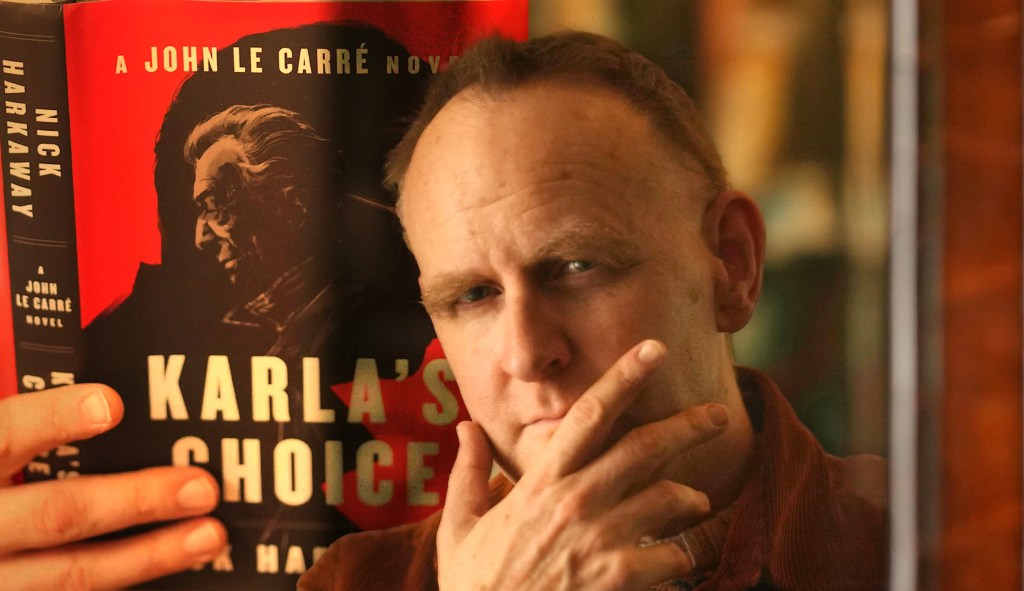
John le Carré has passed the torch to Nick Harkaway, his son. In Karla’s Choice Harkaway takes us to the Circus in London with all the quirky characters who help keep the world safe from the forces which oppose democracies. Harkaway also gives us George Smiley, called back from retirement to unravel a situation involving death and a man who is on the run. Smiley may lose his wife over this one.
Harkaway does a good job of capturing le Carré’s style, and the novel takes us back to post-war days. We tune into events happening behind the Iron Curtain as the runner, Róka, who left London leaving a dead man behind, is a Hungarian national with connections to Communism. The backstory of Róka is perhaps a bit too complicated. I found myself tuning some of it out. Harkaway’s inclusion of Szusanna, Roka’s secretary, lent complications to the operation which added value. Szusanna gave us a reason to stay interested enough to get to the real focus of this tale, Karla. Karla is an agent of Russia and has a reputation for being both brutal and ruthless. Smiley offers Karla a choice. Will he take it? Has the Circus lost some of its effectiveness since the end of the war? This is a good legacy book, but not a great one. It may not be due to the author’s skills as a writer but rather to all the ways the world of spying has changed. Still, we are lured on to solve the mystery of Róka.
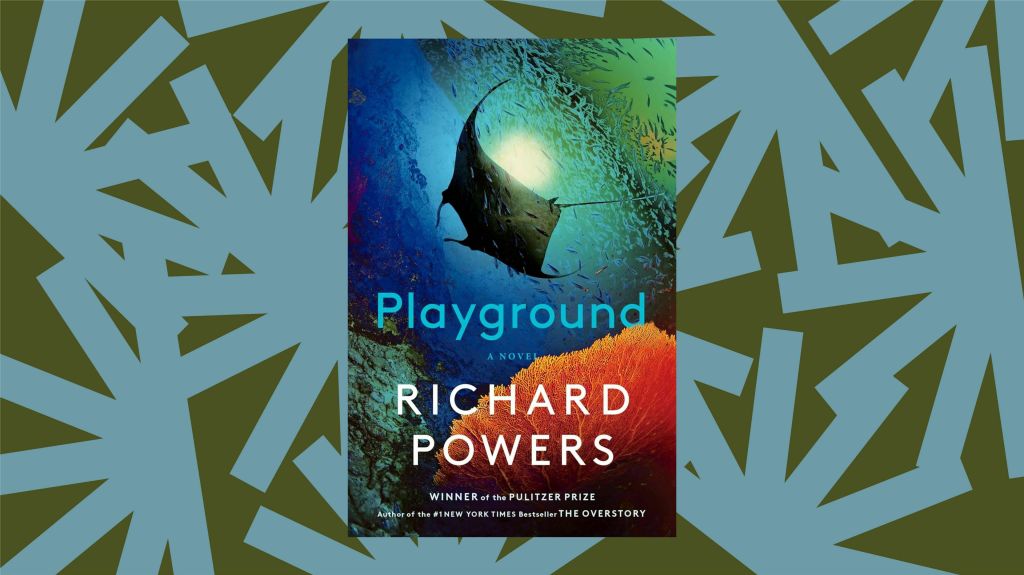
Did you know that fish go to cleaning stations under the ocean and other sea creatures vacuum them and clean their teeth? I didn’t. Did you know that fish and other sea denizens like to play, even sometimes with humans if they come around often enough. The ocean/s come alive in Richard Powers book Playground. The enormous variety of sea life, the bioluminescence divers see that we landlubbers don’t, the coral reefs, the way sea critters turn human trash into new coral reefs-it’s all fascinating and beautiful as Powers describes it.
But what antics creatures get up to underwater is not the only thread in this novel. Playground is also the name of a social media platform designed by Todd Keane that allows users to play and chat online, for a fee. And with the arrival of AI, the site gets more popular until Todd Keane is a billionaire.
But, before Keane earns his billions he meets Rafi Young in school. Rafi is a young black man. Both are from Chicago. Both love games. At first, they play chess. When they discover Go, the infinite variety of moves, the complex strategies lead them to replace chess. They play for hours and years before gaming even begins on the internet.
Todd Keane’s father worked in the pit at the Chicago Board of Trade:
“…a warrior of the open-outcry system, he stood in the heart of the octagon as the furious waves of capitalism crashed all around him.” (pg. 9)
Since Todd’s parents fought and made up loudly and often, he sought solace under Lake Michigan. “When I was young, I could breathe underwater.” (pg. 12) Todd and his father played a series of classic games until they got to Backgammon. Eventually Todd could beat his father every time. Todd came from a wealthy family.
Todd’s father lets him choose a book. He chooses “Clearly It Is Ocean” by Evelyne Beaulieu. Eva’s dad helped invent the first aqualung and he had his daughter take it for a test in the pool. Eva learns to dive, even meets Jacques Cousteau, and travels to coral reefs until she ends up on Makatea.
Rafi Young’s father was a Chicago firefighter. When his mom worried about him walking to school through a tough neighborhood, she made him wear a bright orange coat and hat which solved the mom’s problem but made Rafi’s life worse. When his father heard about all this, he punched Rafi’s mother in the face. Divorce followed, and poverty.
While Todd pursues a degree in math and excels with computers, Rafi earns a PhD in educational psychology. They meet Ina Aroita, born in Honolulu to a Navy family and raised on naval bases in Guam and Samoa. For a while it seems that both men fall in love with Ina. It is Rafi who marries her and becomes a teacher on the island of Makatea where he and Ina adopt two orphaned children and Ina becomes an artist. Todd is the only character not living on Makatea. In fact, Todd and Rafi have had a falling out and Rafi doesn’t speak to Todd. Will there be a reunion? My lips are sealed.
Here’s what Todd has to say about the picture book, “Clearly It Is Ocean.” “Thirty thousand kinds of fish. Fish that migrated their faces across to the sides of their bodies as they grew. Fish whose barrel heads were transparent, revealing their brains. Fish that changed from male to female. Fish that grew their own fishing rods out of their heads. Fish that lived inside the bodies of other living creatures.” (pg. 24)
Makatea, a French colony, was found at one time to be a major source of phosphates, most often used in fertilizer. The discovery of phosphates multiplied the amount of food farmers could produce. Given the exploding population on Earth, the demand was huge and the island was exploited for years. Then the mining companies left, and the island’s population fell to 82 humans. Two of these humans were Rafi and Ina. Evelyne Beaulieu, now 92, lives there also, still diving.
Now, a mysterious company wants to build a “seasteading” community at Makatea, throwing the residents into a panic because they remember what happened in the phosphate situation. It will bring jobs, a new clinic, and a high school. What will it do to the reefs around Makatea? How will the people vote? Is constant growth necessary and healthy for our societies and our planet? Here we have a mashup between AI and the health of Earth’s oceans and the whole wonderful, barely experienced, watery environment and all the living creatures in it. What will it be like to live on a planet whose oceans are no longer teeming with life, a dead ocean? What choice does the island make, and how is Todd Keane involved? What choice would you make?
“In the last chapter (of “Clearly It Is Ocean”), the woman I crushed on with all my ten-year-old heart told of a research trip she had made off the coast of Eastern Australia. She stopped one day in the middle of a dive to watch a giant cuttlefish near the mouth of its den. This tentacled mollusk, kin to squid and octopus, was performing a long wild color dance for no one.” (pg. 34)
It is not easy to talk about extinctions and the destruction of biomes when everyone is madly striving to be a millionaire or billionaire. Taking care of declining habitats and populations of creatures that are basically invisible to us and are dying off doesn’t get much viral attention on social media. Powers’ book does a good job of focusing on our choices between capitalism’s drive to perpetual growth, which is pursued mostly to feed people’s greed, and the importance of play to all living things. He reminds us that the oceans surrounding us are full of fascinating life forms and that we need to help them stay that way. This is not a preachy book. It’s especially great when Eva is underwater.
When Neal Stephenson takes us on a fictionalized historic journey, it will be an improbably wild adventure. However, there will be a contemporary connection. It’s not easy to write social commentary that is both outlandish and entertaining. This is Stephenson’s talent. In Polostan: Volume One of Bomb Light: A Riveting Epic of International Espionage, he combines politics (communism), polo, and physics. How does life unfold for the child of a marriage between a cowgirl and a political activist? Dawn is the child of such a union, and she ends up with two names, two countries, an attachment to tommy guns and Bonny and Clyde, a skill for hitching rides on trains, and for training polo ponies.
In Montana and Wyoming with her mom, she is Dawn Rae Bjornberg. In Chicago with her dad, she is Aurora Maximovna Artemyeva. Out west she trains polo ponies and is privy to the family less-than-legal business concerns. In Chicago she is a socialist activist. When her mom dies of cancer Dawn/Aurora lives full time with her father. Aurora was born in St. Petersburg, renamed Leningrad, and lived there until she was 5. Her parents left from Vladivostok and arrived in Seattle. Her father is dedicated to the Bonus Army, the Bonus Expeditionary Forces of Walter W. Waters (a real person). Her dad is a Red American and a vet. When the Bonus Army gathers in Washington DC (in the 1930s) her father (a Wobbly and a communist) is killed.
Aurora finds herself orphaned and pregnant at 16 after adventures with x rays and a budding physicist who educates her about atomic particles (neutrons had not yet been discovered). She is bilingual with good skills in both American English and Russian. She decides to retrace the steps of her parents and to return to Russia through Seattle. Russia, now the Soviet Union, does not exactly welcome her with open arms.
Comrade Tishenko (described as “a jumped-up peasant) finds her bizarre background difficult to believe. Soviets are paranoid. They see enemies everywhere, “blockages in the Soviet system” from foreign capitalists, cliquism, Jews, inherited rural backwardness, opportunists, hooligans, ineradicable counterrevolutionary tendencies in the Russia Orthodox Church, wreckers, diversionaries, kulaks, Petliurite scum, national deviationists, backsliders, actively malevolent foreign agents, witting and unwitting accomplices. She has to keep explaining why she is fluent in both English and Russian. She is tortured by the OPGU. Read the book for all the gory details.
She meets Fizmatov, who holds a PhD in physics from the University of Paris, helping with the steel factory that is being built at Magnitogorsk. His children are named Electron and Proton. Fizmatov (who made up his name by combining Phys and Math) and Aurora bond over physics. He helps her when he can. Aurora has a tommy gun secreted in the bottom of her trunk. When the Soviets learn of Aurora’s past with training polo ponies in the American West, they find the niche that will allow her to survive for a while. She also is sent out to recruit talent for the steel factory that the Soviets hope to build bigger than the one in Gary, Indiana.
Don’t be fooled by the seeming chaos of Stephenson’s version of history. Anecdotes, even far-out anecdotes, often help his messages go down. Since this novel is only Volume One of Bomb Light, I look forward to where he will take us. He took us on a similar historical journey in his Quicksilver trilogy. It may be the hippy in me that appreciates Neal Stephenson’s strange mashups. He always presents me with a new perspective on current issues and the role of cutting-edge science in modern political power struggles (and their applications to warfare).
Although Cormac McCarthy seemed to dismiss physics as an answer to our current climate dilemmas in his book The Passenger, Stephenson seems to maintain a wait-and-see attitude towards the matter in Polostan. Since America is flirting with authoritarianism, Stephenson may be trying to show how disappointed people were in the 1930s when communism was not living up to its promises.
Indirectly, with several degrees of separation, Thomas Wolfe’s book Look Homeward, Angel was recommended to me by Dustin Hoffman. My literary education did not extend to the Southern authors, although William Faulkner is also considered a classic American author, so he made the cut. Thomas Wolfe is an amazing writer, writing dense prose descriptions that, in this case, tended to emphasize the seasons. The seasons mirror the moods of the characters. The book is a tome. It’s long and the small print was tough on my old eyes, so I read along while I listened to the book on tape.
Look Homeward, Angel was published in 1929 when the author was 29. He was born in 1900 and grew up in Asheville, North Carolina, which Wolfe called Altamont in his book. It was sad to read this as a flood was devastating Asheville in 2024. Wolfe died when he was 37 years old of tubercular meningitis which the internet tells me was too advanced to treat. The book is not as popular today as it probably should be because of the presence of African Americans in terms that we have learned to avoid as culturally hurtful and therefore inappropriate. If you can ignore the outdated historical elements and concentrate on the other content, you will find a master of prose writing and the legacy of an education in the classics.
The novel is considered autobiographical in nature. William and Eliza are the parents of Daisy, Steven, Ben, Grover, Luke, Helen, and Eugene. Eugene is the character who represents the author. He is a brilliant kid and gets special attention from his teachers who recommend a private school for him. This is not an easy choice for his frugal parents who are also rather laissez-faire parents. Mary Leonard runs the school that sees to it that Eugene is treated like the gifted child he is.
Wolfe attributes these sensory memories to Eugene at the age of five:
“He had heard already the ringing of remote church bells over a countryside on Sunday night; had listened to the earth steeped in the brooding symphony of dark and the million-noted little night things; and he had heard thus the far retreating wail of a whistle in a distant valley, and faint thunder on the rails; and he felt the infinite depth and width of the golden world to the brief seductions of a thousand multiplex and mixed mysterious odors and sensations, weaving, with a blinding interplay and aural explosions, one into the other.
He remembered the East India Teahouse at the Fair, the sandalwood, the turbans, and the robes, the cool interior and the smell of India tea; and he felt now the nostalgic thrill of dew-wet mornings in Spring, the cherry scent, the cool clarion earth, the wet loaminess of the garden, the pungent breakfast smells and the floating snow of blossoms. He knew the inchoate sharp excitement of hot dandelions in young Spring grass at noon; the smell of cellars, cobwebs, and built-on secret earth; in July, of watermelons bedded in sweet hay, inside a farmer’s covered wagon; of cantaloupe and crated peaches; and the scent of orange rind, bittersweet, before a fire of coals. He knew the good male smell of his father’s sitting room; of the smooth worn leather sofa, with the gaping horsehair rent; of the blistered varnished wood upon the hearth; of the heated calfskin bindings; of the flat moist plug of Apple tobacco, stuck with a red flag; of woodsmoke and burnt leaves in October; of the brown tired autumn earth; of honeysuckle at night; of warm nasturtiums; of a clean ruddy farmer who comes weekly with printed butter and eggs and milk; of fat limp underdone bacon and of coffee; of a bakery oven in the wind; of large deep-hued stringbeans smoking hot and seasoned well with salt and butter; of a room of old pine boards in which books and carpets have been stored, long closed; of Concord grapes in their long white baskets.
Yes, and the exciting smell of chalk and varnished desks; the smell of heavy bread sandwiches of cold fried meat and butter; the smell of new leather in a saddler’s shop, or of a worn leather chair; of honey and of unground coffee; of barrelled sweet pickles and cheese and all the fragrant compost of the grocer’s; the smell of stored apples in the cellar, and of orchard-apple smells, of pressed cider pulp; of pears ripening on a sunny shelf, and of ripe cherries stewing with sugar on hot stoves before preserving; the smell of whittled wood, of all young lumber, of sawdust and shavings; of peaches stuck with cloves and pickled with brandy; of pine sap, and green pine needles; of a horse’s pared hoof; of chestnuts roasting, of bowls of nuts and raisins, of hot cracklin’, and of young roast pork, of butter and cinnamon melting on hot candied yams.” (pg. 69)
Wolfe occupied a world far richer in smells than our own, but still, you can almost smell it all, and there is more on the next page. But as Eugene grows up his thoughts become concerned with deeper considerations such as “why are we here,” “does it matter what we do”, and as many have wondered, “is there anything after this.
In a last imaginary conversation with his (dead) brother Ben:
“And in his vision he saw the fabulous lost cities, buried in the drifted silt of the earth–Thebes, the seven gated, and all the temples of Daulian and Phocian lands, and all Oenotria to the Tyrrhene gulf. Sunk in the burial urn of earth he saw the vanished cultures: the strange sourceless glory of the Incas, the fragments of lost epics upon a broken shard of Gnossic pottery, the buried tombs of Memphian kings, and imperial dust, wound all about with gold and rotting linen, dead with their thousand bestial gods, their mute unwakened ushabtii, in their finished eternities.
He saw the billion living of the earth, the thousand billion dead: seas were withered, deserts flooded, mountains drowned; and gods and demons come out of the South, and ruled above the little rocket flare of centuries, and sank–came to their Northern Lights of death, the muttering death-flared dust of the completed gods.
But, amid the fumbling march of races to extinction, the giant rhythms of the earth remained. The seasons passed in their majestic processionals, and germinal Spring returned forever on the land–new crops, new men, new harvests, and new gods. (pg. 506)
…
“And rising from his vision he cried: I am not there among the cities. I have sought down a million streets, until the goat cry died within my throat, and I have found no city where I was, no door where I had entered, no place where I had stood.
Then from the edges of moon-bright silence, Ben replied: Fool, why do you look in the streets?
Then Eugene said: I have eaten and drunk the earth, I have been lost and beaten, and I will go no more.
Fool, said Ben, what do you want to find?
Myself, and an end to hunger and the happy land, he answered. For I believe in harbors at the end. O Ben, brother, and ghost, and stranger, you who could never speak, give me an answer now!
Then, as he thought, Ben said: There is no happy land. There is no end to hunger.” (pg, 507)
The book is a trip, a trip to another time, the mind of another person, yet has a familiar humanness we can understand. There are angels but I will let you discover them for yourselves. Families play an enormous role as we are “coming of age.” Eugene Gant is no exception. His parents are quite unique, and it’s easy to see the connection between how parents treat children and life’s challenges and how their children grow and develop. If there had been shrinks as available as today in the late 1920s, would Wolfe’s confessions and philosophical digressions have been expressed with such depth? Would there be angels?
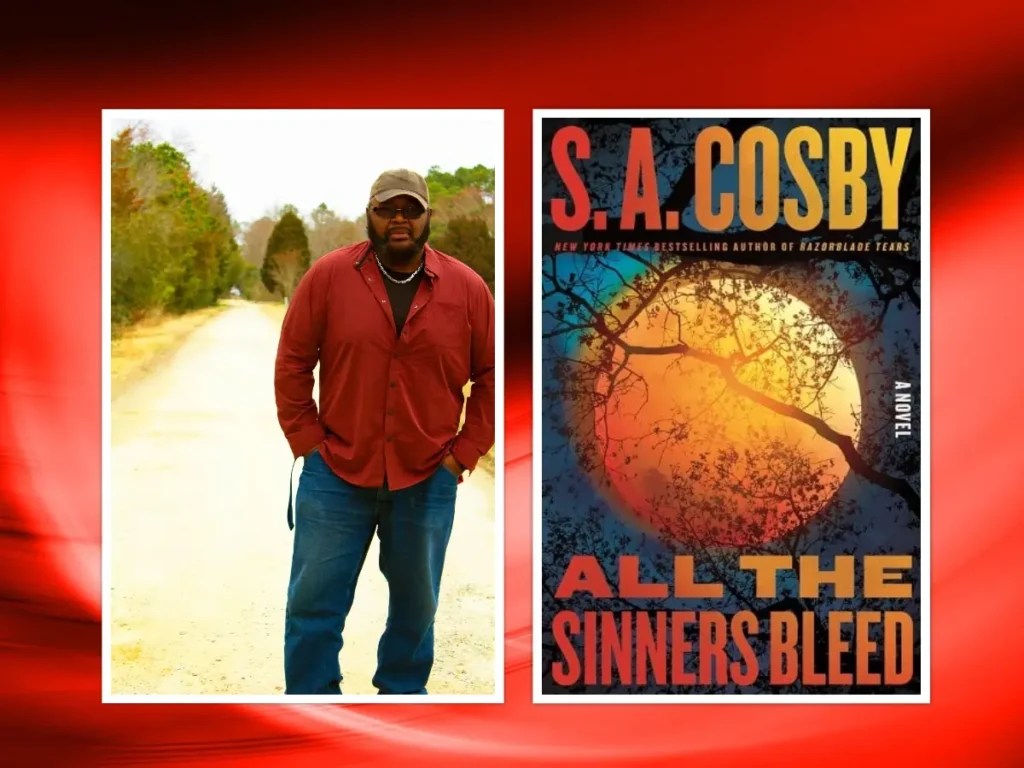
Listening to All the Sinners Bleed by S. A. Cosby comes with the bonus of the reader’s accents, all Southern dialects that vary according to which character is speaking. The accents all share similarities since one reader is speaking but it works and adds flavor to the story. I am listening to books again temporarily because I saved up credits from before my cataract surgery when I couldn’t read print books easily. After briefly subscribing to Audible + I ended up with 6 credits to spend – a dream scenario for a reader.
Charon County (Virginia) has been associated for decades with dark deeds and evil events, perhaps a negative karmic gift that resulted from the mythical reference it was saddled with, and because it was founded in bloodshed against indigenous people, “sown with generations of tears.” “The South doesn’t change” says the author.
Titus is, by some miracle, the first black sheriff of Charon County. Dressing for his day is described with ritualistic echoes of warriors preparing for battle. It’s a good thing Titus is prepared because this is no ordinary day in Charon County. Just as he finishes dressing with his bulletproof vest underneath and his gun belt strapped to his waist, his radio squawks and the news is that there is a school shooting in progress at the high school.
Although mass shootings are right out of the headlines of the moment, it turns out that only one person has been killed. This was a targeted hit. The shooter is a local guy, Latrell (hard to get spelling right from listening to a book). He has killed a very popular teacher of 9th grade geography who has a reputation for going out of his way to help needy students, Mr. Spearman. Why? Titus had hoped to find out by questioning Latrell, but Latrell committed suicide.
What follows is an investigation that uncovers some grisly, hateful, and secretive actions that will weigh heavily on this town for many years to come. These activities do not speak kindly of the darkest bits of human nature, but the author addresses legitimate concerns about real world events. However, this is a mystery novel and not a book that attempts to sort out the human dilemma.
While not for the squeamish, readers will read on to find out the identity of a man who wears a wolf mask to commit heinous acts that act out his deep psychological pain. Titus, an ex-FBI agent, has a warm relationship with his father Albert and his brother Marquis. He has a current girlfriend (Darlene) and an ex-girlfriend (Kelly). These are the core characters showing us a sheriff who is well-adjusted, dedicated to justice, and a bit clueless when it comes to women. Good characters make good books better. If you like mysteries this one is well worth reading.
In Lucky, a novel by Jane Smiley, the author gives us a whole life – the life of fictional folk singer Jodie Rattler. Sadly, Smiley, describes what sounds like an exciting life in a rather monotone and unemotional way. Written all in first person, Jodie rattles off what she did first and what she did then, offering up the tick-tock of her life.
She’s an adventurous character who takes money from a successful day at the races and squirrels it away as a good luck talisman. She writes songs, tours with bands, cuts records but never reaches rock star status, seemingly by choice. Jodie lives in New York City, London, in a cabin she buys in the Hudson Valley, and on and off in St. Louis. Her Uncle Drew helps her recording royalties grow from one to 8 million dollars. Lucky. Jodie, like many women who are freed by the pill has sexual adventures. Unlike many a brokenhearted real live girl, she chooses her men wisely. Although left with many fond memories she decides to stay single and not have children. She meets many people at her concerts, at her gigs, and as she travels but does not keep them as close friends, something she comes to regret and works to change.
Smiley also offers us a love story to a city, the city of St. Louis. Jodie loves to walk around the neighborhoods she admires in St. Louis and repeats the names these neighborhoods are known by. She stops her musical travels and comes back to St. Louis to take up parental caregiving duties as many of us have been called on to do. Caregiving teaches many lessons. In the end Jodie weighs in on current political anxieties and her own gratitude and regrets.
It’s a slow book, but Jodie lived through times familiar to many of Jane Smiley’s readers. Jodie’s lyrics did not connect with me, but it seems there could be many worse lives than that of a musician. I liked the novel but didn’t love it. (OK, perhaps spending too much time on Facebook.)
Elliot Ackerman and James Stavridis have written a book about the future with the title 2054, a follow-up to their book 2034. The government in America is divided between two dueling parties, the Truthers and the Dreamers, that I had difficulty differentiating. There is also an ancient obstructer in the Senate named Wisecarver, who might remind you of Mitch McConnell. To please both factions the President and Vice President are not from the same party. A Civil War seems to be brewing.
President Castro, a seemingly healthy middle-aged man, dies suddenly of a heart attack. After examining the President’s heart there are indications that it has been genetically edited. This is not the same heart that the doctors have examined in the past. Has someone figured out how to edit genes from a distance? Has someone managed to create the Singularity? Can humans and computers now merge? Why does anyone want to pursue the Singularity when the technology carries with it a strong possibility of human extinction? President Castro was not a popular figure, and he is soon replaced with President Smith, previously Vice President Smith. Divisions escalate.
Besides what is going on in the government of America there is a cast of characters who are involved with gene editing and who are trying to trace down those who were working on this science and on the Singularity. Sarah Hunt who has recently died or disappeared is a key figure although we are left with her daughter Julia Hunt because most people believe that Sarah Hunt is dead. Julia, who has been working in the government is also a marine, who is sent back to her barracks under the new administration. We have BT and Michi in the hunt for Dr. Kurzweil, and we have Lily Bao, involved in a secret relationship with Nick Shriver, the new Vice President, but also pursued by Zhao Jin of China who wants her to come home. We also have Ashni traveling with her dad. She is trying to find Dr. Kurzweil because he is the last hope for keeping her father alive. Several groups set off at the same time to find Dr. Kurzweil who has retreated into isolation and who has been working on both gene editing and the Singularity.
This is a good story, but it is quite complicated and just reading it makes more sense than trying to explain the plot twists. What makes the book interesting is the relevance to currently trending topics and situations. Although I found it to be all plot and little substance some of the characters did connect with me well enough that I was interested in what was happening to them. The ending surprised me and perhaps it will surprise you too. This is a book to entertain you on a quiet Sunday afternoon or a sleepless night. The authors weigh in on whether we should try to create the Singularity.
Tommy Orange continues the story of the Red Feather and Bear Shield offspring from his book There There in his new novel Wandering Stars. We have already learned of the Trail of Tears from history class (maybe). We are removed in time from these sorrowful events, but we still bear the shame of our ancestors’ cruelties. Jude Star’s story opens the novel as the most distant traceable ancestor of the children in this story.
We are reminded that wars are always cruel and colonial wars are even crueler because they will always erase or reduce the powers of one party or the other. Jude Star ends up in a prison-castle in Florida from which he eventually escapes. Jude and Hannah Star’s son Charles Star and Opal Bear Shield have a daughter, Victoria Bear Shield. From one partner Victoria gives us Opal Viola Victoria Bear Shield, and from another partner Victoria gives up Jacquie Red Feather, the grandmother of the four children in the Red Feather clan who are being cared for by Opal Viola Victoria Bear Shield who is not their grandmother but who shares a mother with Jacquie.
Orvil, our focal character, has recovered from being shot by a terrorist. This happened the first time he went to a Native American celebration where he danced in public. Of course, even when you physically recover from a near-death experience, your spirit may not heal. It could take time, or it could be psychologically fatal.
Jude Star is the name chosen for Orvil’s ancestor when he is imprisoned in Florida and attempts are made to force former member of tribes to “assimilate” and forget their traditional lifestyles and beliefs. The Star men are wanderers who cannot find their place in an America captured by white folks, white folks who cannot see a way to live beside the people they fought with over this land.
Opal, who now heads Orvil’s family, has changed the fate of the Star offspring. She has purchased a house in Oakdale, California where Orvil, Loother, and Lony can find some stability as a created family. The grandmother Jacquie lives nearby and helps when she can. Opal pays tuition to send Orvil to a good school. The family is about to learn that stability is always in danger from outside forces over which they have little control. Orvil needs pain meds. He is on opioids for pain but when they are no longer prescribed, he must find other sources. He is addicted. This leads the whole fragile little family down a sad path that makes it hard to believe that even the best of intentions can turn some lives around.
Things turn out better than you might ever think, but the family loses its nascent cohesiveness. Colonialism has consequences and Tommy Orange wants us to know that.
Tommy Orange’s books have a historical and cultural significance quite apart from their literary bona fides. They are authentic expressions of a person and a people trying to preserve their culture whose values were expressed by the way they lived lightly on the earth and by rich spiritual traditions. Placed alongside the materialism and power struggles of a culture that is so antithetical to the lived beliefs of America’s indigenous people the contrasts and challenges are clearly exposed in Orange’s novels. Here is a young voice we don’t often hear from illuminating the torn souls of a proud people or set of people with much to offer, especially the way to live lightly on the earth part.
Picking the next book to read is often problematic, a momentary panic sends me back to my book lists scribbled casually in notebooks full of political research, budget info, wordle episodes, drafts of essays, and wish lists. So many tantalizing titles are published each year that my list often leap frogs on to the newest releases without ever finishing with the older lists. There is always guilt and regret. Sometimes I wish I was a Large Language Model filled to the brim with all the world’s great literature and turned into a more well-rounded individual through a corresponding grasp of math and science. I read by instinct and thankfully there are so many excellent choices that I am rarely disappointed.
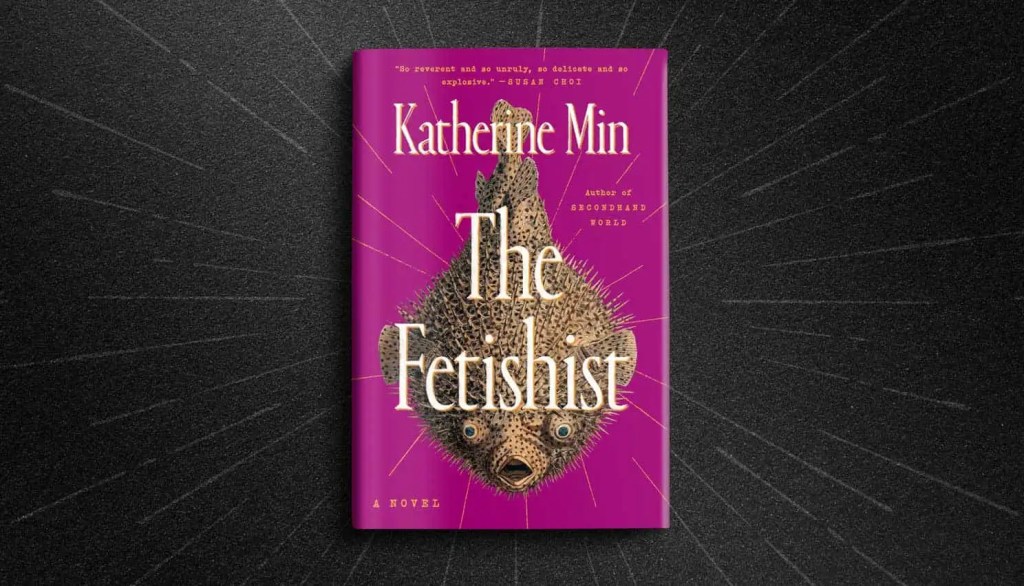
I stumbled upon Katherine Min’s book The Fetishist and once again I was not mislead by my instincts. This is a book for grownups. The book was published posthumously by Katherine Min’s daughter. The content is sophisticated and serious; fantastical and funny. Alma is sometimes the narrator and always the main character. She was a famous cellist who toured worldwide and sat in the first chair in global orchestras. She started playing at the age of 5 and by 11 she was obsessed with the cello.
“It was very physical, more like dancing than playing an instrument, and all her life Alma had felt this weirdly mystical space, the notes like steps, like gestures, the music like breath, like breeze, and the feeling of wide-ranging freedom, of expanse and embrace, and of always ending up somewhere else.” (p. 38)
Alma has MS and can no longer play the cello. Her body betrays her. Her fame is real, but it is a thing of the past. She has plenty of time to think back over her life. Alma fell in love with Daniel, a charming man, a fellow musician, and a womanizer. Daniel had commitment issues. Daniel also gets to narrate at times. Daniel, on an impulse, bought Alma an engagement ring, proposed, and then got caught by Alma doing the deed with Emi, another musician, another Asian musician. Daniel and Alma were engaged for about 5 minutes just before Alma had a very public medical episode that ended her life as a cellist.
“…and because being in a coma means having a lot of free time on your hands and the vagaries of the human brain are such that you never know what will pop into your head at any given moment. Alma finds herself surveying the fetishists she has known over the years. Ri-i-i-sssss kkk-iii-nggggs, rice chasers, Asiaphiles, victims of that mysterious disease known as Yellow Fever. Every Asian woman knows the generic type, but Alma, classical musician, world traveler, and unconscious taxonomist, breaks them down into three categories. 1) The cultural ambassador, 2) The carnal colonialist, 3) The rational revolutionary. (These are covered in more detail.)
A parade of rice kings wherever she went lecherous, treacherous, beseeching–enfolded like origami, bent like bonsai, draped in silk, and embellished with hanzi–presenting themselves like gifts to a foreign bride.” (pp 77-80)
This is the meat of the matter and there is more. Does Daniel pay for his sins? Revenge for Alma was banishment, cutting Daniel off, but her MS weakened the gesture as she no longer felt desirable. Someone else takes on the revenge of Daniel as his past leads to the most unusual kidnapping and Daniel’s mental reckoning. Kornell and Kyoto have their reasons.
This book is a literary gem, while offering an activist view against “Asiaphiles” who have given us terms like “Tiger Lily, China Doll, Geisha Girl, Baby-san, Miss Saigon, Suzie Wong, Me Love You Long Time, Goddamn Madame Butterfly!” (p 80) How you make a book with an axe to grind into a humorous and classy adventure is by being a talented writer; a writer who will entertain us no longer. This is our loss. Books, like music, take us “somewhere else.”







 So Many Books, Choose Wisely