I picked Madhouse at the End of the Earth by Julian Sancton late one night thinking it would be a sci-fi book. In small print the cover said “The Belgica’s Journey into the Dark Antarctic Night” which would have been a clue if I had read it. But it ends up that this journey, one of the first to Antarctica reads like science fiction, although it is a factual account of an expedition to a piece of our own planet that has an environment as alien as any you might encounter in space. It has air humans can breathe, but the behavior of an ice field is treacherous, the cold temperatures are unfriendly to human life, and isolation and severe weather take a toll. What drives men to go on risky adventures, to put their very lives on the line for fame and fortune, science, and curiosity? What drives them to want to simply be first?
Adrien de Gerlache de Gomery of Belgium does not want to do as his family expects. De Gerlache wants to go to sea. Belgium has a tiny navy consisting of only two ferries, but de Gerlache finally is allowed to earn credentials as a navigator after which he joins the navy. King Leopold, his king offers to send him on an expedition to the Congo, but de Gerlache wants to go to Antarctica. He raises money, finds a ship (the Belgica), hires sailors and scientists and after three years of planning sets sail for Antarctica. He wanted to use an all-Belgium crew, but it proved impossible. He left with his friend Danco, Georges Lecointe (28), his captain, an experienced Arctic explorer, Amundsen, and a crew that spoke a variety of languages (French, Dutch, Norwegian, German, Polish, English, Romanian, Latin). The best bit of luck de Gerlache had was when he took on Dr. Cook who met the group in South America and saved many lives on the ship by his Arctic experience and his great good sense.
From a Google Image Search – Wikipedia
De Gerlache made a fateful decision to spend a winter frozen into the Antarctic ice pack because he wanted to continue when summer returned to find the Southern Magnetic Pole. Early adventures on the ice revealed a lovely canal that opened between glaciers where perhaps the expedition spent too long collecting scientific data. By the time they moved on winter was upon them. Thankfully there were men on this expedition who loved to pit themselves against nature, the harsher the better. De Gerlache, suffering from scurvy, never having trekked the cold places, was not one of them, but he was an excellent navigator. He made the decision to spend the winter in the ice pack deliberately and the hardships that ensued should have been laid at his feet, but he never reaped the criticism he deserved, although he did not come off unscathed either.
The expedition undertaken by de Gerlache for family, nation, and science was intended to give Belgium a place on the world stage and it did succeed somewhat in this regard. But it was the Order of the Penguin, the risk-takers, the experienced polar travelers who saved the lives of the men of the Belgica and the reputation of de Gerlache. Lecointe, the 28-year-old captain, Amundsen and Cook, the Arctic explorers brought experience to bear.
Even so, trapped in an ever-changing field of ice and watery channels that opened and closed at a whim, trapped in a season without sun day after day, riddled with scurvy due to a lack of fresh food, life aboard the creaking ship became a madhouse in the sense that holding onto sanity became a challenging legacy of ice and night that no one had foreseen. Obviously, the mental state of participants in extreme conditions presented explorers of Antarctica with information on a subject they had not included in their scientific considerations and studies. Madhouse at the End of the World is a well-researched and detailed presentation of the journey of the Belgica and of the men who went on that expedition. It is also an engrossing read.
Jane Goodall and her work with chimpanzees in the wild always fascinated me because it seemed brave for a woman raised far from the African bush to adjust to living with the heat and the bugs so close to the soil where she had to sit for hours and hours among the chimpanzees in Gombé to get them to accept her as part of the landscape and eventually befriend her.
Jane Goodall tells us in The Book of Hope from the Global Icons Series, in conversation with the author Douglas Abrams, that she often got discouraged, suffered scratches and sores, and once had a near death experience when she fell down a hill in the company of an enormous rock which could have crushed her. Although she had worked with Louis Leakey on his digs in Africa looking for human bones and animal bones that might offer clues to evolution, she was often afraid that her grant money would run out. Interesting to note that as a woman could not venture out into the African forests by herself, Jane’s mother went with her in the early years and was a great help. But how did she continue to hope that one day she would be able to interact with the chimpanzees in their wild habitat? She is perhaps the perfect person to talk to us about hope in these times that seem hopeless.
The book is full of anecdotes which makes it very personal. Storytelling often spices up deep philosophical discussions and takes them from the realm of the sublime and esoteric to a level that makes the abstract real and comprehensible. As the local people started to challenge the ability of the chimpanzees at Gombé to survive, as locals began to cut down the forests that provided habitat for them, as they began to hunt them for food and capture baby chimps to sell as pets, the numbers of chimpanzees dwindled and extinction looked imminent. Rather than criticize the local residents, Jane tried to understand why this was happening. She came to an awareness that this was due to the poverty of the residents, and that unless the poverty was addressed the extinction trend would continue. Through an agency she and others founded, microloans offered to help residents buy farm animals or seeds, to help them accumulate wealth and build schools and maintain fresh water supplies. Once the standard of living rose nature was left alone to bring back the forests and bush lands that the chimpanzees needed to survive and thrive. She shows us how her intimate knowledge of the needs of the species allowed her to made decisions that were wise for both humans and animals, and incidentally for the environment.
Jane Goodall says that we must solve four great challenges and that working on solving these challenges will offer us hope for the future sustainability of all living things on this earth. Even plants are alive. All things on earth, under it, and above it are interconnected.
#1 First we must alleviate poverty. “If you are living in crippling poverty, you will cut down the last tree to grow food. Or fish the last fish because you’re so desperate to feed your family. In urban areas you will buy the cheapest food-you do not have the luxury of choosing a more ethically produced product.”
#2 We must reduce the unsustainable lifestyles of the affluent. Let’s face it, so many people have way more stuff than they need – or even want.
#3 We must eliminate corruption, for without good governance and honest leadership, we cannot work together to solve our enormous social and environmental challenges.
#4 We must face up to the problems caused by growing populations of humans and their livestock. There are over 7 billion of us today, and already, in many places, we have used up nature’s finite natural resources faster than nature can replenish them and by 2050 there will apparently be closer to ten billion of us. If we carry on with business as usual, that spells the end of earth as we know it. (pg. 59-60)
Jane Goodall tells us she was shy, and she describes the first speech she gave in public and says that now she speaks to people all around the world. She tells them and us, her readers, that these environmental and cultural challenges are not insurmountable. She blames our current dilemma on a “disconnect between clever brains and compassionate hearts.” “True wisdom requires both thinking with our head and understanding with our hearts.” We are left with the feeling that we could solve the problems facing us and wondering if we will find the wisdom to do it.
Even if Oprah had not chosen Isabel Wilkerson’s book Caste: The Origins of Our Discontents for her book club this book was destined to become a classic about caste and the role it has played in Hitler’s Nazi Germany, that it still plays in India, and the role it plays in America. We don’t often call the racism we practice against African Americans a caste system, but Wilkerson feels that something that began with enslavement of humans from the African continent has become set in the kind of same kind of stone as the caste system in India. Further she believes that America’s treatment of African Americans after slavery informed the definition of Aryans as the only people with genetics pure enough to remain in the new Germany under the Nazi regime. She has done her due diligence and backs her contentions up with plenty of anecdotes and quotes from those who wrote to preserve the system, and those who wrote to end it.
Pg. 32 “In the winter of 1959, after leading the Montgomery bus boycott that arose from the arrest of Rosa Parks and before the trials and triumphs to come, Martin Luther King, Jr., and his wife, Coretta, landed in India, in the city then known as Bombay, to visit the land of Mohandas Gandhi, the father of nonviolent protest. They were covered with garlands upon arrival, and King told reporters, “To other countries, I may go as a tourist, but to India I come as a pilgrim.”
“One afternoon, King and his wife journeyed to the southern tip of the country, to the city of Trivandrum in the state of Kerala and visited with high school students whose families had been Untouchables. The principal made the introduction.
‘Young people,’ he said, ‘I would like to present to you a fellow untouchable from the United States of America.’
King was floored. He had not expected that term to be applied to him. He was, in fact, put off by it at first. He had flown in from another continent, had dined with the prime minister. He did not see the connection, did not see what the Indian caste system had to do directly with him, did not immediately see why the lowest-caste people in India would view him, an American Negro, and a distinguished visitor, as low-caste like themselves, see him as one of them. ‘For a moment,’ he wrote, ‘I was a bit shocked and peeved that I would be referred to as an untouchable.’
Then he began to think about the reality of the lives of the people he was fighting for—20 million people, consigned to the lowest rank in America for centuries,’ still smothering in an airtight cage of poverty,’ quarantined in isolated ghettos, exiled in their own country.
And he said to himself, ‘Yes, I am an untouchable, and every Negro in the United States of America is an untouchable.’”
Again, using the author’s own words,
Pg. 85 “On this day, June 5, 1934, they were there to debate a legal framework for an Aryan nation, to turn ideology into law, and were now anxious to discuss the findings of their research into how other countries protected racial purity from the taint of the disfavored. They sat down for a closed-door session in the Reich capital that day and considered it serious enough to bring a stenographer to record the proceedings and produce a transcript. As they settled into their chairs to hash out what would eventually become the Nuremberg Laws, the first topic on the agenda was the United States and what they could learn from it.
The man chairing the meeting, Franz Gürtner, the Reich minister of justice, introduced a memorandum in the opening minutes, detailing the ministry’s investigation into how the United States managed its marginalized groups and guarded its ruling white citizenry. The seventeen legal scholars and functionaries went back and forth over American purity laws governing intermarriage and immigration. In debating ‘how to institutionalize racism in the Third Reich,’ wrote Yale legal historian James Q. Whitman, ‘they began by asking how Americans did it.’”
Pg. 88 “By the time that Hitler rose to power, the United States ‘was not just a country with racism,’ Whitman, the Yale legal scholar, wrote. ‘It was the leading racist jurisdiction—so much so that even Nazi Germany looked to America for inspiration.’ The Nazis recognized the parallels even if many Americans did not.”
This might shock you, but Wilkerson offers evidence that the American treatment of African Americans did serve as a model for the Nazi exclusion and genocide of Jews, Gypsies, and others not considered pure enough to live in an Aryan nation. It is unclear whether we can shame Americans who fight to keep African Americans as the lowest caste in America and the scapegoats in everyday disputes. The rest of us, sadly, have no trouble believing that America has even more to shoulder in terms of blame and greater reasons to offer at the very least, apologies; and perhaps to seriously consider reparations. And Wilkerson is not done. She goes on to discuss the eight pillars of caste and to discuss each in some detail with plenty of pertinent details, anecdotes and quotes from scholars. More examples and descriptions of actual events bring us right up to Charlottesville and now.
Pg. 324 “’Trump was ushered into office by whites concerned about their status,” Jardina writes, “and his political priorities are plainly aimed at both protecting the racial hierarchy and at strengthening its boundaries.’ These are people who feel ‘that the rug is being pulled out from under them—that the benefits they have enjoyed because of their race, their group’s advantages, and their status atop the racial hierarchy are all in jeopardy.”
About the social safety net
Pg. 348 “There are thriving, prosperous nations where people do not have to sell their Nobel Prizes to get medical care, where families don’t go broke taking care of elderly loved ones, where children exceed the educational achievements of American children, where drug addicts are in treatment rather than in prison, where perhaps the greatest measure of human success—happiness and a long life—exists in greater measure because they value their shared commonality.”
Pg. 349 “The majority of America’s peer nations have some form of free or low-cost healthcare coverage. The writer Jonathan Chait noted America’s singular indifference, unique among developed nations, towards helping all of its citizens. He connected this hard-heartedness to the hierarchy that arose from slavery. He found that even conservatives in other wealthy nations are more compassionate than many Americans.
‘Few industrialized economies provide as stingy aid to the poor as the United States,’ he observed in New York magazine in 2014. ‘In none of them is the principle of universal health insurance even contested by a major conservative party. Conservatives have long celebrated America’s unique strand of statism as the product of religiosity, or the tradition of English liberty, or the searing experience of the tea tax. But the factor that stands above all the rest is slavery.’
A caste system builds rivalry and distrust and lack of empathy toward one’s fellows. The result is that the United States, for all its wealth and innovation, lags in major indicators of quality of life among the leading countries in the world.”
Whether or not you accept Wilkerson’s theory that African Americans’ position in America represents an actual place at the bottom of a “caste system,” the damage our racism does to our American democracy/republic and to human beings who were brought to this country to be slaves is incontestable. We must redress the harms we have done if we are ever to claim a spot among leading nations on this planet; a spot untarnished by a “big lie” that we truly believe that “all men are created equal.”
Although this book follows all the structures of any good scholarly text, it is quite readable and should be on every reader’s list. Great addition to the genre and will most likely become a reference for other writers on the subject.
Nomadland by Jessica Bruder is an authentic piece of journalism about Americans fed up with our social systems which consistently rob middle-class Americans of things they felt were part of the ‘social contract.’ In a land where our Declaration of Independence proclaims that all men are created equal, and endowed by their creator with certain inalienable rights (life, liberty, the pursuit of happiness), we assume that our government would not legislate against our rights.
Although governing is complicated it seems clear to most of us ‘bottom dwellers’ that our laws have been skewed to advantage the wealthy. When the wealthy play with the stock market and the economy to tweak it so they can get wealthier it hurts those whose finances are least secure. We are taught that consumption is good. We are dazzled by credit card offers that allow us to live well.
But when the rich go too far and we land in the Great Depression or the Great Recession people at the bottom, perhaps those very folks who believed the promise of credit as a road to comfort, fall off the economic scale.
They lose a job, they age out of the job market, they can’t pay their mortgage, they can’t afford health insurance and a major health crisis hits, their long time employer goes bankrupt and they lose their pension, or they are a widowed housewife who now has to live on the abbreviated Social Security they get from their dead husband’s account.
These are the people who sell their homes or lose their homes, who refuse to be homeless, who can find employment but not unless they travel to where employers are hiring. They buy a van or an RV, new or used depending on how much they were able to salvage from their previous life.
They outfit their RV, or van, or bus, or even just their car using lots of advice from those who have set out on this journey before them. They make places to bed down, they deal with how they will get electricity and water if they end up at a campsite with no amenities, they add solar panels hiding them if possible because they are not allowed to have them in some places where they camp, and they figure out what to do about showers and wastes.
There are websites for this. On Reddit there is a thread called ‘vandwellers’. There are searchable maps on a site like FreeCampsites.net, Allstays.com. There is a Wallydocking app. There are websites for Workampers who are seeking jobs to pay for their expenses, to possibly save up for a more comfortable van experience.
Jessica Bruder is a journalist, a writer. When she decided to write about this population she had a hard time getting vandwellers to speak to her. The media had not been kind; they tended to eventually get around to using the word ‘homeless’ which is offensive to vandwellers. These nomads tell the author that they have nothing against the ‘homeless,’ they are just not at all homeless. They have a home; it just is not anchored in one place.
Because the National Park Service allows campers only fourteen days on a site, vandwellers have to move frequently. You can work as a camp host, cleaning bathrooms and campsites, checking in campers, stay for an entire season, and get paid, but these jobs are being eliminated.
Amazon hires workampers at Christmastime but these jobs are difficult for seniors as they involve walking for many miles on the concrete warehouse floors, bending and rising, and hefting a weighty scanner that keeps track of your every move. Workampers consider the challenges worth the rewards, although some do not make it in these physically taxing jobs.
Bruder makes friends with a camper named Linda May and she finally outfits a van of her own, which she names Halen, and joins Linda at sites vandwellers frequent, such as Quartzite, Arizona (The Gathering Place) and the Rubber Tramp Rendezvous. She gets to listen to and learn from many vandwellers when she actually lives the life. Swankie Wheels is one of her sources, Bob Wells who started the website CheapRVLiving.com, Silvianne the astrologer, someone called Ghost Dancer.
One of her sources tells her, “[w]e’re facing the first ever reversal in retirement security in modern US history. Starting with the baby boomer, each successive generation is now doing worse than previous generations in terms of their ability to retire without seeing a drop in living standards…” (pg. 62) Another source says, “[b[y moving into vans and other vehicles people could become conscientious objectors to the system that had failed them. They could be reborn into lives of freedom and adventure.” (pg. 75)
Bruder writes, “[w]hile it’s human nature to put on a good face in turbulent times — and to present that face to strangers – something else was also appearing among the nomads. The truth as I see it is that most people struggle and remain upbeat simultaneously, through even the most soul-testing of challenges. This doesn’t mean they’re in denial. Rather it testifies to the remarkable ability of humankind to adapt, to seek meaning, and kinship when confronted with adversity. In other words the nomads I’d been interviewing for months were neither powerless victims nor carefree adventurers” (pp. 164-5)
Linda May is an especially interesting and aware vandweller. Beset by adversity she still has a grand plan to build an “Earthship” of dirt-packed tires and to get off the grid on her own land. As Nomadland ends she sets foot on the property she has saved for, searched for and purchased, and she is getting ready to build. She has made friends along the way who have promised to help.
The author finds it hard to leave the vandwellers and return to her own life to write the book she has researched and she concludes in this way:
“The most widely accepted measure for calculating income inequality is a century old formula called the Gini coefficient. It’s a gold standard for economists around the globe, along with the World Bank, the CIA, and the Paris-based Organization for Economic Cooperation and Development. What it reveals is startling. Today the United States has the most unequal society of all developed nations. America’s level of inequality is comparable to that of Russia, China, Argentina, and the war-torn Democratic Republic of the Congo.” (pg. 247)
Obviously, I also have had some trouble leaving the vandwellers behind as I continue to digest the details of life on the road and the philosophies that maintain those whose lives have become nomadic. I worry that this could happen to me, or indeed, anyone I know. I have a friend who chooses to be nomadic for a portion of the year, but he and his wife own two expensive properties. Not the same thing at all.
The fact that women are safe and able to pursue this lifestyle if it becomes necessary helps lift my spirits a bit but the thought of 10-hour shifts at an Amazon warehouse to keep me in groceries has the opposite effect. It’s as if we are playing a game where colorful ‘peebles’ are lined up on a shelf and as new ‘peebles’ are added at the front end of the shelf, identical looking ‘peebles’ are falling off the shelf at the other end. Are you ready for Nomadland? Check out more of what Jessica Bruder learned and do a bit of soul-searching.
How To Avoid a Climate Disaster by Bill Gates – Book
If you like a level-headed, carefully researched roadmap to ‘get to zero’ (zero greenhouse gas emissions), tapping into the mind of a man who brought on the age of technology can’t hurt. Bill Gates in How to Avoid a Climate Disaster, is exactly the unemotional problem solver, backed by a team that has helped collect data and facts (you remember facts) who could foment the kinds of changes the humans on our planet need.
Did you know that 51 billion tons of greenhouse gases are added to the atmosphere in a year? How do we get that number to zero? Gates comes as close to showing us how we can do this, without making our lives unrecognizable, as any one has. “I came to focus on climate change in an indirect way – through the problem of energy poverty,” says Gates. (pg. 8) Eventually Gates divested of all stocks in coal, gas, and oil.
Gates offers plenty of graphs and charts but not to prove that carbon dioxide and methane are heating up the world and causing global warming that is great enough to affect climate. He begins with the assumption that this correlation is real and spends his time exploring every thing humans do that creates emissions and how we get each to zero global warming emissions. He uses one graph and some dramatic examples to show how warming affects the earth and some people more than others. He admits that ‘getting to zero’ will be hard. The effects of warming will be worse in poorer countries that are not responsible for emissions. The changes will have to be made in rich nations who will be most reluctant to change their ways.
“To sum up: we need to accomplish something gigantic we have never done before, much faster than we have ever done anything similar. To do it we need lots of breakthroughs in science and engineering. We need to build a consensus that doesn’t exist and create public policies to push a transition that would not happen otherwise. We need the energy systems to stop doing all the things we don’t like and keep doing all the things we do like – in other words, to change completely and also stay the same…But don’t despair. We can do this.” (pg. 48)
Gates starts us off with a chart on page 51 which shows “How much greenhouse gas is emitted by the things we do?” Making things (cement, steel, plastic) – 31%, Plugging in (electricity) – 27%, Growing things (plants, animals) – 19%, Getting around (planes, trains, trucks, cargo ships) – 16%, Keeping warm and cool (heating, cooling, refrigeration) – 7%
Using this chart every greenhouse gas producing activity is assigned a Green Premium. That green premium needs to go to zero. Gates, with the help of his research groups (Gates Ventures and Breakthrough Energy) takes each greenhouse gas emitter and shows how we get to zero carbon emissions. This is another climate book you really need to read. In fact, if you are an inventor, there are any number of areas where you could follow in the footsteps of Bill Gates and perhaps get in on the revolutions in energy that we all need. Will you end up skyrocketing to fame and fortune? Perhaps, perhaps not, but you could end up in some future history books. Help Bill Gates, help yourself.
From a Google Image Search – Women’s Foundation of California
Anna Malaika Tubbs has given us a book about The Three Mothers: How the Mothers of Martin Luther King Jr., Malcolm X, and James Baldwin Shaped a Nation. I began reading this book near the end of Black History Month and finished it on International Women’s Day, a serendipitous accident of relevance.
Emma Berdis Baldwin was born on the island of Grenada to an activist mother and father who faced the same fights for racial equality we have seen in America. America had claimed to be a nation where all men (and they did mean men) were created equal, but of course when she arrived she found that she was not in any racial nirvana. James was Berdis’s eldest child. Berdis was able to communicate love, pride, and the value of an education to her family and her family remained a close and loving one living in a four story Harlem building owned by James Baldwin which offered places for his sisters and brothers. Finding a mother as beloved as Berdis, a mother who produces a child of such value to the nation and the world is surely enough to hold a place for Berdis in our historical memory.
Louise Little, mother of Malcolm X, was an activist all her life. She and her husband and her children moved frequently because her activism made them targets. She was a follower and an important worker in the movement begun by Marcus Garvey. She wrote in his newspaper and spread his message despite one close call with the KKK and other terrorist attempts to force her to be quiet. Her husband Earl was killed when he was pushed in front of a trolley. She and her children struggled with poverty after Earl’s death. Social services (welfare) pursued the family, eventually sending Louise to a mental institution, although her only mental illness was the stress of single parenting in a world where she could find no work. Malcolm X had followed in his mother’s footsteps, although he was not a Garveyite. He founded the Black Panthers and was assassinated for his embrace of violence as a means to change, but of course Martin Luther King Jr. who believed in nonviolent protest was also assassinated. Louise was released after 25 years in the mental institution and was able to spend her last years surrounded by her family in a lovely and peaceful black town they founded.
Alberta King was married to the powerful reverend at the Ebenezer Baptist Church in Atlanta. She led a life of greater affluence. Alberta was a talented musician who played the organ at that famous church and led a renowned choir that people came from miles around to hear. She also gave lessons in music to many black Atlanta children. As she watched Martin Luther, (ML) as he was called, turn into a speaker who captured the attention of the entire world she worried constantly about the forces arrayed against him. One day a stranger entered the Ebenezer Baptist Church and shot Alberta and four others as she sat at her organ. She survived to be surrounded in her age by her remaining children and grandchildren.
Anna Malaika Tubbs is well aware of how women, especially Black women get erased from history and she did not want that to happen in the case of at least these three moms who gave the world so much. As she writes she shows us the ways that these sons were products of their upbringing and how the mothers were the most influential forces in their children’s lives. These mothers lived through many dark days and they kept their families afloat and put hope and love and a need to speak out in their hearts. Our nation benefitted from the lives of these three men and they would, all three, wish us to remember their mothers. I can’t think of a better message for International Women’s Day (March 8, 2021)
From a Google Image Search – Penguin Books Australia
Homo Deus: A Brief History of Tomorrow by Yuval Noah Harari begins by lifting us up as humans and ends with our obsolescence as a species. Harari argues that we humans have almost conquered poverty and disease and that our newest goals will no longer be humanistic ones such as individuality and progress and success. He says, “In seeking bliss and immortality humans are in fact trying to upgrade themselves into gods. Not just because these are divine qualities, but because in order to overcome old age and misery humans will first have to acquire godlike control of their own biological substratum.” (pg. 43) He talks about the ‘new peace’ brought about by the existence of nuclear warfare which threatened man’s actual existence. The implications are so dire that powerful nations have backed off from all-out war. Humanism has replaced the Industrial Age and now even humanism is being replaced by a quest for immortality and happiness.
Harari believes that humans were once just one more animal living as hunter-gatherers like all of the other animals. He bemoans how far we have wandered from our natural state and he does this by making it clear that the way we treat the animals who provide our food is unacceptable. He talks about the cages pigs are placed in where they can barely turn around, and he describes how they are impregnated again and again but not allowed to raise their babies. His descriptions of our food industries’ inhumane way of treating animals, such as chickens, pigs and cows, ignores the science which tells us that animals experience psychological and physical agonies from our treatment of them. It sets the reader to imagining ways that we could change this dynamic, treat our animals as biological entities, or perhaps even become vegetarians. Harari is, of course, right that treating living entities like parts on an assembly line belies what science has taught us about our biological similarities.
Then Harari predicts that we are entering a new religious era. Mr. Harari believes that all of our religions are myths; myths that allowed humans to live together in ever larger groups (caves, villages, towns, cities, nations). He believes we now worship data and he names this new religion “Dataism.” According to Harari we are trying to create the Internet-of-all-Things (the Singularity). But, he warns, if we are able to do that we may create artificial intelligence that will make humans obsolete, unnecessary. His predictions about what our love of data could do to us reminds me of that old saying, “don’t ask for what you want because you might get it.”
Harari’s Dataism also reminds me of Neal Stephenson’s last book “The Fall” in which the world actually does end up empty of all humans when they choose to be stored as data after they die. Eventually there is no one left alive to reproduce and humans no longer have a biological presence, although there is an afterlife of sorts. Artificial intelligence (AI) will be a trending topic of discussion for some time. Can we look far enough ahead as we see the ramifications of our passion for information and data to understand if what we are doing will threaten our very existence? Human pride in accomplishing our objectives makes it difficult to step back despite apprehending the outcomes. Will the Internet-of-all -Things become like the nuclear bomb. Once we go there we will suddenly understand David Foster Wallace’s dedication of being a Luddite. Back away and live; succeed and become extinct. Is Homo Deus too far out? Perhaps not.
Sapiens by Yuval Noah Harari is right up my alley, in my wheelhouse, or any other cliché that means Mr. Harari and I like to think about the same things. We like to think about earth and mankind’s place on earth. We like to think about human societies or cultures if you prefer, how they developed, how we got to this particular overcrowded, possibly existential state we currently find ourselves in, and if and how we can find our way back from the precipice. He begins at the beginning when there are two species of humanoids on the planet at the same time, Neanderthals and homo sapiens.
Humans began as just another species of animals. They had the same needs for food and shelter, communal cooperation and reproduction. There are no other animal species that we know of that left drawings on caves though, and that may be the key difference that started the entire chain of human history. In our early days we did nothing that disturbed the natural balance of the planet. We hunted and gathered but animals and plants were plentiful and all living things flourished or experienced hardships together. If life became difficult in one location people simply moved to a new location. Life was ‘a moveable feast’.
Harari explains that people usually think that it was agriculture that changed the human equation. Of course it did. But, he reasons, what really separated people from other animals was the human facility with storytelling. Animals didn’t name constellations or make up families of capricious gods. But once humans did create these ‘stories’ which Harari calls ‘myths’ humans who shared the same myths began to join together in communities. They could not have done this without learning how to plant seeds and keep a stable food supply nearby. At first these myths might be small and local and they varied from place to place. People fought wars over them. One myth got absorbed into another.
The point at which readers may have difficulty accepting Harari’s ‘myth’ thesis is when we get to modern religions: Christianity, Judaism, Muslims, Buddhism, Hinduism. Whether monotheistic or polytheistic, all of these religions, to Harari, are myths. They are myths that separate us and keep us apart, set back a global future we can hardly avoid unless some disaster drastically lowers the human population or some other life-changing event occurs. Will we ever give up our myths or adopt one worldwide myth?
Yuval shows how far we have gotten from the balance of nature into which mankind was born. So many animals are extinct. Men and women no longer collect in caves and live off the land without radically changing the planet. He discusses the role of imperialism and capitalism, the economic idea of perpetual growth which occupies the thinking of so many of us. Can the exponential growth of the Industrial Revolution continue? Can Capitalism get reined in enough to restore some of the natural balance we need. This is not a book about climate change. This is a book that suggests that we “left the garden” when we built towns and cities and empires and our moves have thrown the planet out of balance. Harari explores economics and even the way we treat cattle and chickens. (We really do need to find a new way to treat our food. We know that this is inhumane because it makes no nod to the equal circumstances in which we all began and it weighs on our spirits.) He discusses globalization and the future of mankind but tells us he will offer more in a second book.
In all, it is a sprawling book and it inspires thoughts while immersed in the author’s ideas and long after. It’s a book I will remember, and I go to sleep some nights going over what Harari had to say, some of which is hard to take, but for the most part is not anything we haven’t heard in the corners of our culture where such things are contemplated. Exercise that brain with thoughtful books and perhaps you will solve the riddle of civilization at the same time. Or we will go to space, take our myths with us and do the whole thing all over again because it’s a pattern we like, or we can’t change, or our myths are now too imbedded and we are too committed.
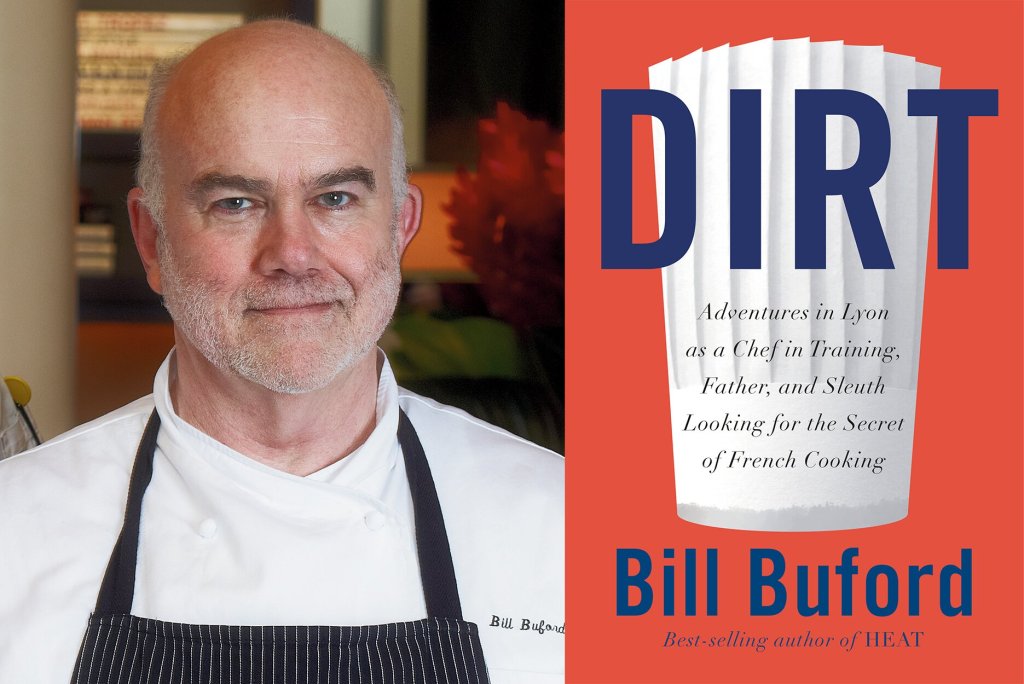
So many people mentioned that they were reading Dirt by Bill Buford that I succumbed to peer pressure and downloaded the book. I’m not really a foodie, except for an unhealthy addiction to sweets, which I am trying to break. But I am a Francophile of sorts because some of my ancestors were French, so I enjoyed Buford’s adventures in Lyon. Mr. Buford is not a chef, he’s a writer, most recently for The New Yorker, but he had done some stints in Italian kitchens and he met Michel Richard, a French chef in Washington, DC.
Although he and his wife Jessica had newborn twin boys, he commuted on weekdays to Washington DC from New York City and was only available to help out with those twins on weekends. If I were Jessica, I think I might have shown him a few creative uses for pots and pans, or, even better, rolling pins, but Jessica is not faint-of-heart. She handles challenges with grace, occasionally requires better spousal behavior and shares her husband’s sense of adventure.
The two had hoped to move to Paris but ended up in Lyon because Chef Richard had connections there. With twins, now toddlers (moving to Lyon is complicated) the family decamped to Lyon. Bill worked for a while with the boulanger (bread maker) downstairs from their apartment who made bread for restaurants and people all over Lyon. Buford wondered why Bob’s bread was so much better than most bread. His search led him into the Dombes, marshes in the foothills of the French Alps and it led to the essential role “dirt” plays in the quality of food.
Buford did not pick up languages easily but fortunately Jessica did. The boys were in preschool in Lyon and also picked up French quite naturally. Bill took some time. He attended an Institute of French Cooking and did some “stages” at restaurants in Lyon. He did pick up in-depth knowledge of Lyonnaise cooking.
Bill kept wanting to find a connection between Italian cooking and Lyonnaise cooking with Italian cooking at the roots of the French cooking and he did form some interesting theories through his researches. He must have been a very charming guy because he got away with this in the chauvinistic city of Lyon. But he also learned not to speak of these theories to anyone in Lyon.
It turns out that much of the cooking in Lyon came from a few famous “meres” (mothers) whose food was so legendary that it formed the basis of a “mere” restaurant. Some “meres” left handwritten cookbooks for their offspring. Often these “mere” kitchens are now just about the exclusive domain of men.
Dirt by Bill Buford is about food and also about the historical roots of food, and about making friends in a place where newcomers are regarded with suspicion and are snubbed. Informative and enjoyable; sometimes giving in to peer pressure is a good thing. I enjoyed the book every much.
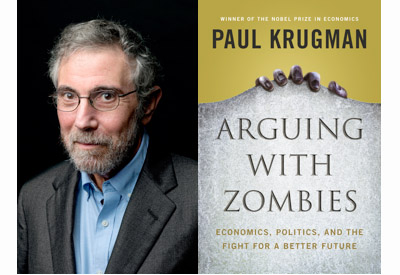
Paul Krugman is an expert in Economics. He defies the economic analyses favored by Conservatives. In Arguing with Zombies Krugman resents that “zombie” economic ideas keep being disproved (dying) and that they keep “shambling along” like the zombie ideas they are because they match up with right-wing ideologies.
Of course, he mentions the origins of these ideas, names like Keynes and Friedman, but Krugman sets out to make the rather arcane, rather subjective field of economics clear to all of us who come down with fuzzy brain syndrome whenever the term economics pops up in conversation.
I always read Krugman’s columns in the New York Times , but I must have missed more than a few because, although this book is a hand-picked collection of his columns, he managed to include ones I had not read. If he can explain economics so I can understand it then he’s very talented indeed.
His topics in this book include: saving social security, the road to Obamacare, attack on Obamacare, bubble or bust, crisis management, the Euro, fiscal phonies, tax cuts, trade wars, inequality, Conservatives, Socialism, climate, Trump and the media. On each topic he contrasts his views with those held by Republicans.
Krugman makes me nod “yes, yes” as I read. If you find yourself nodding “no, no,” then Mr. Krugman is not the economist for you. But I swear he is right. If you read Krugman’s book you can judge if my “Spidey sense” is correct as events in America unfold. Only the last chapter is a bit dense and academic. I appreciate Paul Krugman for his clarity and his ability to come down from the “Ivory Tower” inhabited by most economists.