
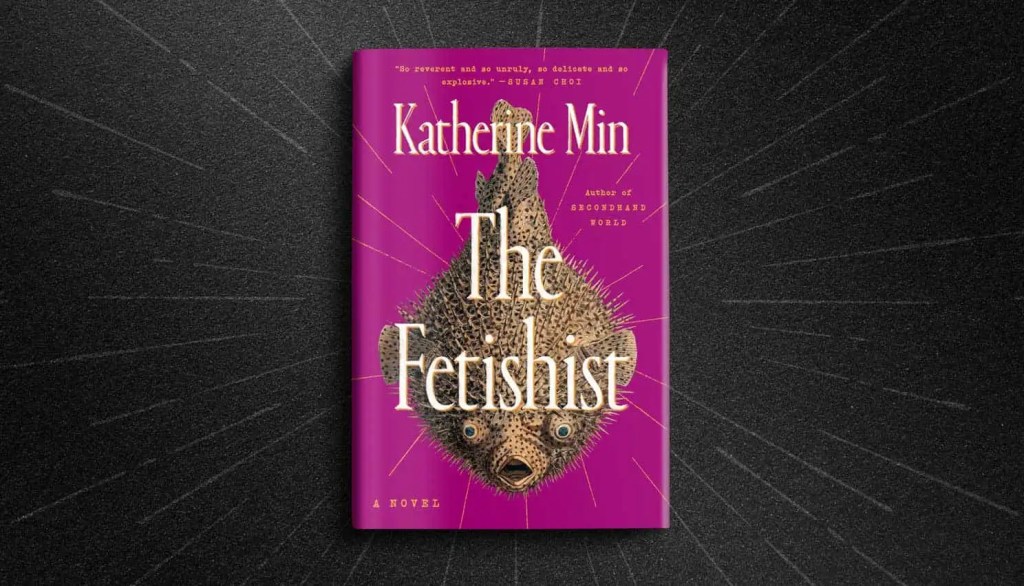
From a Google Image Search – Barnes and Nobel
Picking the next book to read is often problematic, a momentary panic sends me back to my book lists scribbled casually in notebooks full of political research, budget info, wordle episodes, drafts of essays, and wish lists. So many tantalizing titles are published each year that my list often leap frogs on to the newest releases without ever finishing with the older lists. There is always guilt and regret. Sometimes I wish I was a Large Language Model filled to the brim with all the world’s great literature and turned into a more well-rounded individual through a corresponding grasp of math and science. I read by instinct and thankfully there are so many excellent choices that I am rarely disappointed.
I stumbled upon Katherine Min’s book The Fetishist and once again I was not mislead by my instincts. This is a book for grownups. The book was published posthumously by Katherine Min’s daughter. The content is sophisticated and serious; fantastical and funny. Alma is sometimes the narrator and always the main character. She was a famous cellist who toured worldwide and sat in the first chair in global orchestras. She started playing at the age of 5 and by 11 she was obsessed with the cello.
“It was very physical, more like dancing than playing an instrument, and all her life Alma had felt this weirdly mystical space, the notes like steps, like gestures, the music like breath, like breeze, and the feeling of wide-ranging freedom, of expanse and embrace, and of always ending up somewhere else.” (p. 38)
Alma has MS and can no longer play the cello. Her body betrays her. Her fame is real, but it is a thing of the past. She has plenty of time to think back over her life. Alma fell in love with Daniel, a charming man, a fellow musician, and a womanizer. Daniel had commitment issues. Daniel also gets to narrate at times. Daniel, on an impulse, bought Alma an engagement ring, proposed, and then got caught by Alma doing the deed with Emi, another musician, another Asian musician. Daniel and Alma were engaged for about 5 minutes just before Alma had a very public medical episode that ended her life as a cellist.
“…and because being in a coma means having a lot of free time on your hands and the vagaries of the human brain are such that you never know what will pop into your head at any given moment. Alma finds herself surveying the fetishists she has known over the years. Ri-i-i-sssss kkk-iii-nggggs, rice chasers, Asiaphiles, victims of that mysterious disease known as Yellow Fever. Every Asian woman knows the generic type, but Alma, classical musician, world traveler, and unconscious taxonomist, breaks them down into three categories. 1) The cultural ambassador, 2) The carnal colonialist, 3) The rational revolutionary. (These are covered in more detail.)
A parade of rice kings wherever she went lecherous, treacherous, beseeching–enfolded like origami, bent like bonsai, draped in silk, and embellished with hanzi–presenting themselves like gifts to a foreign bride.” (pp 77-80)
This is the meat of the matter and there is more. Does Daniel pay for his sins? Revenge for Alma was banishment, cutting Daniel off, but her MS weakened the gesture as she no longer felt desirable. Someone else takes on the revenge of Daniel as his past leads to the most unusual kidnapping and Daniel’s mental reckoning. Kornell and Kyoto have their reasons.
This book is a literary gem, while offering an activist view against “Asiaphiles” who have given us terms like “Tiger Lily, China Doll, Geisha Girl, Baby-san, Miss Saigon, Suzie Wong, Me Love You Long Time, Goddamn Madame Butterfly!” (p 80) How you make a book with an axe to grind into a humorous and classy adventure is by being a talented writer; a writer who will entertain us no longer. This is our loss. Books, like music, take us “somewhere else.”
 So Many Books, Choose Wisely