The Loneliness of Sonia and Sunny by Kiran Desai – Book

From a Google Image Search – Shortlisted for the Booker Prize, 2025

Sonia Shah is in her junior year at a college in Vermont and she is lonely. She cries on the phone to her parents in India. Thus begins the story by Kiran Desai, The Loneliness of Sonia and Sunny. It’s an excellent story of two upper middle-class families in India experiencing the injections of modernity into their traditional lives. There is the traditional reliance on arranged marriages, for example, while all the younger people seem to believe that it is better to marry for love. 

Sunny Bhatia’s father died young so Babita, his mother, is left to fend for herself. Her father (the Colonel) happens to play chess with Sonia’s Papa, Manav, and he suggests an arranged marriage between his daughter, Sonia, and Sunny. A letter is sent to Sunny in NYC and to Sonia in Vermont. The timing is bad, as these are two of those modern children who want to marry for love.

Sonia, in her loneliness, becomes involved with an older man, an artist, with a personality that wavers between charming and mentally abusive. Ilan de Toojen Foss, is a strange man given to magical imagery and manipulation. He’s a painter and very ambitious. The relationship of these two has a Haruki Murakami vibe.

Sunny is living with an American woman from the Midwest, Ulla. They travel together to meet her parents in Kansas, which Ulla thinks will be a disaster. It isn’t a great success, but it isn’t terrible. When they return to NYC, Sunny goes home to visit his family in Delhi. He’s working as a reporter-at-large for the Associated Press and he plans to write and publish articles as he travels. When he arrives back in New York, he finds that Ulla has left him, moved out with all her possessions. 

Sonia, who wants to write a book, is still with Ilan when his wife arrives and eventually evicts Sonia. Sonia’s mother keeps a cache of jewelry at an Indian bank, intended for her daughter’s dowry, but she gives Sonia an amulet in a silver case carved with Tibetan clouds and dragons holding a little demon figure. The demon is a talisman called Badal Baba, or Cloud Baba. When Sonia leaves Ilan he keeps her amulet. 

Is this why Sonia and her family have a run of bad luck? Is this why a fierce ghost dog keeps chasing Sonia and disappearing. Is this why she almost drowns in Goa. 

Sonia and Sunny do not realize that their parents have arranged their marriage, although they give them a choice in the matter. These two meet entirely by chance in India on a train. Sunny likes her right away because of the title of the book Sonia is reading. They have a few conversations in India, and when Sunny’s friend Satya gets married, Sunny convinces him to go to Goa where he also plans to meet Sonia. Goa is on the ocean and the two of them encounter the terrifying ghost dog who, fortunately, disappears into thin air. 

Sunny returns to NYC, and Sonia stays in India with her family. Sonia’s mother and father live separate lives. Her mother lives in the cloud cottage in the mountains, full of magical visions and fantastical imaginings. There are eyes everywhere in this story. 

Sometimes the story turns very informative, revealing aspects of Indian life, relationships with servants, the tensions between Hindus and Muslims. Parents are aging and need care, so Sonia becomes the caregiver for her father. Sunny’s mom faces a crisis that forces her to sell her home. Her families’ ties to corruption are revealed. She ends up in Goa.

It’s a long time before Sunny and Sonia meet again after a disastrous trip to Venice. Read the book. It’s wonderful, but I can’t tell you all the reasons why. I listened to the book on Audible because I had built up credits. The voice of Sneha Mathan, the woman who read the story made the story even better. Then I bought the book so I could get all the names straight. 
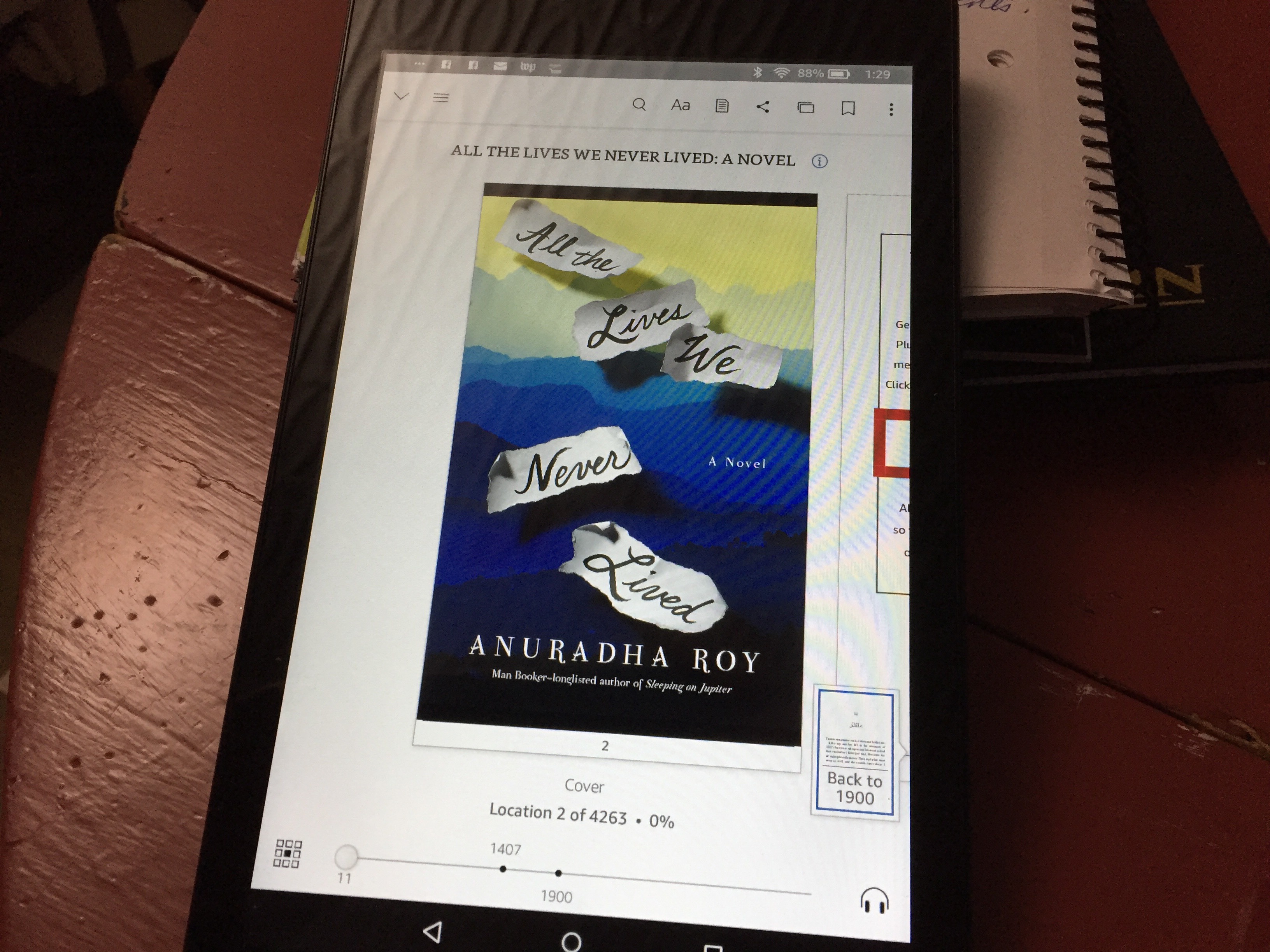
All the Lives We Never Lived by Anuradha Roy – Book

IMG_0931

Although All the Lives We Never Lived by Anuradha Roy is narrated, as it begins, by Myshkin, a young boy, and is also narrated by this boy grown to be an old man in his sixties, this is actually a book that has its roots in a true story of a German artist who travelled in Asia between the Great War (WW I to us) and World War II. Walter Spies was a creative person (and probably a wealthy person) who was so unique and charming that he was considered accomplished and interesting wherever he went, although he was also perceived as somewhat out-of-place, a curiosity. He travelled extensively in India (the author imagines) but he fell in love with Bali and made that his home base in Asia for many years.

Anuradha Roy wrote two stories in one because she admired Mr. Spies and wanted to bring him to life. So she begins her tale not with Spies but with that young narrator in India, a young boy with a mother who was given a nontraditional upbringing by her doting father, a woman born with a passion for an authentic life and a talent for painting and drawing. She was a woman, Gayatri, married to a professor and political activist, who felt held back, held down, imprisoned by her conventional life and loveless marriage. Her husband tried to give her a modicum of freedom but they did not perceive life in the same way. Women of that time, of course, were expected to marry and raise families and did not go traipsing off looking for their bliss.

But Gayatri did run off and left her husband and her young son. She meant to take her son with her but he got delayed at school that day and she had to leave him behind. She is happy in her new life but abandoning her child put a shadow of grief on her happiness. She ran off with a man, Walter Spies, but not to be his lover, rather to be free and live an artist’s life in the way that Walter and his friend Beryl de Zoete were living theirs. Beryl travelled in Asia studying dance and movement.

In this way Anuradha Roy is able to talk about the way women’s lives are curtailed by cultural expectations and public censure. She is also able to tell us about an artist she admired, whose freedom was likewise eventually curtailed, but not by the Asians he lived among, rather the Europeans he had fled.

Gayatri’s boy grows up and becomes, to his father’s dismay, a horticulturist, but he always remains the boy who lost his mother. Years later, as an adult he read the letters his mother wrote to her closest female friend from her life in India. We find that life can destroy our dreams in more than one way.

“As an old man, trying to understand my past, I am making myself read of others like her, I am trying to view my mother somewhat impersonally, as a rebel who might be admired by some, an artist with a vocation so intense she chose it over family and home.”

“But then his father left too to go off on his journey to the center of his self.” Interesting that in India, as in other places, if you are rich enough, both parents can leave but servants and relatives keep the details of the child’s life stable, even at the sacrifice of the child’s heart. Fortunately for Myshkin the grandfather in this story is a kindly and solicitous soul who stands in for the father.

In this way All the Lives We Never Lived by Anuradha Roy weaves the familiar daily routines of Indian life with the more foreign whims of European artists escaping from the daily routines of their own lives into a believable whole, a novel that explores the tension between art and cultural mores and rules. I just found myself wishing that both parts of the story were based on true events. However I remind myself that the author is an Indian woman and there may be kernels of truth in that fictional family’s portrayal. In the end I have always been happy so far when immersed in a story of India.

Photo Credit: Nancy Brisson