Ali is marrying Jack’s brother Will, but everyone thinks that she is showy and inauthentic. She loses her passport just as they are all trying to check in at the airport to fly to a villa in Portugal-a destination wedding. Then everyone else loses their patience.
The Guilt Trip by Sandie Jones gives us a tale of misjudgments and suspicions. Rachel, Jack’s wife, tells the story, and we are inside her head. Her head tells her that Ali is having an affair with her husband Jack. Will, Ali’s husband-to-be, is Jack’s brother. Rachel’s best friend Noah and his wife, Paige, are also staying at the villa. After speaking with Noah about their past together, Rachel is obsessed with her own guilt trip, which makes it more difficult to focus on the social interactions around her. She draws several incorrect conclusions.
Fortunately, Jack and Paige are smokers, so they get to disappear periodically to have a smoke, thus giving Rachel plenty of time to indulge her fears and wallow in her guilt. Ironically, she is probably one of the least guilty people at the wedding.
The events that bring the wedding weekend to a dramatic conclusion are certainly unusual, but it’s difficult to ‘suspend our disbelief’. The restaurant chosen for this expensive destination wedding is described as structurally unsound, somewhat ramshackle. Why would the couple pick such a spectacular villa to stay in before the wedding and such a rundown reception venue? Given what happens, far more casualties would have been expected.
What kept me reading is the actual guilt trip at the center of the story. The guilt trip itself was entirely believable, as were the superficial judgments made about Ali’s character. However, the astounding events at the end were a bit too engineered and unlikely. As for Ali, well, I can’t even tell you, but all is revealed in the aftermath of the dramatic denouement.
The Murderbot Diaries by Martha Wells is a fun series for all fans of space and science fiction. This particular addition to the series is called Fugitive Telemetry. When our Murderbot removed his governor module and became aware of his intended purpose he was aghast. He really was not at all inclined to go around murdering humans, although it was much easier with evil humans. Much of the world at this time is run by corporations who have their headquarters in the corporate rim. GrayCris is one of the worst, willing to commit all kinds of mayhem for profit.
Murderbot met up with a research space lab piloted by a bot named ART. ART and Murderbot did not get along well at first. MB turned ART on to the videos of his favorite soap operas and saved the ship from an attack. Art helped MB use the medical unit aboard ship to change himself into a less obvious Security unit or Sec Unit. But he still has his guns in his arms so, if necessary, he will kill in self-defense or to save his new human cohorts.
Murderbot saved Mensah, the leader of Preservation Station, a semi-utopian independent colony established outside the corporation rim. She had a run-in with GrayCris and MB saved her. She took MB, now a Sec Unit, home to Preservation where he lived as the only augmented human. Sec Unit didn’t like humans much, but he did like Mensah and he knew GrayCris would come after her again.
But that’s not what happens in Fugitive Telemetry. This time Sec Unit solves a murder on Preservation Station, a very rare occurrence. What he uncovers is a crime we find fairly common on earth and his investigation involves a rescue. He also makes some headway in becoming accepted by the Preservation police force. Just a little candy bar of a story in the grand scheme of things; fast, nutty and satisfying.
Summer beach books are usually light, enjoyable, and often as forgettable as a strawberry Twissler®. The Paper Palace by Miranda Cowley Heller is a cut above the usual beach book. This might be Heller’s first novel, but she has props from a career writing for HBO and for TV. A novel is a different beast than a screen play, but it’s not a distant reach. Heller’s characters are strong, especially the women, but even some of the men stand the test of reader approval also.
Wallace, an indifferent mother, a beautiful woman, after her husband divorces her, spends too much time needing the attention of other men, and trying to force relationships that are not close or rewarding enough, to suffice. When she finally gives up on looking for love she becomes the matriarch with enough feisty character to become a better grandparent than she was a parent. Still, however much you might appreciate her wit and beauty, you wouldn’t want to leave your children alone with Wallace for too long. She’s too self-absorbed.
The Paper Palace is the name of the Cape Cod summer house that has been in the family for decades. It was built when times were economically tough, so it is not necessarily glamorous. There is a Big House with kitchen, living room, porch, pantry and bathroom. There is an outdoor shower and several ticky-tacky cottages just for sleeping. It’s a place that you learn to love through familiarity and longevity. The camp faces a pond, with a narrow wood beyond, and at the end of the wood is the ocean. The wildlife the family encounters are more pond and woods creatures than ocean dwellers. Of course, the family makes many visits to more accessible beaches on the Cape.
Leo is the most recent of Wallace’s husbands. He’s a jazz musician and is gone a lot. Leo and Wallace fight frequently. He has two children by another marriage, but his daughter stays with the mom. Wallace’s family adds Chuck. To Wallace and Leo, Chuck is a socially awkward, poorly adjusted boy who will grow out of his difficulties; to Wallace’s daughters, Elle and Anna, he is a creepy and guilty secret they keep because they can’t bear to break up Wallace and Leo.
Secrets have consequences and these secrets fall far more on Elle than on Anna, because Anna goes away to boarding school. And yet, even as a young girl, Elle has far better taste in men than her mother ever had. Both Jonas and Peter love her. Would she have married Jonas if they didn’t share a terrible guilt of their own, and if Chuck wasn’t involved in the whole mess?
The story and the characters are enough to hold your interest, but Heller uses her words to bring us to camp with her. Through Wallace and Elle, she takes us through the earthy and the sublime, the earthy being her witty and profane conversations, the sublime being the way she describes nature and the close connections having a lifetime of Cape Cod summers offer those who are lucky enough to have such a legacy.
Maggie Shipstead’s book Great Circle is a multi-saga. It’s a family saga, a historical saga, a saga of a girl with a goal, so a cultural saga of women’s struggles. The only part of her story that is true is the history bits, but Shipstead did her due diligence and she knows the flight records achieved with regularity after Kitty Hawk. Women who flew were a key target of her studies. In the midst of her prose story she will recite a timely fact about a milestone accomplished by a pilot.
Marian and Jamie Graves lost their abused and understandably reluctant mother as infants when the ship their father, Addison Graves, was captaining exploded and sank. Their father was sent to Sing Sing prison for disobeying the code of captains at sea in order to save the twin infants. The children grew up under the neglectful care of their painter uncle, Wallace Graves, addicted to gambling and drinking. When Addison was released he took one look at the young twins and walked away, unable to believe that he would be a good father. (In fact, there are a lot of reluctant parents in this book and perhaps an argument for the individualism promoted by free-range parenting.)
Years later, in 2014, if you go by chronology, we meet Hadley, a young actress whose life parallels Marian’s. She also lost her parents and was raised by an uncle. Her parents died when their plane crashed into Lake Superior. In the midst of a boyfriend scandal, Hadley, hoping to rehab her reputation takes on the role of Marian Graves, a heroine of her childhood from a book recommended to her by a school librarian. So, the story becomes a two-fer and the modern “Marian” is not necessarily having an easier time of it than the Marian of the last century who tried to navigate a life that went against the cultural grain.
Great Circle is not just a fictional saga though. Marian’s story tells us about obstacles women face when they don’t feel comfortable within the narrow norms that circumscribe women’s lives. Marian’s fascination with the poles, the ultimate test of cold places which was a male domain, and her encounter with a married pair of barnstormers who stay with her uncle and take her up for her first flight, sets the course for her life. Her uncle cannot hold on to money. In order to learn to fly Marian delivers bootleg liquor and wine during Prohibition. She is young and slight. She can pass for a boy if she dresses in overalls and pulls a hat low and tries not to make eye contact. This works until she meets Barclay McQueen, a wealthy, powerful and seemingly respectable criminal. He is fascinated by Marian but she is too young. He woos her with pilot lessons and airplanes, wins her reluctant hand in marriage, and tries to control her and tame her by forcefully raping her until she is pregnant. Once Marian wins her freedom she flies, literally and figuratively. Her life’s trajectory faces the constant limits on what is allowed for women. Marian always finds ways to fly. She even finds ways to love who she loves, finding herself in love with Ruth and Caleb at the same time.
Hadley, our modern “Marian”, star of the movie Peregrine about Grave’s life and disappearance/death, still, in the twenty-first century, finds herself, at the beginning of her career in a #metoo moment. Even later in her career she finds herself in the midst of sexual shaming, which leads to her losing her star role in a TV series called Archangel. However, she has gained some equanimity over the years and is freed to accept the role in Peregrine, a possible future indie success with greater heft than her former roles.
The novel is readable and long, although it doesn’t really seem long. Do the themes justify the length? There is some really good writing in there. It gives us two great stories and many side stories. Could the author had made more of the great circle analogy so that when the moment came for Marian to tackle her dream it seemed like a true culmination? Possibly. The novel still accomplishes a lot and the characters may have longevity and enter that group of fictional people who we perceive as real. Only time will tell. Is Marian’s Great Circle dream ever realized? Perhaps. But culturally our goals might rather be to break some great circles, send the lines off in new directions that offer far more freedom from gender roles and rules.
Nora Seed is depressed. She has lost so many things recently. When a man she is attracted to knocks on her door in the midst of her despair, she thinks things might be looking up, but he is just there to tell her that he thinks her cat, a ginger tabby named Voltaire, is dead at the side of the road. He stays to help her bury the cat, but then she is late for her job at String Theory, a shop that sells albums and musical instruments, so she gets fired. Her only piano student’s mom tells her that Leo will no longer be taking lessons. She looks back over her life and sees that she has been unable to commit to anything and that this has caused pain to her brother Joe and to others in her life. She tips over the scary edge and swallows enough pills to end her miserable life, but she ends up in a limbo between life and death (with lots of talk about Schrodinger’s cat) in The Midnight Library with Mrs. Elm, the school librarian who helped her when she was younger.
The Midnight Library is a place we might all want to visit. Nora is faced with a big book of her regrets, which become far less of a weight once she has made it through the book. The shelves are infinite and all the books are green. Nora is able to go back to each moment in her life when she chose a path and see what would have happened if she stayed on that path. The Midnight Library is not endlessly patient. There are rules that can be broken with existential results. Nora has a degree in philosophy and knows all about existential results. But she longs for an authentic life such as that of Henry David Thoreau.
Matt Haig is the author of this book and we readers always get a little nervous when a male author chooses to feature a female character. Did Nora Seed have to be female? Perhaps in this tale the gender of the main character doesn’t matter as much because, although this is an interesting concept and a good story, it doesn’t have the literary heft or the philosophical depth that it could have had. There is a certain Faustian quality to Nora’s library research. She doesn’t have to sell her soul, but she has to remember that her corporeal body is alone in her apartment flickering between life and death. The concept of The Midnight Library is interesting and the plot resembles time travel, but the overall effect is quite quotidian and therefore a bit disappointing. Enjoyable, just not profound.
The Invisible Life of Addie LaRue by V. E. Schwab warns us to follow her neighbor Estelle’s advice and never make a deal with gods who answer after dark. The tale of Adeline LaRue shows what can happen if you make such a deal, even by accident, or because you are desperate. Adeline ends up making a very bad deal with a tricky god who takes on the appearance of Adeline’s perfect partner, a made up figure she has been drawing for many years.
Adeline grows up in the 18th century in a small village called Villon in France. It is practically impossible for a daughter to avoid a local marriage and the life of a wife and mother, hard and full of toil if you are not from a wealthy family. Adeline doesn’t want this life. She wants to be free, in a time when freedom for women was also something that might be marginally possible only if you were rich. Adeline’s family is not rich. Her father carves small, and quite desirable figures from wood and sells them at local markets.
Be careful what you ask for.
I almost put this book aside because I don’t usually read fiction about the occult or magic but I was ready for light entertainment and so I kept reading. Adeline’s deal means that she gets to live a long life as a ‘free’ woman, but no one remembers her. She can’t rent a hotel room or own any thing or have a normal relationship because she is always unknown. Everything is temporary. She can’t even say her own name. She is not really free at all because she sold her soul to ‘Luc’ for a freedom that is worthless. Luc visits Addie frequently to see if she is ready to give up her soul yet, but she is a stubborn girl. The more he tries to get her to give up, the more determined she becomes to go on. Three hundred years later, looking back, she acknowledges the things she has gained from her long life. Certain pieces of art work seem to give credence to Addie’s story. But she is tired.
In 2014 she finds a way to change the deal – at least temporarily. How does that happen? Read and find out. This was an inventive and entertaining piece of fiction, although the word ‘palimpsest’ cropped up a bit too often perhaps. Good job, V. E. Schwab.
Jhumpa Lahiri finds herself in Italy, with time between books and engagements. In Whereabouts she takes a notebook with her as she meanders around a country she knows well. She’s not a tourist. She’s more of a ‘flaneuse’ or in Italian, a ‘fannuilona’ or a ‘perdigomo.’
Her notebook is not actually a journal because it’s not organized by dates (or days), but by geography, places, “whereabouts.” She is mostly alone and her writing reflects some of the decay, weight, and beauty of antiquity. Italy has a long history.
Although published in English in 2021, as translated by the author, the book was first published in Italian in 2018. So, we are not experiencing Italy either during or in the wake of the coronavirus pandemic. Italy was hit early and hard but would not have allowed for a whimsical wander about any of its cities in those sad days.
Chapter names reflect content: On the Sidewalk, On the Street, In Spring, In my Head, Nowhere.
From In My Head, page 31
“Solitude: it’s become my trade. As it requires a certain discipline, it’s a condition I try to perfect. And yet it plagues me, it weighs on me in spite of my knowing it so well. It’s probably my mother’s influence. She’s always afraid of being alone and now her life as an old woman torments her so much that when I call to ask how she’s doing, she just says, I’m very alone…”
From At the Museum, page 33
“The most beautiful room—it belonged to an emperor’s consort—has a garden painted onto the walls, teeming with trees, flowers, citrus plants, animals. Pomegranates have split open and birds perch on the branches of the trees. The scene is fixed, faded. The trees with their thin branches, seem to bend as if from the soft breeze that courses through the landscape. This semblance of a breeze is what makes the painted nature tremble, rendering everything paradoxically alive.”
Interesting to be in someone else’s head and space for a while, especially in the head of Jhumpa Lahiri, an author I admire. Virtual reality, old style. This book is fiction but I identified with it so strongly that I read it as nonfiction.
There is a writer’s lecture series at a local theater which is currently held as a Zoom presentation because of the covid pandemic. You buy a ticket and you are registered to attend. Meg Wolitzer was the writer and the book she was speaking about was The Female Persuasion. I ordered the book but did not finish it in time so I never bought a ticket to the presentation. I find it hard to keep track of the many zoom meetings that come to me in my email. I am sorry I missed it though. I don’t often get to see a best-selling author in person (on zoom).
I finished the book not long after that, although spring had been a pleasant distraction. The Female Persuasion by Meg Wolitzer covered women’s rights territory that had key moments in my younger years, and here in this novel we have young people involved in the women’s movement which is having another key moment. Women’s rights are under attack. Hard won concerns, once thought resolved, could possibly be overturned here at the beginning of the twenty-first century. Wolitzer’s book does not spend much time arguing the issues though.
Greer Kadestsky, a young lady who did not get to attend the college of her dreams with her boyfriend, Cory, finds herself at a smaller college. Despite having to travel to keep her relationship with Cory alive, Greer makes a good friend Zee. Although Zee is gay and Greer is not, their friendship transcends their sexuality. When Greer meets an iconic figure from the women’s movement of the 60’s, Faith Frank, she finds her focus. Zee has guilted her into going to the lecture, but it is Greer who becomes a Faith Frank fan.
After college Greer goes to work for Faith and overcomes her fear of public speaking, but she also learns about the compromises Faith has felt it necessary to make. Greer eventually criticizes the lack of purity in her mentor. Her mentor reminds Greer of something Greer has done which is a betrayal of a relationship.
Greer also has some lessons to learn about her relationship with Cory, a man who does not just talk the talk. It turns out that he understands love and sacrifice in ways that Greer does not recognize – until she finally does.
It’s a good story and some of the observations about compromise, and purity, and the correlations between means and ends are interesting to think about for our own lives and issues. It just didn’t grip me. It wasn’t relevant enough to women’s rights to hook me. Today’s news, modern activism and the current makeup of the Supreme Court offer far more gripping concerns. The mentor relationship was less interactive than it kept promising to be. However, Cory I came to like very much, and he might end up being the best mentor for Greer in this novel.
Kazuo Ishiguro may seem to be telling folkloric tales in his most recent books, but they are actually quite philosophical and contemporary. In Klara and the Sun we meet a number of AF’s on display in a shop in a city very like London. The Manager rotates the AF’s into and out of the front window hoping to attract the attention of a teen who will convince an affluent parent to buy an attractive friend, dedicated only to them. Klara and Rosa are both B2’s, with the newest B3 models hot on their heels. They follow all the manager’s directions to try to attract a buyer. A teenager named Josie admires Klara and tries to convince her mother to purchase her but then she disappears. Klara takes a chance and turns down a potential buyer because she is waiting for Josie to come back. Manager lets her get away with it, but tells her she will not be allowed to turn down a buyer again.
Klara is an unusual AF because she pays attention to what is going on around her and draws conclusions from what she sees in the store and outside the front window. She watches when the sun seems to resurrect the Beggar Man and the Dog and when it smiles on the reunion of long separated lovers. She is shocked when the Cootings Machine comes to park in the street with its 3 funnels that vacuum pollution and send it out into the air, turning day into night.
This is a future, perhaps a near future, when some children are genetically “lifted” in their childhood years if parents so choose. A social gap arises between those who are lifted and those who are not. Josie is “lifted.” Her best friend from a young age, and now her boyfriend is Rick, who was not “lifted.” For some young people being “lifted” can cause illness and even death. Josie is at the critical age when she is ill and she could die. That’s when her mother buys Klara for her. Klara goes home with Josie to their home in the suburbs.
I believe this is a story about soul; do we have one, can an AF have a soul, what is a soul. Perhaps Ishiguro is answering back to someone like Yuval Noah Harari who doesn’t put much stock in a human soul in his book Sapiens. To Harari we are animals, human but not “lifted” above any of the other animals on the planet. In fact, to Harari our big brains have been more of a liability than an advantage, especially to the planet we call home.
But Ishiguro may be suggesting that our soul may be a function of what we do, of how we live our life. If even a robot can do something that seems soulful, could believing in a soul prompt us to do better, to be less selfish. Klara undertakes a task that she thinks will cure Josie but she is unsure how her own abilities will be affected by the bargain she accepts and the sacrifice she must make to complete it. We can’t help but compare Klara’s optimism to the way Josie’s mom, Chrissie, gives in to the past experience she has had in this matter and sets a truly selfish and rather macabre plan in motion. If Klara had chosen to go along with Mother’s plan how would things have turned out differently, for everyone?
Do we have a soul? Do we build a soul by believing that we can affect the universe in positive ways? Is soul the same thing as character? Regardless of how you answer these questions or others you might arrive at, it is almost certain that you will find Klara an extraordinary AF indeed. This one speeds by. Make sure you stop and ponder the ideas as well as the story.
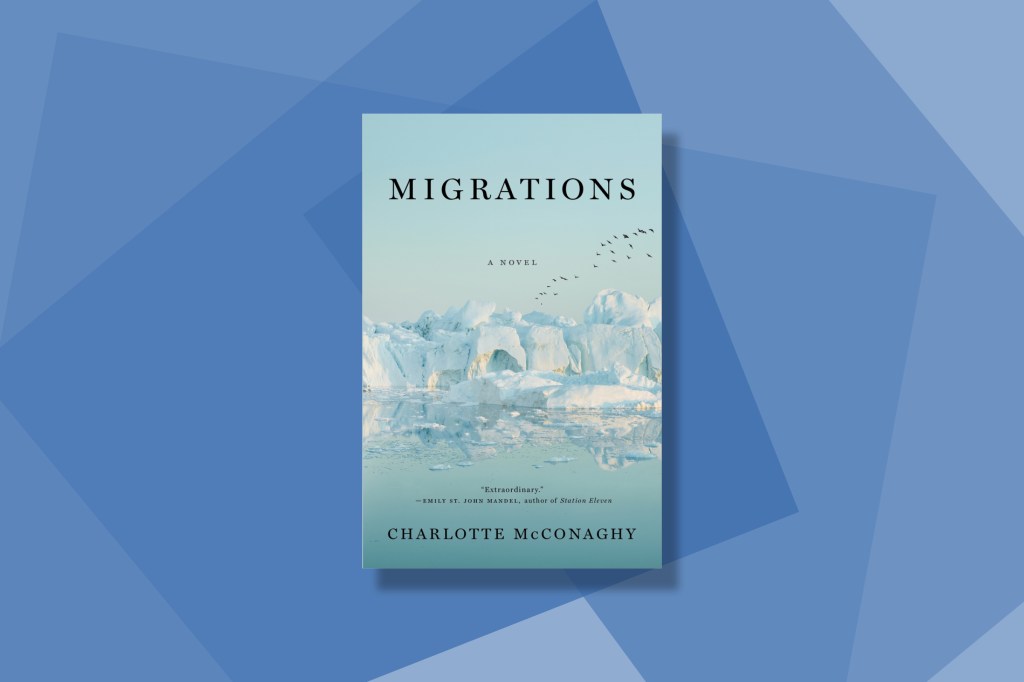
Franny Stone, born in Australia, taken to live in Galway by her mother, is one the migrators in Charlotte McConaghy’s book Migrations. She is part ocean, part sea ice and part arctic tern. In this atmospheric tale the reader is taken to a landscape and a life unlike their own. Franny is a woman who must live near water, cold water, wild water. She must live near the few nesting sea birds that remain in a world where wild animals are almost gone. She embraces the cold and it seems to have seeped into her, except that she is also passionate.
This is a love story. Two people have this passion for arctic terns in common, and Niall Lynch is the only one who can bring this wanderer Franny to stay on land. This is a tragedy. I can’t tell you the details. This is an Irish folk tale. People imagine that Franny is a selkie (she’s not). When she is ten she leaves her home and follows a boy to his home on the other coast of Ireland. He tells her this story; “There was a lady, long ago, who spent her life coughing up feathers, and one day when she was gnarled and gray she stretched from a woman into a black bird.”
Franny, now older, places trackers on three arctic terns at a nesting site in Greenland. It is her passion to follow them on their migration, one of the longest of any of the birds. She has to find a sea captain who will take her. She has to ride on a fishing boat when she knows that fishing is over and destroys the very balance she wishes she could protect. She finds Ennis Malone, captain of the Saghani, in Greenland. Saghani means raven. Off they go.
You carry the entire Franny ecosystem in your mind for days, perhaps longer. A sadly sweet, cold water journey of a book. In a time when we are not supposed to leave our living rooms what would happen to a footloose, can’t stay in one place person whose entire life is a series of Migrations? And, since we already lost 3 billion birds it is not at all unlikely that there may be a last migration.