Elliot Ackerman and James Stavridis have written a book about the future with the title 2054, a follow-up to their book 2034. The government in America is divided between two dueling parties, the Truthers and the Dreamers, that I had difficulty differentiating. There is also an ancient obstructer in the Senate named Wisecarver, who might remind you of Mitch McConnell. To please both factions the President and Vice President are not from the same party. A Civil War seems to be brewing.
President Castro, a seemingly healthy middle-aged man, dies suddenly of a heart attack. After examining the President’s heart there are indications that it has been genetically edited. This is not the same heart that the doctors have examined in the past. Has someone figured out how to edit genes from a distance? Has someone managed to create the Singularity? Can humans and computers now merge? Why does anyone want to pursue the Singularity when the technology carries with it a strong possibility of human extinction? President Castro was not a popular figure, and he is soon replaced with President Smith, previously Vice President Smith. Divisions escalate.
Besides what is going on in the government of America there is a cast of characters who are involved with gene editing and who are trying to trace down those who were working on this science and on the Singularity. Sarah Hunt who has recently died or disappeared is a key figure although we are left with her daughter Julia Hunt because most people believe that Sarah Hunt is dead. Julia, who has been working in the government is also a marine, who is sent back to her barracks under the new administration. We have BT and Michi in the hunt for Dr. Kurzweil, and we have Lily Bao, involved in a secret relationship with Nick Shriver, the new Vice President, but also pursued by Zhao Jin of China who wants her to come home. We also have Ashni traveling with her dad. She is trying to find Dr. Kurzweil because he is the last hope for keeping her father alive. Several groups set off at the same time to find Dr. Kurzweil who has retreated into isolation and who has been working on both gene editing and the Singularity.
This is a good story, but it is quite complicated and just reading it makes more sense than trying to explain the plot twists. What makes the book interesting is the relevance to currently trending topics and situations. Although I found it to be all plot and little substance some of the characters did connect with me well enough that I was interested in what was happening to them. The ending surprised me and perhaps it will surprise you too. This is a book to entertain you on a quiet Sunday afternoon or a sleepless night. The authors weigh in on whether we should try to create the Singularity.
Tommy Orange continues the story of the Red Feather and Bear Shield offspring from his book There There in his new novel Wandering Stars. We have already learned of the Trail of Tears from history class (maybe). We are removed in time from these sorrowful events, but we still bear the shame of our ancestors’ cruelties. Jude Star’s story opens the novel as the most distant traceable ancestor of the children in this story.
We are reminded that wars are always cruel and colonial wars are even crueler because they will always erase or reduce the powers of one party or the other. Jude Star ends up in a prison-castle in Florida from which he eventually escapes. Jude and Hannah Star’s son Charles Star and Opal Bear Shield have a daughter, Victoria Bear Shield. From one partner Victoria gives us Opal Viola Victoria Bear Shield, and from another partner Victoria gives up Jacquie Red Feather, the grandmother of the four children in the Red Feather clan who are being cared for by Opal Viola Victoria Bear Shield who is not their grandmother but who shares a mother with Jacquie.
Orvil, our focal character, has recovered from being shot by a terrorist. This happened the first time he went to a Native American celebration where he danced in public. Of course, even when you physically recover from a near-death experience, your spirit may not heal. It could take time, or it could be psychologically fatal.
Jude Star is the name chosen for Orvil’s ancestor when he is imprisoned in Florida and attempts are made to force former member of tribes to “assimilate” and forget their traditional lifestyles and beliefs. The Star men are wanderers who cannot find their place in an America captured by white folks, white folks who cannot see a way to live beside the people they fought with over this land.
Opal, who now heads Orvil’s family, has changed the fate of the Star offspring. She has purchased a house in Oakdale, California where Orvil, Loother, and Lony can find some stability as a created family. The grandmother Jacquie lives nearby and helps when she can. Opal pays tuition to send Orvil to a good school. The family is about to learn that stability is always in danger from outside forces over which they have little control. Orvil needs pain meds. He is on opioids for pain but when they are no longer prescribed, he must find other sources. He is addicted. This leads the whole fragile little family down a sad path that makes it hard to believe that even the best of intentions can turn some lives around.
Things turn out better than you might ever think, but the family loses its nascent cohesiveness. Colonialism has consequences and Tommy Orange wants us to know that.
Tommy Orange’s books have a historical and cultural significance quite apart from their literary bona fides. They are authentic expressions of a person and a people trying to preserve their culture whose values were expressed by the way they lived lightly on the earth and by rich spiritual traditions. Placed alongside the materialism and power struggles of a culture that is so antithetical to the lived beliefs of America’s indigenous people the contrasts and challenges are clearly exposed in Orange’s novels. Here is a young voice we don’t often hear from illuminating the torn souls of a proud people or set of people with much to offer, especially the way to live lightly on the earth part.
Imagine if Martin Luther King never existed, or if the Civil Rights movement came too late to prevent a second Civil War. It’s not hard to imagine if you just find old videos of Strom Thurmond on You Tube. In Rae Giana Rashad’s book The Blueprint, we meet Solenne and Bastien, who sound like characters in a romance book. But this is no ordinary romance. Bastien is a Councilman headed to become President of the new America known as The Order. Solenne is a young Black woman, fifteen years old, headed to become a ‘concubine’. Since this book is written by a Black woman, I will use her words to offer insight into her story. In the Author’s Note, Rashad refers to female slaves in real America as “forgotten handmaids,” so here is another handmaid’s tale, every bit as chilling as the original, except it explains how Atwood’s tale of the handmaids is even more fraught for Black women.
Page 13
“Then he was gone, ballroom lights tunneling the dark, the hush of champagne on my tongue. THE PATH WE WALKED TO BECOME Black women wasn’t straight; it was a loop. Starting from nowhere, it brought you back to nowhere. A man at one end, a man at the other, humming the same song. ‘It’s just a body. Nothing special.’ If that were true, why did they want it? Why couldn’t it belong to me.”
Page 25
“I would never know how it felt to walk boldly because this world wasn’t mine…There was no protection for me, a Black girl, no tender touch, no consideration for a delicate exterior. No space to scream.”
Page 31
“They bragged about their accomplishments in private, boasted about the difference between them and their brother. But skin quality and quantity of sleeve emblems aside, from neck to ankle, the men were identical.”
“Councilmen were the Order’s most decorated men. The talented, skilled, brilliant. Engineers, physicians, cryptographers, developers. But fundamentally they were soldiers. Killers.
Page 104
“And still, this country is better than it was when it was the United States. An economy outpaced by the rest of the world, the racial unrest, the increasing crime and abortion rates, no, we couldn’t go on with so much death.”
Page 133
“From his frame above the fireplace, Thomas Jefferson watched me. What had Sally seen in him? He brought her to France at fourteen, where she worked, lived, and earned money as a freed woman. When he decided to return to America two years later, she didn’t stay like the French urged her. She returned to America, where she remained enslaved, and the babies followed like footsteps.
Page 214
“Seven years of militias, fragmented state governments, and millions of deaths. We’re fortunate the Founders of the Order had a vision for the country. Their sacrifice ended the war.”
(Solenne’s great-grandfather wounded, and in the hospital, talks about that war and the aftermath.)
“In that unseasonably warm January of 1960 in Metairie, Louisiana, he witnessed a military dictatorship seamlessly replace the civil government. Where did these men come from, he asked his nurse. She couldn’t have been more than thirteen. Nobody knows, she said. They came from nowhere. But that wasn’t true, they were military officers police officers, senators, governors, a World War II veteran like Bastien’s grandfather. While my great-grandfather slept, Black and white men stood in offices letting the ink dry on treaties. In those documents women had fewer rights than they did before the war, and Black women caught the worst of it.”
[Black men were given the state of Louisiana as a free state, but they had to relocate by 1962 or accept the new Constitution]
Page 249
“They knew that once you get that taste of freedom nothing will keep you in line. Lucas [Bastien’s rival] knew it. I’d already seen the sunset over Sanibel Island in pink and orange. Seeing something like that makes you feel like somebody created something just for you. It was like unwrapping a present every time I blinked. I wanted to keep it forever. Not a piece of it. All of it.
Page 277
“Pleading. This was the only system designed for us. We were girls, fifteen, sixteen, seventeen. We were our ancestors, forbidden to read or write while lying under the arms of men who drafted legislation.”
Page 293 Author’s Note
“It was difficult to read these stories of forgotten handmaids and their forced reproduction. Though the United States outlawed the international slave trade in 1808, slaveholders found a way to increase the slave population by exploiting the domestic slave trade. They forced Black women into men’s beds, punishing those who didn’t have multiple children by their teens and rewarding those who did.”
Who wins, Bastien or Solenne? Find out how they both win, and both lose. Clearly this book connects to the America that we live in now, in 2024. There is talk from time-to-time about the possibility of a second Civil War when discourse heats up or when rights are lost. Women’s rights recently experienced a setback in the Supreme Court, a setback that will figure in the upcoming election and that could escalate depending on the results of the next election. The fears of Black women, that they might become “concubines” if the right-wing wins must be quite real and harrowing. Throughout Rashad’s story of Solenne, she is writing a book about a slave from 100 years ago, Henriette (Kumba) drawing parallels between the two women’s lives, reminding us that Black women are not property or sexual objects and warning us about the dangers of allowing racism to rule ever again.
I feel a kinship to Rae Giana Rashad because I wrote a similar book about losing freedoms if America becomes an authoritarian state. She did a better job than I did since she had to create all her characters from scratch, and I used both real and fictional people. My attempt in this genre is entitled 2028: The Rebellion. Rashad is offering fair warning to everyone. You should read the book.
Ever since I met Martha Wells’ Murderbot I have looked forward to new books in the series, although they are finished much too quickly. The latest book is called System Collapse. This installment in the life and times of Murderbot opens with an action scene. Some ag-bots have been contaminated with an alien virus and are attacking anyone or anything that gets too close. If you are thinking about starting the series with this book, don’t. Start at the beginning. In this installment, Wells doesn’t do much in the way of summarizing previous adventures. SecUnit is here with ART, a university-run ship that conducts research and supports humans and bots who are being exploited by corporations. Can a ship be a character? Of course, just think of the Enterprise.
Fighting against alien contamination to protect a human community is difficult enough but our SecUnit is dealing with a personal issue (redacted) and a ship from Barish Estranza, a corporation that tricks populations in planetary settlements that are in disarray into signing contracts to work in corporate mines as corporation serfs or slaves. It turns out that some of the colonists on this planet split off to establish a separate community, but all communications have been abandoned between the original group and the splinter group. SecUnit finds those who left living in a pre-corporate space, but so does Barish Estranza.
SecUnit usually soothes itself when overloads occur or it needs to rest up by watching episodes of The Rise and Fall of Sanctuary Moon, which it wishes it could access much more than the constant need to pay attention to real-world events allows, but Sanctuary also taught SecUnit lots of useful strategies and has educated SecUnit (an organic and inorganic construct) in human behaviors. In fact, SecUnit introduced ART to the videos and he also uses it to help other SecUnits after they disconnect their governor modules.
What has SecUnit redacted? Is SecUnit becoming more and more human? Will SecUnit be given a human name? That is all up to Martha Wells. I am just a human organic form who enjoys following SecUnit all along the corporate rim and beyond. It’s a literary amuse bouche in space.
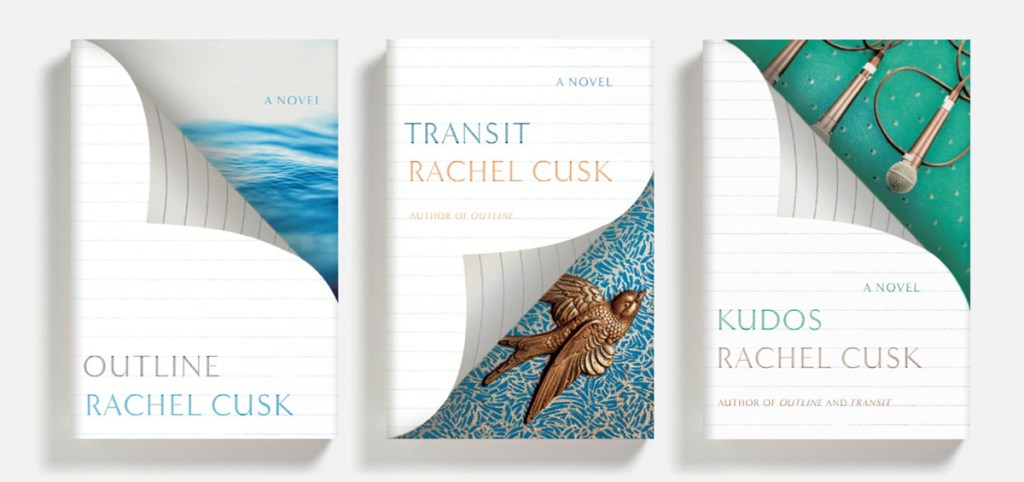
Rachel Cusk’s trilogy encompasses books entitled Outline, Transit, and Kudos. In every case Cusk presents character stories of people met in chance, or occasionally planned, encounters. In Outline, the author, Faye, (characters are typically unnamed or given only first names) is on a plane headed to a Book fair in Greece where she will sit on a panel and be asked to speak. Her seatmate on the plane gets in-depth treatment as we learn the story of his life and his marriage. Even at the book panel, the event runs out of time before the author speaks, but one outgoing male author has plenty to say.
Hardly any of the characters in these books have names, or they might have a first name, as already mentioned. This seems to be a new trend in fiction which probably has a purpose, as in allowing us to relate to the character, not wanting to create a character that jumps off the page and becomes an icon or to make it easier for the reader to imagine that s/he is the main character. The main character in this case is an author who has been through a crushing divorce. She and her husband have two sons. But her writing career is taking off, first literally to the Book Fair in Greece.
Rachel Cusk has a talent for telling stories of the people who meet this author as she travels, renovates an apartment, and goes to a second writer’s convention where awards are being given. But we know little about the author or her book. We are treated to an in-depth exploration of all the people she sits next to or interacts with. She seems to have no close friends, but this story is not really about the author. It is about men and women and the difficulties of intimate male-female relationships, especially in marriages in the twenty-first century.
Even as she fights off the bile of her new downstairs neighbors in Transit, she finds out the details of the life of the contractor who spends the most time on her renovation. Her neighbors are a nasty pair who knock on the ceiling with a broom as they follow her footsteps through her new flat. The downstairs couple seem to be bound together by their hatred for whoever lives upstairs, and they delight in intimidation. These are people I would want to run away from, but she stands her ground (without a rifle). When they realize that she is soundproofing the floor their hatred knows no limits but never gets physical. It is all bluster, an act to drive her away. The author has sent her sons to stay with their father while the reno is undertaken and although they beg and cry to come home to her, she encourages them to be independent. Is she a bad mother?
In the last book, Kudos, the author has obviously had some success and is attending a conference where she is supposed to be interviewed on television. Although she learns the life story of the interviewer, the technicians are never able to make the electrical hookups and the interview is called off. She meets another interviewer, a book critic, and he never learns a single fact about her, but we learn all about him. Almost all the people we meet are men and what they have to say about marriage is not encouraging. She also meets a wealthy woman who has given up on men and now invites writers and artists to come stay in her mansion where they can be warm all year long and enjoy more sun than the author has ever enjoyed in England where she lives with her sons in her redone flat over her miserable neighbors. Will she take Paolo up on her offer? Although this exploration of modern relationships is relevant this is a literary book than many readers are likely to skip. Rachel Cusk, however, has earned much praise from those critics who know and love well-written fiction.
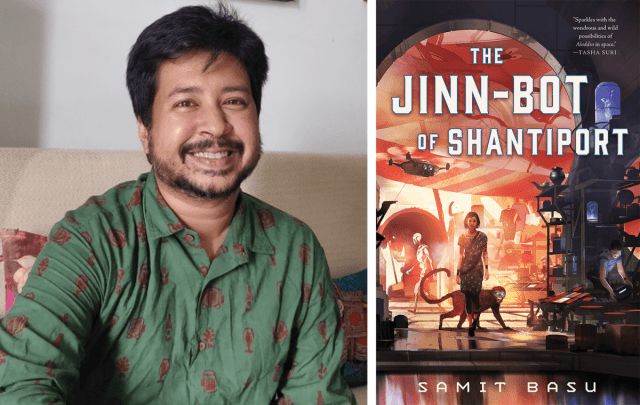
While The Jinn-Bot of Shantiport by Samit Basu is not great literature, this novel epitomizes the discussions of AI that dominated 2023. It also does that thing that sci-fi does so well. It offers commentary on modern and future society and politics.
Shantiport is a once-prominent city with a port that was busy and thriving. It is now a backwater decaying city that has internal problems which keep it in existential danger of dying out completely.
We wonder how we will ever become home to multicultural societies which should be easy for us because we are all humans. Shantiport wants to become a multicultural oasis which seamlessly protects the rights of both humans and bots. The bots seem to exhibit the same propensities as humans for violence, elitism, and tribalism. In this case the Tiger clan is warring against the Monkey clan.
The bot characters are well done and are as appealing, at least those who are main characters, as the human main characters. In fact, we find that those main characters, both bot and human, are a family unit as in brothers/sisters/ancestors. When the “jinn” is recovered from where it was hidden (Aladdin of legend) the one who holds the jinn gets three wishes. If your goal is to restore Shantiport to its former glory and make it a truly multicultural city what would your three wishes be? Be careful, it’s a very tricky jinn.
The same difficulties apply if you are trying to profit personally and don’t really care about the fate of Shantiport. This may not be literary fiction, but it is fun, and inspires thoughts about our own present and future dilemmas.
I set a course to read all the Bosch books by Michael Connelly this summer. Well, I didn’t quite make it before fall set in but, except for the newest book, which is not available yet, I finished all of them. I did not review each book as I finished it because I decided to classify them as recreational reading, but characters like Bosch deserve a few words. Harry or Hieronymus Bosch is a police detective in the homicide division when Connelly’s series begins. He has a sad past as he was born to a single mother who did not share the name of his father with him. They lived in run-down apartments in poor neighborhoods and his mother sometimes prostituted herself to earn enough money to live. She was found murdered in an alley; a victim of a crime Bosch eventually solves. Bosch is sent to a home for orphaned children, a place that locked defiant children away in a dark cubbyhole in a time when there were no laws about such abuse. Bosch was a defiant child and a frequent runaway.
But Bosch developed an anathema to the evil side of people, people whose acts create the dark corners of our society, its dark hidden alleys, and the twisted actions of those who are damaged. So, despite Bosch’s obvious issues with authority and his contempt for the politics of policing he is a detective who doesn’t quit. He breaks rules only if they prevent him from pursuing a case using rules he deems trivial. If his current LT (Lieutenant) happens to be a stickler for rules or in cahoots with the big wigs on the tenth floor, he is likely to be suspended once he solves a case (sometimes even before he solves the case). In some of the Bosch books he is a private detective. In later books he works to solve cold cases or volunteers at the San Fernando police department, gets hired there, gets suspended from there and finally retires for good, but still mentors Renee Ballard, a smart young policewoman.
Bosch’s house, where he spends far too little time, is an oasis above the city, a legacy of a movie that was made about a case he solved. It sits high above the city cantilevered out over scrubland and coyotes with a wall of windows and outside an open deck with a convenient railing. Jazz music fills the space which is somewhat minimalist and rather shipshape as if floating in air is like floating at sea. It does have three bedrooms however, which is fortunate when Bosch discovers that he has a daughter from his only wife and only love, the former FBI agent and very successful gambler, Eleanor Wish. Wish and Bosch do not work as partners but their daughter, Maddie, is a great addition to the series. She plays a more prominent role in the TV series, but she and Harry have an easy and positive relationship even though or perhaps because Harry is hardly ever home. Maddie understands what drives her father and she finds herself driven by the same desire to rid the world of evil doers. She humanizes Harry.
Michael Connelly creates a thinking detective, not an action hero, and he takes us through cases that come out of the news of the moment. This gives his books a historical perspective on what different eras have brought to life in Los Angeles and to the world.
I thoroughly enjoyed my summer of Bosch. It offered a nice break from the ever more chaotic politics of America and everywhere else. To go along as a hero follows the trail of a criminal murderer or rapist, an arsonist who burned up children to cover a crime, or people who committed ‘all the sins that flesh is heir to’, to use a “murder book” to catch a criminal, brought a sense of balance back into my life. Seeing wrongs righted offers satisfaction even if the heroics are fictional. I also find, whenever I read a book set in LA, that we are given lots of highway routes in case we ever want to follow in Bosch’s footsteps. Don’t bring a gun; bring some Charles Mingus and some good fast food. You won’t need a GPS. Just take the 405 to Mulholland
From an SNL skit:
Yes, Californians yak about traffic the same way Oregonians talk about the weather, effortlessly working it into conversations.
A hilarious example from jealous boyfriend Fred Armisen during Saturday’s SNL skit “The Californians”:
“I think you should go home now, Devin! Get back on San Vincente. Take it to the 10. Switch over to 405 North and let it dump you into Mulholland…where you belong.”
Thank you, Michael Connelly. You provided a great bridge to take me out of COVID isolation and sorrow, back to fighting the good fight to save democracy and enjoying life.
Book lists around Christmas and the New Year are not always typical in terms of content with regard to book lists from the rest of the year. This month you should look for the book lists that offer up the Best Books of 2019. Every site that reviews books usually has such a list. When you look over the offerings from the NYT you will find the suggestions at the beginning of December were quite lengthy. Since books make wonderful gifts for many readers the list is rounded out with appealing suggestions for books as presents. It is now past Christmas but it’s never to late to give a great book to a book lover and you will find some books for art lovers and those who love the dance world
.Amazon
Literature and Fiction
The Long Petal of the Sea: A Novel by Isabel Allende
Small Days and Nights: A Novel by Tishani Doshi
Show Them a Good Time by Nicole Flattery
Dear Edward: A Novel by Ann Napolitano
American Dirt by Jeanine Cummins
Little Gods: A Novel by Meng Jin
Topics of Conversation: A Novel by Miranda Popkey
The Black Cathedral: A Novel by Marcial Gala and Anna Kushner
Processed Cheese: A Novel by Stephen Wright
Hitting a Straight Lick with a Crooked Stick by Zora Neale Hurston
Mysteries and Thrillers
The Vanishing (Fogg Lake) by Jayne Ann Krantz
The Tenant by Katrine Engberg
The Missing American (An Emma Djan Investigation) by Kwei Quartey
The Better Liar by Tanen Jones
No Fixed Lines (22) (A Kate Shugak Investigation) by Dana Stabenow
Lost Hills by Lee Goldberg
The Rabbit Hunter by Lars Kepler
House on Fire: A Novel by Joseph Finder
The Wife and the Widow by Christian White
First Cut: A Novel by Judy Melinek, MD, TJ Mitchell
Biographies and Memoirs
Consider This: Moments in My Writing Life after Which Everything was Different by Chuck Palahniuk
Race of Aces: WW II’s Elite Airmen and the Epic Battle to Become Masters of the Sky by John R. Bruning
Father of Lions: One Man’s Remarkable Quest to Save the Mosul Zoo by Louise Callaghan
Will: A Memoir by Will Self
Imperfect Union: How Jessie and John Fremont Mapped the West, Invented Celebrity, and Helped Cause the Civil War by Steven Inskeep
Building a Life Worth Living: A Memoir by Marsha M Linehan
We Will Rise: A True Story of Tragedy and Resurrection in the American Heartland by Steve Beaven
Uncanny Valley: A Memoir by Anna Wiener
The Magical Language of Others: A Memoir by E J Koh
Nonfiction
Hill Women: Finding a Family and a Way Forward in the Appalachian Mountains by Cassidy Chambers
Leadership Strategy and Tactics: Field Manual Jocko Willink
Tiny Habits: The Small Changes that Change Everything by B J Fogg, PhD
The Third Rainbow: The Long Life of a Double Murder in Appalachia by Emma Copley Eisenberg
The Passion Economy: The New Rules for Thriving in the Twenty-first Century by Peggy Orenstein
Tightrope: Americans Reaching for Hope by Nicholas Kristof, Sheryl Wu Dunn
Why We Can’t Sleep: Women’s New Midlife by Ada Calhoun
Humble Pi: When Math Goes Wrong in the Real World by Matt Parker
History
999: The Extraordinary Young Women of the First Official Jewish Transport to Auschwitz by Heather Dune Macadam and Caroline Moorehead
Black Wave: Saudi Arabia, Iran, and the Forty-Year Rivalry that Unraveled Culture, Religion, and a Collective Memory in the Middle East by Kim Grattas
Overground Railroad: The Green Book and Roots of Black Travel in America by Candacy Taylor
Wilmington’s Lies: The Murderous Coup of 1898 by David Zucchino
Information Hunters: When Librarians, Soldiers, and Spies Banded Together in World War II Europe by Kathy Peiss
Mengele: Unmasking the “Angel of Death” by David G Marwell
Transcendence: How Humans Evolved through Fire, Language, Beauty, and Time by Gaia Vince
Science Fiction
The Vanished Birds by Simon Jimenez
The Secret Chapter (The Invisible Library Novel) by Genevieve Cogman
NYT Book Update
12/9/2019
Fiction
Mary Toft: or The Rabbit Queen by Dexter Palmer
The Second Sleep by Robert Harris
10 Best Crime Books of 2019
The Bird Boys by Lisa Landlin
The Chestnut Man by Soren Sviestrup
Conviction by Denise Mina
The Good Detective by John McCain
Heaven My Home by Attica Locke
The Never Game by James Deaver
The New Iberia Blues by James Lee Burke
The Night Fire by Michael Connelly
The Old Success by Martha Grimes
Sarah Jane by James Sallis
Nonfiction
Still Here by Alexander Jacobs (Bio of Elaine Stritch)
Listening for America by Rob Kapilow
Life Isn’t Everything: Mike Nichols, as Remembered by 150 of His Closest Friends by Ash Carter and Sam Kashner
A Month in Siena by Hisham Matar (Art)
Art Books
Climbing Rock By Francois Lebeau
Silent Kingdom by Christian Vizl
Light Break – Photos of Ray DeCarava
The Sound I Saw – Photos of Ray Cavara (Harlem Photographer
Nonfiction
Novel Houses by Christina Hardyment
The Seine: The River that Made Paris by Elaine Sciolino
Art Books
The Lost Books of Jane Austen by Janine Barchas
Nonfiction
The Europeans by Orlando Figes
The Life and Loves of E. Nesbit by Eleanor Fitzsimons
It’s Gary Shandling’s Book edited by Judd Apatow
Irving Berlin by James Kaplan
Texas Flood by Alan Paul and Andy Aledort (Stevie Rae Vaughn)
A Pilgrimage to Eternity by Timothy Egan
I Used to Be Charming: The Rest of Eve Babitz, Ed. By Sara J Kramer
Vanity Fair’s Women on Women, Ed. By Radhika Jones with David Friend
Parisian Lives by Deirdre Bair (Beckett and Beauvoir)
Disney’s Island by Richard Snow
Art Book
Rihanna (Memoir)
Nonfiction
Infused: Adventures in Tea by Henrietta Lovell
Life in a Cold Climate by Laura Thompson (Nancy Mitford)
Janis: Her Life and Music by Holly George-Warren
Horror Stories by Liz Phair
Out Loud by Mark Morris
Dance
Love, Icebox: Letters from John Cage to Merce Cunningham by Laura Kuhn
Ballerina Project by Dane Shitogi
The Style of Movement: Fashion and Dance by Ken Brower and Deborah Ory
12/13/2019
Fiction
On Swift Horses by Shannon Pufahl
Find Me by André Aciman
The Shortlist
Walking on the Ceiling: A Novel by Aysegul Savas
The Seven or Eight Deaths of Stella Fortuna by Juliet Grimes (family saga)
How We Disappeared by Jing-Jing Lee
Nonfiction
The Man Who Solved the Market by George Zuckerman
Big Sister, Little Sister, Red Sister by Jung Chang
Battling Bella by Leandra Ruth Zarnow (Bella Abzug)
Return to the Reich by Eric Lichtblau
The Shadow of Vesuvius by Daisy Dunn (Bio of Pliny the Elder and Pliny the Younger)
12/20/2019
Crime
Just Watch Me by Jeff Lindsay
A Madness of Sunshine by Nalini Singh
Shatter the Night by Emily Littlejohn
Bryant and May: The Lonely Hour by Christopher Towles
Fiction
The Sacrament by Olaf Olafson
They Will Drown in their Mother’s Tears by Johannes Anyuru
Dead Astronauts by Jeff VanderMeeks
Nietzsche and the Burbs by Lars Iyer
The Mutations by Jorge Comensal
Nonfiction
97,196 Words by Emmanuel Carere (essays)
User Friendly by Cliff Kuang and Robert Fabricant
Busted in New York by Darryl Pinckney (essays)
Essays One by Lydia Davis
They Don’t Represent Us by Lawrence Lessig
The Great Democracy by Ganesh Sitaraman
Of Morsels and Marvels by Maryse Condé
Family Papers: A Sephardic Journey through the Twentieth Century by Sarah Abrevaya Stein
The Cartiers: The Untold Story Behind the Jewelry Empire by Francesca Carter Brickell
12/27/2019
Nonfiction
The Selected Letters of Ralph Ellison, Ed by John F Callahan and Marc C Conner
Genius and Anxiety by Norman Lebrecht
The Confounding Island by Orlando Patterson
In the Dream House by Carmen Maria Machado (Memoir)
The Depositions by Thomas Lynch
One Long River of Song by Brian Doyle
Great Society: A New History by Amity Shlaes
1/2/2020
Crime
A Small Town by Thomas Perry
Naked Came the Florida Man by Tim Dorsey
The Playground by Jane Shemilt
Fiction
The Heap by Sean Adams
10 Minutes, 38 Seconds, in this Strange World by Elif Shafak
The Corner that Held Them by Sylvia Townsend Warner
Medieval Bodies by Jack Hartnell
The Revisionaries by A R Moxon
The Heart is a Full-Wild Beast by John L’Heureux
The Bishop’s Bedroom by Piero Chiara
Science Fiction
Queen of the Conquered by Kacen Callender
Homesick by Nino Cipri (Short stories)
Nonfiction
Uncanny Valley By Anna Wiener (Memoir)
Trump and His Generals by Peter Bergen
A Bookshop in Berlin by Francoise Frenkel
The Shortlist
The Sea Journals: Seafarers Sketchbooks by Huw Lewis-Jones
An Underground Guide to Sewers: Or: Down, Through and Out in Paris, London, New York &c by Stephen Halliday
Expeditions Unpacked: What Great Explorers Took Into the Unknown by Ed Stafford
New and Noteworthy
Crossing the Rubicon: Caesar’s Decision and the Fate of Rome by Luca Fezzi
Yellow Earth by John Sayles
The American People, Volume 2: The Brutality of Fact by Larry Kramer
Once More to the Rodeo: A Memoir by Calvin Hennick
Publisher’s Weekly
12/13/2019
I’ve Seen the End of You: A Neurosurgeon’s Look at Faith, Doubt, and the Things We Think We Know by W. Lee Warren, MD – NF
You Were There Too by Colleen Oakley – F
Naked Came the Florida Man by Tim Dorsey – F
Cesare by Jerome Charyn – F
One of Us is Next by Karen M McManus – F
A Collective Bargain: Unions, Organizing, and the Fight for Democracy by Jane McAlevey – NF
Waltz into Darkness by Cornell Woolrich – F
The Art of Dying by Ambrose Parry – F
Kill Reply All: A Modern Guide to Online Etiquette by Victoria Turk – NF
The Black Cathedral by Marcial Gala – F
Consider This: Moments in My Writing Life After Which Everything was Different by Chuck Palahniuk – Memoirs
All The Days Past by Mildred D. Taylor – F
Spitfire: A Livy Nash Mystery by M. L. Huie – F
Wilmington’s Lie: The Murderous Coup of 1898 and the Rise of White Supremacy by David Zucchino – NF
A Long Time Comin’ by Robin W. Pearson – F
That’s all of the PW Tip sheets that I found in my files this month. You can look for the online.
I decided not to put together a book list for December, although I may do that later when life slows down. But here are links to lists of the best books of 2019.
I have a recurring dream. I am escorted to a well-appointed studio apartment with all the new books for the month piled on every available surface. I am given a key, a valet robot who can cook and clean, and an AI virtual presence to handle my business and social interactions. I can read as long as I like but I can’t take any books out of the apartment and if I leave I can’t come back in. Am I obsessed? Actually this is a dream that could turn into a nightmare. However if you could take books out into the world with you and if you could come and go as you please, it might just be perfect.
Amazon
Literature and Fiction
The Starless Sea by Erin Morgenstern F*
This is Pleasure: A Story by Mary Gaitskill F
On Swift Horses: A Novel by Shannon Pufahl F
Girl, Woman, other: A Novel by Berndine Evaristo F*
The Innocents: A Novel by Michael Crummay F
Find Me: A Novel by André Aciman F
The Revisioners: A Novel by Margaret Wilkerson Sexton F
The Confession Club: A Novel (Mason) by Elizabeth Berg F*
Nothing to See Here by Kevin Wilson F*
Mary Toft: or The Rabbit Queen: A Novel by Dexter Pullman F*
Mysteries and Thrillers
The Lost Causes of Beale Creek: A Novel by Rhett McLaughlin, Link Neal
Broken Glass (A Nik Pohl Thriller) by Alexander Hartung and Fiona Beaton
A Christmas Gathering by Anne Perry
Nothing More Dangerous by Allen Eskens
The Family Upstairs: A Novel by Lisa Jewell
Kiss the Girls and Make Them Cry: A Novel by Mary Higgins Clark
The Siberian Dilemma 9 (The Arkady Renko Novels) by Martin Cruz Smith
An Equal Justice (David Adams) by Chad Zunker
A Minute to Midnight by David Baldacci
36 Righteous Men by Steven Pressfield
Nonfiction
Vicksburg: Grant’s Campaign that Broke the Confederacy by Donald L Miller
Valley Forge by Bob Drury and Tom Clavin
Acid for the Children: A Memoir by Flea, Patti Smith *
When the Earth Had Two Moons: Cannibal Planets, Icy Giants, Dirty Comets, Dreadful Orbits, and the Origins of the Night Sky by Erik Asphang
Our Wild Calling: How Connecting with Animals can Transform our Lives and Save Theirs by Richard Louv
The Beautiful Ones by Prince
Hymns of the Republic: The Story of the Final Years of the American Civil War by S. C. Gwynne
Checkpoint Charlie: The Cold War, the Berlin Wall and the Most Dangerous Place on Earth by Iain McGregor *
Canyon Dreams: A Basketball Season on the Navajo Nation by Michael Powell
The Great Pretender – The Undercover Mission that Changed our Understanding of Madness by Susannah Cahalan *
The Witches Are Coming by Lindy West
User Unfriendly: How the Hidden Rules of Design are Changing the Way We Live, Work and Play by Cliff Kuang with Robert Fabricant
Why Are We Yelling: The Art of Productive Disagreement by Buster Benson
Don’t Be Evil: How Big Tech Betrayed its Founding Principles – and all of us by Rana Foroohar
Volume Central: Hearing in a Deafening World by David Owen.
Science Fiction and Fantasy
The Deep by Rivers Solomon and Daveed Diggs
The Pursuit of William Abbey by Claire North
Call Down the Hawk (The Dreamer Trilogy, Bk. 1 by Maggie Stiefvater
Star Wars – Resistance Reborn: The Rise of Skywalker by Rebecca Roanhorse
Made Things by Adrian Tchaikovsky
Fate of the Fallen (Shroud of Prophecy) by Kel Kade
New York Times Book Update
Oct. 4 th
The Topeka School by Ben Lerner F
Sarah Jane by James Sallis – Crime
Bloody Genius by John Sanford – Crime
Gallows Court by Martin Edwards – Crime
The Bird Boys by Lisa Sandlin – Crime
Cantoras by Carolina De Robertis F
Akin by Emma Donoghue *
Growing Things by Paul Tremblay – Short stories – Horror
The Cabin at the End of the Lane by Paul Tremblay – Horror
Sealed by Naomi Booth – Horror
Nonfiction
Talking to Strangers by Malcolm Gladwell
A State at Any Cost: The Life of David Ben-Gurion by Tom Segev
What was Liberalism? The Past, Present, and Promise of a Noble Idea by James Traub
The Stakes – 2020 and the Survival of American Democracy by Robert Kuttner
The Accusation by Edward Berenson
Scarred by Sarah Edmondson – Nxivm
Super Pumped by Mike Isaac (Uber)
The Anarchy by William Dalrymple
Oct. 11 th
Fiction
The Shadow King by Namwali Serpell
The Sweetest Fruits by Moneque Truong
A Pure Heart by Rajia Hassib
The World that We Knew by Alice Hoffman
A Man in Love by Martin Walser (Göethe)
The Shortlist – Love and War in European Fiction
Country by Michael Hughes
Will and Testament by Vigdis Hjorth
The Girl at the Door by Veronica Raimo
Nonfiction
Transaction Man by Nicholas Lemann
Know My Name by Chanel Miller
The Second Founding by Eric Foner
Beaten Down, Worked Up by Steven Greenhouse
Homesick by Jennifer Croft (Memoir)
Fashionopolis by Dana Thomas
We are the Weather by Jonathan Safran Foer
Syria Secret Library by Mike Thompson
A Polar Affair by Lloyd Spencer Davis (promiscuous penguins)
New York Times does Halloween but I don’t.
Nov. 1 st
The Old Success by Martha Grimes – Crime
Death in Focus by Anne Perry – Crime
Elevator Pitch by Linwood Barclay – Crime
The Quaker by Liam McIlvanney – Crime
Grand Union by Zadie Smith – Short Stories
The World Doesn’t Require You by Rion Amilcar Scott
Fiction
Olive Again by Elizabeth Strout
Girl by Edna O’Brien
Call Upon the Water by Stella Tillyard
Lampedusa by Steven Price
Nonfiction
Edison by Edmund Morris – Bio.
To Build a Better World by Condoleezza Rice and Philip Zelikow
Sontag by Benjamin Moser – Bio.
Who is an Evangelical? by Thomas S. Kidd
The Immoral Majesty by Ben Howe
The Problem with Everything by Meghan Daum
The Economist’s Hour by Binyamin Appelbaum
The Marginal Revolutionaries by Janek Wasserman
The Shortlist – 3 Memoirs by Famous Women
Inside Out by Demi Moore
Home Work: A Memoir of My Hollywood Years by Julie Andrews with Emma Walton Hamilton
Touched by the Sun: My Friendship with Jackie by Carly Simon
Publisher’s Weekly
Oct. 7 th
Salt Show by Julia Armfield
Ninth House by Leigh Bardugo
Ordinary Hazards: A Memoir by Nikki Grimes
Older Brother by Mahir Guven, trans. from French by Tina Kover Europa
American Radicals: How Nineteenth Century Protest Shaped the Nation by Holly Jackson
How We Fight For Our Lives: A Memoir by Saeed Jones
Passing: A Memoir of Love and Death by Michael Korda
Anti-Social: Online Extremists, Techno-Utopians, and the Hijacking of the American Conversation by Andrew Marantz
Tuesday Mooney Talks to Ghosts by Kate Racculia
Cosmosknights: Book One by Hannah Templer
Commute: An Illustrated Memoir of Female Shame by Erin Williams
Oct. 14
Celestial Bodies by Jokha Alharthi trans. from Arabic by Marilyn Booth (Oman) F
Wild Game: My Mother, Her Lover, and Me by Adrienne Brodeur
The Body: A Guide for Occupants by Bill Bryson NF
Your House Will Pay by Steph Cha F – based on true case
Life Undercover: Coming of Age in the CIA by Amaryllis Fox Memoir
Music: A Subversive History by Ted Gioia History
One Hundred Autobiographies: A Memoir by David Lehman Memoir
The Adventure of the Peculiar Protocols: Adapted from the Journals of John H. Watson, MD by Nicholas Meyer F
The First Cell: And the Human Cost of Pursuing Cancer to the Last by Azra Razer NF
Salvaged by Madeleine Roux Science Fiction Thriller
It Would Be Night in Caracas by Karina Sainz Borgo trans. from Spanish by Elizabeth Bryer (Caracas, Venezuela) F
Olive Again by Elizabeth Strout
Oct. 21
All This Could Be Yours by Jami Attenberg F *
The Peanut Papers: Writers and Cartoonists on Charlie Brown, Snoopy and the Gang, and the Meaning of Life – Edited by Andrew Blauner (Essays, Poems, Cartoons) (Valentines to Charles M. Schultz)
The Night Fire by Michael Connelly F
The Deserter by Nelson DeMille and Alex DeMille Thriller *
Initiated: Memory of a Witch by Amanda Yates Memoir
Janis: Her Life and Music by Holly George-Warren Biography *
The Family Upstairs by Lisa Jewell Thriller
Edison by Edmund Morris Biography
The Promise by Silvina Ocampo trans. from Spanish by Suzanne Jill Levine and Jessica Powell F
The Fragility of Bodies by Sergio Olguin, trans. from Spanish by Miranda France, Bitter Lemon Crime
The Fountains of Silence by Ruta Sepetys (Franco, Madrid) F
Famous in Cedarville by Erica Wright F
Oct. 28
Blue Moon: A Jack Reacher Novel by Lee Child F
The Lives of Lucien Freud: The Restless Years, 1922-1968 by William Feaver Biography
Overview: A New Perspective of Earth by Benjamin Grant Photos
Blood: A Memoir by Allison Moorer Memoir
Shadow Network: Media, Money and the Secret Hub of the Radical Right by Anne Nelson NF*
The Factory by Hiroko Oyamada, trans from Japanese by David Boyd F
The In-Betweens: The Spiritualists, Mediums, and Legends of Camp Etna by Mira Ptacin NF
Nothing to See Here by Kevin Wilson (humor) F
Nov. 4
The Movie Musical! by Jeanine Bassinger NF
The History of Philosophy by A. C. Grayling NF
Get a Life, Chloe Brown by Talia Hibbert (“a contemporary page-turning winner”) F
In the Dream House: A Memoir by Carmen Mava Machado (same sex domestic abuse) Memoir
The Starless Sea by Erin Morgenstern F
The Book of Lost Saints by Daniel Jose Older F
The Arab of the Future 4: A Childhood in the Middle East, 1987-1992 by Riad Sattouf, trans. from Frenchy by Sam Taylor Autobiography *
The Siberian Dilemma by Martin Cruz Smith (Arkady Renko #9) by Thriller
Love Unknown: The Life and Worlds of Elizabeth Bishop by Thomas Travisano Biography and Literary Study




 So Many Books, Choose Wisely