My best friend married a Jewish man who became a good friend to all of us. He was trying to learn Yiddish for a while, so when I saw this book on Amazon called Speaking Yiddish to Chickens by Seth Stern, I decided to read it and to get my friend a copy of the book. I thought it might be humorous or full of lost Yiddish words, but this did not turn out to be the case. That is not to say that it wasn’t fascinating. I did not know that Jewish refugees from Europe after World War II often found life in NYC or other urban places too crowded and, after all their trials, too chaotic. They longed for peace and a way to remake their shattered lives.
The Jewish Agricultural Society (JAS) suggested to some refugees that chicken farming in southern New Jersey was becoming a popular lifestyle choice for refugees. The book is centered around two Grine (Grin-ah) (the category used to describe postwar Jewish refugees) named Nuchim (New-kim) and Bronia (Bron-yah) Green who decide to buy a south Jersey chicken farm in a place called Vineland. These two are the author’s grandparents and he talked with them many times while writing this book. Their daughter, Ruth Green, married a Stern. The author is Ruth’s son.
Both Nuchim and Bronia spent a part of the war in a forest in Germany as underground fighters and to hide from deportation to a concentration camp. When Bronia got to the US she weighed only 80 pounds. Deprivation was a common denominator for Jewish people who survived. They decided to buy a farm with another couple, the Liverants. Both couples had one child, both girls.
I bought a copy of the book on Audible so I could hear the correct pronunciation of all those Yiddish words that weren’t there, but it was still a good story to listen to.
As we follow Seth Stern’s grandparents through the years when they pursued chicken farming, and as the children in the community got older, we see the family more involved in a community of people, eventually enjoying trips to a nearby beach, playing cards, and enjoying other social occasions. By this time Bronia and Nuchim have their own farm.
However, chicken farming is hard work. Chickens can’t get too cold, especially baby chicks. Chickens must be fed every few hours. The eggs must be washed and dried by hand, then candled to make sure they meet government regulations. There were few hours for playing, at least until people started inventing automatic feeders, egg dryers, and ways to candle eggs without handling each one separately. The economic security of chicken farmers was very dependent on the market price for eggs, and this price varied from season to season and year to year. No one was getting rich.
The author interviewed the children (his mother and her contemporaries) asking about what life on the farm was like and about how they were treated in school. They told him that they had been subjected to plenty of antisemitism in public schools. He interviewed the parents to find out how they were dealing with the terrible things that happened to them in the war. Many parents did not want to ever talk about what they had experienced. Others were very vocal about the abuses they endured.
I’m very glad I read this book. Here is a little corner of American Jewish life that I knew nothing about. There are many more such corners to explore but not all are documented in books. Speaking Yiddish to Chickens is a true nonfiction book with an index and bibliography. Because it focuses on two people related to the author and expands outward from there, it is not overly academic and is very readable.
From a Google Image Search – Chicago Review of Books
Sally Rooney wrote Intermezzo, a story of two brothers, the Kubek brothers. An intermezzo is an intermission. We meet the younger Kubek brother first. Ivan is in his twenties, and he considers himself socially awkward. All his previous encounters have not gone well. He would become filled with anxiety and unable to approach social situations with an acceptable level of poise. He used his alone time, and it was considerable, to become an expert chess player. When he goes to a small town to play some chess against amateur players, he meets a beautiful 36-year-old woman, and he becomes involved with her. She does not find him the least bit awkward.
Peter is Ivan’s brother. He’s 35 and dating the 20-something Naomi. Peter is also involved with Sylvia, who he intended to marry. She was in a terrible accident, and although he still loves her, she can’t be there for Peter as a wife because she lives with constant pain.
Ivan and Peter recently lost their father and have not yet dealt with the pain of their loss. Their parents were divorced when Ivan was quite young, and the boys lived with their father. Since Peter is so much older than Ivan, he soon went off to college. There is that dynamic of who did Dad love best. Losing their father throws them temporarily off balance. Does the title refer to the time spent adjusting to this major change in their lives?
Rooney add in some Wittgenstein, a physicist I find quite abstract (pg. 399). Schrödinger’s box makes an appearance. Conversations between Sylvia, a professor, and Peter were too esoteric for me, a reflection, I imagine, of their level of intellectual sophistication, and a contrast to Naomi, who is needy, pretty, good company and surprisingly wise for someone so young but no intellectual. I usually like brain puzzles to unravel but this time I will have to go back over that part of the book to see if it is worth trying to grasp what these two characters are saying, or if the author is just showing off her erudition. (Sally Rooney wouldn’t do that.)
“Something about fascism he says, and they go on walking, talking about fascist aesthetics and the modernist movement. Neoclassicism, obsessive fixation on ethnic difference, thematics of decadence, bodily strength and weakness. Purity or death. Pound, Eliot. And on the other hand, Woolf, Joyce. Usefulness and specificity of fascism as a political typology in the present day. Aesthetic nullity of contemporary political movements in general. Related to, or just coterminous with, the almost instantaneous corporate capture of emergent visual styles. Everything beautiful immediately recycled as advertising. The freedom of that, or not. The necessity of an ecological aesthetics, or not. We need an erotics of environmentalism.” (pg. 393)
Since the story takes place in Dublin and small towns nearby, the odd sentence structure may reflect local dialect. Sentences often seem to be written backwards to avoid the use of conjunctions. Is this a Rooney thing or an Irish thing. I do not know. I found it interesting but not annoying.
“Terribly childish wish he feels once in his life to do as he’s told.” (pg. 410)
Sally Rooney gives us characters who seem like real people we could meet and know. Ivan and Margaret, Peter, Sylvia, and Naomi could be friends of ours. How they deal with traumas in their lives, how they deal with nontraditional relationships, how they come of age, regardless of their age in years; these are the interactions that hold our interest. If the ending seems a bit too happy, I don’t mind.
From a Google Image Search – Flickr – (C)KIM BECKER
A friend gave me the book The Queen’s Fool by Philippa Gregory for Christmas. I had read several Philippa Gregory books, but not this one. Gregory writes period fiction, usually about English history, especially royalty. These books are very readable and immersive. In The Queen’s Fool Gregory focuses on the short reign of Edward, too young to be king and too ill to rule for long and the sisters who followed him on the throne of England.
Many readers know this story well because two half-sisters were waiting to be queen. Mary was first in line. Mary was the daughter of Henry VIII’s first wife, Catherine Parr. He divorced her mother to marry Anne Boleyn. Elizabeth was the child of this marriage. Although she was declared illegitimate when Anne Boleyn was executed, she was later declared legitimate.
Mary was not the queen most of the English people wanted. Henry, her father left the Catholic church (and the authority of the Pope) when he wanted a divorce, and the church would not grant it. England was turned upside down as Henry closed the monasteries, took the riches that had been amassed, and executed formerly powerful church officials. He eventually founded the Church of England which was closer to Protestantism. Mary was a devout Catholic who, once she became queen, turned England upside down again by restoring the Catholic church and punishing prominent Protestants. Subjects who wanted to stay alive had to return to behaving like loyal Catholics. Mary’s half-sister was not old enough when Edward died to be queen, but she was a Protestant who had no fixed ideas about God or the Church.
The Queen’s Fool, threading her way through all this religious upheaval, was Jewish, a religion that was unwelcome in almost every nation at the time. Jews had to pretend to be Protestants when that was expedient and Catholics when nations were loyal to the Pope. Hannah became the queen’s fool because she had the “sight.” If you remember your history of Mary and Elizabeth, then you remember that Lord Robert Dudley and Elizabeth were an item for a while. Hannah Green once saw Robert Dudley in the street and behind him she saw the angel Uriel. Dudley was the one who recommended her to be a fool for the Tudors. Lord Dudley’s protection kept Hannah alive through many tense moments.
Reading books about royalty is a guilty pleasure that I don’t often indulge anymore but I was happy to enjoy this book. Adding the Jewish faith into this mix, at this time when religions were matters of life and death, was a new twist. Hannah lived with her mother and father in Spain until her mother was burned at the stake by the Inquisition. Hannah and her father kept moving around Europe trying to find somewhere they could live in safety. It was dangerous for Hannah to be involved with the Catholic reign of Mary.
The Jewish people have been hunted throughout history until they found safety in America and Israel, but they realize that this safety could be ephemeral once again. We all live with some religious uncertainties in the twenty-first century, but no people have been as consistently hounded as those of the Jewish religion. Exploring a historical moment we have explored in other books, as seen through the lens of religious turmoil and of one Jewish girl at the mercy of fate, kept me reading and reminded me of how fraught the Jewish diaspora has been for believers in the Jewish faith. Gregory took a timeless story we are familiar with and added another layer.
Spies make for what is often edge-of-the-seat reading. Spy novels often offer references to obscure historical activities that may not have been universally covered by the media and which may have only been uncovered long after the actual events. John le Carré has long been considered the master of spy stories involving classic spy craft methods which may not work as well in our age of high tech. This may be why so many books about spying refer to WWII and its aftermath in the Cold War and the times when a wall divided East and West Berlin. The end of wars often leaves loose ends which reveal themselves much later. Now spying usually happens on a grand scale, as portrayed by events like China’s recent hacking of the US Treasury Department, and classic up-close and personal spying is out of fashion.
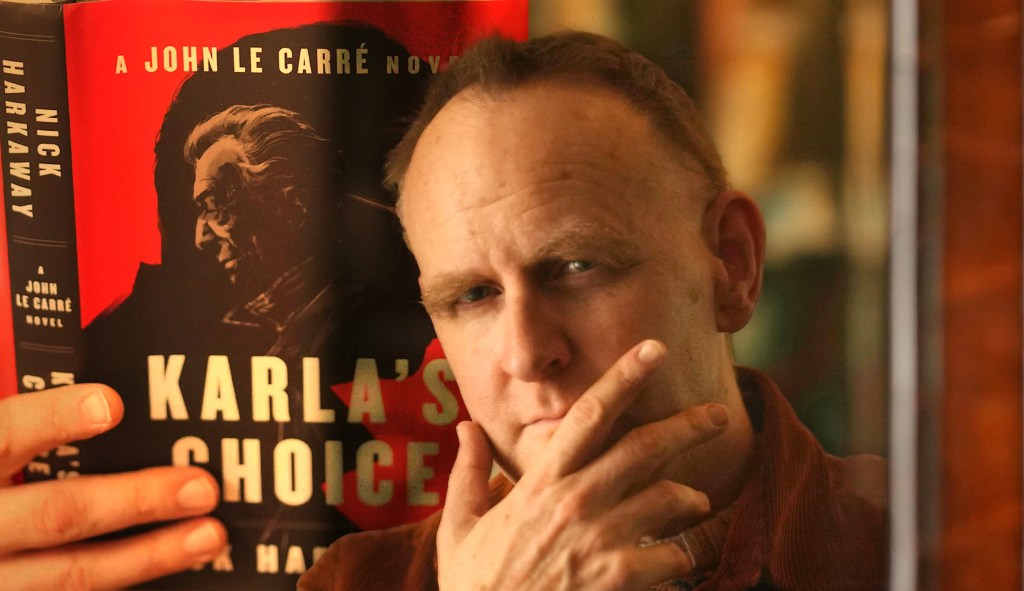
John le Carré has passed the torch to Nick Harkaway, his son. In Karla’s Choice Harkaway takes us to the Circus in London with all the quirky characters who help keep the world safe from the forces which oppose democracies. Harkaway also gives us George Smiley, called back from retirement to unravel a situation involving death and a man who is on the run. Smiley may lose his wife over this one.
Harkaway does a good job of capturing le Carré’s style, and the novel takes us back to post-war days. We tune into events happening behind the Iron Curtain as the runner, Róka, who left London leaving a dead man behind, is a Hungarian national with connections to Communism. The backstory of Róka is perhaps a bit too complicated. I found myself tuning some of it out. Harkaway’s inclusion of Szusanna, Roka’s secretary, lent complications to the operation which added value. Szusanna gave us a reason to stay interested enough to get to the real focus of this tale, Karla. Karla is an agent of Russia and has a reputation for being both brutal and ruthless. Smiley offers Karla a choice. Will he take it? Has the Circus lost some of its effectiveness since the end of the war? This is a good legacy book, but not a great one. It may not be due to the author’s skills as a writer but rather to all the ways the world of spying has changed. Still, we are lured on to solve the mystery of Róka.
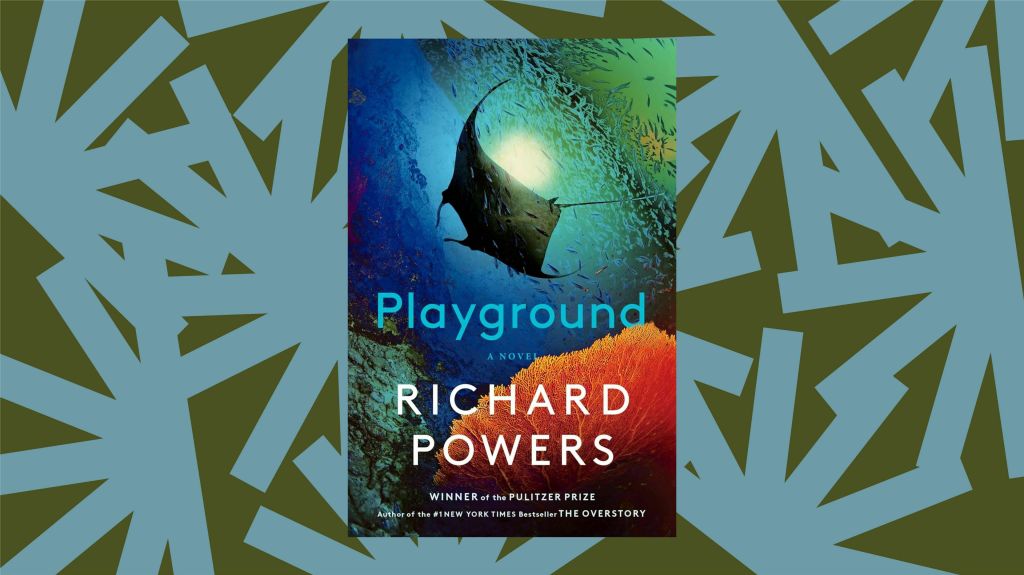
Did you know that fish go to cleaning stations under the ocean and other sea creatures vacuum them and clean their teeth? I didn’t. Did you know that fish and other sea denizens like to play, even sometimes with humans if they come around often enough. The ocean/s come alive in Richard Powers book Playground. The enormous variety of sea life, the bioluminescence divers see that we landlubbers don’t, the coral reefs, the way sea critters turn human trash into new coral reefs-it’s all fascinating and beautiful as Powers describes it.
But what antics creatures get up to underwater is not the only thread in this novel. Playground is also the name of a social media platform designed by Todd Keane that allows users to play and chat online, for a fee. And with the arrival of AI, the site gets more popular until Todd Keane is a billionaire.
But, before Keane earns his billions he meets Rafi Young in school. Rafi is a young black man. Both are from Chicago. Both love games. At first, they play chess. When they discover Go, the infinite variety of moves, the complex strategies lead them to replace chess. They play for hours and years before gaming even begins on the internet.
Todd Keane’s father worked in the pit at the Chicago Board of Trade:
“…a warrior of the open-outcry system, he stood in the heart of the octagon as the furious waves of capitalism crashed all around him.” (pg. 9)
Since Todd’s parents fought and made up loudly and often, he sought solace under Lake Michigan. “When I was young, I could breathe underwater.” (pg. 12) Todd and his father played a series of classic games until they got to Backgammon. Eventually Todd could beat his father every time. Todd came from a wealthy family.
Todd’s father lets him choose a book. He chooses “Clearly It Is Ocean” by Evelyne Beaulieu. Eva’s dad helped invent the first aqualung and he had his daughter take it for a test in the pool. Eva learns to dive, even meets Jacques Cousteau, and travels to coral reefs until she ends up on Makatea.
Rafi Young’s father was a Chicago firefighter. When his mom worried about him walking to school through a tough neighborhood, she made him wear a bright orange coat and hat which solved the mom’s problem but made Rafi’s life worse. When his father heard about all this, he punched Rafi’s mother in the face. Divorce followed, and poverty.
While Todd pursues a degree in math and excels with computers, Rafi earns a PhD in educational psychology. They meet Ina Aroita, born in Honolulu to a Navy family and raised on naval bases in Guam and Samoa. For a while it seems that both men fall in love with Ina. It is Rafi who marries her and becomes a teacher on the island of Makatea where he and Ina adopt two orphaned children and Ina becomes an artist. Todd is the only character not living on Makatea. In fact, Todd and Rafi have had a falling out and Rafi doesn’t speak to Todd. Will there be a reunion? My lips are sealed.
Here’s what Todd has to say about the picture book, “Clearly It Is Ocean.” “Thirty thousand kinds of fish. Fish that migrated their faces across to the sides of their bodies as they grew. Fish whose barrel heads were transparent, revealing their brains. Fish that changed from male to female. Fish that grew their own fishing rods out of their heads. Fish that lived inside the bodies of other living creatures.” (pg. 24)
Makatea, a French colony, was found at one time to be a major source of phosphates, most often used in fertilizer. The discovery of phosphates multiplied the amount of food farmers could produce. Given the exploding population on Earth, the demand was huge and the island was exploited for years. Then the mining companies left, and the island’s population fell to 82 humans. Two of these humans were Rafi and Ina. Evelyne Beaulieu, now 92, lives there also, still diving.
Now, a mysterious company wants to build a “seasteading” community at Makatea, throwing the residents into a panic because they remember what happened in the phosphate situation. It will bring jobs, a new clinic, and a high school. What will it do to the reefs around Makatea? How will the people vote? Is constant growth necessary and healthy for our societies and our planet? Here we have a mashup between AI and the health of Earth’s oceans and the whole wonderful, barely experienced, watery environment and all the living creatures in it. What will it be like to live on a planet whose oceans are no longer teeming with life, a dead ocean? What choice does the island make, and how is Todd Keane involved? What choice would you make?
“In the last chapter (of “Clearly It Is Ocean”), the woman I crushed on with all my ten-year-old heart told of a research trip she had made off the coast of Eastern Australia. She stopped one day in the middle of a dive to watch a giant cuttlefish near the mouth of its den. This tentacled mollusk, kin to squid and octopus, was performing a long wild color dance for no one.” (pg. 34)
It is not easy to talk about extinctions and the destruction of biomes when everyone is madly striving to be a millionaire or billionaire. Taking care of declining habitats and populations of creatures that are basically invisible to us and are dying off doesn’t get much viral attention on social media. Powers’ book does a good job of focusing on our choices between capitalism’s drive to perpetual growth, which is pursued mostly to feed people’s greed, and the importance of play to all living things. He reminds us that the oceans surrounding us are full of fascinating life forms and that we need to help them stay that way. This is not a preachy book. It’s especially great when Eva is underwater.
When Neal Stephenson takes us on a fictionalized historic journey, it will be an improbably wild adventure. However, there will be a contemporary connection. It’s not easy to write social commentary that is both outlandish and entertaining. This is Stephenson’s talent. In Polostan: Volume One of Bomb Light: A Riveting Epic of International Espionage, he combines politics (communism), polo, and physics. How does life unfold for the child of a marriage between a cowgirl and a political activist? Dawn is the child of such a union, and she ends up with two names, two countries, an attachment to tommy guns and Bonny and Clyde, a skill for hitching rides on trains, and for training polo ponies.
In Montana and Wyoming with her mom, she is Dawn Rae Bjornberg. In Chicago with her dad, she is Aurora Maximovna Artemyeva. Out west she trains polo ponies and is privy to the family less-than-legal business concerns. In Chicago she is a socialist activist. When her mom dies of cancer Dawn/Aurora lives full time with her father. Aurora was born in St. Petersburg, renamed Leningrad, and lived there until she was 5. Her parents left from Vladivostok and arrived in Seattle. Her father is dedicated to the Bonus Army, the Bonus Expeditionary Forces of Walter W. Waters (a real person). Her dad is a Red American and a vet. When the Bonus Army gathers in Washington DC (in the 1930s) her father (a Wobbly and a communist) is killed.
Aurora finds herself orphaned and pregnant at 16 after adventures with x rays and a budding physicist who educates her about atomic particles (neutrons had not yet been discovered). She is bilingual with good skills in both American English and Russian. She decides to retrace the steps of her parents and to return to Russia through Seattle. Russia, now the Soviet Union, does not exactly welcome her with open arms.
Comrade Tishenko (described as “a jumped-up peasant) finds her bizarre background difficult to believe. Soviets are paranoid. They see enemies everywhere, “blockages in the Soviet system” from foreign capitalists, cliquism, Jews, inherited rural backwardness, opportunists, hooligans, ineradicable counterrevolutionary tendencies in the Russia Orthodox Church, wreckers, diversionaries, kulaks, Petliurite scum, national deviationists, backsliders, actively malevolent foreign agents, witting and unwitting accomplices. She has to keep explaining why she is fluent in both English and Russian. She is tortured by the OPGU. Read the book for all the gory details.
She meets Fizmatov, who holds a PhD in physics from the University of Paris, helping with the steel factory that is being built at Magnitogorsk. His children are named Electron and Proton. Fizmatov (who made up his name by combining Phys and Math) and Aurora bond over physics. He helps her when he can. Aurora has a tommy gun secreted in the bottom of her trunk. When the Soviets learn of Aurora’s past with training polo ponies in the American West, they find the niche that will allow her to survive for a while. She also is sent out to recruit talent for the steel factory that the Soviets hope to build bigger than the one in Gary, Indiana.
Don’t be fooled by the seeming chaos of Stephenson’s version of history. Anecdotes, even far-out anecdotes, often help his messages go down. Since this novel is only Volume One of Bomb Light, I look forward to where he will take us. He took us on a similar historical journey in his Quicksilver trilogy. It may be the hippy in me that appreciates Neal Stephenson’s strange mashups. He always presents me with a new perspective on current issues and the role of cutting-edge science in modern political power struggles (and their applications to warfare).
Although Cormac McCarthy seemed to dismiss physics as an answer to our current climate dilemmas in his book The Passenger, Stephenson seems to maintain a wait-and-see attitude towards the matter in Polostan. Since America is flirting with authoritarianism, Stephenson may be trying to show how disappointed people were in the 1930s when communism was not living up to its promises.
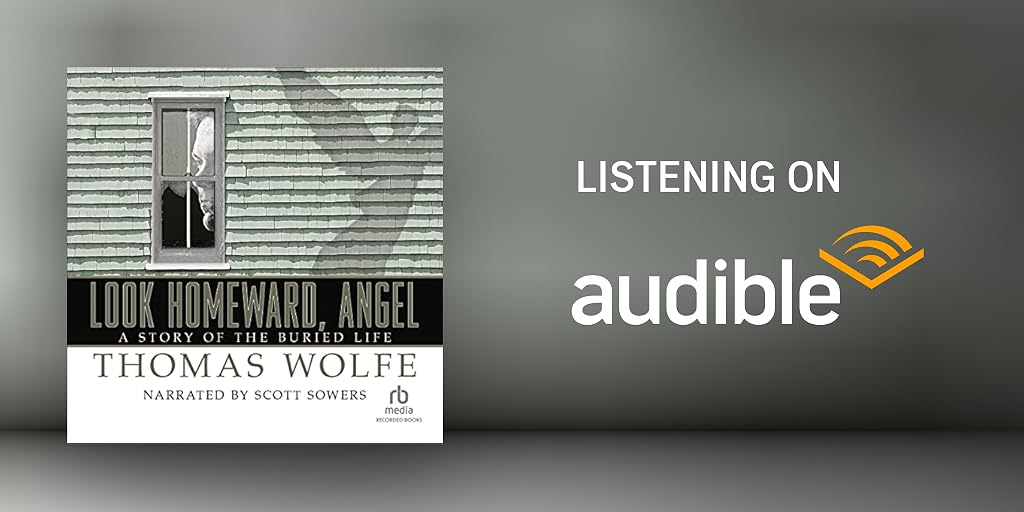
Indirectly, with several degrees of separation, Thomas Wolfe’s book Look Homeward, Angel was recommended to me by Dustin Hoffman. My literary education did not extend to the Southern authors, although William Faulkner is also considered a classic American author, so he made the cut. Thomas Wolfe is an amazing writer, writing dense prose descriptions that, in this case, tended to emphasize the seasons. The seasons mirror the moods of the characters. The book is a tome. It’s long and the small print was tough on my old eyes, so I read along while I listened to the book on tape.
Look Homeward, Angel was published in 1929 when the author was 29. He was born in 1900 and grew up in Asheville, North Carolina, which Wolfe called Altamont in his book. It was sad to read this as a flood was devastating Asheville in 2024. Wolfe died when he was 37 years old of tubercular meningitis which the internet tells me was too advanced to treat. The book is not as popular today as it probably should be because of the presence of African Americans in terms that we have learned to avoid as culturally hurtful and therefore inappropriate. If you can ignore the outdated historical elements and concentrate on the other content, you will find a master of prose writing and the legacy of an education in the classics.
The novel is considered autobiographical in nature. William and Eliza are the parents of Daisy, Steven, Ben, Grover, Luke, Helen, and Eugene. Eugene is the character who represents the author. He is a brilliant kid and gets special attention from his teachers who recommend a private school for him. This is not an easy choice for his frugal parents who are also rather laissez-faire parents. Mary Leonard runs the school that sees to it that Eugene is treated like the gifted child he is.
Wolfe attributes these sensory memories to Eugene at the age of five:
“He had heard already the ringing of remote church bells over a countryside on Sunday night; had listened to the earth steeped in the brooding symphony of dark and the million-noted little night things; and he had heard thus the far retreating wail of a whistle in a distant valley, and faint thunder on the rails; and he felt the infinite depth and width of the golden world to the brief seductions of a thousand multiplex and mixed mysterious odors and sensations, weaving, with a blinding interplay and aural explosions, one into the other.
He remembered the East India Teahouse at the Fair, the sandalwood, the turbans, and the robes, the cool interior and the smell of India tea; and he felt now the nostalgic thrill of dew-wet mornings in Spring, the cherry scent, the cool clarion earth, the wet loaminess of the garden, the pungent breakfast smells and the floating snow of blossoms. He knew the inchoate sharp excitement of hot dandelions in young Spring grass at noon; the smell of cellars, cobwebs, and built-on secret earth; in July, of watermelons bedded in sweet hay, inside a farmer’s covered wagon; of cantaloupe and crated peaches; and the scent of orange rind, bittersweet, before a fire of coals. He knew the good male smell of his father’s sitting room; of the smooth worn leather sofa, with the gaping horsehair rent; of the blistered varnished wood upon the hearth; of the heated calfskin bindings; of the flat moist plug of Apple tobacco, stuck with a red flag; of woodsmoke and burnt leaves in October; of the brown tired autumn earth; of honeysuckle at night; of warm nasturtiums; of a clean ruddy farmer who comes weekly with printed butter and eggs and milk; of fat limp underdone bacon and of coffee; of a bakery oven in the wind; of large deep-hued stringbeans smoking hot and seasoned well with salt and butter; of a room of old pine boards in which books and carpets have been stored, long closed; of Concord grapes in their long white baskets.
Yes, and the exciting smell of chalk and varnished desks; the smell of heavy bread sandwiches of cold fried meat and butter; the smell of new leather in a saddler’s shop, or of a worn leather chair; of honey and of unground coffee; of barrelled sweet pickles and cheese and all the fragrant compost of the grocer’s; the smell of stored apples in the cellar, and of orchard-apple smells, of pressed cider pulp; of pears ripening on a sunny shelf, and of ripe cherries stewing with sugar on hot stoves before preserving; the smell of whittled wood, of all young lumber, of sawdust and shavings; of peaches stuck with cloves and pickled with brandy; of pine sap, and green pine needles; of a horse’s pared hoof; of chestnuts roasting, of bowls of nuts and raisins, of hot cracklin’, and of young roast pork, of butter and cinnamon melting on hot candied yams.” (pg. 69)
Wolfe occupied a world far richer in smells than our own, but still, you can almost smell it all, and there is more on the next page. But as Eugene grows up his thoughts become concerned with deeper considerations such as “why are we here,” “does it matter what we do”, and as many have wondered, “is there anything after this.
In a last imaginary conversation with his (dead) brother Ben:
“And in his vision he saw the fabulous lost cities, buried in the drifted silt of the earth–Thebes, the seven gated, and all the temples of Daulian and Phocian lands, and all Oenotria to the Tyrrhene gulf. Sunk in the burial urn of earth he saw the vanished cultures: the strange sourceless glory of the Incas, the fragments of lost epics upon a broken shard of Gnossic pottery, the buried tombs of Memphian kings, and imperial dust, wound all about with gold and rotting linen, dead with their thousand bestial gods, their mute unwakened ushabtii, in their finished eternities.
He saw the billion living of the earth, the thousand billion dead: seas were withered, deserts flooded, mountains drowned; and gods and demons come out of the South, and ruled above the little rocket flare of centuries, and sank–came to their Northern Lights of death, the muttering death-flared dust of the completed gods.
But, amid the fumbling march of races to extinction, the giant rhythms of the earth remained. The seasons passed in their majestic processionals, and germinal Spring returned forever on the land–new crops, new men, new harvests, and new gods. (pg. 506)
…
“And rising from his vision he cried: I am not there among the cities. I have sought down a million streets, until the goat cry died within my throat, and I have found no city where I was, no door where I had entered, no place where I had stood.
Then from the edges of moon-bright silence, Ben replied: Fool, why do you look in the streets?
Then Eugene said: I have eaten and drunk the earth, I have been lost and beaten, and I will go no more.
Fool, said Ben, what do you want to find?
Myself, and an end to hunger and the happy land, he answered. For I believe in harbors at the end. O Ben, brother, and ghost, and stranger, you who could never speak, give me an answer now!
Then, as he thought, Ben said: There is no happy land. There is no end to hunger.” (pg, 507)
The book is a trip, a trip to another time, the mind of another person, yet has a familiar humanness we can understand. There are angels but I will let you discover them for yourselves. Families play an enormous role as we are “coming of age.” Eugene Gant is no exception. His parents are quite unique, and it’s easy to see the connection between how parents treat children and life’s challenges and how their children grow and develop. If there had been shrinks as available as today in the late 1920s, would Wolfe’s confessions and philosophical digressions have been expressed with such depth? Would there be angels?
From a Google Image Search – What’s so bad about multipolarity? – Al Majalla
When we look at politics in America at this moment, poised as we are to go to the polls to elect a new president, and when we realize that one candidate wants to change America’s operating system while the other candidate will stay within the parameters our founder’s and previous administrations have designed for us, we can’t help looking ahead and imagining what American governance will be like in the future. The world seems to be slowly converting to autocratic governments run by dictators who pay loyalists by turning them into oligarchs to ensure their continued loyalty. These oligarchs steal money from citizens, stashing it away in tax shelters or secret bank accounts allowing kleptocracy to exist together with autocracy. How grim life becomes for people who are not part of these governments depends on the temperament and ideology of the “dear leader.”
Autocracy is not as shocking in a country that has never been a democracy, which perhaps evolved from a monarchy to a communist government and then to a dictatorship. But it is shocking to hear autocratic echoes in America which has always been a democracy since it won the right to be a sovereign nation rather than a colony. (We could take a moment to bemoan our imperialism, but it won’t help us in this instance.)
“Sovereign” is a key term that autocrats like to use, Anne Applebaum tells us in Chapter 4 of her book, Autocracy, Inc. As in, we are a “sovereign” nation. Keep your laws out of our country. Mind your own government. Your human rights are not necessarily our human rights.
In a review of Timothy Snyder’s new book, On Freedom, in the New York Times, the reviewer reminds us that
“On Nov. 9 it will be 35 years since the Berlin Wall fell. The exhilaration of that moment was followed by high hopes for the spread of democracy throughout Eastern Europe, then in Russia itself when the Soviet Union imploded. Gradually hope gave way to frustration, disappointment and then dismay. Russia did not become a liberal democracy, and nor did a number of its former satrapies.”
Sovereignty means keep your mitts off my country, hegemony means my country belongs at the top of the heap because it has the strongest economy, government, and military. If America held the hegemony in the twentieth century, other nations, autocratic nations, are competing for hegemony in the twenty-first century and beyond. We didn’t necessarily need Anne Applebaum to tell us this. As humans, we understand human nature. Competition seems hardwired in humans and all living things. What Anne Applebaum is telling us is that autocrats might be uniting to woo underdeveloped countries with aid and support for their autocratic leaders to create a world-wide-web of autocratic nations for the strength in numbers that might shift hegemony from America and the West to China and/or Russia.
Where once (after WWII) human rights became a goal of the nations that beat the Nazis and did not end up behind the “Iron Curtain” of Stalin’s Russia, all bets are now off. Where once nations declared that “recognition of the inherent dignity and of the equal and inalienable rights of all members of the human family is the foundation of freedom, justice and peace in the world. It is also acknowledged that ‘disregard and contempt for human rights have resulted in barbarous acts which have outraged the conscience of mankind.’…everyone has the right to life, liberty, and security of person. Applebaum continues to remind us of what was said in the shadow of Nazi genocide, “No one should be subjected to arbitrary arrest, detention, or exile. Torture and slavery should be banned.” (p. 99)
Applebaum speaks of what has been collectively known as “the rules-based order. She goes on to say that how the world ought to work is not how it actually works, that many signatories have violated these rules, but that (for now) they still influence behavior in the real world.”(p. 100)
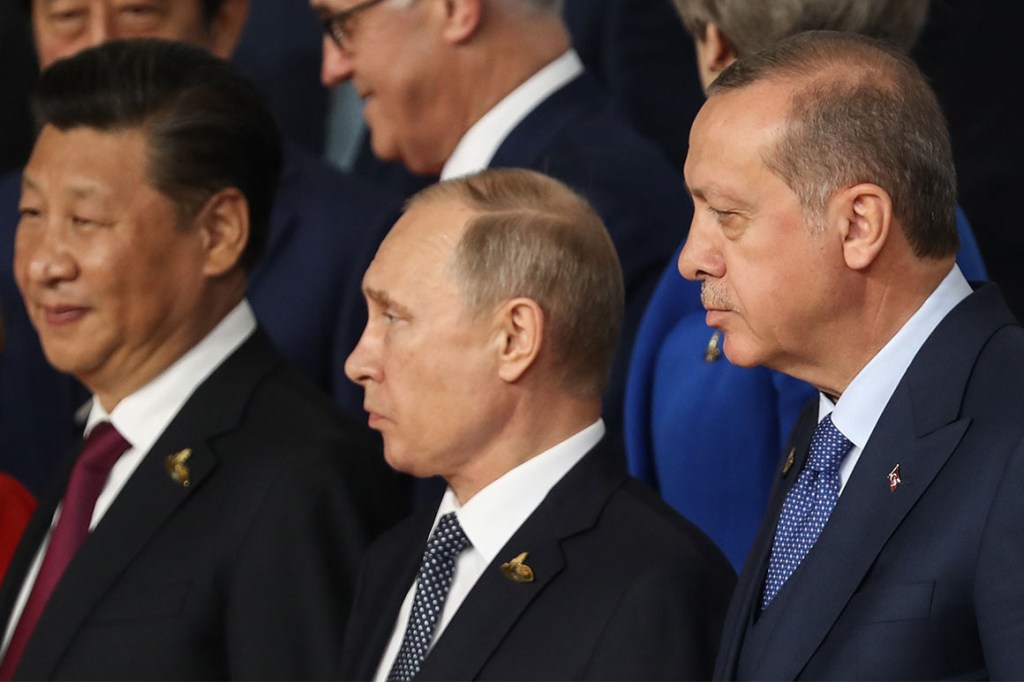
She warns us that powerful autocracies like China or Russia want to get rid of the language of these old agreements. Xi Jinping said this while addressing the Communist Party in 2017, “China seeks to take an active part in leading reform of the global governance system.” She tells us the remarks of Andrea Worden, a legal scholar and China expert, “For the CCP to attain the moral legitimacy, respect, and recognition it needs for leadership of a new world order, it must remove the threat of Western universal human rights.” (p.101)
She tells us what Putin has to say about sovereignty. “Sovereignty includes the right to abuse citizens at home and to invade others abroad. This privilege is available to only a very few large nations. There are not many countries in the world that have sovereignty.” (p.102)
Another term that is popular with autocrats right now according to Applebaum is the term “multipolarity” because it telegraphs an organization of autocratic states, banded together for greater power, stronger economics, and hegemony. Of course, hegemony is not up for grabs. As in Putin’s view on sovereignty, hegemony belongs to very few nations, or perhaps only one and that would be whatever country wins the hegemony competition, takes hegemony away from the US.
What does this have to do with America? A lot. We have an autocrat running to be our president right now and he has a passionate cult following. You might also want to read this article from today’s New York Times about what liberals may not realize about MAGAs.
If you are paying any attention to politics, then you must have heard that this is an existential election. Donald Trump is not only not a Democrat, but he also doesn’t put much stock in democracy. He likes strong men and sees himself as one of these alpha males. He wants to head America and go steady with other autocrats. He may even think that his presence alone will ensure America’s hegemony among autocratic nations.
Perhaps inciting your followers to violence is something strong leaders do, but Trump doesn’t like to take responsibility for the violence he incites. Other autocrats have no difficulty showing that they don’t just intimidate, they act (although often they still delegate violent actions to others). Donald Trump believes that by changing the rules he can change our minds. He believes his propaganda is more effective than 240 years of living in a democracy. Americans have no experience living in an autocratic state. Even if he wins one, it might be hard to keep it. How will it feel if he actually sends troops out to round up immigrants (both legal and illegal) and spends our tax dollars to deport them or puts them in “camps” which are nothing like sports camps or computer camps but more like the Japanese Internment camps.
China, Applebaum says, wants to change the language, to throw out “political rights” or “human rights” and replace it with squishy language like “win-win cooperation” and “mutual respect.” (pp. 102-3)”
When I read the book To Paradise by Hana Yanagihara (which was not an easy book because of the way it skipped around in place and time while focusing on one family and its descendants) the book offered glimpses of an America under the thumb of the Chinese government (the UK was still a free nation). The America she depicts bears little resemblance to our beloved democracy/republic. Applebaum’s careful discussion and her evidence for a future united autocratic institution (the anti-UN) is a warning that we are in danger of losing our access to whatever human rights we still treasure and that many nations around the world will rejoice if we choose autocracy, if we replace “the rule of law” with “rule by law” (or whatever the leader says).
“A world in which autocracies work together to stay in power, work together to promote their system, and work together to damage democracies is not some distant dystopia. That world is the one we are living in right now,” says Anne Applebaum. (p. 121)
Anne Applebaum’s book has a subtitle, The Dictators Who Want to Run the World. From her perch in Poland, she has a nearer view of all the players, Russia, China, Syria, Iran, and Africa. Nations that are run by autocrats are using new technologies not only to spy on other countries (especially democracies) but also to spy on their own citizens. You might argue that nations need to know what their enemies, both foreign and domestic, are up to but there are more sinister motives at work here too. Chapter 3 in Autocracy, Inc. has the title, “Controlling the Narrative”.
The author begins by reminding Americans that our NSA is collecting data about US citizens as we were informed by Edward Snowden, a whistleblower or traitor, depending on your point of view, who is living as an exile in Russia. She also mentions Pegasus spyware in Poland which was eventually exposed and investigated.
“If no parallel scandal has ever unfolded in China, Russia, Iran, or North Korea, that’s because there are no legislative committees or free media that could play the same role.” (p. 71)
Applebaum reasons that when democracies use spyware it helps autocracies justify their abuse. If there are fewer objections to using spyware outside of China, then there will be fewer objections to using it inside of China.
In fact, we all expect that surveillance inside nations, even democracies, will escalate as new tech advances are developed. Why develop spyware if you won’t use it. Americans objected to the intrusions of the Patriot Act after the attacks on 9/11 but were so shaken by these brazen attacks on America that we accepted these rules while also believing that they would be temporary. They have been replaced by the USA Freedom Act which curtailed the government’s authority to collect data in 2015. Democrats in Congress strongly objected whenever Trump wanted to collect names of people in a group he wanted to target.
In China, objections can be deadly, as in Tiananmen Square in 1989. China, says Applebaum, first tried to eliminate the activists (people), then set out to eliminate the ideas such as the rule of law, the separation of powers, the right to free speech and the right to assemble which are described as “spiritual pollution”. (p. 66)
While Americans still believe, or say they believe that the internet would lead to a cultural renaissance, Applebaum predicted in 2012 that the internet would become a tool of control. China was designing “the Great Firewall of China” (p. 67) which used an “elaborate system of blocks and filters to prevent users from seeing particular words and tools. She tells us that foreign companies rushed into the new security market in the same way companies had rushed into the post-Soviet financial market. (Yahoo, Microsoft, Cisco Systems all made software that complied with China’s rules.) These companies were eased out once China had access to their software. (p. 68)
The security network was expanded by combining online tracking with tools of repression such as security cameras, police inspections and arrest. Other tools might include “nanny apps” on phones, monitoring book purchases, picking up on unusual behaviors, voice recognition, and even DNA swabs. All these tools have been used on the Uighur population in China. Now add in facial recognition and AI and you have a state that can truly control the narrative.
Anne Applebaum did not just write her book to expose state surveillance tactics. Perhaps she felt we needed to understand what might be coming to a place near you. These systems can be copied and have been copied by many nations including Pakistan, Brazil, Mexico, Serbia, South Africa and Turkey.
“The more China can bring other countries’ models of grievance into line with China’s own,” argues Steven Feldstein, an expert in digital technology, “the less these countries pose a threat to Chinese hegemony.” (Am I nervous about writing these words without a powerful husband such as Applebaum’s to make her a public figure and hard to attack – yes, I am sometimes paranoid.)
Russia plays a different game says Applebaum. Lie constantly and blatantly and when exposed offer no counterarguments. (p. 78) Blame everyone but yourself. This “fire hose of falsehoods” makes citizens question how you can possibly know what really happened and so they avoid politics altogether. Autocrats spread hopelessness and cynicism because it works to their advantage. This is not Russia’s only game. Russia is also a surveillance state.
Surveillance was a thing we worried about in the post-WWII world. We had all read Orwell’s 1984. We expected our freedom to include privacy. After the events of 9/11 we saw the need for some spying, both domestic and foreign, but we still hoped to not invade the homes of private citizens. Now, we are in an age where we live with hacking, with having our data stolen regularly, and with who knows how much surveillance because we can’t imagine our lives without the internet and cell phones.
Many American fully believe that if Trump and the right-wing MAGA’s win in 2024 all aspects of surveillance will be expanded and private citizens may be pursued because of the things they think and what they write or have written. Even without the MAGA’s in power, surveillance will most likely expand given all the autocracies that have cropped up everywhere. We may not be able to keep it focused on only foreign countries. This is one of our great fears of AI that it will be used by our government to control our behavior, regardless of what party you are registered with or the fact that you choose to not belong to a party.
“In seeking to create, these new propagandists, like their leaders, will reach for whatever ideology, whatever technology, and whatever emotions might be useful.”…Only the purpose never changes, Autocracy, Inc. hopes to rewrite the rules of the international system itself.” (p. 97)
Chapter 3 also goes into, in some detail, the changes in print and social media that are accompanying this rise in “spying”. Project 2025 will give MAGA carte blanche to spy on all Americans. Anne Applebaum’s book is a warning. Soon she will offer some remedies.
Let’s see what Anne Applebaum means when she compares the spread of autocracy and kleptocracy to the spread of a cancer. As Western nations try to influence nations that intimidate or use violence against their citizens – nations that give power to a few and squelch the human rights of many – by sanctioning them or their banks or institutions, autocratic leaders are creeping in to bypass these sanctions or boycotts. In a way Autocracy, Inc., if it existed as a formal global entity, would be an anti-NATO. These nations seek to undermine democracies and, if they succeed, they create new autocracies. The pilfering of national dollars can cause the nations they “protect” to fail without their assistance (sometimes even with their assistance). The lure of fortunes to be made and sequestered away is creating a pull towards autocracy in nations that are long-established democracies. This has us fearing that the balance of global power is shifting towards autocratic/kleptocratic governance and may give global hegemony to a giant autocracy like China, or a giant, ruthless autocracy like Russia. The 2024 election in America could weaken our democracy, perhaps beyond restoration, if Trump and the Republicans win.
Applebaum uses several examples to illustrate how Autocracy Inc., through mostly unplanned interventions, allows dysfunctional, pillaged national economies to continue to serve as fodder for kleptocrats. These rescuer nations may have once required no quid pro quos, but they have learned to profit as they preserve autocracies in trouble.
This article will summarize her discussion of this dynamic with one example in Venezuela, but there are more examples in Applebaum’s book. President Hugo Chavez rose to power in 1998. Venezuela was an oil state, “nepotistic and corrupt.” Politicians were bribed and deals were offered to friends of the former President. Chavez ran as a leader “who promised to create a more honest “Bavarian Republic of Venezuela”. But as corruption crept in Chavez did not pursue opportunities to end it, in fact he fired the whistleblower, a member of his inner circle. Chavez, like Putin, chose to turn Venezuela into a kleptocracy. “Corrupt officials prove more malleable than clean ones.” (p. 45)
Chavez eliminated transparency and accountability, he broke democratic institutions like the press, the courts, the civil service. (Sound familiar?) All the while he kept proclaiming his belief in democracy. Applebaum says, “since everyone was breaking the law no one wanted to talk about it.” Meanwhile, officials were hiding millions in oil money in a Portuguese Bank (Banco Espirito Santo). Ten billion dollars went into Swiss banks and 26 billion from a Venezuelan oil company scam was stashed in Andora Banks. A later investigation showed 127 cases of large-scale corruption just in the oil industry. (pg. 46)
A new form of corruption later named currency exchange manipulation offered a way to profit from skimming dollars and exploiting weak laws. For a while students figured out how to game the currency exchange system. It was called the “democratization of kleptocracy” Chavez was able to fool many for a while until the decline of the oil industry began in 2002-3.
“Billions (or maybe tens of billions) of state funds had vanished, the country’s foreign currency had disappeared into private offshore accounts, hyperinflation accelerated and imported goods vanished.” (p. 48-49)
Chavez died in 2013, and Venezuelans hoped the corruption would end when they elected Nicolás Maduro, but, Applebaum contends, “Autocracy Inc. stepped in to help.” Rogue states surviving under sanctions turned to new sources of funding. They turned to drug trafficking, illegal mining, extortion, kidnapping, and gasoline smuggling. She argues, “[i]f a state is a member of Autocracy Inc. there are other options.” (p. 50) There are friends and trading partners in other sanctioned states. There are companies that are unbothered by corruption – happy to encourage it and to participate in it.
Russian companies stepped in to replace North America, South America, and Europe. Rosneft, Gazprom, Lukoil, TNK-BP all put money into Venezuela. Grain imports from the US and Canada were replaced by Russia along with 4 billion in Russian weapons.
China started loaning money to Venezuela without conditions which bought Chavez and Maduro time before collapse. China eventually added conditions when Venezuela defaulted on the loans. China sold riot gear to the regimes.
Cuba was linked to Venezuela by an anti-American agenda. Oil moved from Venezuela to Cuba; soldiers, police officers, and security and intelligence experts moved from Cuba to Venezuela (to quell riots and demonstrations). Cuba taught Venezuela how to use food shortages to end dissent (think about it).
Turkey helped because of personal links between Erdogan and Maduro who were bonded by their dislike of democracy and its anti-corruption movements. Venezuela sent gold to Turkey in exchange for food.
Iran seemed the most improbable tie, Applebaum tells us. Oil binds them and anti-Americanism, opposition of democratic movements at home, trading information about how to evade sanctions. Iran got gold, Venezuela got food, gasoline and advice on the repression of dissidents. Iran helped Venezuela build a drone factory and sent money to be laundered for Hezbollah.
There are more examples in Chapter 2. More nations are involved. Applebaum says, “there are hybrid states that are a legitimate part of international financial systems, that normally trade with the democratic world, that are sometimes part of democratic military alliances but are also willing to launder or accept criminal or stolen wealth or to assist people and companies that have been sanctioned.” (p. 50)
My comments – Perhaps you have been very aware of the spread of autocracy and are not surprised by corruption, but it is important to note how autocratic nations are pitching in to get around sanctions that democracies use to try to enforce humanitarian standards both in peace and war. Will Autocracy Inc. become an institutionalized force against democracy instead of providing hit and run assistance to kleptocracies that go too far, whose economies fail, and who have sanctions against them? These nations deliberately try to exert power to prevent humanitarian reforms in the nations that may soon make up a true Autocracy Inc.






 So Many Books, Choose Wisely