Migrations by Charlotte McConaghy – Book

From a Google Image Search – Time Magazine

Franny Stone, born in Australia, taken to live in Galway by her mother, is one the migrators in Charlotte McConaghy’s book Migrations. She is part ocean, part sea ice and part arctic tern. In this atmospheric tale the reader is taken to a landscape and a life unlike their own. Franny is a woman who must live near water, cold water, wild water. She must live near the few nesting sea birds that remain in a world where wild animals are almost gone. She embraces the cold and it seems to have seeped into her, except that she is also passionate. 

This is a love story. Two people have this passion for arctic terns in common, and Niall Lynch is the only one who can bring this wanderer Franny to stay on land. This is a tragedy. I can’t tell you the details. This is an Irish folk tale. People imagine that Franny is a selkie (she’s not). When she is ten she leaves her home and follows a boy to his home on the other coast of Ireland. He tells her this story; “There was a lady, long ago, who spent her life coughing up feathers, and one day when she was gnarled and gray she stretched from a woman into a black bird.”

Franny, now older, places trackers on three arctic terns at a nesting site in Greenland. It is her passion to follow them on their migration, one of the longest of any of the birds. She has to find a sea captain who will take her. She has to ride on a fishing boat when she knows that fishing is over and destroys the very balance she wishes she could protect. She finds Ennis Malone, captain of the Saghani, in Greenland. Saghani means raven. Off they go.

You carry the entire Franny ecosystem in your mind for days, perhaps longer. A sadly sweet, cold water journey of a book. In a time when we are not supposed to leave our living rooms what would happen to a footloose, can’t stay in one place person whose entire life is a series of Migrations? And, since we already lost 3 billion birds it is not at all unlikely that there may be a last migration.

A Promised Land by Barrack Obama – Book

From a Google Image Search – CNN

Hanging out with President Barrack Obama has been a real trip through his early days in politics, campaigning for the Senate, his journey through the presidential primary in 2007, his presidential campaign and a win that will seem like a bit of magic and a truly historical accomplishment. Obama was both a black man and a young man, fairly new to Washington, but with a grasp of American hopes and a charisma that fueled his improbable election. 

It took a while to finish Obama’s book, A Promised Land, but not because it wasn’t readable or revealing, just because there were so many things going on as the 2020 election unfolded and the events of January 6 th shocked us all. I was actually blogging about politics all through the Obama administration because the opposition to him in the Republican party and in the media, especially the alternative media (Fox News, Talk Radio) became a constant stream of negativity. As a Democrat, I agreed with Obama’s politics, but setting that aside, the use of racist tropes and the shade cast on his every move jump-started my love of the underdog. 

Obama’s book gives him space to reveal the thinking behind his actions as President and offers plenty of insight into foreign affairs, especially the upheavals in the Middle East, which perhaps grew out of the wars in Afghanistan and Iraq which Obama inherited but did not initiate. 

After blogging for the past decade, I published some of my posts in a series of books entitled Loving America to Death and two omnibus editions which cover all ten years, including the Trump administration. Reading about the same events I wrote about with the new advantage of being, in a sense, inside Obama’s head and heart was similar to time travel. He discusses but does not dwell on the ACA. The BP oil spill in the Gulf of Mexico and the difficulty plugging that leak was something we both wrote about. Obama touches on Fukushima, the tsunami and the failure of the nuclear reactor. The dual track optics was so odd for me. We were observing the same events; me as a citizen sitting out here in the cheap seats, and Obama as the prime actor, the President of the United States. 

Even if you don’t agree with Barrack Obama and you don’t like his politics and you think any of the dozens of complaints that were aired about him were true, it never hurts to spend time in someone else’s shoes. The memoir is personal, intimate, and informative and well worth the time it takes to read it. After all, it is our history.

https://www.amazon.com/author/nlbrisson

The Vanishing Half by Brit Bennett – Book

From a Google Image Search – Vanity Fair

Twin girls born in a town that isn’t even on any map, black girls with skin so light who, in any fair world, would not have to worry about how society would classify them are at the center of this story – twin girls who see their father dragged from home and lynched in the middle of a traumatic night. This is the world that Brit Bennett describes in The Vanishing Half. It is a world where skin color is an issue and not just with white people but also with black folks. Desiree and Stella find their small eerily segregated town, confining. They graduate from high school and run away to the big city. Desiree is the twin with the inclination to wander, but Stella is the one who disappears.

Good characters and an interesting concept introduce us to a world most of us cannot inhabit. Even to talk about the issues presented in this novel makes it far too easy to stray from political correctness. Before slavery was there a skin color hierarchy? When we acknowledge that skin color is used as a kind of class indicator even among black folks does that indicate that the superficial judgments of slave owners were passed on to their human “property”? These are things I can perceive but cannot pass judgment on. But Bennett gives us a peek behind the curtain.

This is not a heavy tome full of academic discussions of these matters. This is basically the story of a family and the traumas that determine their futures. It is a story of separation and a sort of reconciliation. It is a story of secrets kept and finally half revealed. But behind the story is that undertow that makes us think deeper thoughts. Interestingly, it is a wanderer who becomes the glue in this family of woman who were robbed of their father/husband. I wouldn’t mind having my own Mr. Early.

Hamnet by Maggie O’Farrell – Book

From a Google Image Search = Goodreads

Hamnet by Maggie O’Farrell has gotten a lot of buzz and it made this reader curious enough to open the covers and enjoy Maggie’s novel. O’Farrell takes us back to Shakespearean England. She noticed a record in a local parish that recorded the death of a child named Hamnet Shakespeare. The tale she embroiders is as possible as any tale of Shakespeare’s homelife about which very little is known.

Agnes attracts the attention of a barely adult William while he is tutoring Latin at a local sheep farm to pay a debt owed by his father, a glove maker. She goes into the woods most days with a falcon (kestrel) on her gloved hand. She is a bit older than William but she is a conundrum he wants to solve. When that kestrel flies off to hunt and then returns from these wild adventures to the hand of Agnes, William imagines that she is a singular woman with a will of her own and powers that set her apart from other village women. 

Agnes is able to read people’s lives, but she lives long enough to learn that what she reads may be cryptic and misleading. William and Agnes have three children, one girl, Suzanna and then twins, Judith and Hamnet. Judith is tiny and is often afflicted with health problems. Hamnet is a strong and smart boy. But when the plague comes to Stratford the outcome surprises Agnes and breaks the hearts of both Agnes and William. 

I think what comes across most powerfully in this invented history is the depiction of a mother’s grief and what it does to a family and a marriage. Although Agnes is not a witch, she has supernatural talents and a knowledge of plants as medicines. How much of Agnes’ character is based in fact and how much is created by the author could be determined by finding out what is known about Shakespeare’s wife, who we know as Anne. The idea that Shakespeare’s play, Hamlet, may have been inspired by family tragedy is a possibility that would be difficult to prove, but it makes for a good book, even if you have to suspend some disbelief.

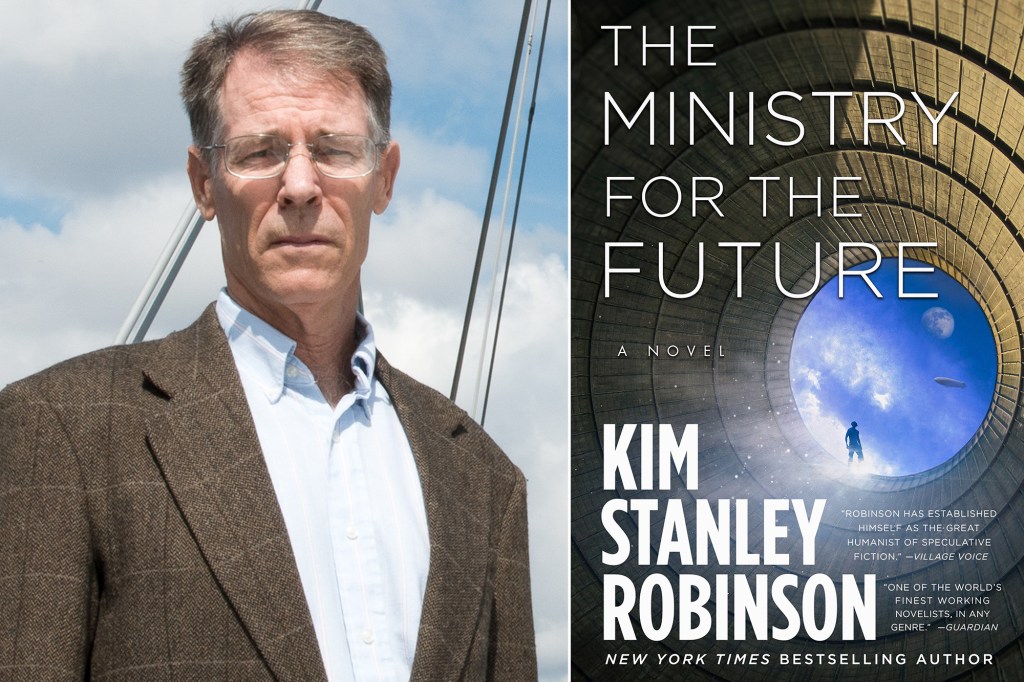
The Ministry for the Future by Kim Stanley Robinson – Book

This is a book but also politics – From a Google Image Search – Entertainment Weekly

In order to profit from The Ministry for the Future by Kim Stanley Robinson you must get through the first chapter – the catalyst for all that follows. Frank May is the only survivor of an extreme heat wave event that kills 20 million people, an entire village, in India. We don’t even learn his name until much later in the book. There are reasons.

Robinson skips around a lot which helps move this fictional/nonfiction book, full of what could be very dry science, along. India, in reaction to that enormous heat wave tragedy tries to recreate the ashy clouds of the Pinatubo volcanic eruption which blocked the sun for almost two years. The strategy India settles on of creating a layer of  a reflective substance (several are under consideration) which would reflect some sunlight back into space thus cooling the earth’s atmosphere temporarily is an actual tactic being considered by climate scientists. The Children of Kali, also in India, decide to go ‘dark’ and use more violent strategies.

In order to make the billionaires listen up and force these greedy souls to give up fossil fuels, massively effective plans will be required. The Ministry of the Future, a UN project headed by Mary Murphy from Zurich, Switzerland, never openly supports violent action. But Mary’s Assistant Chair, Badim, has no such compunctions and he has Mary’s permission to head a ‘dark’ arm of the agency. It is so ‘dark’ that even as the book ends we have no clues about the tactics used by Badim’s group, but you might want to learn about Pebble Mobs.

Mary Murphy’s machinations are not secret at all. Through the Ministry, Robinson’s book offers up one idea after another – the state of the art ideas, the far out ideas and ideas unpalatable to many – that could be used to lower the temperature raised by global warming and for sequestering the carbon dioxide (carbon) that is to blame. A story that is basically a climate textbook is made readable by making it a personal story with characters who interest us, and by flashing around the globe. We might be in India in one short chapter, or in China, or at a committee meeting, or experiencing the kidnapping of Mary Murphy, or in Antarctica, or Russia, or in the Alps, or San Francisco, along the new wildlife corridors, presenting an audacious financial plan to the world’s central banks. It’s a whirlwind for the most part, belying how slow actual change may be, but it’s exciting and it makes the reader believe that we could do this; we could save the planet.

The Ministry for the Future is a fiesta of climate ideas. If it gets a bit Kumbaya near the end, after all our recent coronavirus isolation, some communal esprit might be welcome. Mary Murphy’s mantra is “lose, lose, lose, lose, lose, lose, win.” We might need to stop losing and use some of Robinson’s pirated ideas if we want to have any hope of winning. Every person on the planet should read this book.

Homo Deus by Yuval Noah Harari – Book

From a Google Image Search – Penguin Books Australia

Homo Deus: A Brief History of Tomorrow by Yuval Noah Harari begins by lifting us up as humans and ends with our obsolescence as a species. Harari argues that we humans have almost conquered poverty and disease and that our newest goals will no longer be humanistic ones such as individuality and progress and success. He says, “In seeking bliss and immortality humans are in fact trying to upgrade themselves into gods. Not just because these are divine qualities, but because in order to overcome old age and misery humans will first have to acquire godlike control of their own biological substratum.” (pg. 43) He talks about the ‘new peace’ brought about by the existence of nuclear warfare which threatened man’s actual existence. The implications are so dire that powerful nations have backed off from all-out war. Humanism has replaced the Industrial Age and now even humanism is being replaced by a quest for immortality and happiness.

Harari believes that humans were once just one more animal living as hunter-gatherers like all of the other animals. He bemoans how far we have wandered from our natural state and he does this by making it clear that the way we treat the animals who provide our food is unacceptable. He talks about the cages pigs are placed in where they can barely turn around, and he describes how they are impregnated again and again but not allowed to raise their babies. His descriptions of our food industries’ inhumane way of treating animals, such as chickens, pigs and cows, ignores the science which tells us that animals experience psychological and physical agonies from our treatment of them. It sets the reader to imagining ways that we could change this dynamic, treat our animals as biological entities, or perhaps even become vegetarians. Harari is, of course, right that treating living entities like parts on an assembly line belies what science has taught us about our biological similarities.

Then Harari predicts that we are entering a new religious era. Mr. Harari believes that all of our religions are myths; myths that allowed humans to live together in ever larger groups (caves, villages, towns, cities, nations). He believes we now worship data and he names this new religion “Dataism.” According to Harari we are trying to create the Internet-of-all-Things (the Singularity). But, he warns, if we are able to do that we may create artificial intelligence that will make humans obsolete, unnecessary. His predictions about what our love of data could do to us reminds me of that old saying, “don’t ask for what you want because you might get it.” 

Harari’s Dataism also reminds me of Neal Stephenson’s last book “The Fall” in which the world actually does end up empty of all humans when they choose to be stored as data after they die. Eventually there is no one left alive to reproduce and humans no longer have a biological presence, although there is an afterlife of sorts. Artificial intelligence (AI) will be a trending topic of discussion for some time. Can we look far enough ahead as we see the ramifications of our passion for information and data to understand if what we are doing will threaten our very existence? Human pride in accomplishing our objectives makes it difficult to step back despite apprehending the outcomes. Will the Internet-of-all -Things become like the nuclear bomb. Once we go there we will suddenly understand David Foster Wallace’s dedication of being a Luddite. Back away and live; succeed and become extinct. Is Homo Deus too far out? Perhaps not.

Squeeze Me by Carl Hiaasen -Book

From a Google Image Search – The New York Times

How does a character who relocates wild critters who have wandered too close to a human turn out to be a person of rare and admirable character? That describes Angie Anderson, the main character in Carl Hiaasen’s new book, Squeeze Me. Perhaps Angie stands out because most of the characters in Hiaasen’s book are caricatures. Hiaasen, a Florida author, is famous for creating both mayhem and humor that is recognizably Floridian. He loves Florida but he also sees that it is a wacky place and he mines it for his satirical prose. He knows how to tell good stories.

This time we find ourselves at Casa Bellicosa, a thin disguise for the winter White House. You can probably guess who has the code name Mastodon, and by association, who has the code name Mockingbird. There are secret service men and women all over the place. Mastodon and Mockingbird are getting it on, but not with each other. We also have the Potussies (POTUS + Pussies) a gaggle of old socialite club members who idolize Mastodon.

When one the Potussies disappears the wealthy ladies are sad to lose one of their own but they are also worried that there will be a scandal for their beloved POTUS. Assumptions are made which lead to the arrest of Diego, an illegal immigrant and college graduate who just found his way back to the US where he went to college. He’s in the wrong place at the wrong time. Mastodon is only too happy to whip up his cult to harass the young man in his cell in the local jail, and to even get cult members arrested so they can try to kill Diego. Sentiments are running high and Diego is in despair.

Angie Anderson has a good idea of what happened to Kiki Fitzsimmons, but the proof keeps escaping from her clutches even though the proof is dead. It’s a romp that feeds into a certain political viewpoint which may or may not be yours. If it is you will surely enjoy Hiaasen’s book, Squeeze Me. I don’t want to give away the yucky parts so this is all I can tell you. If you subscribe to the opposite political viewpoint buy the book anyway. You can always burn it on behalf of the president you love. Support writers.

Sapiens by Yuval Noah Harari – Book

Sapiens by Yuval Noah Harari is right up my alley, in my wheelhouse, or any other cliché that means Mr. Harari and I like to think about the same things. We like to think about earth and mankind’s place on earth. We like to think about human societies or cultures if you prefer, how they developed, how we got to this particular overcrowded, possibly existential state we currently find ourselves in, and if and how we can find our way back from the precipice. He begins at the beginning when there are two species of humanoids on the planet at the same time, Neanderthals and homo sapiens.

Humans began as just another species of animals. They had the same needs for food and shelter, communal cooperation and reproduction. There are no other animal species that we know of that left drawings on caves though, and that may be the key difference that started the entire chain of human history. In our early days we did nothing that disturbed the natural balance of the planet. We hunted and gathered but animals and plants were plentiful and all living things flourished or experienced hardships together. If life became difficult in one location people simply moved to a new location. Life was ‘a moveable feast’. 

Harari explains that people usually think that it was agriculture that changed the human equation. Of course it did. But, he reasons, what really separated people from other animals was the human facility with storytelling. Animals didn’t name constellations or make up families of capricious gods. But once humans did create these ‘stories’ which Harari calls ‘myths’ humans who shared the same myths began to join together in communities. They could not have done this without learning how to plant seeds and keep a stable food supply nearby. At first these myths might be small and local and they varied from place to place. People fought wars over them. One myth got absorbed into another.

The point at which readers may have difficulty accepting Harari’s ‘myth’ thesis is when we get to modern religions: Christianity, Judaism, Muslims, Buddhism, Hinduism. Whether monotheistic or polytheistic, all of these religions, to Harari, are myths. They are myths that separate us and keep us apart, set back a global future we can hardly avoid unless some disaster drastically lowers the human population or some other life-changing event occurs. Will we ever give up our myths or adopt one worldwide myth?

Yuval shows how far we have gotten from the balance of nature into which mankind was born. So many animals are extinct. Men and women no longer collect in caves and live off the land without radically changing the planet. He discusses the role of imperialism and capitalism, the economic idea of perpetual growth which occupies the thinking of so many of us. Can the exponential growth of the Industrial Revolution continue? Can Capitalism get reined in enough to restore some of the natural balance we need. This is not a book about climate change. This is a book that suggests that we “left the garden” when we built towns and cities and empires and our moves have thrown the planet out of balance. Harari explores economics and even the way we treat cattle and chickens. (We really do need to find a new way to treat our food. We know that this is inhumane because it makes no nod to the equal circumstances in which we all began and it weighs on our spirits.) He discusses globalization and the future of mankind but tells us he will offer more in a second book.

In all, it is a sprawling book and it inspires thoughts while immersed in the author’s ideas and long after. It’s a book I will remember, and I go to sleep some nights going over what Harari had to say, some of which is hard to take, but for the most part is not anything we haven’t heard in the corners of our culture where such things are contemplated. Exercise that brain with thoughtful books and perhaps you will solve the riddle of civilization at the same time. Or we will go to space, take our myths with us and do the whole thing all over again because it’s a pattern we like, or we can’t change, or our myths are now too imbedded and we are too committed.

Inland Intrigue by Michael Hughes – Book

From a Google Image Search – Goodreads

Michael Hughes sent me a note asking me to read his novel Inland Intrigue so I did. I had never heard of the Inland Empire, a rather ostentatious name given to a not so ostentatious section of southern California, apparently to help market the area. The story takes place in the Inland Empire town of Riverside and all around the Inland Empire in 2006 and 2012. Tyler and his dad are on the way to the funeral of Bill Higgins, a man who was a friend of his father, a lawyer who worked for a bank called CalCoast that was into subprime housing loans. He died in a car accident. On the way David suggests that Tyler get involved with the Republican Party someday. Six years later Tyler Conway is home from college and staying with mom Linda and dad David at the upscale family home with pool and hot tub. Tyler is at loose ends about what to do with his summer so he decides to do as his Dad suggested. He gets involved in the local Republican election campaign. 

Political campaigns are not exactly hotbeds of activity during the summer months but Tyler’s dad puts him in touch with the Vice Chair of Riverside County Republican Party, Seamus O’Malley. Madison, Tyler’s sister is the only Democrat in the family and she gets some heat as she comes back from Boston to work in a program called Housing Helpers which is supposed to assist those who were hurt when the housing bubble burst. Tyler figures the program is a scam. He is also not sure that his dad’s friend Bill died from natural causes. If he is doing detective work it is the lowest key detective work I have ever experienced, but he does get some answers.

Hughes spends a lot of time describing Tyler’s days which are almost as boring serving the party as they would be if he just stayed home all summer. Is the Groundhog Day pace of the book purposeful, as it really does describe political campaigning several months out from an election, or is it a flaw in plotting? Do we really want to pull into the driveway in Riverside day after day in either the Mercedes Benz E320 or the Land Cruiser and jump in the pool and then the hot tub, or take a nap and heat up a pot pie. I kept reading. I didn’t quit. Perhaps because, often enough, a day would bring one new piece of the puzzle, or one new character to catch my interest. Weekends we often went to dinner with Linda and David and Tyler where conversation seemed scarce. I also had problems with the unusual uses of the word “but” in Tyler’s thoughts and conversations. Is this a regionalism? Is it just bad grammar? Just when it started to bother me the odd usage stopped.

Highways are complex in California and knowing which ones you will take and where your exits are is very important. Is it important to include every detail of each time the ‘Benz’ or the ‘Cruiser’ hit the road? You will have to judge for yourself. However, if you need to know how to get anywhere in the Inland Empire or the route to Tyler’s sister’s place, or to a weekend convention or a photo shoot, Tyler is as good as a GPS. He tells you every highway to take, every exit and even surface street directions if necessary, and he describes the neighborhoods he is passing by. I would consider these kinds of details superfluous as they were not part of the plot, but another reader might appreciate knowing exactly where they were at all times, and it might be a California thing. 

It is not easy to write books, even fiction books, so I give Hughes credit for a book that hangs together and has all the necessary elements of a story. Is it an exciting story? Is it great storytelling? I will leave that to other readers to decide. But there was intrigue of a sort and it was uncovered. I had some trouble with Tyler’s reactions to what he discovered. You will have to judge for yourself. Keep writing Michael Hughes. You’re off to a good start. And that’s how writers get better.

Brave New World by Aldous Huxley – Book

From a Google Image Search – The British Library

Given all the recent interest in a book that was required reading when I was in school, and the new TV series based on the book (which I have not seen), rereading Brave New World by Aldous Huxley seemed in order. It was shocking to find how little I remembered about the book so, good plan. The book is actually a philosophical exploration of the underpinnings of societies and it projects us into a mechanized future with universal happiness as its goal. I’m experiencing this as a sort of a mash-up because I am also reading Sapiens: A Brief History of Mankind by Yuval Noah Harari at the same time. Harari suggests that the only difference between homo sapiens and other animals is our ability to tell stories, our facility for generating myths that allows us to exist in collective groups greater than the 150 members of the largest groups that prevailed in previous ages. This reverberates with what Huxley writes about in Brave New World in 1931. 

In the society Huxley creates, the god who is at the mythical core is Henry Ford and the model is the assembly line which was the object of both admiration and consternation among various groups. It allowed the production of all those Model A cars and Model T’s that offered the freedom of the open road and seemingly conquered the matters of distance and time. Rather than turning out one vehicle at a time the assembly line could produce dozens in a day or hundreds in a year and the production rates kept improving. So what if you applied the idea of the assembly line to human reproduction. Rather than the whole messy and often tragic process of biological birth, what if birth could be mechanized, removed from the nuclear family and moved into a factory setting. You could even produce different castes of humans depending on the way you controlled the birth environment and later the mental development. Huxley used Greek letters to indicate these castes: Alphas as the highest, Epsilons as the lowest.

We begin our tour of the “World’s State” at the Central London Hatchery and Conditioning Centre. The motto of the State is “Community, Identity, Stability.” Because of the Bokanovsky Process it is possible to create infinite numbers of twins by causing branching in fertilized eggs. These groups of identical twins work very well together without pesky disagreements, and in addition to their genetic content they are mentally conditioned or programmed to enjoy their group identity and their slot in society, however high or low. Alphas and even Betas are individuals and are not ‘twinned’. Epsilons are slated for menial labor. Alphas are, within limits, thinkers.

Sexuality is key to the goals and order of this society. Toddlers are encouraged to engage in sexual play. Many groups are sterile. During naptimes subliminal conditioning is broadcast as nursery rhymes and songs that are treasured in adulthood even as they control the behaviors of the various groups. Alphas and Betas cannot reproduce but they can have as many sexual partners as they wish, although pair bonds are frowned upon. If you live in this Brave New World and you find yourself in any way troubled or unhappy there is a drug for that. Soma will restore your happiness and send you tripping off into musical, light and sexual sensations that make you happy once again, and if that doesn’t work you can really zone out, take lots of soma and take a soma holiday.

An Alpha, rumored to have experienced a chemical imbalance in his birth bottle, promises to take Lenina, a female conditioned to enjoy sexual encounters, to an area that has stayed ‘savage’. There we meet Linda, who was what Lenina is now, but was left for dead by a previous Alpha who toured the same area. Linda was pregnant and was forced to do the very thing she was conditioned to despise. She had to give birth and have the feelings that mothers have. But she had also been taught to perceive of motherhood as a relic of the past, as an unacceptable role for women. It leaves procreation to chance. This combination of biological imperative and conditioned loathing is not a recipe for good parenting. We also meet her son John who does not biologically fit into this tribe in which he has been born. This tribe worships two gods; they worship Jesus and a tribal god. John has been raised with this religious conditioning. His mother acts promiscuously within the tribe and is shunned because of it. That is part of her conditioning, as is her willingness to take the mescalin and peyote available to her as a soma substitute. John is torn. He loves his mother and he loathes her sinful behaviors and the way it spills over into the tribes’ perceptions of him.

So what happens when our Alpha takes Linda and John back to the World’s Society, the Brave New World? What happens when myths collide? This is exactly the point where Sapiens and Brave New World collide, although they were written decades apart. You can probably make some guesses about what happens but this is a book that should be read and pondered as you question societies and what you believe they should be like.