Steve Jobs by Walter Isaacson-Book

From a Google Image Search – CNN

In the Steve Jobs biography by Walter Isaacson, the author puts Jobs in a class with Einstein and Leonardo Da Vinci because Issacson also wrote about those great men. Was Steve Jobs a great man? He was certainly complicated. He loved perfection in design, but he knew that he was not perfect. Some people in Jobs’ life believed that the fact that he was adopted may have been at the bottom of some aspects of his personality. The author uses the adjectives “abandoned – chosen – special” to sum up the emotional impacts Jobs experienced as he wrestled with being given away by his actual parents. In fact, Jobs refused to meet his birth father. 

Steve had a daughter, Lisa, when he was very young, and he did not see her for years although he later tried to include her in his life. He also had a half-sister, Mona Simpson, a novelist. He did not have an easy-going personality, in fact he could be cutting and cruel, but he also had access to considerable charm. He raged at employees and suppliers, he sometimes cried when he was frustrated, and he had very bizarre eating habits (lots of fasting, mostly vegetarian or vegan). There were, however, saving graces.

He visited Japan and was very taken with the spareness and spirituality of Japanese design, and all things Japanese. He grew up with Bob Dylan, the Beatles, the Rolling Stones and many more rock stars, eventually meeting most of them. He had an interest in Eastern religion and philosophy, as many famous figures did in the 1960s and 70s.

Steve Jobs is the myth. Jobs did drop out of school to tinker with computers in his parent’s garage for a while (with friends). He envisioned a future for computers, a future where everyone had a computer of his/her own. The computers he wanted to design had to have that same spareness he loved in Japanese culture, but he wanted these computers to be proprietary machines, not sharing hardware or software with Microsoft computers or any of the other companies that were racing to produce popular computers. He was fired by his own company and went off unsuccessfully on his own to create other brands but when Apple was in trouble he went back to the company, and he stayed. Although Jobs eventually agreed to allow Apple computers to use Microsoft Office, it was a tough compromise for this purist.

Find out how Jobs named Apple. Find out how Jobs got involved with Disney and Pixar. Isaacson’s book is very readable and detailed. Find out how and when he met his wife Laurene Powell and about the family they made. Jobs loved to make deals during walks with suppliers and creators who interested him. Many deals were hammered out on these long walks. The weather in California colluded with him on this. Bill Gates, with his completely different personality, showed up in Jobs’ life from time to time. They were rivals, but Gates was not as mercurial as Jobs. They didn’t collaborate much, but they were contemporaries in a field that was exploding with innovation. 

Find out how Jobs made his very seductive ads, how he imagined the iPod, iPad, iCloud, and iTunes. Jobs made each roll out of an Apple product into a ‘magical mystery tour.” He kept new products shrouded in mystery until the magical reveal. He was not only a great product designer; he was an expert at marketing. 

It’s a very good book about a very interesting person and his too short life. It is a long book but spending all that time with Jobs and his A team, his family, his temperament, and his amazingly creative mind is time well spent. Unlike Einstein and Da Vinci, Steve Jobs lived in some of the same decades we have lived in. He is not a historical figure. He is a contemporary and we forgive him his bad behavior because his creative genius inspires us to believe that even flawed humans can accomplish great things. 

Walter Isaacson is one of our quintessential biographers. He gives us the real Steve Jobs, if that is possible to do in a biography. Credit is due to Steve Jobs also for allowing Isaacson to depict him honestly.

Intermezzo by Sally Rooney – Book

From a Google Image Search – Chicago Review of Books

Sally Rooney wrote Intermezzo, a story of two brothers, the Kubek brothers. An intermezzo is an intermission. We meet the younger Kubek brother first. Ivan is in his twenties, and he considers himself socially awkward. All his previous encounters have not gone well. He would become filled with anxiety and unable to approach social situations with an acceptable level of poise. He used his alone time, and it was considerable, to become an expert chess player. When he goes to a small town to play some chess against amateur players, he meets a beautiful 36-year-old woman, and he becomes involved with her. She does not find him the least bit awkward.

Peter is Ivan’s brother. He’s 35 and dating the 20-something Naomi. Peter is also involved with Sylvia, who he intended to marry. She was in a terrible accident, and although he still loves her, she can’t be there for Peter as a wife because she lives with constant pain.

Ivan and Peter recently lost their father and have not yet dealt with the pain of their loss. Their parents were divorced when Ivan was quite young, and the boys lived with their father. Since Peter is so much older than Ivan, he soon went off to college. There is that dynamic of who did Dad love best. Losing their father throws them temporarily off balance. Does the title refer to the time spent adjusting to this major change in their lives?

Rooney add in some Wittgenstein, a physicist I find quite abstract (pg. 399). Schrödinger’s box makes an appearance. Conversations between Sylvia, a professor, and Peter were too esoteric for me, a reflection, I imagine, of their level of intellectual sophistication, and a contrast to Naomi, who is needy, pretty, good company and surprisingly wise for someone so young but no intellectual. I usually like brain puzzles to unravel but this time I will have to go back over that part of the book to see if it is worth trying to grasp what these two characters are saying, or if the author is just showing off her erudition. (Sally Rooney wouldn’t do that.)

“Something about fascism he says, and they go on walking, talking about fascist aesthetics and the modernist movement. Neoclassicism, obsessive fixation on ethnic difference, thematics of decadence, bodily strength and weakness. Purity or death. Pound, Eliot. And on the other hand, Woolf, Joyce. Usefulness and specificity of fascism as a political typology in the present day. Aesthetic nullity of contemporary political movements in general. Related to, or just coterminous with, the almost instantaneous corporate capture of emergent visual styles. Everything beautiful immediately recycled as advertising. The freedom of that, or not. The necessity of an ecological aesthetics, or not. We need an erotics of environmentalism.” (pg. 393)

Since the story takes place in Dublin and small towns nearby, the odd sentence structure may reflect local dialect. Sentences often seem to be written backwards to avoid the use of conjunctions. Is this a Rooney thing or an Irish thing. I do not know. I found it interesting but not annoying.

“Terribly childish wish he feels once in his life to do as he’s told.” (pg. 410)

Sally Rooney gives us characters who seem like real people we could meet and know. Ivan and Margaret, Peter, Sylvia, and Naomi could be friends of ours. How they deal with traumas in their lives, how they deal with nontraditional relationships, how they come of age, regardless of their age in years; these are the interactions that hold our interest. If the ending seems a bit too happy, I don’t mind.

Jackson Brodie Mysteries by Kate Atkinson

Version 1.0.0

From a Google Image Search – Kenyan Library – not all these books are in the series and not all the titles in the series are present

It is Kate Atkinson’s fault that I haven’t been able to do my housework. It’s her fault that my sleep schedule has been upended. I’m not resentful. Bingeing on a great series of books can be just as satisfying as bingeing on those made-for-TV series. More even. Kate Atkinson has written a series of six mystery books featuring the semi-enlightened, always striving for full enlightenment, Jackson Brodie. Her plots are unique and offer some interesting variety. Brodie’s personal friends and family members stay with us throughout the series once they make an appearance. The thread that holds the series together is Atkinson’s passion to raise awareness of the vulnerability of girls and woman in a world where many men embrace male dominance or outright exploitation of women.

The women in this series are shot, stabbed, beaten, kidnapped, and used. There are also strong women who may have once been downtrodden but will no longer tolerate abuse. Jackson Brodie often falls in love with these women and occasionally marries them. Don’t be frustrated if it takes a while for Brodie to appear. All the threads come together in astonishing and very satisfying ways, except for when Jackson thinks he might have stumbled upon the best relationship of all.

In order, Atkinson offers us 1. Case histories, 2. One Good Turn, 3. When Will There Be Good News, 4. Started Early Took My Dog, 5. Big Sky, 6. Death at the Sign of the Rook.

Case Histories: Victor meets Rosemary – “Women seemed to him to be in possession of all kinds of undesirable properties, chiefly madness, but also a multiplicity of physical drawbacks–blood, sex, children–which were unsettling and other. Yet something in him yearned to be surrounded by the kind of activity and warmth so missing in his own childhood, which was how, before he even knew what had happened, like opening the door to the wrong room, he was taking tea in a cottage in rural Norfolk while Rosemary shyly displayed a (rather cheap) diamond-chip engagement ring to her parents.” (p. 23) You can probably guess that this doesn’t end well.

One Good Turn: An incident of road rage involving a timid mystery author escalates due to mistaken identity to reveal a Russian sex trafficking ring hiding behind a maid service. Jackson is married to Julia, an actress he met under sad circumstances, although Julia doesn’t do sad. Atkinson gets to have fun giving us the fantasies of our sensitive mystery author. Jackson is in Scotland with Julia, so he is having a tough time navigating his way through the arts festival that is making for crowds everywhere. As he explores one tourist site, he comes across a beautiful dead woman who drowned but when he tries to pull her back to land, she disappears. He reports the incident, but the police have a hard time believing him. Chaos ensues and Jackson ends up bruised, battered, briefly jailed, and almost killed. 

When Will There Be Good News: Gabrielle, Joanna, younger daughter Jessica, and baby Joseph are violently attacked while walking home along a country lane. Joanna is the only survivor. We meet Joanna again, all grown up, now Dr. Hunter, with a feckless husband and child of her own. Reggie (Regina) Chase is Dr. Hunter’s mother’s helper and babysitter. When Dr. Hunter and her baby are kidnapped, it is Jackson Brodie to the rescue.

Started Early Took My Dog: Clearly the Jackson Brodie mysteries are not happening in America. We are in Great Britain in this series of books. What happens to women in America is just as bad though. This we know. Jackson is in Leeds now but we, the reader, are briefly in 1975. We meet Tracy Waterhouse of the police force. Years later, near retirement, on impulse Tracy pays a wayward mom, probably a hooker, and probably on drugs to sell her the child the mom is dragging through the mall, berating the child as they go. Back at the beginning of her career (in 1975) she talks to her partner. “Tracy Waterhouse pressed her thumb on the doorbell and kept it there. Glanced down at her ugly police-issue regulation black lace-ups and wriggled her toes inside her ugly police-issue regulation black tights. Her big toe had gone right through the hole in the tights now and a ladder was climbing up toward one of her big footballer’s knees. ‘It’ll be some old bloke who’s been lying here for weeks,’ she said. “I bloody hate them.” 

“I hate train jumpers.”

“Dead kiddies.”

“Yeah. They’re the worst,” Arkwright agreed. Dead children were trumps, every time.” (p.5)

It will be a long time and many side trips before Jackson catches up with Tracy Waterhouse.

Big Sky: Jackson is renting a place by the sea, but as they say, death takes no holidays. Jackson learned he had fathered a son with Julia, who tried to hide the child’s paternity. Nathan, the son, is staying with his dad, Jackson, but he is a teenager and not a happy one. We have crooked cops and ex-cops, money laundering, comics and drag queens. Eventually we have Reggie Chase and Jackson working reluctantly together to solve the mystery of a woman killed by a golf club. The crooked cops are all members of an elite golf club, and they are acting dodgy. The sky may be big and the view beautiful, but humans (especially men) are still up to no good.

Death at the Sign of the Rook: This mystery proceeds like a classic Agatha Christie mystery with all the possible murderers trapped together in a nearly bankrupt estate where they are holding a murder mystery weekend during an unexpected raging snowstorm. What brutal body injuries will Jackson suffer this time. What horrific things will or won’t happen to the women in the story.

You should read these, but just remember they are almost impossible to put down once you start. Kate Atkinson’s point about the vulnerability of women and girls is a good reminder that regardless of how accomplished and powerful women get they still need to take care. She reminds us that we need to work on creating societies where women are not victims.

Wandering Stars by Tommy Orange-Book

From a Google Image Search – MPR News

Tommy Orange continues the story of the Red Feather and Bear Shield offspring from his book There There in his new novel Wandering Stars. We have already learned of the Trail of Tears from history class (maybe). We are removed in time from these sorrowful events, but we still bear the shame of our ancestors’ cruelties. Jude Star’s story opens the novel as the most distant traceable ancestor of the children in this story. 

We are reminded that wars are always cruel and colonial wars are even crueler because they will always erase or reduce the powers of one party or the other. Jude Star ends up in a prison-castle in Florida from which he eventually escapes. Jude and Hannah Star’s son Charles Star and Opal Bear Shield have a daughter, Victoria Bear Shield. From one partner Victoria gives us Opal Viola Victoria Bear Shield, and from another partner Victoria gives up Jacquie Red Feather, the grandmother of the four children in the Red Feather clan who are being cared for by Opal Viola Victoria Bear Shield who is not their grandmother but who shares a mother with Jacquie.

Orvil, our focal character, has recovered from being shot by a terrorist. This happened the first time he went to a Native American celebration where he danced in public. Of course, even when you physically recover from a near-death experience, your spirit may not heal. It could take time, or it could be psychologically fatal.

Jude Star is the name chosen for Orvil’s ancestor when he is imprisoned in Florida and attempts are made to force former member of tribes to “assimilate” and forget their traditional lifestyles and beliefs. The Star men are wanderers who cannot find their place in an America captured by white folks, white folks who cannot see a way to live beside the people they fought with over this land.

Opal, who now heads Orvil’s family, has changed the fate of the Star offspring. She has purchased a house in Oakdale, California where Orvil, Loother, and Lony can find some stability as a created family. The grandmother Jacquie lives nearby and helps when she can. Opal pays tuition to send Orvil to a good school. The family is about to learn that stability is always in danger from outside forces over which they have little control. Orvil needs pain meds. He is on opioids for pain but when they are no longer prescribed, he must find other sources. He is addicted. This leads the whole fragile little family down a sad path that makes it hard to believe that even the best of intentions can turn some lives around. 

Things turn out better than you might ever think, but the family loses its nascent cohesiveness. Colonialism has consequences and Tommy Orange wants us to know that.

Tommy Orange’s books have a historical and cultural significance quite apart from their literary bona fides. They are authentic expressions of a person and a people trying to preserve their culture whose values were expressed by the way they lived lightly on the earth and by rich spiritual traditions. Placed alongside the materialism and power struggles of a culture that is so antithetical to the lived beliefs of America’s indigenous people the contrasts and challenges are clearly exposed in Orange’s novels. Here is a young voice we don’t often hear from illuminating the torn souls of a proud people or set of people with much to offer, especially the way to live lightly on the earth part.

The Blueprint by Rae Giana Rashad – Book

From a Google Image Search – Paper Literary

Imagine if Martin Luther King never existed, or if the Civil Rights movement came too late to prevent a second Civil War. It’s not hard to imagine if you just find old videos of Strom Thurmond on You Tube. In Rae Giana Rashad’s book The Blueprint, we meet Solenne and Bastien, who sound like characters in a romance book. But this is no ordinary romance. Bastien is a Councilman headed to become President of the new America known as The Order. Solenne is a young Black woman, fifteen years old, headed to become a ‘concubine’. Since this book is written by a Black woman, I will use her words to offer insight into her story. In the Author’s Note, Rashad refers to female slaves in real America as “forgotten handmaids,” so here is another handmaid’s tale, every bit as chilling as the original, except it explains how Atwood’s tale of the handmaids is even more fraught for Black women.

Page 13

“Then he was gone, ballroom lights tunneling the dark, the hush of champagne on my tongue. THE PATH WE WALKED TO BECOME Black women wasn’t straight; it was a loop. Starting from nowhere, it brought you back to nowhere. A man at one end, a man at the other, humming the same song. ‘It’s just a body. Nothing special.’ If that were true, why did they want it? Why couldn’t it belong to me.”

Page 25

“I would never know how it felt to walk boldly because this world wasn’t mine…There was no protection for me, a Black girl, no tender touch, no consideration for a delicate exterior. No space to scream.”

Page 31

“They bragged about their accomplishments in private, boasted about the difference between them and their brother. But skin quality and quantity of sleeve emblems aside, from neck to ankle, the men were identical.”

“Councilmen were the Order’s most decorated men. The talented, skilled, brilliant. Engineers, physicians, cryptographers, developers. But fundamentally they were soldiers. Killers.

Page 104

“And still, this country is better than it was when it was the United States. An economy outpaced by the rest of the world, the racial unrest, the increasing crime and abortion rates, no, we couldn’t go on with so much death.”

Page 133

“From his frame above the fireplace, Thomas Jefferson watched me. What had Sally seen in him? He brought her to France at fourteen, where she worked, lived, and earned money as a freed woman. When he decided to return to America two years later, she didn’t stay like the French urged her. She returned to America, where she remained enslaved, and the babies followed like footsteps.

Page 214

“Seven years of militias, fragmented state governments, and millions of deaths. We’re fortunate the Founders of the Order had a vision for the country. Their sacrifice ended the war.”

(Solenne’s great-grandfather wounded, and in the hospital, talks about that war and the aftermath.)

“In that unseasonably warm January of 1960 in Metairie, Louisiana, he witnessed a military dictatorship seamlessly replace the civil government. Where did these men come from, he asked his nurse. She couldn’t have been more than thirteen. Nobody knows, she said. They came from nowhere. But that wasn’t true, they were military officers police officers, senators, governors, a World War II veteran like Bastien’s grandfather. While my great-grandfather slept, Black and white men stood in offices letting the ink dry on treaties. In those documents women had fewer rights than they did before the war, and Black women caught the worst of it.”

[Black men were given the state of Louisiana as a free state, but they had to relocate by 1962 or accept the new Constitution]

Page 249

“They knew that once you get that taste of freedom nothing will keep you in line. Lucas [Bastien’s rival] knew it. I’d already seen the sunset over Sanibel Island in pink and orange. Seeing something like that makes you feel like somebody created something just for you. It was like unwrapping a present every time I blinked. I wanted to keep it forever. Not a piece of it. All of it.

Page 277

“Pleading. This was the only system designed for us. We were girls, fifteen, sixteen, seventeen. We were our ancestors, forbidden to read or write while lying under the arms of men who drafted legislation.”

Page 293 Author’s Note

“It was difficult to read these stories of forgotten handmaids and their forced reproduction. Though the United States outlawed the international slave trade in 1808, slaveholders found a way to increase the slave population by exploiting the domestic slave trade. They forced Black women into men’s beds, punishing those who didn’t have multiple children by their teens and rewarding those who did.”

Who wins, Bastien or Solenne? Find out how they both win, and both lose. Clearly this book connects to the America that we live in now, in 2024. There is talk from time-to-time about the possibility of a second Civil War when discourse heats up or when rights are lost. Women’s rights recently experienced a setback in the Supreme Court, a setback that will figure in the upcoming election and that could escalate depending on the results of the next election. The fears of Black women, that they might become “concubines” if the right-wing wins must be quite real and harrowing. Throughout Rashad’s story of Solenne, she is writing a book about a slave from 100 years ago, Henriette (Kumba) drawing parallels between the two women’s lives, reminding us that Black women are not property or sexual objects and warning us about the dangers of allowing racism to rule ever again.

I feel a kinship to Rae Giana Rashad because I wrote a similar book about losing freedoms if America becomes an authoritarian state. She did a better job than I did since she had to create all her characters from scratch, and I used both real and fictional people. My attempt in this genre is entitled 2028: The Rebellion. Rashad is offering fair warning to everyone. You should read the book.

System Collapse by Martha Wells-Book

From a Google Image Search – Tor.com

Ever since I met Martha Wells’ Murderbot I have looked forward to new books in the series, although they are finished much too quickly. The latest book is called System Collapse. This installment in the life and times of Murderbot opens with an action scene. Some ag-bots have been contaminated with an alien virus and are attacking anyone or anything that gets too close. If you are thinking about starting the series with this book, don’t. Start at the beginning. In this installment, Wells doesn’t do much in the way of summarizing previous adventures. SecUnit is here with ART, a university-run ship that conducts research and supports humans and bots who are being exploited by corporations. Can a ship be a character? Of course, just think of the Enterprise.

Fighting against alien contamination to protect a human community is difficult enough but our SecUnit is dealing with a personal issue (redacted) and a ship from Barish Estranza, a corporation that tricks populations in planetary settlements that are in disarray into signing contracts to work in corporate mines as corporation serfs or slaves. It turns out that some of the colonists on this planet split off to establish a separate community, but all communications have been abandoned between the original group and the splinter group. SecUnit finds those who left living in a pre-corporate space, but so does Barish Estranza. 

SecUnit usually soothes itself when overloads occur or it needs to rest up by watching episodes of The Rise and Fall of Sanctuary Moon, which it wishes it could access much more than the constant need to pay attention to real-world events allows, but Sanctuary also taught SecUnit lots of useful strategies and has educated SecUnit (an organic and inorganic construct) in human behaviors. In fact, SecUnit introduced ART to the videos and he also uses it to help other SecUnits after they disconnect their governor modules.

What has SecUnit redacted? Is SecUnit becoming more and more human? Will SecUnit be given a human name? That is all up to Martha Wells. I am just a human organic form who enjoys following SecUnit all along the corporate rim and beyond. It’s a literary amuse bouche in space.

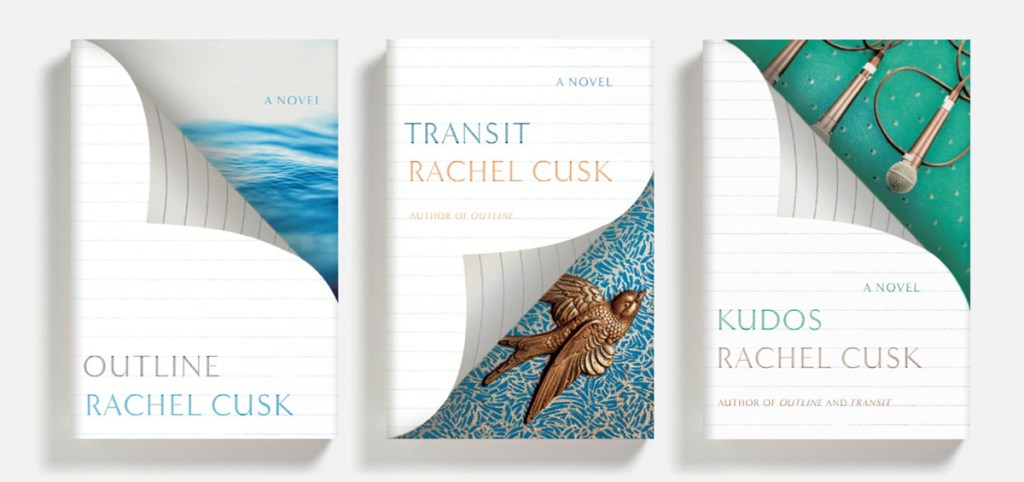
Outline, Transit, Kudos: Rachel Cusk Trilogy – 3 Books

From a Google Image Search – Literary Hub

Rachel Cusk’s trilogy encompasses books entitled Outline, Transit, and Kudos. In every case Cusk presents character stories of people met in chance, or occasionally planned, encounters. In Outline, the author, Faye, (characters are typically unnamed or given only first names) is on a plane headed to a Book fair in Greece where she will sit on a panel and be asked to speak. Her seatmate on the plane gets in-depth treatment as we learn the story of his life and his marriage. Even at the book panel, the event runs out of time before the author speaks, but one outgoing male author has plenty to say.

Hardly any of the characters in these books have names, or they might have a first name, as already mentioned. This seems to be a new trend in fiction which probably has a purpose, as in allowing us to relate to the character, not wanting to create a character that jumps off the page and becomes an icon or to make it easier for the reader to imagine that s/he is the main character. The main character in this case is an author who has been through a crushing divorce. She and her husband have two sons. But her writing career is taking off, first literally to the Book Fair in Greece. 

Rachel Cusk has a talent for telling stories of the people who meet this author as she travels, renovates an apartment, and goes to a second writer’s convention where awards are being given. But we know little about the author or her book. We are treated to an in-depth exploration of all the people she sits next to or interacts with. She seems to have no close friends, but this story is not really about the author. It is about men and women and the difficulties of intimate male-female relationships, especially in marriages in the twenty-first century. 

Even as she fights off the bile of her new downstairs neighbors in Transit, she finds out the details of the life of the contractor who spends the most time on her renovation. Her neighbors are a nasty pair who knock on the ceiling with a broom as they follow her footsteps through her new flat. The downstairs couple seem to be bound together by their hatred for whoever lives upstairs, and they delight in intimidation. These are people I would want to run away from, but she stands her ground (without a rifle). When they realize that she is soundproofing the floor their hatred knows no limits but never gets physical. It is all bluster, an act to drive her away. The author has sent her sons to stay with their father while the reno is undertaken and although they beg and cry to come home to her, she encourages them to be independent. Is she a bad mother?

In the last book, Kudos, the author has obviously had some success and is attending a conference where she is supposed to be interviewed on television. Although she learns the life story of the interviewer, the technicians are never able to make the electrical hookups and the interview is called off. She meets another interviewer, a book critic, and he never learns a single fact about her, but we learn all about him. Almost all the people we meet are men and what they have to say about marriage is not encouraging. She also meets a wealthy woman who has given up on men and now invites writers and artists to come stay in her mansion where they can be warm all year long and enjoy more sun than the author has ever enjoyed in England where she lives with her sons in her redone flat over her miserable neighbors. Will she take Paolo up on her offer? Although this exploration of modern relationships is relevant this is a literary book than many readers are likely to skip. Rachel Cusk, however, has earned much praise from those critics who know and love well-written fiction.

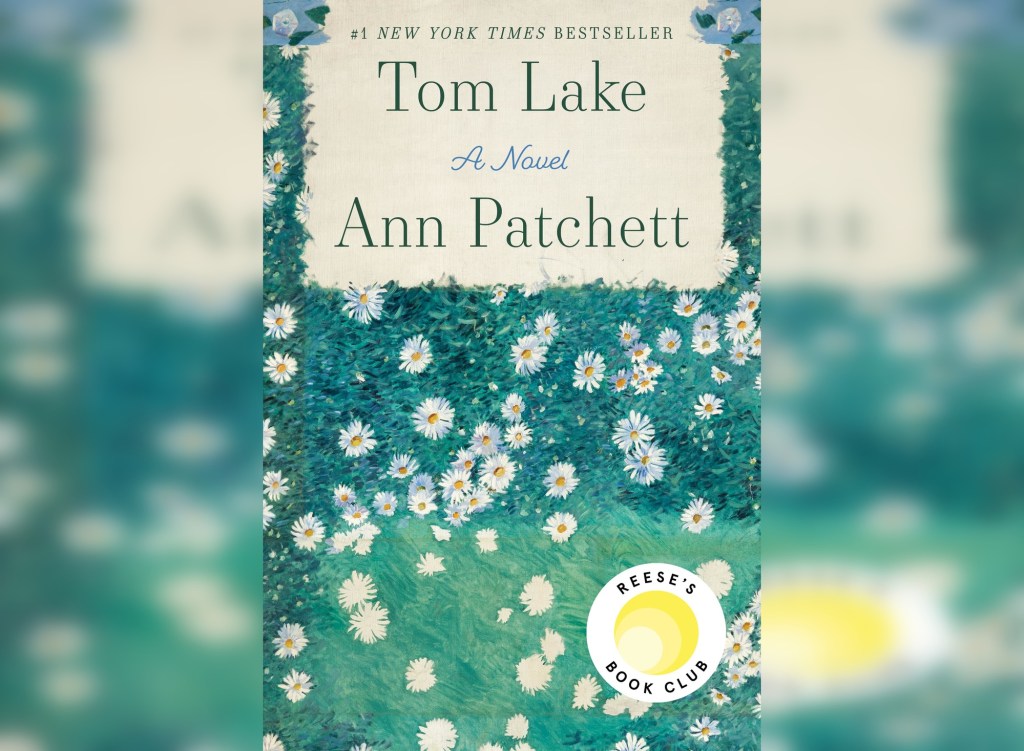
Tom Lake by Ann Patchett – Book

From a Google Image Search – The Harvard Crimson

Tom Lake by Ann Patchett is a pandemic book of sorts. Lara and Joe Nelson own a farm, rows of cherry trees, some plum trees, some pear trees. The cherries are the money makers. Sweet cherries must be hand-picked. The tarter cherries for pies and cooking can be shaken from the trees onto tarps and they can be frozen.

The pandemic has made it difficult for their usual pickers to arrive. Lara and Joe’s three daughters, all grown but not yet married, come home to ride out the pandemic and to help pick the cherries. When Lara’s daughters find out that she dated Peter Duke, a famous and handsome movie star, Emily, Maisie, and Nell enliven a tedious repetitive task by prying the story of their mom and Peter Duke out of their reticent mother.

Once upon a time a local presentation of the play Our Town finds Lara and her friend registering local actors for the upcoming production in their New Hampshire town where Lara’s mother and father live. Our Town is a big deal in New Hampshire. If you have read the play, you know why. If you haven’t read it, you should. After a failure to find an “Emily” to play that important role, Lara ends up trying out. Turns out she is a natural. Her Emily is so well done that she is invited to go to Hollywood to test for a movie. Lara feels a connection to the Emily character but is she a great actress she wonders. After she wins the part in the movie playing another Emily-style character the film is shelved for several years. Lara is packed off to play Emily in Our Town again, this time in a professional summer theater in Tom Lake, Michigan.

Lara’s daughters, picking cherries and prodding their mother to get to the part where she meets Peter, find that they are finally there. But they want more, they want details. Because these daughters did not come home to tend to their mom on her deathbed (as in some novels and movies), this is a far lighter novel with only a few tragic elements. It’s basically a book that would make a great Nora Ephron movie. Do we have a new Nora Ephron? If Ephron was a product of her times, then we may never have another Nora Ephron, nor another Ann Patchett. 

The challenges of being an independent farmer are braided through the other elements in the book and the specter of all those cherries which represent the farm’s income rotting on the trees with no one to pick them is a pressure as intense as our desire to hear about Lara and Duke and why Lara is a farmer’s wife rather than a movie star. Readers also get an interesting peek into what it’s like to work in a summer theater.

Tom Lake was a good read, but it’s also a trip to more carefree, innocent days even though it is during the COVID pandemic. Perhaps people envy America these days in the 21st century because some people still get to live such a life. How much longer? How many of us? Although it is a new novel it already feels nostalgic. The orderliness of a well-run farm, the lines of heavily laden cherry trees under blue, blue skies. You might enjoy spending some time in a place that seems so fragile so in danger of disappearing altogether. I borrowed this book from my local library.