The Blueprint by Rae Giana Rashad – Book

From a Google Image Search – Paper Literary

Imagine if Martin Luther King never existed, or if the Civil Rights movement came too late to prevent a second Civil War. It’s not hard to imagine if you just find old videos of Strom Thurmond on You Tube. In Rae Giana Rashad’s book The Blueprint, we meet Solenne and Bastien, who sound like characters in a romance book. But this is no ordinary romance. Bastien is a Councilman headed to become President of the new America known as The Order. Solenne is a young Black woman, fifteen years old, headed to become a ‘concubine’. Since this book is written by a Black woman, I will use her words to offer insight into her story. In the Author’s Note, Rashad refers to female slaves in real America as “forgotten handmaids,” so here is another handmaid’s tale, every bit as chilling as the original, except it explains how Atwood’s tale of the handmaids is even more fraught for Black women.

Page 13

“Then he was gone, ballroom lights tunneling the dark, the hush of champagne on my tongue. THE PATH WE WALKED TO BECOME Black women wasn’t straight; it was a loop. Starting from nowhere, it brought you back to nowhere. A man at one end, a man at the other, humming the same song. ‘It’s just a body. Nothing special.’ If that were true, why did they want it? Why couldn’t it belong to me.”

Page 25

“I would never know how it felt to walk boldly because this world wasn’t mine…There was no protection for me, a Black girl, no tender touch, no consideration for a delicate exterior. No space to scream.”

Page 31

“They bragged about their accomplishments in private, boasted about the difference between them and their brother. But skin quality and quantity of sleeve emblems aside, from neck to ankle, the men were identical.”

“Councilmen were the Order’s most decorated men. The talented, skilled, brilliant. Engineers, physicians, cryptographers, developers. But fundamentally they were soldiers. Killers.

Page 104

“And still, this country is better than it was when it was the United States. An economy outpaced by the rest of the world, the racial unrest, the increasing crime and abortion rates, no, we couldn’t go on with so much death.”

Page 133

“From his frame above the fireplace, Thomas Jefferson watched me. What had Sally seen in him? He brought her to France at fourteen, where she worked, lived, and earned money as a freed woman. When he decided to return to America two years later, she didn’t stay like the French urged her. She returned to America, where she remained enslaved, and the babies followed like footsteps.

Page 214

“Seven years of militias, fragmented state governments, and millions of deaths. We’re fortunate the Founders of the Order had a vision for the country. Their sacrifice ended the war.”

(Solenne’s great-grandfather wounded, and in the hospital, talks about that war and the aftermath.)

“In that unseasonably warm January of 1960 in Metairie, Louisiana, he witnessed a military dictatorship seamlessly replace the civil government. Where did these men come from, he asked his nurse. She couldn’t have been more than thirteen. Nobody knows, she said. They came from nowhere. But that wasn’t true, they were military officers police officers, senators, governors, a World War II veteran like Bastien’s grandfather. While my great-grandfather slept, Black and white men stood in offices letting the ink dry on treaties. In those documents women had fewer rights than they did before the war, and Black women caught the worst of it.”

[Black men were given the state of Louisiana as a free state, but they had to relocate by 1962 or accept the new Constitution]

Page 249

“They knew that once you get that taste of freedom nothing will keep you in line. Lucas [Bastien’s rival] knew it. I’d already seen the sunset over Sanibel Island in pink and orange. Seeing something like that makes you feel like somebody created something just for you. It was like unwrapping a present every time I blinked. I wanted to keep it forever. Not a piece of it. All of it.

Page 277

“Pleading. This was the only system designed for us. We were girls, fifteen, sixteen, seventeen. We were our ancestors, forbidden to read or write while lying under the arms of men who drafted legislation.”

Page 293 Author’s Note

“It was difficult to read these stories of forgotten handmaids and their forced reproduction. Though the United States outlawed the international slave trade in 1808, slaveholders found a way to increase the slave population by exploiting the domestic slave trade. They forced Black women into men’s beds, punishing those who didn’t have multiple children by their teens and rewarding those who did.”

Who wins, Bastien or Solenne? Find out how they both win, and both lose. Clearly this book connects to the America that we live in now, in 2024. There is talk from time-to-time about the possibility of a second Civil War when discourse heats up or when rights are lost. Women’s rights recently experienced a setback in the Supreme Court, a setback that will figure in the upcoming election and that could escalate depending on the results of the next election. The fears of Black women, that they might become “concubines” if the right-wing wins must be quite real and harrowing. Throughout Rashad’s story of Solenne, she is writing a book about a slave from 100 years ago, Henriette (Kumba) drawing parallels between the two women’s lives, reminding us that Black women are not property or sexual objects and warning us about the dangers of allowing racism to rule ever again.

I feel a kinship to Rae Giana Rashad because I wrote a similar book about losing freedoms if America becomes an authoritarian state. She did a better job than I did since she had to create all her characters from scratch, and I used both real and fictional people. My attempt in this genre is entitled 2028: The Rebellion. Rashad is offering fair warning to everyone. You should read the book.

System Collapse by Martha Wells-Book

From a Google Image Search – Tor.com

Ever since I met Martha Wells’ Murderbot I have looked forward to new books in the series, although they are finished much too quickly. The latest book is called System Collapse. This installment in the life and times of Murderbot opens with an action scene. Some ag-bots have been contaminated with an alien virus and are attacking anyone or anything that gets too close. If you are thinking about starting the series with this book, don’t. Start at the beginning. In this installment, Wells doesn’t do much in the way of summarizing previous adventures. SecUnit is here with ART, a university-run ship that conducts research and supports humans and bots who are being exploited by corporations. Can a ship be a character? Of course, just think of the Enterprise.

Fighting against alien contamination to protect a human community is difficult enough but our SecUnit is dealing with a personal issue (redacted) and a ship from Barish Estranza, a corporation that tricks populations in planetary settlements that are in disarray into signing contracts to work in corporate mines as corporation serfs or slaves. It turns out that some of the colonists on this planet split off to establish a separate community, but all communications have been abandoned between the original group and the splinter group. SecUnit finds those who left living in a pre-corporate space, but so does Barish Estranza. 

SecUnit usually soothes itself when overloads occur or it needs to rest up by watching episodes of The Rise and Fall of Sanctuary Moon, which it wishes it could access much more than the constant need to pay attention to real-world events allows, but Sanctuary also taught SecUnit lots of useful strategies and has educated SecUnit (an organic and inorganic construct) in human behaviors. In fact, SecUnit introduced ART to the videos and he also uses it to help other SecUnits after they disconnect their governor modules.

What has SecUnit redacted? Is SecUnit becoming more and more human? Will SecUnit be given a human name? That is all up to Martha Wells. I am just a human organic form who enjoys following SecUnit all along the corporate rim and beyond. It’s a literary amuse bouche in space.

Iron Flame by Rebecca Yarros-Book

From a Google Image Search – Apple Books

Rebecca Yarros’ Empyrean Series will eventually have five books. So far, we have two. The first book was Fourth Wing. The second is called Iron Flame. The kingdom of Navarre has isolated itself from the rest of the known world and Basgiath College is not only running the kingdom (although there is king), training up the citizens who will protect the kingdom militarily, but they are also hiding something. Violet Sorrengail, whose mother is one of the administrators who run the college, is estranged from her mom. Violet is now in her second year, and she has been chosen by not just one dragon, but two, although she only rides one. She came in as a frail girl who barely passed the rigorous admissions tests and has become strong by building physical strength and by learning how to lean on other skills that make her extraordinary. The college trains foot soldiers (infantry), and the dragons train the riders, there are scribes who keep the history, and healers who mend the wounded.

Xaden Riorson is one of 104 children of a rebel group from another kingdom whose parents were executed. The children are marked with tattoos along one arm and Xaden was cut 104 times on his back by Violet’s mother to remind him that he is responsible for the others. Although he sets out to make Violet’s life at the college difficult because he thinks she is too weak to be there, she has opportunities to show him that she can keep a secret. She is also dangerously attracted to Xaden. A fantasy with a hot romance combines two genres that have plenty of fans. Readers will get very invested in the love blooming between these two. 

The kingdom of Navarre is protected by wards that keep out enemies, but why are there enemies and who are they? Who is attacking the kingdoms on other continents where the wards have failed? Why are the college administrators so secretive about what is happening at the fringes of the kingdom? If the rebellion was quelled who are the enemies of Navarre? The riders sent to the fringes are battling flyers who seem to think that Navarre is their enemy. But something else is out there and Violet, who studied history with her father, knows what they are up against. She knows that the college administrators have hidden away books that would enlighten everyone, and perhaps show how to reactivate the failing and failed wards that used to keep evil away. 

Is there such a thing as unconditional love? Violet and Xaden are about to find out, in the next book. You might be tempted to unlove this series but perhaps the author has points to make, and you might want to hang in to find out. Will the people of Navarre have to vanquish all their enemies, or will they find a way to unite all the world in utopian tolerance and keep the lovers together to bring joy to the new world? How will the dragons deal with the changes that they must internalize? This is a series that has readers on an emotional rollercoaster and that gives it value if you like to read for entertainment.

Fourth Wing by Rebecca Yarrow – Book

Sometimes taking a break from reading about weighty subjects is good for the brain. We might return to a genre that has given us pleasure in the past, in a novel that flies by, the passing of time forgotten. Fourth Wing by Rebecca Yarros promised to be just such a novel. It has been given a new genre classification, romantic fantasy. There are dragons, family intrigue, magic, power struggles, and love happening at a military college training kids to become soldiers to defend the kingdom. Some at the college are training to be infantry, some to be riders bonded to a dragon, some to be scribes to keep the books that record the history of Navarre, and some to be Healers. 

Violet Sorrengail is the newest cadet to walk the Parapet to gain entry to this school that is headed by her estranged mother. Violet has a weak joint disease and was trained by her father to be a scribe, but she decides to become a rider, despite the challenges her fragile body presents. Violet surprises everyone, especially the wingleader, Xaden Riorson who would like to see her fail but is drawn to her by a powerful sexual attraction. Violet, although not training as a Scribe, realizes that something is wrong with the Basgiath College archives. Books are missing. Parts of the histories of Navarre have been lost or locked away. And the wards that guard Navarre’s borders are weakening or falling.

It takes a while to put together a group of true friends when you are in a new school. There is a lot of social power jockeying and close friendships emerge along with personal enemies. The power of friendship and love to align the forces of good against the forces of evil is part of any good fantasy world and the Empyrean is no exception. It is these friendships, sexual attractions, and love relationships that bond us to the characters in a fantasy, even the dragons, and it is the animosities, the evil plots that inspire us to read further to see what unfolds. We always hope that good will win, that our heroes will grow and add to their talents. Until George R. R. Martin this outcome was predictable. Not so much now. 

This book is part of a projected series of fantasy books known as the Empyrean Series. Iron Flame is the second book in the series, but the last three books have not yet been written. If you like Nora Roberts and hot sex you may like Fourth Wing

Outline, Transit, Kudos: Rachel Cusk Trilogy – 3 Books

From a Google Image Search – Literary Hub

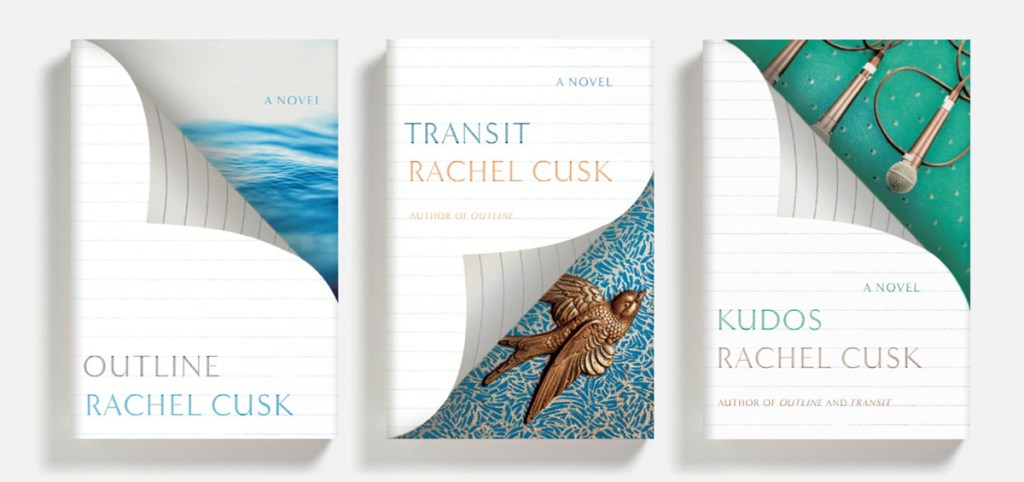
Rachel Cusk’s trilogy encompasses books entitled Outline, Transit, and Kudos. In every case Cusk presents character stories of people met in chance, or occasionally planned, encounters. In Outline, the author, Faye, (characters are typically unnamed or given only first names) is on a plane headed to a Book fair in Greece where she will sit on a panel and be asked to speak. Her seatmate on the plane gets in-depth treatment as we learn the story of his life and his marriage. Even at the book panel, the event runs out of time before the author speaks, but one outgoing male author has plenty to say.

Hardly any of the characters in these books have names, or they might have a first name, as already mentioned. This seems to be a new trend in fiction which probably has a purpose, as in allowing us to relate to the character, not wanting to create a character that jumps off the page and becomes an icon or to make it easier for the reader to imagine that s/he is the main character. The main character in this case is an author who has been through a crushing divorce. She and her husband have two sons. But her writing career is taking off, first literally to the Book Fair in Greece. 

Rachel Cusk has a talent for telling stories of the people who meet this author as she travels, renovates an apartment, and goes to a second writer’s convention where awards are being given. But we know little about the author or her book. We are treated to an in-depth exploration of all the people she sits next to or interacts with. She seems to have no close friends, but this story is not really about the author. It is about men and women and the difficulties of intimate male-female relationships, especially in marriages in the twenty-first century. 

Even as she fights off the bile of her new downstairs neighbors in Transit, she finds out the details of the life of the contractor who spends the most time on her renovation. Her neighbors are a nasty pair who knock on the ceiling with a broom as they follow her footsteps through her new flat. The downstairs couple seem to be bound together by their hatred for whoever lives upstairs, and they delight in intimidation. These are people I would want to run away from, but she stands her ground (without a rifle). When they realize that she is soundproofing the floor their hatred knows no limits but never gets physical. It is all bluster, an act to drive her away. The author has sent her sons to stay with their father while the reno is undertaken and although they beg and cry to come home to her, she encourages them to be independent. Is she a bad mother?

In the last book, Kudos, the author has obviously had some success and is attending a conference where she is supposed to be interviewed on television. Although she learns the life story of the interviewer, the technicians are never able to make the electrical hookups and the interview is called off. She meets another interviewer, a book critic, and he never learns a single fact about her, but we learn all about him. Almost all the people we meet are men and what they have to say about marriage is not encouraging. She also meets a wealthy woman who has given up on men and now invites writers and artists to come stay in her mansion where they can be warm all year long and enjoy more sun than the author has ever enjoyed in England where she lives with her sons in her redone flat over her miserable neighbors. Will she take Paolo up on her offer? Although this exploration of modern relationships is relevant this is a literary book than many readers are likely to skip. Rachel Cusk, however, has earned much praise from those critics who know and love well-written fiction.

Tom Lake by Ann Patchett – Book

From a Google Image Search – The Harvard Crimson

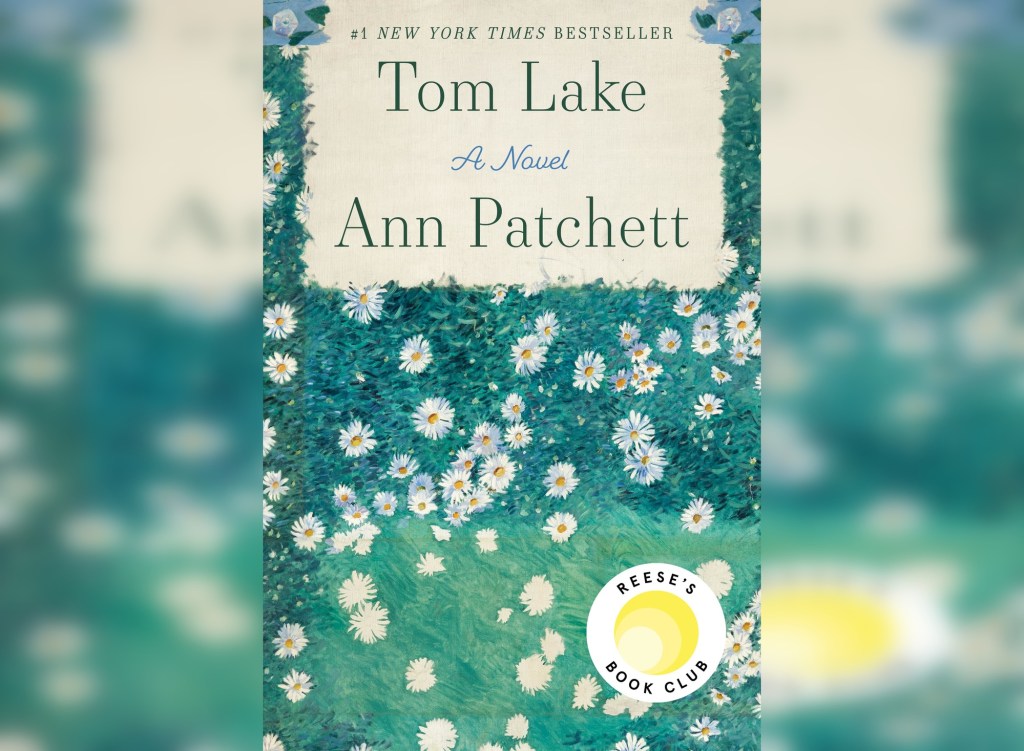
Tom Lake by Ann Patchett is a pandemic book of sorts. Lara and Joe Nelson own a farm, rows of cherry trees, some plum trees, some pear trees. The cherries are the money makers. Sweet cherries must be hand-picked. The tarter cherries for pies and cooking can be shaken from the trees onto tarps and they can be frozen.

The pandemic has made it difficult for their usual pickers to arrive. Lara and Joe’s three daughters, all grown but not yet married, come home to ride out the pandemic and to help pick the cherries. When Lara’s daughters find out that she dated Peter Duke, a famous and handsome movie star, Emily, Maisie, and Nell enliven a tedious repetitive task by prying the story of their mom and Peter Duke out of their reticent mother.

Once upon a time a local presentation of the play Our Town finds Lara and her friend registering local actors for the upcoming production in their New Hampshire town where Lara’s mother and father live. Our Town is a big deal in New Hampshire. If you have read the play, you know why. If you haven’t read it, you should. After a failure to find an “Emily” to play that important role, Lara ends up trying out. Turns out she is a natural. Her Emily is so well done that she is invited to go to Hollywood to test for a movie. Lara feels a connection to the Emily character but is she a great actress she wonders. After she wins the part in the movie playing another Emily-style character the film is shelved for several years. Lara is packed off to play Emily in Our Town again, this time in a professional summer theater in Tom Lake, Michigan.

Lara’s daughters, picking cherries and prodding their mother to get to the part where she meets Peter, find that they are finally there. But they want more, they want details. Because these daughters did not come home to tend to their mom on her deathbed (as in some novels and movies), this is a far lighter novel with only a few tragic elements. It’s basically a book that would make a great Nora Ephron movie. Do we have a new Nora Ephron? If Ephron was a product of her times, then we may never have another Nora Ephron, nor another Ann Patchett. 

The challenges of being an independent farmer are braided through the other elements in the book and the specter of all those cherries which represent the farm’s income rotting on the trees with no one to pick them is a pressure as intense as our desire to hear about Lara and Duke and why Lara is a farmer’s wife rather than a movie star. Readers also get an interesting peek into what it’s like to work in a summer theater.

Tom Lake was a good read, but it’s also a trip to more carefree, innocent days even though it is during the COVID pandemic. Perhaps people envy America these days in the 21st century because some people still get to live such a life. How much longer? How many of us? Although it is a new novel it already feels nostalgic. The orderliness of a well-run farm, the lines of heavily laden cherry trees under blue, blue skies. You might enjoy spending some time in a place that seems so fragile so in danger of disappearing altogether. I borrowed this book from my local library.

The Jinn-Bot of Shantiport by Samit Basu – Book

From a Google Image Search – Tor.com

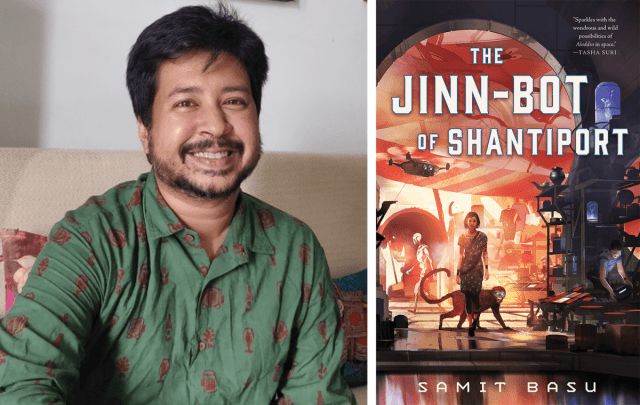
While The Jinn-Bot of Shantiport by Samit Basu is not great literature, this novel epitomizes the discussions of AI that dominated 2023. It also does that thing that sci-fi does so well. It offers commentary on modern and future society and politics.

Shantiport is a once-prominent city with a port that was busy and thriving. It is now a backwater decaying city that has internal problems which keep it in existential danger of dying out completely.

We wonder how we will ever become home to multicultural societies which should be easy for us because we are all humans. Shantiport wants to become a multicultural oasis which seamlessly protects the rights of both humans and bots. The bots seem to exhibit the same propensities as humans for violence, elitism, and tribalism. In this case the Tiger clan is warring against the Monkey clan.

The bot characters are well done and are as appealing, at least those who are main characters, as the human main characters. In fact, we find that those main characters, both bot and human, are a family unit as in brothers/sisters/ancestors. When the “jinn” is recovered from where it was hidden (Aladdin of legend) the one who holds the jinn gets three wishes. If your goal is to restore Shantiport to its former glory and make it a truly multicultural city what would your three wishes be? Be careful, it’s a very tricky jinn.

The same difficulties apply if you are trying to profit personally and don’t really care about the fate of Shantiport. This may not be literary fiction, but it is fun, and inspires thoughts about our own present and future dilemmas.

The Excellent Lombards by Jane Hamilton – Book

The Excellent Lombards big

In The Excellent Lombards Jane Hamilton is doing a Jane Smiley-style farm family story for us. Jane Smiley hasn’t always write about the same farm but she usually writes about a similar era, the era when family farms are no longer profitable, or the children don’t want to continue being farmers, or the suburbs crowd out the farms as developers convince farmer after farmer to sell off parcels of land for housing developments or malls or a Walmart Superstore, a Seven-Eleven. There are always a few farmers who are not ready to sell, who cannot imagine any other way of life or who have a child (in this case, a daughter, Francie) who is in love with the family land and the family business. Jane Hamilton gives us such a tale in her new novel.

There are two brothers, the Lombard brothers, who live on the family land with its 3 houses, 3 barns, four hundred acres of forest, sheep pastures and the prize, the apple orchard. This orchard and the surrounding land has been in the family for four generations. In this generation Sherwood and Dolly Lombard occupy the main house with their two children, Adam and Amanda. Mary Hill, an adopted cousin lives upstairs in the big old farmhouse. Sherwood is not a true farmer, he invents things. Adam and Amanda are being groomed for college. They do not like the outdoors and are unlikely to want to run an orchard.

On the other side of the road Francie lives with her Mom and Dad, Jim and Nellie Lombard and Francie’s brother William. Francie is the narrator. We hear her voice through several years as she changes from child to teenager but the book is not childish. In this generation Francie is the Lombard who loves the farm, cannot imagine any other life and is thrown for a loop whenever she glimpses what the probable fate of the orchard and the estate and the lifestyle will be. Does it still matter in modern times that Francie is a girl? You will have to see for yourself what you think about this.

What I always loved about Jane Smiley was the way she immersed us in a farm family, and we experienced the tortuous inheritance decisions, the romance of a life lived close to nature on owned land, the anxieties of the economics of farm families, so dependent on uncontrollable variables like weather and world events and markets. Jane Hamilton brings to life these same elements that have eventually led to fewer and fewer family farms in America. We have all watched farms disappear from the near hinterlands around our cities. We all see the poor Canada geese trying to conduct their natural lives on tiny manicured wetlands near car dealerships. We have watched them cross eight lane highways with their ducklings – well at least I have. Every day I ride on a road that ran through farmland and now runs through senior housing.

Francis never says this but we can see that she worries. As much as she loves the farm she sees that she would have to learn the things that May Hill knows and she does not want to become May Hill. May Hill is a genius when it comes to fixing farm equipment but she is also a rather scary recluse. Francie says this about May Hill, “She did not like anyone – she did not want to see you on the path.”

Jane Hamilton and The Excellent Lombards made me long to inherit an orchard, at least before the realities began to outweigh the romanticism, but she, like Jane Smiley, made me wish that family farms had never become too culturally irrelevant to survive, or too labor-intensive for modern sensibilities and too lacking in economic stability to be attractive. I fall for this sort of farm tale every time. It is always the same, like a familiar litany, but different enough to captivate me, like an old photograph that gives me such enjoyable nostalgia that I don’t mind seeing it again and again. It would be sad if this way of life did not leave a trace, but as long as people read the books about farming written by these two women, it will live on.

We’re All Damaged by Matthew Norman – Novel

Were all Damaged big


We’re All Damaged by Matthew Norman is a novel of this moment, this cultural age, as yet unnamed, in the America we are all currently immersed in. It is interesting to have our main character and narrator be a guy, Andrew, Andy, with a sort of funny way about him (not in a ha-ha way, but in an ironic, self-deprecating, nerdy but shell-shocked way). As we meet him Andy is reliving the end of his marriage to Karen. He wishes that the setting had been somewhere more appropriate than an Applebee’s. He wishes for a different soundtrack although he sees the “jagged little piece of pop music irony” in  “Wake me up before you go-go” which was playing at the exact moment that Karen breaks the news, not even affected, apparently, by the older couple enjoying drinks and touching hands at a nearby table.

It has actually been a year since these events and Andy is now a bartender in NYC, but he is still feeling as bad psychically as his body feels when he gets hit by one of those speedy New York bicyclers. He has to go home with all his bruises and breaks because his family calls to tell him his Grandpa does not have long to live. He has to go home to Omaha, Nebraska, where Karen is now living in their old house with the ripped EMT guy she left Andy for. Andrew is definitely not over this. Will going home help?

When Andy stops in a local bookstore he runs into a tattooed 30-something pretty girl named Daisy. Daisy is a sort of cool girl, a seeming psychic savant and a rebel which is probably the part of her personality that connects with Andy at this point in his life. But who is Daisy and why is she so interested in his Grandpa?

You may ask if this is sort of the guy equivalent of chick lit as many have suggested, and it could be, but it is still a nice little novel about the way guys can sometimes experience a breakup as a sort of killer ego-destroying treason and how it can, perhaps, with time, lead to a higher level of maturity. I am sorry that the author chose the picture he did on his author page – it makes a handsome man with humor look cruel. Other than that, good job.


Behind Closed Doors by B A Paris – Book Review

behind closed doors big

Behind Closed Doors by BA Paris was a difficult book to read. It was not complexity that made it difficult; it was content and awareness. From almost the first page we are aware that all is not right with Jack and Grace Angel, although they are often described as perfect. He’s perfectly handsome, has great taste, good manners, and he is such a successful lawyer that he has never lost a case.

Grace is obviously pretty, although we don’t hear an awful lot about this. She is a good cook and hostess. Her home with Jack is well decorated and she is devoted to her much younger sister, Millie, who has Downs Syndrome and who currently resides at a great school in North London.

How do we know that there is something not quite right in all this stylish perfection? There are small details that give us the beginnings of our goose bumps. At the dinner party which opens the book Jack and Grace entertain two couples – Esther and Rufus who Jack just met, and Diane and Adam who they have known for a while. The question is raised of how Grace manages to stay so very thin despite a seemingly ravenous appetite. When Esther presents Grace with a box of very expensive chocolates Grace seems to be worried that if she doesn’t open them before her guests leave she won’t get any. Grace is very fearful that there might be noticeable flaws in her meal. Jack makes sure that no one is ever alone with Grace. Grace doesn’t seem keen on showing the pictures from their honeymoon in Thailand – and more, much more. In fact Millie dislikes Jack until Grace gets Millie to transfer her dislike to Jorj Koony (George Cooney).

Since I sense right from the beginning that all is not as it appears it fills me with a sort of unspecified dread. It also makes me question whether the author should tip her hand so early. Sometimes I like obvious symbols but even the last name Angel doesn’t really work here. Somehow John Irving always carried this off. The stuffed dog Sorrow that kept popping up in Hotel New Hampshire is one of the best examples ever of an obvious symbol that works. But Paris is not John Irving. There is just not enough subtlety here. But even so I could not stop reading (even though I wanted to) and I hoped all the while that somehow all would be well.

We know situations like this really happen. In my small city there is a famous, fairly recent case of Mr. Jankowski, living in an upper middle class suburb, who built a secret underground room behind his basement. He was a serial kidnapper who kept a woman locked in a prison-like cell where he had complete control over her. When he was done with one victim he kidnapped another. He got away with this several times. There were also the three woman held prisoner for a decade or more who escaped from their captor perhaps because he sort of let them. There are other stories like this, fortunately somewhat rare, but even one such imprisonment is too many.

Most of Behind Closed Doors is spent showing how Jack managed to turn an independent woman into the fearful woman that Grace became, incapable of finding a way out, and how he was able to have such a seemingly normal social life. Could anyone actually have so much control over someone that they did not have to keep their prisoner physically locked up? A good part of the book is also spent telling us what happens to Millie, as Millie is the emotional blackmail Jack uses, and Millie is the one Jack really wants.

This novel is chilling and sadly all too believable, but I think the writer’s skills were not quite up to the task of dealing with the subject matter. It’s as if the entire book is written to tick off a check list the author has created of the ways Jack was able to fool Grace and everyone else. However, there is a part of us that likes to know how such a captivity could take place in such a crowded world and the topic is an important one. The book is not long and reads fast, but you will have to decide for yourself whether you want to tackle this one.