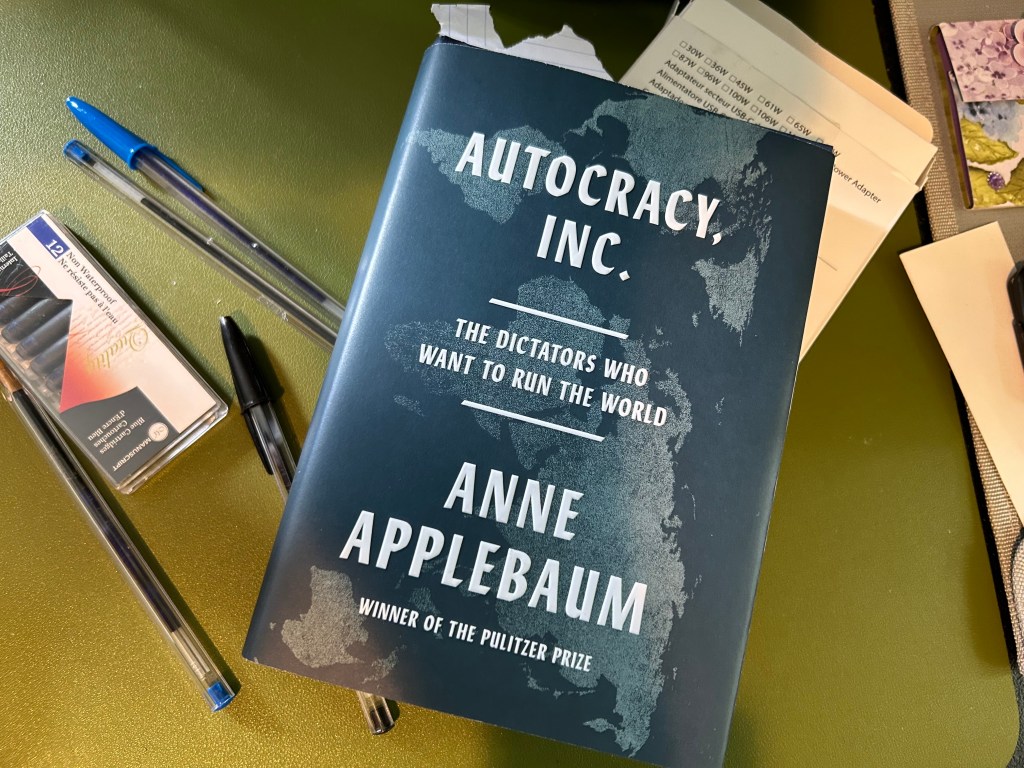
Autocracy, Inc. by Anne Applebaum, Ch. 4, Changing the Operating System/Hegemony

From a Google Image Search – What’s so bad about multipolarity? – Al Majalla

When we look at politics in America at this moment, poised as we are to go to the polls to elect a new president, and when we realize that one candidate wants to change America’s operating system while the other candidate will stay within the parameters our founder’s and previous administrations have designed for us, we can’t help looking ahead and imagining what American governance will be like in the future. The world seems to be slowly converting to autocratic governments run by dictators who pay loyalists by turning them into oligarchs to ensure their continued loyalty. These oligarchs steal money from citizens, stashing it away in tax shelters or secret bank accounts allowing kleptocracy to exist together with autocracy. How grim life becomes for people who are not part of these governments depends on the temperament and ideology of the “dear leader.”

Autocracy is not as shocking in a country that has never been a democracy, which perhaps evolved from a monarchy to a communist government and then to a dictatorship. But it is shocking to hear autocratic echoes in America which has always been a democracy since it won the right to be a sovereign nation rather than a colony. (We could take a moment to bemoan our imperialism, but it won’t help us in this instance.)

“Sovereign” is a key term that autocrats like to use, Anne Applebaum tells us in Chapter 4 of her book, Autocracy, Inc. As in, we are a “sovereign” nation. Keep your laws out of our country. Mind your own government. Your human rights are not necessarily our human rights.

In a review of Timothy Snyder’s new book, On Freedom, in the New York Times, the reviewer reminds us that

“On Nov. 9 it will be 35 years since the Berlin Wall fell. The exhilaration of that moment was followed by high hopes for the spread of democracy throughout Eastern Europe, then in Russia itself when the Soviet Union imploded. Gradually hope gave way to frustration, disappointment and then dismay. Russia did not become a liberal democracy, and nor did a number of its former satrapies.”

Sovereignty means keep your mitts off my country, hegemony means my country belongs at the top of the heap because it has the strongest economy, government, and military. If America held the hegemony in the twentieth century, other nations, autocratic nations, are competing for hegemony in the twenty-first century and beyond. We didn’t necessarily need Anne Applebaum to tell us this. As humans, we understand human nature. Competition seems hardwired in humans and all living things. What Anne Applebaum is telling us is that autocrats might be uniting to woo underdeveloped countries with aid and support for their autocratic leaders to create a world-wide-web of autocratic nations for the strength in numbers that might shift hegemony from America and the West to China and/or Russia.

Where once (after WWII) human rights became a goal of the nations that beat the Nazis and did not end up behind the “Iron Curtain” of Stalin’s Russia, all bets are now off. Where once nations declared that “recognition of the inherent dignity and of the equal and inalienable rights of all members of the human family is the foundation of freedom, justice and peace in the world. It is also acknowledged that ‘disregard and contempt for human rights have resulted in barbarous acts which have outraged the conscience of mankind.’…everyone has the right to life, liberty, and security of person. Applebaum continues to remind us of what was said in the shadow of Nazi genocide, “No one should be subjected to arbitrary arrest, detention, or exile. Torture and slavery should be banned.” (p. 99)

Applebaum speaks of what has been collectively known as “the rules-based order.  She goes on to say that how the world ought to work is not how it actually works, that many signatories have violated these rules, but that (for now) they still influence behavior in the real world.”(p. 100)

She warns us that powerful autocracies like China or Russia want to get rid of the language of these old agreements. Xi Jinping said this while addressing the Communist Party in 2017, “China seeks to take an active part in leading reform of the global governance system.” She tells us the remarks of Andrea Worden, a legal scholar and China expert, “For the CCP to attain the moral legitimacy, respect, and recognition it needs for leadership of a new world order, it must remove the threat of Western universal human rights.” (p.101)

She tells us what Putin has to say about sovereignty. “Sovereignty includes the right to abuse citizens at home and to invade others abroad. This privilege is available to only a very few large nations. There are not many countries in the world that have sovereignty.” (p.102)

Another term that is popular with autocrats right now according to Applebaum is the term “multipolarity” because it telegraphs an organization of autocratic states, banded together for greater power, stronger economics, and hegemony.  Of course, hegemony is not up for grabs. As in Putin’s view on sovereignty, hegemony belongs to very few nations, or perhaps only one and that would be whatever country wins the hegemony competition, takes hegemony away from the US.

What does this have to do with America? A lot. We have an autocrat running to be our president right now and he has a passionate cult following. You might also want to read this article from today’s New York Times about what liberals may not realize about MAGAs.

If you are paying any attention to politics, then you must have heard that this is an existential election. Donald Trump is not only not a Democrat, but he also doesn’t put much stock in democracy. He likes strong men and sees himself as one of these alpha males. He wants to head America and go steady with other autocrats. He may even think that his presence alone will ensure America’s hegemony among autocratic nations.

Perhaps inciting your followers to violence is something strong leaders do, but Trump doesn’t like to take responsibility for the violence he incites. Other autocrats have no difficulty showing that they don’t just intimidate, they act (although often they still delegate violent actions to others). Donald Trump believes that by changing the rules he can change our minds. He believes his propaganda is more effective than 240 years of living in a democracy. Americans have no experience living in an autocratic state. Even if he wins one, it might be hard to keep it. How will it feel if he actually sends troops out to round up immigrants (both legal and illegal) and spends our tax dollars to deport them or puts them in “camps” which are nothing like sports camps or computer camps but more like the Japanese Internment camps.

China, Applebaum says, wants to change the language, to throw out “political rights” or “human rights” and replace it with squishy language like “win-win cooperation” and “mutual respect.” (pp. 102-3)”

When I read the book To Paradise by Hana Yanagihara (which was not an easy book because of the way it skipped around in place and time while focusing on one family and its descendants) the book offered glimpses of an America under the thumb of the Chinese government (the UK was still a free nation). The America she depicts bears little resemblance to our beloved democracy/republic. Applebaum’s careful discussion and her evidence for a future united autocratic institution (the anti-UN) is a warning that we are in danger of losing our access to whatever human rights we still treasure and that many nations around the world will rejoice if we choose autocracy, if we replace “the rule of law” with “rule by law” (or whatever the leader says).

“A world in which autocracies work together to stay in power, work together to promote their system, and work together to damage democracies is not some distant dystopia. That world is the one we are living in right now,” says Anne Applebaum. (p. 121)

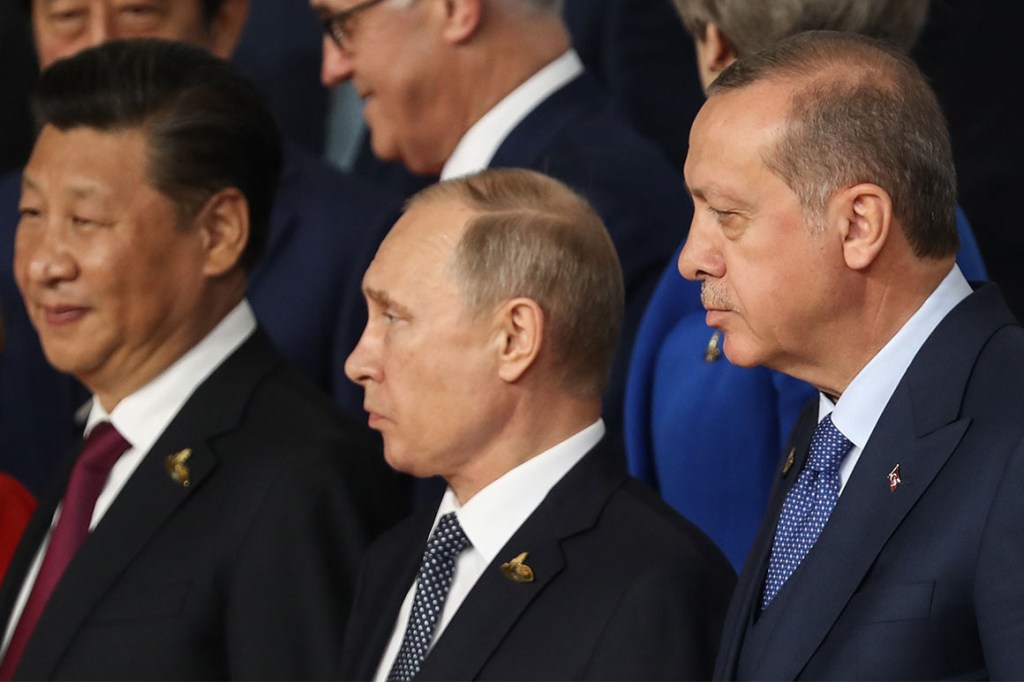
Autocracy, Inc. by Anne Applebaum, Ch. 3, National Security and Government Control

From a Google Image Search – Politico

Anne Applebaum’s book has a subtitle, The Dictators Who Want to Run the World. From her perch in Poland, she has a nearer view of all the players, Russia, China, Syria, Iran, and Africa. Nations that are run by autocrats are using new technologies not only to spy on other countries (especially democracies) but also to spy on their own citizens. You might argue that nations need to know what their enemies, both foreign and domestic, are up to but there are more sinister motives at work here too. Chapter 3 in Autocracy, Inc. has the title, “Controlling the Narrative”. 

The author begins by reminding Americans that our NSA is collecting data about US citizens as we were informed by Edward Snowden, a whistleblower or traitor, depending on your point of view, who is living as an exile in Russia. She also mentions Pegasus spyware in Poland which was eventually exposed and investigated. 

“If no parallel scandal has ever unfolded in China, Russia, Iran, or North Korea, that’s because there are no legislative committees or free media that could play the same role.” (p. 71)

Applebaum reasons that when democracies use spyware it helps autocracies justify their abuse. If there are fewer objections to using spyware outside of China, then there will be fewer objections to using it inside of China. 

In fact, we all expect that surveillance inside nations, even democracies, will escalate as new tech advances are developed. Why develop spyware if you won’t use it.  Americans objected to the intrusions of the Patriot Act after the attacks on 9/11 but were so shaken by these brazen attacks on America that we accepted these rules while also believing that they would be temporary. They have been replaced by the USA Freedom Act which curtailed the government’s authority to collect data in 2015. Democrats in Congress strongly objected whenever Trump wanted to collect names of people in a group he wanted to target. 

In China, objections can be deadly, as in Tiananmen Square in 1989. China, says Applebaum, first tried to eliminate the activists (people), then set out to eliminate the ideas such as the rule of law, the separation of powers, the right to free speech and the right to assemble which are described as “spiritual pollution”. (p. 66)

While Americans still believe, or say they believe that the internet would lead to a cultural renaissance, Applebaum predicted in 2012 that the internet would become a tool of control. China was designing “the Great Firewall of China” (p. 67) which used an “elaborate system of blocks and filters to prevent users from seeing particular words and tools. She tells us that foreign companies rushed into the new security market in the same way companies had rushed into the post-Soviet financial market. (Yahoo, Microsoft, Cisco Systems all made software that complied with China’s rules.) These companies were eased out once China had access to their software. (p. 68)

The security network was expanded by combining online tracking with tools of repression such as security cameras, police inspections and arrest. Other tools might include “nanny apps” on phones, monitoring book purchases, picking up on unusual behaviors, voice recognition, and even DNA swabs. All these tools have been used on the Uighur population in China. Now add in facial recognition and AI and you have a state that can truly control the narrative.

Anne Applebaum did not just write her book to expose state surveillance tactics. Perhaps she felt we needed to understand what might be coming to a place near you. These systems can be copied and have been copied by many nations including Pakistan, Brazil, Mexico, Serbia, South Africa and Turkey. 

“The more China can bring other countries’ models of grievance into line with China’s own,” argues Steven Feldstein, an expert in digital technology, “the less these countries pose a threat to Chinese hegemony.” (Am I nervous about writing these words without a powerful husband such as Applebaum’s to make her a public figure and hard to attack – yes, I am sometimes paranoid.) 

Russia plays a different game says Applebaum. Lie constantly and blatantly and when exposed offer no counterarguments. (p. 78) Blame everyone but yourself. This “fire hose of falsehoods” makes citizens question how you can possibly know what really happened and so they avoid politics altogether. Autocrats spread hopelessness and cynicism because it works to their advantage. This is not Russia’s only game. Russia is also a surveillance state.

Surveillance was a thing we worried about in the post-WWII world. We had all read Orwell’s 1984. We expected our freedom to include privacy. After the events of 9/11 we saw the need for some spying, both domestic and foreign, but we still hoped to not invade the homes of private citizens. Now, we are in an age where we live with hacking, with having our data stolen regularly, and with who knows how much surveillance because we can’t imagine our lives without the internet and cell phones. 

Many American fully believe that if Trump and the right-wing MAGA’s win in 2024 all aspects of surveillance will be expanded and private citizens may be pursued because of the things they think and what they write or have written. Even without the MAGA’s in power, surveillance will most likely expand given all the autocracies that have cropped up everywhere. We may not be able to keep it focused on only foreign countries. This is one of our great fears of AI that it will be used by our government to control our behavior, regardless of what party you are registered with or the fact that you choose to not belong to a party. 

“In seeking to create, these new propagandists, like their leaders, will reach for whatever ideology, whatever technology, and whatever emotions might be useful.”…Only the purpose never changes, Autocracy, Inc. hopes to rewrite the rules of the international system itself.” (p. 97)

Chapter 3 also goes into, in some detail, the changes in print and social media that are accompanying this rise in “spying”. Project 2025 will give MAGA carte blanche to spy on all Americans. Anne Applebaum’s book is a warning. Soon she will offer some remedies.

How Autocracies Metastasized, Chapter 2, Autocracy, Inc.

From a Google Image Search – Politico

Let’s see what Anne Applebaum means when she compares the spread of autocracy and kleptocracy to the spread of a cancer. As Western nations try to influence nations that intimidate or use violence against their citizens – nations that give power to a few and squelch the human rights of many – by sanctioning them or their banks or institutions, autocratic leaders are creeping in to bypass these sanctions or boycotts. In a way Autocracy, Inc., if it existed as a formal global entity, would be an anti-NATO. These nations seek to undermine democracies and, if they succeed, they create new autocracies. The pilfering of national dollars can cause the nations they “protect” to fail without their assistance (sometimes even with their assistance). The lure of fortunes to be made and sequestered away is creating a pull towards autocracy in nations that are long-established democracies. This has us fearing that the balance of global power is shifting towards autocratic/kleptocratic governance and may give global hegemony to a giant autocracy like China, or a giant, ruthless autocracy like Russia. The 2024 election in America could weaken our democracy, perhaps beyond restoration, if Trump and the Republicans win.

Applebaum uses several examples to illustrate how Autocracy Inc., through mostly unplanned interventions, allows dysfunctional, pillaged national economies to continue to serve as fodder for kleptocrats. These rescuer nations may have once required no quid pro quos, but they have learned to profit as they preserve autocracies in trouble.

This article will summarize her discussion of this dynamic with one example in Venezuela, but there are more examples in Applebaum’s book. President Hugo Chavez rose to power in 1998. Venezuela was an oil state, “nepotistic and corrupt.” Politicians were bribed and deals were offered to friends of the former President. Chavez ran as a leader “who promised to create a more honest “Bavarian Republic of Venezuela”. But as corruption crept in Chavez did not pursue opportunities to end it, in fact he fired the whistleblower, a member of his inner circle. Chavez, like Putin, chose to turn Venezuela into a kleptocracy. “Corrupt officials prove more malleable than clean ones.” (p. 45) 

Chavez eliminated transparency and accountability, he broke democratic institutions like the press, the courts, the civil service. (Sound familiar?) All the while he kept proclaiming his belief in democracy. Applebaum says, “since everyone was breaking the law no one wanted to talk about it.” Meanwhile, officials were hiding millions in oil money in a Portuguese Bank (Banco Espirito Santo). Ten billion dollars went into Swiss banks and 26 billion from a Venezuelan oil company scam was stashed in Andora Banks. A later investigation showed 127 cases of large-scale corruption just in the oil industry. (pg. 46)

A new form of corruption later named currency exchange manipulation offered a way to profit from skimming dollars and exploiting weak laws. For a while students figured out how to game the currency exchange system. It was called the “democratization of kleptocracy” Chavez was able to fool many for a while until the decline of the oil industry began in 2002-3.

“Billions (or maybe tens of billions) of state funds had vanished, the country’s foreign currency had disappeared into private offshore accounts, hyperinflation accelerated and imported goods vanished.” (p. 48-49) 

Chavez died in 2013, and Venezuelans hoped the corruption would end when they elected Nicolás Maduro, but, Applebaum contends, “Autocracy Inc. stepped in to help.” Rogue states surviving under sanctions turned to new sources of funding. They turned to drug trafficking, illegal mining, extortion, kidnapping, and gasoline smuggling. She argues, “[i]f a state is a member of Autocracy Inc. there are other options.” (p. 50) There are friends and trading partners in other sanctioned states. There are companies that are unbothered by corruption – happy to encourage it and to participate in it.

Russian companies stepped in to replace North America, South America, and Europe. Rosneft, Gazprom, Lukoil, TNK-BP all put money into Venezuela. Grain imports from the US and Canada were replaced by Russia along with 4 billion in Russian weapons.

China started loaning money to Venezuela without conditions which bought Chavez and Maduro time before collapse. China eventually added conditions when Venezuela defaulted on the loans. China sold riot gear to the regimes. 

Cuba was linked to Venezuela by an anti-American agenda. Oil moved from Venezuela to Cuba; soldiers, police officers, and security and intelligence experts moved from Cuba to Venezuela (to quell riots and demonstrations). Cuba taught Venezuela how to use food shortages to end dissent (think about it).

Turkey helped because of personal links between Erdogan and Maduro who were bonded by their dislike of democracy and its anti-corruption movements. Venezuela sent gold to Turkey in exchange for food.

Iran seemed the most improbable tie, Applebaum tells us. Oil binds them and anti-Americanism, opposition of democratic movements at home, trading information about how to evade sanctions. Iran got gold, Venezuela got food, gasoline and advice on the repression of dissidents. Iran helped Venezuela build a drone factory and sent money to be laundered for Hezbollah.

There are more examples in Chapter 2. More nations are involved. Applebaum says, “there are hybrid states that are a legitimate part of international financial systems, that normally trade with the democratic world, that are sometimes part of democratic military alliances but are also willing to launder or accept criminal or stolen wealth or to assist people and companies that have been sanctioned.” (p. 50)

My comments – Perhaps you have been very aware of the spread of autocracy and are not surprised by corruption, but it is important to note how autocratic nations are pitching in to get around sanctions that democracies use to try to enforce humanitarian standards both in peace and war. Will Autocracy Inc. become an institutionalized force against democracy instead of providing hit and run assistance to kleptocracies that go too far, whose economies fail, and who have sanctions against them? These nations deliberately try to exert power to prevent humanitarian reforms in the nations that may soon make up a true Autocracy Inc. 

Autocracy, Inc. by Anne Applebaum, Chapter 1

From a Google Image Search – The Guardian

Autocracy, Inc. by Anne Applebaum

There are reasons why Anne Applebaum’s book Autocracy, Inc. is directly related to the 2024 election. Voters should always have access to issues that will affect their future as Americans. Sometimes there are issues that are flying under the radar, not being given the weight they should bear in our decision-making. Applebaum offers the details that show the roots of our autocratic tendencies. She ties togethers what seems like an economic wet dream with a flirtatious ideological invitation to keep the money train moving by voting. If Americans give Trump autocratic powers, he will guarantee that wealthy people will have pathways to stay wealthy (cutting taxes, cutting government, tariffs, favoritism). Those who support Trump in every way will be allowed to accumulate fortunes, as has been true for the oligarchs in autocratic states. Applebaum is asking us if we really want to give up our democracy so that rich people can turn the American economy into the Cayman Islands and the American government into Hungary (or Russia)? So, I am offering my version of Cliff Notes on Autocracy, Inc.

Anne Applebaum’s book Autocracy, Inc. is dense with statements of fact and proofs for those facts. Attempting to summarize and condense the contents is difficult. The ideas I am offering are not my own ideas. These are the arguments Anne Applebaum makes in her deceptively petite book. However, I do agree with her ideas and the details provided in her proofs make her commentary important. So, some of my summary will paraphrase the author and some will quote her directly. The contents of this book give us explanations for the rise of autocracies and show how America (and Great Britain) have become enmeshed in these kleptocratic practices. Applebaum is showing us our own drift towards autocracy and kleptocracy. Will abandoning human rights work to bring economic equality to all or to just a very few oligarchs? It’s an easy question to answer, but being able to get “down in the weeds” with cogent examples is the gift Anne Applebaum offers us. She has a team helping her with her research summarizing the content of many sources. She then passes what she has learned on to us.

How did America begin to adopt the practices of autocracies and kleptocracies?

“Western political leaders spoke about “democracy” and the “rule of law” in Russia, but Western companies were building autocracies and lawlessness and not only in Russia…By the time Putin became president, he was well acquainted with the double standards of Western democracies, which preached liberal values at home but were very happy to help build illiberal regimes everywhere else.” (p. 33)

Did we reap what we sowed?

Applebaum would say “yes,” I think. Her example takes us to Russia. Russia under Putin was designed to look like a democracy but look closer she suggests.

1. there were “no accidental winners” in Russian elections

2. everything was a front

3. banks that looked like banks were often money-laundering operations

4. “companies were sometimes facades” – what they offered were “ways for the very wealthy to siphon assets away from the state”

Many inhabitants of the Western world profited, ostensibly believing that Putin intended to democratize Russia.

Example: A steel plant in Warren, Ohio with a history of two explosions and many safety violations was shut down for good in January 2016. Kolomoisky (a Ukrainian oligarch from when the government followed the Russian model) owned the mill and hundreds of millions of dollars’ worth of midwestern properties (“as part of a money-laundering operation connected to defrauding PrivatBank – a retail bank in Ukraine”).

“For decades, American real estate agents were not required to examine the source of their client’s funding.” It was okay to buy property anonymously (both in the US and in Europe). (p. 37)

Kolomoisky’s money from PrivatBank flowed through shell companies in Cyprus, the British Virgin Islands, and an American Branch of Deutsche Bank in Delaware.

Applebaum names some names:

Two Americans bought properties for Kolomoisky. Chaim Schochet of Miami and Mordechai Korf, a Miami businessman. Marc Kasowitz (who also represents Donald Trump) was their lawyer.

“These arrangements make no sense as business decisions,” says Applebaum, “but make plenty of sense in the arcane world of international kleptocracy.”

“In such a system, theft is rewarded, taxes are not paid, law enforcement is impotent and underfunded, and regulation is to be dodged,” she reminds us.

What we have learned.

Remember the revelations in the Pandora Papers (October 2021) from the International Consortium of Investigative Journalists.

(Paraphrased) We have learned that financial traffic does not just go through the Caribbean — it also goes through the US and Great Britain. In the US, Delaware, Nevada, South Dakota and Wyoming are open for secretive financial operations.

Applebaum’s Conclusions in Chapter 1

“To stay in power, modern autocrats need to be able to take money and hide it without being bothered by political institutions that encourage transparency, accountability, or public debate.”

“Kleptocracy and autocracy go hand in hand, reinforcing each other but also undermining any other institution they touch. the real estate agents who don’t ask too many questions in Sussex or Hampshire, the factory owners eager to unload failing businesses in Warren, the bankers in Sioux Falls happy to accept mystery deposits from mystery clients — all of them undermine the rule of law in their own countries and around the world. The globalization of finance, the plethora of hiding places, and the benign tolerance that democracies have shown for foreign graft now give autocrats opportunities that few could have imagined a couple of decades ago. (p. 42)

Autocracy, Inc. by Anne Applebaum-Book

Personal Photo

Autocracy, Inc. by Anne Applebaum – Book

Anne Applebaum is a reporter, an expert on Eastern Europe, Russia, China, Arabic nations and African nations. She is a Pulitzer Prize winner. Her newest book, Autocracy, Inc: The Dictators Who Want to Run the World, looks small but it’s an important manual describing the wheeling and dealing of autocrats both at home and abroad. This is a book that should be in your library if you believe that democracy, freedom, and human rights are worth fighting for. If you don’t think that there is a fight, read this book and it just might make you a believer. If you want to hear about strategies that could work in this fight they are on offer. It’s a war unlike the old Cold War we are familiar with. The dynamics are complex and the strategies change. Summarizing this book won’t work as it is a handbook and every word seems to carry weight. It is full of anecdotes that make concepts easy to understand and add value to the author’s arguments.

In the Introduction, Applebaum argues that it is greed that binds these autocrats, that their kleptocracy is metastasizing, that autocrats have learned how to control the narrative and change up the operating system (with a boost from tech advances) and that part of their plan involves smearing the Democrats. Action strategies are discussed in the Epilogue entitled Democrats United.

“Nowadays, autocracies are run not by one bad guy, but by sophisticated networks relying on kleptocratic financial structures, a complex of security systems-military, paramilitary, police-and technological experts who provide surveillance, propaganda, and disinformation.” (p. 1)

Members of Autocracy, Inc are connected within a given autocracy, but also with leaders in other autocratic countries, and sometimes with politicians in democracies too. These nations have different historical roots, goals and aesthetics, Applebaum tells us and then lists the nations:

China-Communism

Russia-Nationalism

Venezuela-Bolivarian socialism

North Korea-Juche

Islamic Republic of Iran-Shia radicalism

 Monarchies: not as likely to seek to undermine the democratic world

Saudi Arabia

The Emirates

Vietnam

Softer autocracies (illiberal democracies)-choose allies based on expediency

Turkey

Singapore

India

Phillippines

Hungary

Other autocracies:

Nicaragua

Angola

Myanmar

Cuba

Syria

Zimbabwe

Belarus

Sudan

Azerbaijan 

and 3 dozen others that are not named in the introduction.

Applebaum tells us that these nations do not act like a “bloc” but rather like “an agglomeration of companies bound not by ideology but rather a ruthless single-minded determination to preserve wealth and power). (which Applebaum and others call Autocracy, Inc.) (p. 4)

“They share a determination to deprive their citizens of any real influence or public voice, to push back against all forms of transparency or accountability, and to repress anyone, at home or abroad, who challenges them. (p. 3)

She tells us that their bonds are “cemented not through ideals, but through deals.” (p. 3)

Autocracy, Inc. nations collaborate to keep members in power and create a new world order (to replace the liberal world order). (p. 17) 

“The autocracies believe they are winning. That belief-where it came from, why it persists, how the democratic world originally helped consolidate it, and how we can defeat it-is the subject of this book.) (p. 17)

It’s difficult to write about Applebaum’s book in my own words because she has done her due diligence, she is the expert we all need to consult, and every point she makes resonates if you have been watching and feeling anxious about the spread of autocracy. The book is full of anecdotes that we will recognize from news feeds although, perhaps, we were not able to put them into an organized framework to explain how powerful these concerted and often selfish efforts have been in creating changes in the world. If we don’t want to give up on the ideals of freedom of speech and freedom of thought and transparency; all the democratic principles we admire, then we will need better strategies to fight nations that do not mind fighting dirty. Demonstrations are not the best option. Applebaum explains why.

If you are an activist this is an important book to read and study. If you think governments are too corrupt and that you will ignore politics and live your life, you also need to read and study this book. Autocracy, Inc. is counting on ambivalence as an important weapon in this war on democracy.