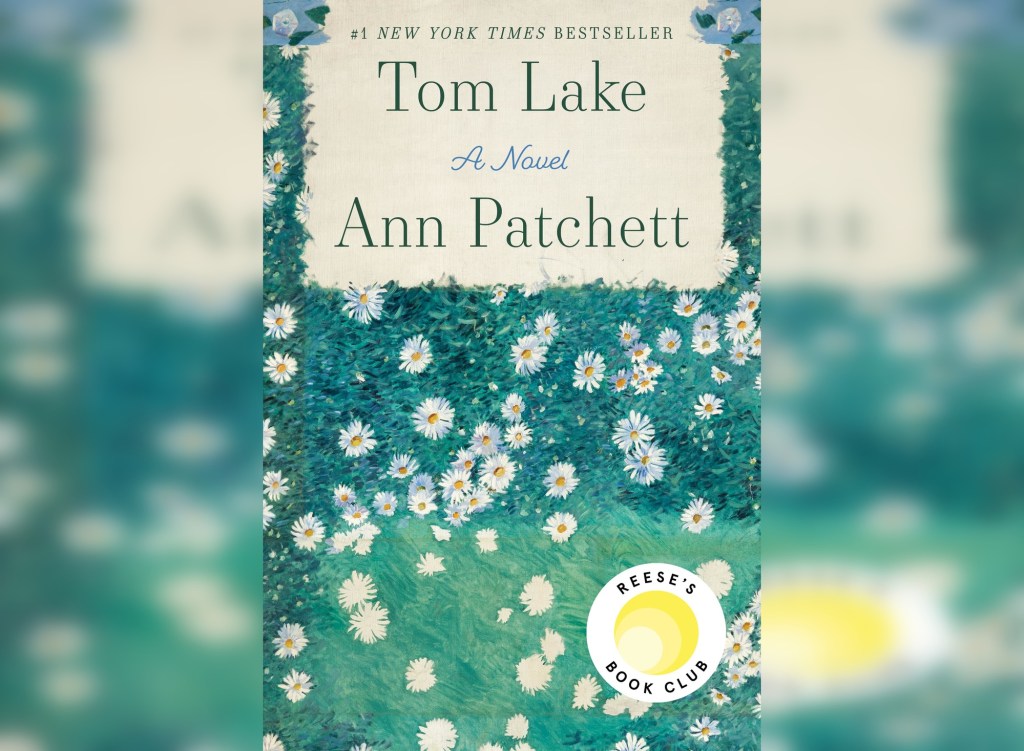
Tom Lake by Ann Patchett – Book

From a Google Image Search – The Harvard Crimson

Tom Lake by Ann Patchett is a pandemic book of sorts. Lara and Joe Nelson own a farm, rows of cherry trees, some plum trees, some pear trees. The cherries are the money makers. Sweet cherries must be hand-picked. The tarter cherries for pies and cooking can be shaken from the trees onto tarps and they can be frozen.

The pandemic has made it difficult for their usual pickers to arrive. Lara and Joe’s three daughters, all grown but not yet married, come home to ride out the pandemic and to help pick the cherries. When Lara’s daughters find out that she dated Peter Duke, a famous and handsome movie star, Emily, Maisie, and Nell enliven a tedious repetitive task by prying the story of their mom and Peter Duke out of their reticent mother.

Once upon a time a local presentation of the play Our Town finds Lara and her friend registering local actors for the upcoming production in their New Hampshire town where Lara’s mother and father live. Our Town is a big deal in New Hampshire. If you have read the play, you know why. If you haven’t read it, you should. After a failure to find an “Emily” to play that important role, Lara ends up trying out. Turns out she is a natural. Her Emily is so well done that she is invited to go to Hollywood to test for a movie. Lara feels a connection to the Emily character but is she a great actress she wonders. After she wins the part in the movie playing another Emily-style character the film is shelved for several years. Lara is packed off to play Emily in Our Town again, this time in a professional summer theater in Tom Lake, Michigan.

Lara’s daughters, picking cherries and prodding their mother to get to the part where she meets Peter, find that they are finally there. But they want more, they want details. Because these daughters did not come home to tend to their mom on her deathbed (as in some novels and movies), this is a far lighter novel with only a few tragic elements. It’s basically a book that would make a great Nora Ephron movie. Do we have a new Nora Ephron? If Ephron was a product of her times, then we may never have another Nora Ephron, nor another Ann Patchett. 

The challenges of being an independent farmer are braided through the other elements in the book and the specter of all those cherries which represent the farm’s income rotting on the trees with no one to pick them is a pressure as intense as our desire to hear about Lara and Duke and why Lara is a farmer’s wife rather than a movie star. Readers also get an interesting peek into what it’s like to work in a summer theater.

Tom Lake was a good read, but it’s also a trip to more carefree, innocent days even though it is during the COVID pandemic. Perhaps people envy America these days in the 21st century because some people still get to live such a life. How much longer? How many of us? Although it is a new novel it already feels nostalgic. The orderliness of a well-run farm, the lines of heavily laden cherry trees under blue, blue skies. You might enjoy spending some time in a place that seems so fragile so in danger of disappearing altogether. I borrowed this book from my local library.

The Dutch House by Ann Patchett – Book

Goodreads.com

The Dutch House by Ann Patchett is a study of a family, an American family. It is a story told by the second child, a boy named Danny. It’s a story about a clueless father and husband who buys his wife a house, a famous house, built with much attention to detail by a wealthy family, the VanHoebeeks,. The ceiling in the dining room is a work of art, literally. The house has a ballroom and a conservatory. Since the sale was an estate sale, all the VanHoebeek’s belongings are still in the house, including portraits of husband and wife over the mantle in the drawing room. Despite all the architectural glories the house has a very small kitchen because the staff would use it, not the family. There is also a pool.

Into this ritzy house Cyril Conroy brings his wife. He bought the house for her as a surprise. At the time they had one child, their daughter Maeve. The house was a source of pride for the husband who was a real estate investor and property manager. But his wife, was appalled by the expensive details. She yearned to dedicate her life to helping the poor. Clive found Elna just as she was preparing to enter a convent, not yet a nun. He whisked her away and married her. We often see our partners in life through cloudy mirrors. We make assumptions that if they love us they must be like us. The Dutch House is a story about misplaced love and misunderstood love. Maeve shoulders all the responsibilities of these selfish parents when the family falls apart. Some people should never have children. She yearns for what they lost, the family and the house and the hired women who took care of them, Fluffy, Sandy, and Jocelyn. Maeve is obsessed and cannot move on with her own life. 

Although this is a story of a family, and of loss and reunion, even more it is a story of a house. If you have ever given a home and your heart to cats you know that some cats fall in love with people, but some cats fall in love with houses. How do Maeve and her brother lose The Dutch House and then get it back? Although nothing earthshaking happens, there are plenty of repercussions. What stories are more interesting than stories about families? Take your pick, but I will usually enjoy a good family saga by any writer as skilled as Ann Patchett. This book will probably be made into a movie, but doesn’t even have to be made into a movie because it already creates one in your mind.

Commonwealth by Ann Patchett – Book


Commonwealth is a traditional English term for a political community founded for the common good.

The term literally meant “common well-being”.

There is, however, another form of commonwealth. The ever-helpful Dictionary.com offers this alternate definition: a “self-governing, autonomous political unit…

https://en.wikipedia.org/wiki/Commonwealth

There are at least two commonwealths in the novel Commonwealth by Ann Patchett. In one instance the term most likely refers to the Commonwealth of Virginia (technically designated as such) and in the other instance it could describe the relationship that develops among the children in the two blended families we meet in this novel. If you have watched You’ve Got Mail as many times as I have, then you remember the scene in Kathleen Kelly/Meg Ryan’s little bookshop where Joe Fox/Tom Hanks is trying to hide his identity. When one of the children with him reveals that she is the aunt of the much older Joe Fox and the other young child reveals that he is Fox’s brother, Tom Hanks says, “We are an American family.” Well here in Commonwealth we find another such non-nuclear American family.

The beautiful Beverly is married to a man named Fix Keating, who is a policeman. When his second child is born an uninvited DA, Albert Cousins, crashes the party and that ends up being the catalyst that brings about the destruction of two marriages. The problem is that Beverly is a parent who really is not suited to parenting and her second husband, the wife stealer DA, Bert, is almost a completely absent father. These two parents reside in Virginia. Fix and the wife of Bert Cousins, Teresa reside in California. There are six children. Carolyn and Franny are the children of Beverly and Fix. Cal, Holly, Jeannette, and Albie are the children of Bert and Teresa. After Beverly and Bert divorce their spouses and marry each other, Fix and Teresa both remarry but not to each other. So each child ends up with 3 sets of part time parents.

Two of the children, Carolyn and Franny live in Virginia and only visit California; the other four spend the school year in California and the summers in Virginia. It is difficult to keep these families straight when the children are young. Although each child has his or her own personality, I found it difficult to remember which child belonged to which parent.

The children have complicated emotional responses to their situation and to their natural and by-marriage siblings. But as they age they find that they become a sort of commonwealth of five and we learn who is who, so it is not necessary for readers to worry about those early confusions. There is, of course, a great tragedy that brings the children together in guilt. They are keeping a secret about what happened to the sixth child, which does not really get told until the parents are dying. In classic novels this would have been the key to deep psychological wounds in the children, but the tone of this novel is perhaps too superficial, or too modern, to go “there” in any meaningful way.

Ann Patchett is an excellent writer who knows how to tell a story but this story is just giving us details of a tale that is so common in modern life as to almost be cliché. I liked the children and some of the parents but the story is more a slice of life than any kind of social commentary. Do I think fiction has to be culturally relevant? Perhaps not, but novels that stand the test of time usually have a je ne sais quoi factor that raises them out of the ordinary. I enjoyed reading Commonwealth, but I am not sure that it will turn out to be a keeper.