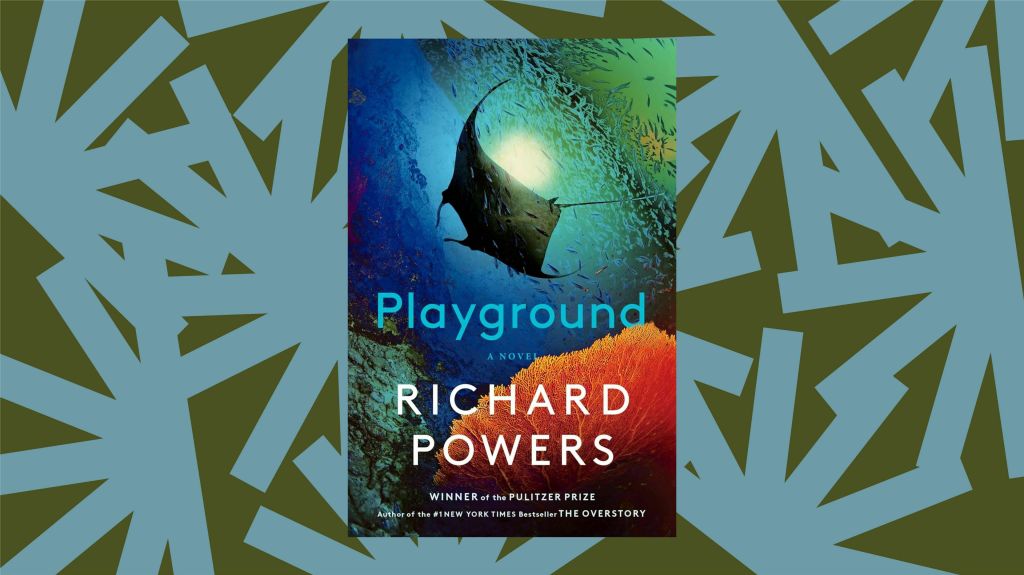
Playground by Richard Powers-Book

From a Google Image Search – NPR

Did you know that fish go to cleaning stations under the ocean and other sea creatures vacuum them and clean their teeth? I didn’t. Did you know that fish and other sea denizens like to play, even sometimes with humans if they come around often enough. The ocean/s come alive in Richard Powers book Playground. The enormous variety of sea life, the bioluminescence divers see that we landlubbers don’t, the coral reefs, the way sea critters turn human trash into new coral reefs-it’s all fascinating and beautiful as Powers describes it.

But what antics creatures get up to underwater is not the only thread in this novel. Playground is also the name of a social media platform designed by Todd Keane that allows users to play and chat online, for a fee. And with the arrival of AI, the site gets more popular until Todd Keane is a billionaire.

But, before Keane earns his billions he meets Rafi Young in school. Rafi is a young black man. Both are from Chicago. Both love games. At first, they play chess. When they discover Go, the infinite variety of moves, the complex strategies lead them to replace chess. They play for hours and years before gaming even begins on the internet.

Todd Keane’s father worked in the pit at the Chicago Board of Trade:

“…a warrior of the open-outcry system, he stood in the heart of the octagon as the furious waves of capitalism crashed all around him.” (pg. 9)

Since Todd’s parents fought and made up loudly and often, he sought solace under Lake Michigan. “When I was young, I could breathe underwater.” (pg. 12) Todd and his father played a series of classic games until they got to Backgammon. Eventually Todd could beat his father every time. Todd came from a wealthy family.

Todd’s father lets him choose a book. He chooses “Clearly It Is Ocean” by Evelyne Beaulieu. Eva’s dad helped invent the first aqualung and he had his daughter take it for a test in the pool. Eva learns to dive, even meets Jacques Cousteau, and travels to coral reefs until she ends up on Makatea. 

Rafi Young’s father was a Chicago firefighter. When his mom worried about him walking to school through a tough neighborhood, she made him wear a bright orange coat and hat which solved the mom’s problem but made Rafi’s life worse. When his father heard about all this, he punched Rafi’s mother in the face. Divorce followed, and poverty. 

While Todd pursues a degree in math and excels with computers, Rafi earns a PhD in educational psychology. They meet Ina Aroita, born in Honolulu to a Navy family and raised on naval bases in Guam and Samoa. For a while it seems that both men fall in love with Ina. It is Rafi who marries her and becomes a teacher on the island of Makatea where he and Ina adopt two orphaned children and Ina becomes an artist. Todd is the only character not living on Makatea. In fact, Todd and Rafi have had a falling out and Rafi doesn’t speak to Todd. Will there be a reunion? My lips are sealed.

Here’s what Todd has to say about the picture book, “Clearly It Is Ocean.” “Thirty thousand kinds of fish. Fish that migrated their faces across to the sides of their bodies as they grew. Fish whose barrel heads were transparent, revealing their brains. Fish that changed from male to female. Fish that grew their own fishing rods out of their heads. Fish that lived inside the bodies of other living creatures.” (pg. 24)

Makatea, a French colony, was found at one time to be a major source of phosphates, most often used in fertilizer. The discovery of phosphates multiplied the amount of food farmers could produce. Given the exploding population on Earth, the demand was huge and the island was exploited for years. Then the mining companies left, and the island’s population fell to 82 humans. Two of these humans were Rafi and Ina. Evelyne Beaulieu, now 92, lives there also, still diving.

Now, a mysterious company wants to build a “seasteading” community at Makatea, throwing the residents into a panic because they remember what happened in the phosphate situation. It will bring jobs, a new clinic, and a high school. What will it do to the reefs around Makatea? How will the people vote? Is constant growth necessary and healthy for our societies and our planet? Here we have a mashup between AI and the health of Earth’s oceans and the whole wonderful, barely experienced, watery environment and all the living creatures in it. What will it be like to live on a planet whose oceans are no longer teeming with life, a dead ocean? What choice does the island make, and how is Todd Keane involved? What choice would you make?

“In the last chapter (of “Clearly It Is Ocean”), the woman I crushed on with all my ten-year-old heart told of a research trip she had made off the coast of Eastern Australia. She stopped one day in the middle of a dive to watch a giant cuttlefish near the mouth of its den. This tentacled mollusk, kin to squid and octopus, was performing a long wild color dance for no one.” (pg. 34)

It is not easy to talk about extinctions and the destruction of biomes when everyone is madly striving to be a millionaire or billionaire. Taking care of declining habitats and populations of creatures that are basically invisible to us and are dying off doesn’t get much viral attention on social media. Powers’ book does a good job of focusing on our choices between capitalism’s drive to perpetual growth, which is pursued mostly to feed people’s greed, and the importance of play to all living things. He reminds us that the oceans surrounding us are full of fascinating life forms and that we need to help them stay that way. This is not a preachy book. It’s especially great when Eva is underwater.

2054 by Ackerman and Stavridis-Book

From a Google Image Search – NPR

Elliot Ackerman and James Stavridis have written a book about the future with the title 2054, a follow-up to their book 2034. The government in America is divided between two dueling parties, the Truthers and the Dreamers, that I had difficulty differentiating. There is also an ancient obstructer in the Senate named Wisecarver, who might remind you of Mitch McConnell. To please both factions the President and Vice President are not from the same party. A Civil War seems to be brewing. 

President Castro, a seemingly healthy middle-aged man, dies suddenly of a heart attack. After examining the President’s heart there are indications that it has been genetically edited. This is not the same heart that the doctors have examined in the past. Has someone figured out how to edit genes from a distance? Has someone managed to create the Singularity? Can humans and computers now merge? Why does anyone want to pursue the Singularity when the technology carries with it a strong possibility of human extinction? President Castro was not a popular figure, and he is soon replaced with President Smith, previously Vice President Smith. Divisions escalate. 

Besides what is going on in the government of America there is a cast of characters who are involved with gene editing and who are trying to trace down those who were working on this science and on the Singularity. Sarah Hunt who has recently died or disappeared is a key figure although we are left with her daughter Julia Hunt because most people believe that Sarah Hunt is dead. Julia, who has been working in the government is also a marine, who is sent back to her barracks under the new administration. We have BT and Michi in the hunt for Dr. Kurzweil, and we have Lily Bao, involved in a secret relationship with Nick Shriver, the new Vice President, but also pursued by Zhao Jin of China who wants her to come home. We also have Ashni traveling with her dad. She is trying to find Dr. Kurzweil because he is the last hope for keeping her father alive. Several groups set off at the same time to find Dr. Kurzweil who has retreated into isolation and who has been working on both gene editing and the Singularity. 

This is a good story, but it is quite complicated and just reading it makes more sense than trying to explain the plot twists. What makes the book interesting is the relevance to currently trending topics and situations. Although I found it to be all plot and little substance some of the characters did connect with me well enough that I was interested in what was happening to them. The ending surprised me and perhaps it will surprise you too. This is a book to entertain you on a quiet Sunday afternoon or a sleepless night. The authors weigh in on whether we should try to create the Singularity.

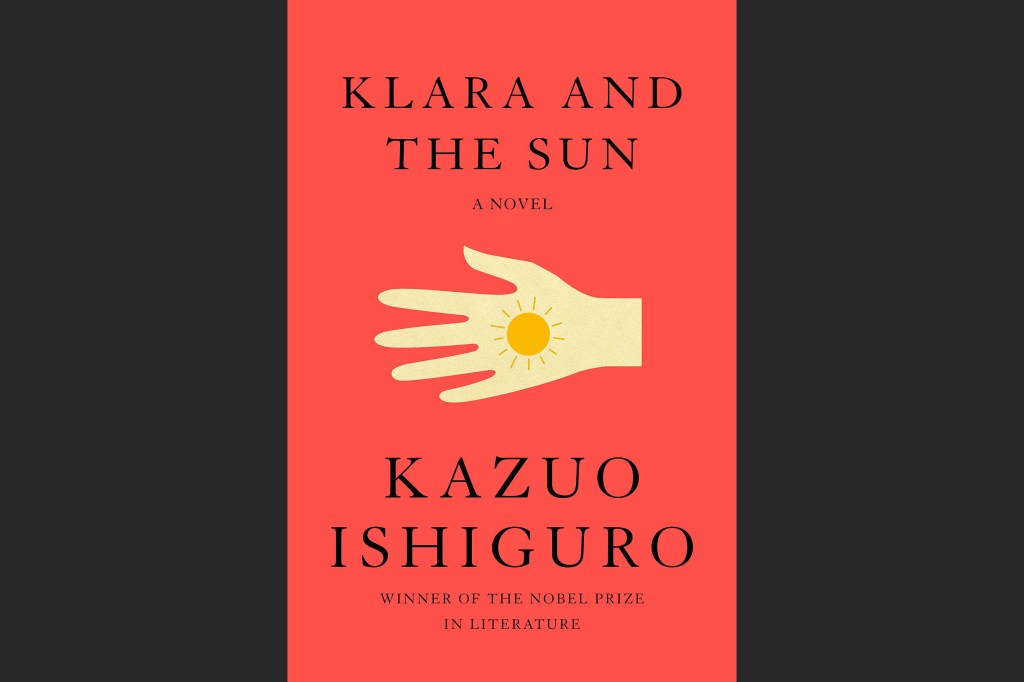
Klara and the Sun by Kazuo Ishiguro – Book

From a Google Image Search – http://www.nwaonline.com

Kazuo Ishiguro may seem to be telling folkloric tales in his most recent books, but they are actually quite philosophical and contemporary. In Klara and the Sun we meet a number of AF’s on display in a shop in a city very like London. The Manager rotates the AF’s into and out of the front window hoping to attract the attention of a teen who will convince an affluent parent to buy an attractive friend, dedicated only to them. Klara and Rosa are both B2’s, with the newest B3 models hot on their heels. They follow all the manager’s directions to try to attract a buyer. A teenager named Josie admires Klara and tries to convince her mother to purchase her but then she disappears. Klara takes a chance and turns down a potential buyer because she is waiting for Josie to come back. Manager lets her get away with it, but tells her she will not be allowed to turn down a buyer again. 

Klara is an unusual AF because she pays attention to what is going on around her and draws conclusions from what she sees in the store and outside the front window. She watches when the sun seems to resurrect the Beggar Man and the Dog and when it smiles on the reunion of long separated lovers. She is shocked when the Cootings Machine comes to park in the street with its 3 funnels that vacuum pollution and send it out into the air, turning day into night. 

This is a future, perhaps a near future, when some children are genetically “lifted” in their childhood years if parents so choose. A social gap arises between those who are lifted and those who are not. Josie is “lifted.” Her best friend from a young age, and now her boyfriend is Rick, who was not “lifted.” For some young people being “lifted” can cause illness and even death. Josie is at the critical age when she is ill and she could die. That’s when her mother buys Klara for her. Klara goes home with Josie to their home in the suburbs.

I believe this is a story about soul; do we have one, can an AF have a soul, what is a soul. Perhaps Ishiguro is answering back to someone like Yuval Noah Harari who doesn’t put much stock in a human soul in his book Sapiens. To Harari we are animals, human but not “lifted” above any of the other animals on the planet. In fact, to Harari our big brains have been more of a liability than an advantage, especially to the planet we call home.

But Ishiguro may be suggesting that our soul may be a function of what we do, of how we live our life. If even a robot can do something that seems soulful, could believing in a soul prompt us to do better, to be less selfish. Klara undertakes a task that she thinks will cure Josie but she is unsure how her own abilities will be affected by the bargain she accepts and the sacrifice she must make to complete it. We can’t help but compare Klara’s optimism to the way Josie’s mom, Chrissie, gives in to the past experience she has had in this matter and sets a truly selfish and rather macabre plan in motion. If Klara had chosen to go along with Mother’s plan how would things have turned out differently, for everyone?

Do we have a soul? Do we build a soul by believing that we can affect the universe in positive ways? Is soul the same thing as character? Regardless of how you answer these questions or others you might arrive at, it is almost certain that you will find Klara an extraordinary AF indeed. This one speeds by. Make sure you stop and ponder the ideas as well as the story.

Fall by Neal Stephenson – Book

From a Google Image Search – The Verge

When Neal Stephenson takes on a subject he does not fool around, or he does but with purpose. In Fall, Neal Stephenson takes on the small topics of our times like how to fix the internet, immortality, artificial intelligence, and the Singularity. He even gets in a prolonged jab at modern American culture when he takes us with Sophia to Ameristan for a quick and terrifying visit (hint: the border is made up of WalMarts).

Who is Sophia? She’s Dodge’s great niece. Dodge, also known as Richard Forthrast, is the key character in this sprawling novel. One of Dodge’s last acts before entering a clinic for a simple procedure (which proves fatal) is to be distracted by a red leaf that he catches on the palm of his hand before it hits the pavement (Fall). He asks “if we lived on as spirits or were reconstituted as digital simulations” would things still have “quale” (for example) ‘the subjective experience of redness’.

Dodge, although his demise is premature, has made legal arrangements to have his brain frozen (a legal dilemma since the cryonics company has folded, but also not a dilemma because Forthrast is a very wealthy man with relatives who love him). So his brain is separated from his body until those at the forefront of using computers to scan brains and preserve them in digital form can progress. Once this is accomplished Dodge awakens in an empty digital simulation, a digital afterlife. But Dodge earned his fortune as the inventor of a popular world-building game called T’Rain. He begins to build a world to give the afterlife form. Back on earth living people can watch Dodge’s simulation unfold (he remembers his name as Egdod)

Dodge’s cohorts and rivals are Corvallis Kawasaki (cohort) and Elmo Shepherd (rival) and, of course his niece Zula, mother of Sophia (loyal family). A fake nuclear incident which leaves many people believing that the town of Moab, Utah was attacked points out some of shortcomings of the internet. “The Internet – what Dodge used to call the Miasma – had just gone completely wrong. Down to the molecular level it was still a hippie grad school project. Like a geodesic dome that a bunch of flower children had assembled from scrap lumber on ground infested with termites and carpenter ants. So rotten that rot was the only thing that was holding it together.”

Our intrepid computer wizards and coders invent a new way to protect an individual’s identity by using their actual “lifeprint”, called a PURDAH (Personal Unseverable Designation for Anonymous Holography). The internet needs to keep expanding to keep Dodge and all the new souls being scanned into the afterlife alive. Then Dodge, creator of the land mass of the afterlife from his Palace to the Knot, decides to see if he can bring forth new souls in the Landform Visualization Utility (LVU). When he is ultimately successful his old rival El (Elmo) Shepherd feels the entire design has been taken in the wrong direction. He decides to end his own life (he has a fatal disease anyway) and get scanned into Dodge’s creation. He ousts Dodge and takes over.

Eventually, of course, all the friends and enemies of Dodge die (or are murdered) (bots are no better than their owners). The population of Earth is declining. Who will be left to make sure the afterlife is supplied with enough energy to continue to exist? How do we get to the Singularity?

It’s a long strange trip (from the Grateful Dead song ‘Truckin’). Neal Stephenson is always amazing and Fall might just be the quintessential gamer fantasy novel/or you might think it is just past weird. As for me, although it lagged in a few parts, it worked. That does seem like one way we could get to the Singularity and leave the Earth to its own devices to recover from humans. On the other hand, I have not signed up for any tech leading to a digital afterlife, and as far as I know, no such tech exists. I don’t think the afterlife looked all that appealing unless you were a member of the ‘Pantheon’. We may find out if books copy life, or if life copies books. Keep your ears open.