Violeta by Isabel Allende – Book

From a Google Image Search – Houston Chronicle

Isabel Allende set some of her books in California, showing glimpses of the lives of Americans who migrated from Central and South America. Violeta, the main character in Allende’s eponymous book, lives in an unnamed country in South America, in a city that is named Sacramento, echoing her California stories. (The internet tells me there are 31 cities named Sacramento.) Violeta lived for one hundred years and is able to portray the instability of the government in her country against her own ability to stay successful in business. She never fell afoul of the various governments or regimes that ruled her country, especially the authoritarian or military governments, which often expressed their power by executing key figures and their supporters from the previous government. Violeta Del Valle and her family knew how to be invaluable to government while staying out of politics.

Violeta was also lucky with the people who surrounded her, her extended family. Violeta tends to turn those who are close to her into family members. Her governess from Scotland, Josephine Taylor and Josephine’s lover Teresa Rivas, a bohemian social activist, are loyal to Violeta. Teresa has family in Patagonia, Chili with a farm. When the country’s democratic government is overturned, Violeta escapes danger by going to the Rivas farm. Teresa’s family becomes Violeta’s second family.

Miss Violeta has a series of husbands and lovers. Her first husband is a German immigrant from a wealthy family who is so engrossed with the science of artificial insemination of farm animals that the relationship with his wife just kind of fizzles out without offspring. Although, when Violeta wants a divorce, it doesn’t prove easy to make that happen.

Julián Bravo, a swashbuckler, takes up quite a few of Violeta’s 100 years. If her last romance fizzled, this romance sizzles. It turns into more of an addiction than a love story. Julián lives at the edge of adventure, crime, and political disaster. He doesn’t want children and is irate when Violeta is pregnant with his son. Their relationship is tempestuous and toxic, but Violeta can’t give him up. They also have a daughter, Nieves. They never marry. After Violeta’s daughter moves to America with her father, Nieves falls into the traps many modern children have fallen into. Throughout the tragic moments of Nieves’ life, there is a man who steadfastly keeps Violeta informed about her daughter. Ray Cooper is an ex-convict; he is now a detective. He comforts Violeta and they enter into a calm long distance relationship that satisfies both of them.

Violeta is not a novel full of literary techniques and esoteric symbolism. Allende give us a woman who is simply telling the story of her 100 years to her grandson, Camilo, in a letter, a really long letter. Violeta’s story does not need literary poetics. She is a businesswoman. We get to live her life through her as she experiences a century of worldly events that are not so much history as events that touch her life and the lives of the people she loves. She is a strong woman, and she understands how to earn and keep money. At the end of her life, she meets another man, this time from Norway, who should be boring but isn’t. I always like where Isabel Allende takes me. This time she takes to a remarkable life of a remarkable woman. Does it have elements of autobiography? Hard to say unless you know Allende very well. 

Surrender by Bono – Book

From a Google image Search – Entertainment.io

Bill Gates recommends books in his Gates Notes which you can subscribe to. He posts them on Linkedin. One of the books he read last year was Surrender by Bono of U2 fame. I have been reading the writings of well-known rockers on occasion. I read Flea’s book (Red Hot Chili Peppers) Acid for the Children, hoping all the while that the title was symbolic. It was and it wasn’t. I also read The Year of the Monkey by Patti Smith. Patti Smith’s book covers a melancholy time when friends were dying and is both nostalgic and surreal. She’s such a good writer. So that’s why I decided to follow Gates’ lead and dip into Surrender

Bono was born in Dublin and grew up at 10 Cedarwood Road with his “da” Bob Hewson, his mom Iris Hewson, née Rankin who died when he was fourteen of a brain aneurysm and his brother Norman. He was born during the “Troubles,” but his parents were not involved in the war. Bono’s dad was Catholic, and his mom was Protestant and that seemed to temper their animosities. There exists a level of spirituality throughout Bono’s life. He meets his bandmates when he is a teen. They remain an active band throughout their lives with ups and downs as individual lives are lived out over decades. Read the book. 

Each chapter begins with the lyrics to a song and a bad drawing although the drawings improve as the book progresses. Bono takes us with him to 10 Cedarwood Road so we can know his roots and then he takes us around the world. The book is long and detailed and well-written so take your time with it. It’s a remarkable story of a man who played no instrument and had to develop as a singer but who had the luck to have great band members, Larry, Adam, and Edge, stable, honest management, and a knack for meeting the right person at the right time.

Bono moved from punk rock to activism as he became richer and more famous. He married Ali and they had a family. Although he was often gone, he was lucky in his marriage too. Ali was a solid partner, and she also had her own life to live. He had enough security in his life to allow him to tune into world events. These were the days of the AIDS epidemic. At the time there were drugs, but they were very expensive. The disease took a terrible toll, offering up a tortuous death from various pneumonias and cancers, causing disfigurement and starvation. So many talented people were lost to this disease, which arrived seemingly from nowhere. Rock musicians raised money for AIDS research and treatment at massive concerts like LIVE AID and Bono and U2 were there through all of this, although the band was not all about activism.

How does a rock star who throws himself into crowds with abandon, stay a rock star but also become an activist? How does the band stay together and the marriage? Bono makes it clear that he was lucky to have great people around him in his band and in his private life. Rock bands travel all over the world. They see things that we only hear about in the news. Ali and Bono went to Africa and saw what was needed. It didn’t just take one rock concert, regardless of how many artists performed, to raise enough money to take AIDS treatments to Africa. Bono made contacts in the American government. He made deals. America was reluctant to budget the kinds of funding needed to wipe out AIDS in Africa. Bono won. 

It’s a great story of how a boy from Dublin ended up meeting political power brokers in Washington DC and in the Oval Office. You also get the bonus of lyrics for 40 U2 songs. Rock stars lead interesting lives. Read the book.  

How the World Really Works by Vaclav Smil – Book

Bill Gates recommends books for me to read. Well, okay, not just for me but for millions of people who subscribe to his Gates Notes and to the letters from The Bill and Melinda Gates Foundation. Sometimes I recommend books to him, in the comment section on his Linkedin page. I assume he takes my suggestions seriously. (Just kidding.) He may never look at the comments. So, it was at the behest of Mr. Gates that I decided to include Vaclav Smil’s book, How the World Really Works, written during COVID home isolation, on my reading list. Now that I have finished Smil’s book I can’t say that I loved the things he had to say, but he is a polymathic professor at the University of Manitoba and my elder. (only by two years) He has several areas of expertise, all related to knowledge that is important to solving climate change, ocean pollution, and uneven distribution of fresh water. Although you may experience a Smil downer, the theses in this book must be taken into account as we try to approach getting to zero carbon emissions while still housing, feeding, and quenching the thirst of a global population that is still growing (despite lower rates of reproduction in many nations).

By methodically and numerically talking us through the 4 pillars of modern culture, steel, ammonia, cement, and plastics Smil shows us a series of daunting tasks. It is illuminating to read about how completely fossil fuels are entangled in almost every aspect of making these four key products that cannot be easily replaced. 

“The real wrench in the works: we are a fossil-fueled civilization whose technical and scientific advances, quality of life, and prosperity rest on the combustion of huge quantities of fossil carbon, and we cannot simply walk away from this critical determination of our fortunes in a few decades, never mind years.

Complete decarbonization of the global economy by 2050 is now conceivable only at the cost of unthinkable global economic retreat, or as a result of extraordinarily rapid transformations relying on near-miraculous technical advances.” (pg. 5)

Smil takes us through the intricacies of agriculture and of fertilizing soil. Without fertilizers to replenish nitrogen in our soils we would never be able to grow enough food to feed the 8 billion people who now inhabit the planet. This is where ammonia comes in. It is important in helping nitrogen take a form that plants can use. 

Smil says, “None of the people reading this book will relocate to Mars, all of us will continue to eat staple grain crops grown in soil on large expanses of agricultural land, rather than in skyscrapers imagined by the proponents of so-called urban agriculture, none of us will live in a dematerialized world that has no use for such irreplaceable natural services as evaporating water or pollinating plants. But delivering these existential necessities will be an increasingly challenging task, because a large share of humanity lives in conditions that the affluent minority left behind generations ago, and because growing demand for energy and materials has been stressing the biosphere so much and so fast that we have imperiled its capability to keep its flows and stores within the boundaries compatible with its long-term functioning.” (pg. 3)

Makes you want to prove Vaclav Smil wrong, doesn’t it? Before you set out to do that you had better read the book. He has done the math for you. First chapter covers Energy Fuels and Electricity, second chapter covers Food Production: Eating Fossil Fuels, third chapter covers Our Material World: The Four Pillars of Modern Civilization. fourth chapter covers Globalization Engines, Microchips, and Beyond, the fifth chapter covers Understanding Risks: From Viruses to Diets to Solar Flares and the sixth chapter covers Understanding the Environment: The Only Biosphere We Have.

In the last chapter Smil talks about how we are swinging between apocalypse and the singularity. 

“Apocalyptic visions of the future–with assorted hells offered by major religions–have been strongly revived by modern promoters of doom, who have been pointing to rapid population growth, environmental pollution, or now, increasingly, to global warming as the sins that will transport us to the netherworld. In contrast, incorrigible techno-optimists continue the tradition of believing in miracles and the delivery of eternal salvation. It is not uncommon to read how artificial intelligence and deep learning systems will carry us all the way to the “Singularity.” (pg. 213)

Vaclav Smil is basically telling us that there are far too many places and procedures that still rely on fossil fuels to get to zero or to decarbonize even by 2050. He also chastises us for not having done our due diligence over the many decades that we have known about climate changes like global warming, damages to our oceans and the unequal distribution of freshwater resources. We could still, if we worked together design a plan that might involve, for example, making sure soil in Africa has adequate supplies of fertilizer and fresh water to grow their own food and enough steel and concrete (made with cement) to build housing that will protect them from hot spots. Given that we cannot all agree that we need a wider, more global plan our situation looks bleak but Smil believes that earth will stay livable for many years to come.

Is this a wake up call or and admonition? Have we done too little and left things until too late? We will have to live it to learn it. Meanwhile, I assume and hope that environmentalists will keep plugging away. If they stop believing we are in big trouble.

Babel by R. F. Kuang – Book

From a Google Image Search – Orange County Register

Science fiction and social commentary are for all practical purposes in love and married to each other. Writers of sci-fi may build worlds but they generally have something to address in the actual world we occupy. In her book Babel: or, The Necessity of Violence: An Arcane History of the Oxford Translator’s Revolution, R. F. Kuang creates a new world right on the nineteenth century campus of Oxford University. England runs a bit differently than it does in our histories. In Kuang’s novel England runs on silver and language, and the whole system is run by translators.

The eight-floor high tower of Babel sits on the Oxford University Campus and only translators and their professors are allowed inside. Students enter on the first floor and work their way up to the eighth floor where their language skills allow them to make powerful decisions that keep the Empire running smoothly. 

Although the quality of people’s lives is affected by the silver/linguistics technology, England is otherwise the same colonial power as history records. Wealthy Brits believe that other nations on other continents are full of savages with primitive intelligence and backward customs, even in the case of a culture like China which existed for centuries before the English arrived. China opened its doors to trade for a brief period in the nineteenth century providing England with much coveted Chinese tea, but England is running out of the silver it needs to keep its wealthy citizens happy. China is not willing to mine silver for England or let England mine China’s silver. England plans to secretly flood China with opium to make it a quiescent nonentity. Surprise, surprise. China figures out this secret plan and does not agree with it.

Because the silver effect is controlled with word pairs from two different languages and by the etymological connections between the meanings of the paired words, this system does not work without the translators. All translators must have a firm grasp of Latin and Greek and at least two other languages. One of the languages must be English. Students must study for three years before they get to work in the silverworks on the eighth floor. 

In order for word pairs to function the words must not both be in common use. As the age of discovery and colonization begins to connect nations words that once belonged to a single geographic region become popular in common use across many nations. This makes it more difficult for England’s translators to come up with unique pairs. Suppose you want the sewer system throughout the country to function well and the rivers to stay clean, the drinking water to stay potable. Silver bars with the correct word pairs can make this happen if you happen to live in an elite neighborhood or an important village.

As England looks around the world for more esoteric languages, they find ways to parent children with native women, or they seek out talented children and they place them in the homes of wealthy sponsors or professors and offer them all the comforts of a wealthy life while they force these children to learn Latin, Greek, and English. They must also retain proficiency in their native language. What happens when these children grow up and attend Babel to become translators is the crux of this novel and the part where social commentary comes to the fore. How do you think children from nations Brits feel are inferior are treated at Oxford? Where does violence come into the picture? 

R. F. Kuang’s novel is complex, perhaps a bit too complex. The action should reach a crescendo at some point, but the intensity seems to be tamped down to a sort of monotone. The social commentary is clear, but it ends too abruptly in a simple epilogue. Will the actions the central characters finally choose have the desired effects? The author does not really answer that question. Does heroic sacrifice work as an alternative to violence? Will any of the voracious appetites of the wealthy be kept under control? The book is interesting, and the characters affect us much as the characters in Harry Potter do, but the book needs to go on to the aftermath for a bit. Perhaps there will be a sequel. It was an interesting read. The book has echoes of Neal Stephenson’s Quicksilver Trilogy, except that he is a small g “god” of sci-fi.

The Last Chairlift by John Irving – Book

From a Google Image Search – CBC

It took me a while to adjust to John Irving’s bizarre characters and plotting details in The Last Chairlift, but John Irving knows how to have his way with his loyal readers. Will new readers of Irving like this book? Can an old activist discuss the wide array of modern genders without being guilty of cultural appropriation? Well, he has his tricks but perhaps only true readers, celebrated in this book, will go the course, ski the diamond runs.

John Irving is from New Hampshire. Skiing and skiers are things he probably knows quite a bit about. In The Last Chairlift his mom is a ski instructor and Adam is her one and only (child). She begat him in Aspen at the Jerome Hotel from a boy just entering puberty. She lives in a sort of dorm full of raucous and fun-loving girl ski instructors with her partner, Molly, a trail groomer, and a big old reliable girl with a sweet spirit. A number of women in Irving’s book have a big problem with penises. Then there are the characters who see ghosts and those that don’t. Adam and Little Ray (his mom) both see ghosts, especially at the Jerome Hotel but several ghosts visit Adam in the attic bedroom at his grandmother’s house where he lives while is mother is busy at various ski mountains. 

Adam is from a family of small people. His father, who does not appear until late in his life is small, his mother is small, thus the nickname “Little Ray,” she marries the very small Elliot Barlow (not too small to be a good wrestling coach, just the right size for a man who should have been born a woman). Small size does not make these characters small in spirit. 

Adam has a big cousin, Nora, a lesbian, and a true activist, bold, creative, and outspoken and much admired by Adam. Nora’s girlfriend, with the legendary wild and loud orgasms, is actually mute. These two have a comedy act at a NYC club that resembles The Stonewall Inn, called Two Dykes, One Who Talks. Em doesn’t talk but she becomes a master of awkward pantomime. She’s the pretty one. Adam loves all these people, but it seems he is in unrequitable love with Em (McPherson).

Moby Dick plays a big role in this novel, perhaps similar to the role the dog, Sorrow, played in Hotel New Hampshire, as a source of literary content, social commentary and “dick” humor. Repetition is one of the ways Irving gets us to immerse ourselves in his mayhem. Irving plays his usual comic tricks that never fail to provide humor that makes us shake our heads because it is so outlandish and sick. Adam’s early sexual liaisons with injured women, one on crutches with twitchy nerves, one with a cast, one who is a bleeder, might prove as obstacles to normal sexual development to a young man who did not have Little Ray and Molly and his nonchalant grandmother in his corner. 

But love is all around, and it tempers all the many disasters in this long tale. It is typically Irving, over-the-top, endearing social commentary intended to change your views and make you suspend your disbelief. Who decides when a great writer is too old to write? It’s a thing between writers and readers. This may or may not be Irving’s last novel, but in this one he’s still got his writer mojo.

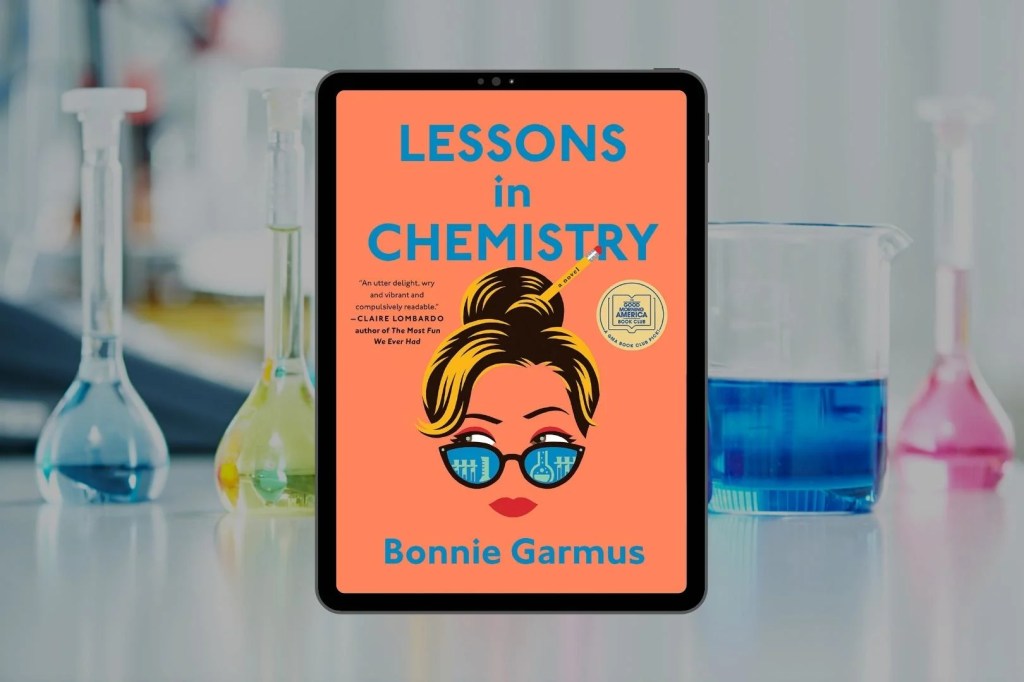
Lessons in Chemistry by Bonnie Gramus – Book

From a Google Image Search – Book Club Chat

A book about what befalls a woman in a field dominated by men doesn’t usually sound like much fun, but Bonnie Garmus cracked that code in Lessons in Chemistry. Elizabeth Zott is a chemist, a talented chemist. She has exactly the right character for scholarly experimentation. She doesn’t plan to marry or have children. But she is beautiful, and it has created no end of problems for her. She doesn’t have her doctorate because she was sexually abused by the professor who was advising her. She is hired by a lab but is given a space that is poorly equipped. She wants to study abiogenesis, trying to trace life to one organism, but the head chemist, Dr. Donatti, will not sign off on that. Might she have been left to her own devices if she had not been beautiful? Maybe, but it would have been a different story.

While stealing beakers from the lab of Calvin Evans, the chemistry star of the university, recognized in significant articles in science literature, she piques his ire and then his interest. Calvin is not handsome, but he is tall and lanky and authentic. Elizabeth Zott cannot help herself. They become a couple and they eventually live together with their dog, Six-Thirty. Calvin proposes but EZ stays true to her decision not to marry. Calvin keeps the jealous, unethical, and lecherous Donatti at bay. He offers balance in EZ’s life, and he gets her to try rowing. Then tragedy strikes. (That’s all I can say)

Elizabeth Bennet from Pride and Prejudice could have been Elizabeth Zott if she had been born in the twentieth century. Although this snapshot of a woman just trying to excel at something men usually do is from the 1950’s, before women’s lib, this dynamic has not changed as much as you might think. Once women are established or have worked for an enlightened organization, women can compete, but the path to the top is still littered with abuse and attempts to make a woman’s accomplishments less or her lifestyle unacceptable. In Lessons in Chemistry Dr. Donatti and his assistants plagiarize Elizabeth’s work, and he publishes it as his own. You may think this is despicable because it is, but this has certainly happened although sometimes in more subtle ways. Elizabeth is forced by circumstances to earn her props in a related field before she can get back to pure chemistry.

Bonnie Garmus has managed to make this story madcap and humorous, certainly without the heaviness you would expect from a description of the book’s subject. It’s a wonderful book and it is over all too fast. If you liked Where’d You Go Bernadette, by Maria Semple you will like this book too, perhaps finding it more realistic. In conclusion, I will simply suggest that you might want to get an erg for your living room. 

Desert Star by Michael Connelly – Book

Last summer (2022) I set out to do some recreational reading. I decided to read all the Harry Bosch books by Michael Connelly. I finished in early fall, but a new book was announced. Of course, I had to read it. The book is Desert Star, and it is also a Renée Ballard story. Since Harry Bosch has aged along with the books Connelly has written, Bosch has been retired from police work for some time. However, Harry Bosch has a life mission to rid the world of those who do evil. It is his frequently stated belief that “everyone counts, or no one does.” He despises the politics that infiltrates policing, and he runs afoul of those who occupy the tenth floor (the police commissioner and his staff) because when he is chasing someone truly evil, he cannot stop until he finds the guilty party or parties, even if he has to bend or break police department rules to do it.

In Desert Star, Bosch is invited to work with the Cold Case group which Renée Ballard has been authorized to set up. This division comes and goes with pressures from people outside the department. A pol who has a personal interest in an old case has put the pressure on the department to take another look at this case. 

The cold case division is also revisited when there is a new development in criminal forensics. This time the new developments are in DNA analysis. With the popularity of online genealogy websites and the family trees developed through these DNA analyses it is possible to trace crime scene DNA by using genealogical matches that are less than 100%. You can locate a criminal by locating relatives.

Bosch has agreed to volunteer with the new task force to solve a case that he cannot forget. Out in the desert are four cairns that mark the spots where an entire family (mother, father, young daughter, and son) are buried. They were shot and buried in the desert in a mass grave until a college class dug up their bones while completing a geology/paleontology project. Bosch has to find out what kind of evil human being would basically assassinate an entire family and why the evil one felt it was necessary.

We find Bosch torn between working on the case that the politician has ordered and the case he wants to solve. Ballard’s job is to rein Bosch in and keep him on task. Bosch has worked with Ballard before, and she has only the slightest edge on keeping him in line over any other police administrator because he likes her. This time Bosch goes beyond just breaking with police procedure; if anyone knew and could prove how he resolved the case that enraged him he would probably be charged with a crime. 

Can Harry Bosch ever work a case again? Is he too old to go rogue and become a vigilante? This time Harry may have to retire for real or become an evil one himself.

Mercury Pictures Presents by Anthony Marra – Book

From a Google Image Search – You Tube

Anthony Marra’s most recent book is called Mercury Pictures Presents. I decided to read his book A Constellation of Vital Phenomena first and that did give me a glimpse into his most important theme, war, its absurdities and dislocations. This time we are focused on a village in Italy, San Lorenzo in the time of Mussolini and Hitler, in World War II. Two young people from that village end up in Los Angeles, escaping the constant fear of a misstep that will inspire the local commissioner to put you in a box under the floor of the jail and force you to suffer a sentence of isolation and sensory deprivation.

We begin in the office of Artie Feldman, head of Mercury Pictures where we meet one of those young San Lorenzo escapees, Maria Lagana, daughter of Giuseppe Lagana, once an occupant of the San Lorenzo isolation cell. Maria is Artie’s extremely talented assistant, a woman in a man’s business who is trying to change her fate and produce movies. We also meet Artie’s varied collection of toupees, named and displayed on wooden mannequin heads. Nearby is a perfect model of the entire grounds of Mercury Pictures right down to the back lots, in miniature.

In San Lorenzo we meet the villagers whose lives, once placid and one might even say boring, have been turned chaotic because of a dictator who leads by fear and threats, creating rules that are impossible to keep track of and all too easy to run afoul of. Maria’s father lives in this village. He is a photographer who takes photos for visas. He always takes two photos. One he uses for the visa. The second is torn in half and one half is given to the customer. Giuseppe’s address is on the back. He asks the traveler to send the other half back to him when they arrive at their destination. He rejoins the two halves and mounts them in an album. 

Maria’s father takes in a young man who wants to learn photography. Although he was from San Lorenzo, he was a student for a law degree in Rome until he met Giuseppe, smelled the dark room chemicals, and saw the photo album of the travelers. With his first camera he was hooked. Through a complex set of circumstances this young man Antonio “Nino” Picone arrives in Los Angeles with a new name. He is Vincent Cortese, supposedly the son of Concetta Cortese. Maria knows his real name because the man who took him in is her father. She wants nothing to do with him. 

The motion picture industry in Los Angeles is competitive and unstable. Your studio can be popular and rich at one moment and in dire circumstances the next depending on the quality of the movies the studio produces and the acceptance of movie goers. Once Japan bombs Pearl Harbor America gets involved in war movies which are important as propaganda for the war effort. However, there is a problem with capturing war footage or photos that show the drama of modern warfare. Most battles happen at night and photography cannot film action at night beyond bursts of light from weapons. In the daytime everyone is asleep in a trench, unwilling to risk daylight exposure to the enemy. Nino, now Vincent Cortese, left his law studies to become a war photographer. He can document the preparations for battle and the aftermath of battle, but not the actual battle. The Japanese have been interned in camps and other foreign nationals from enemy nations have severe limitations on their movements. Since it is difficult to make a believable war movie given the current way war is waged Mercury Pictures uses the miniaturist who created the model in the front office, a refugee from Germany, to build a scale model of her old Berlin neighborhood so it can be bombed and filmed to look authentic. 

Eventually Nino does return to San Lorenzo, and he travels around Italy filming the aftermath of war. He is sent to a small Italian village to recreate the capture of the village using the techniques he learned at Mercury Pictures to make it look like he was embedded in the original battle. “Ninety percent of the shots the moviegoing public associated with war drama realism were physically impossible outside the sound stage. The other ten percent were only possible by sacrificing the cameraman,” the author tells us.

This is a plot-driven novel, and the plot is complicated. We do get attached to the characters although sometimes the San Lorenzo characters can get a bit confusing. Somehow at the end it all comes together. Thematically, since we are experiencing war through the lenses of cameras we are removed from the horrors of war and we are with the civilians, experiencing the war as it affected people “behind the scenes.” Our point of view does not make war any more palatable. The movie connection is what makes the novel interesting and unique. The commentary on war is the author’s passion. War permits humans to act in extremely inhumane ways, which are often horrific, and occasionally absurd. It took me a long time to read this one, but it was because life kept interrupting.

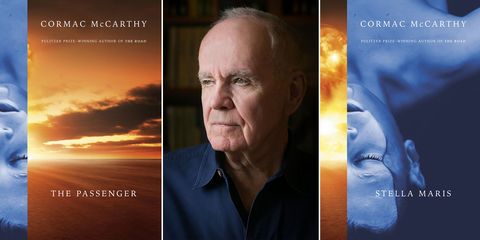
Stella Maris by Cormac McCarthy-Book

From a Google image Search – Alta Journal

Stella Maris by Cormac McCarthy is so immersive; it’s like having a conversation with that person you could talk to all night. It’s one of those conversations that discusses little that is trivial. It goes deep and explores the human condition, the universe, the meaning of life, the nature of families and love. Stella Maris – could that translate to sea of stars? Apparently, it refers to a saint called star of the sea. Stella Maris in this case is the name of the fictional mental institution that Alicia Western has checked herself into as the novel begins. 

Alicia is a genius who began college in her early teens. Her parents worked for the Manhattan Project and moved with it to Oak Ridge Tennessee. They helped produce the atomic bombs dropped on Hiroshima and Nagasaki. Her father was a physicist and her mother worked in a factory setting to separate U235 from U238.  There is guilt, lots of guilt. Alicia’s genius is in mathematics. Apparently true genius only occurs among mathematicians. 

Why did I so enjoy reading a book that I can’t pretend to totally comprehend? It made me feel both brilliant and sadly lacking in intellect at one and the same time. The names of famous physicists and mathematicians offer a fair bibliography of the work in these fields. 

Can mathematics solve the riddle of life and the universe? Does the pursuit of answers drive Alicia’s insanity, or just complicate it? It seems as if she was born to contribute to and expand on the work that comprises the field of math, but then why is she also born with a gene for schizophrenia and probably autism?

She spends her life in rare libraries and esoteric pursuits when her demons leave her periodically alone. She has no friends. She computes in notebook after notebook and in her mind when no paper is available. These are the things she discusses with her therapist, who seems able to follow her intellectually, although not mathematically. Having worked my way through advanced algebra with great difficulty, it is hard for me to imagine how math leads to so much philosophy but there it is, and its deep. You won’t like her conclusions about “life, the universe, and everything” as Douglas Adams put it, so I won’t tell you that part.

Alicia has a brother, Bobbie Western. He is the subject of the first book in this series (The Passenger). I believe that it helps to read them in order. Bobbie could not follow his sister to the heights (or depths) of her mathematical pursuits, so he studied physics and threw it all over for speed. He became a race car driver. 

Alicia is in love with her brother, despite society’s biological taboo against incest. He is the only one who understands her and loves her. He seems to also be in love with his sister, but he will not break the taboo on sexual intercourse. His sister’s broken heart contributes to her psychological burdens and to her worldview. 

If Cormac McCarthy is having his midnight conversation with his readers, which I think he is, then these books show unplumbed depths. But I warn you, at 89 his own worldview is perhaps not one that is designed to cheer you up, or even wake you up, as all human efforts seem to lead us to conclude that there is no powerful being or force watching out for us puny humans. I would still love to read both books, The Passenger and Stella Maris all over again and if I have the time I will. Is it that one book to take with you to a desert island? Not unless you also bring a math tutor. However, you can grasp the gist of this book without doing the math.

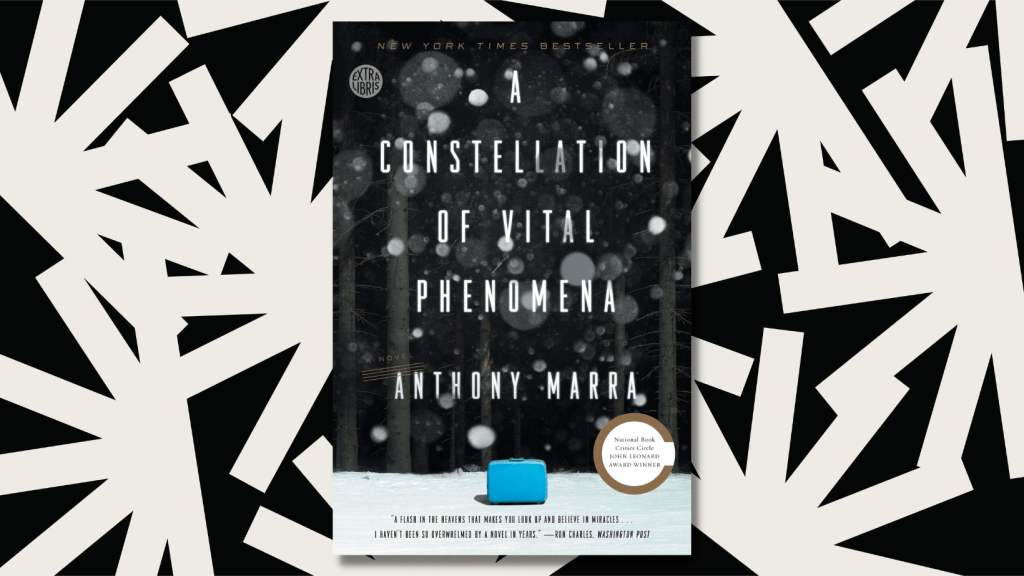
A Constellation of Vital Phenomenon by Anthony Marra-Book

From a Google Image Search – NPR

Reading A Constellation of Vital Phenomenon by Anthony Marra was like laying on your back in blackest night and regarding the heavens because the catastrophes that occur in the daytime world require that you escape to somewhere universal and seemingly immutable. Of course, the news brought all of us the fact of Russia’s wars in Chechnya. Marra brings those wars to life offering us characters to get attached to so that the wars become real. Chechens talk about two wars with Russia. Marra’s characters speak of the deportation of Chechens to camps in Russia, they talk of Russia replacing them with ethnic Russians, and then sending the Chechens back to Chechnya before waging a second war against this country which bulges up into Russian territory where it is surrounded by Russians, with Georgia to the south (a separatist state also invaded by Russia at least once). 

It’s a complicated history, all of it since the fall of the USSR, although the Chechen villages are still undeveloped. Chechens find themselves neighbors with relocated Russians, an ethnic dilemma, and a complicated social environment. The two wars leave little time to dwell on ethnic differences and wreak havoc with Chechnya’s economic development. Municipal buildings rise and fall, schools are formed and funded and then become too dangerous to attend and are eventually leveled by bombs and land mines, by Russian soldiers on Chechen soil. Hospitals are supposed to be left alone, but we know that Russia and the Geneva Convention rules have only a passing acquaintance. 

Let’s look through the other end of our telescope or binoculars at the upheaval in just one rural town near Grozny, Chechnya. The town has been destroyed. Just one resident, turned into an informer, has sent his neighbors to the terrible interrogation center in the Landfill where they die or return too broken to rejoin society. Ramzan is the name of this informer, and he did try to hold out against Russian tortures. He made it through his first trip to the Landfill. He could not stay true to his neighbors the second time he was taken. The crimes he reports are all about whether his neighbors are assisting the rebels, who they are assisting because they are fighting to keep Chechnya free.

Let’s focus in on the three or four residents left who live nearest to Ramzan, his neighbor Akhmed, his father Khassan, Akhmed’s wife Ula, and Dokka’s daughter Havaa. They realize they are next on Ramzan’s list. In fact, he has already turned in the names of Dokka and Havaa who offer beds to rebels passing through the village. There seems no where to turn in this story for relief but when Akhmed realizes the danger Havaa (who is ten) is in he takes her to the hospital in Grozny, 11 miles away. There we meet Sonja, and through her we learn the story of her sister Natasha. People live on tenterhooks and life is a precarious state. There is so much more. This is well worth reading. In fact, it’s also a love story.

The book cannot be read without thinking about what is happening in Ukraine, so parallel to what happened in Chechnya. And Russia may not be done with Chechnya yet. Devastation at the hands of Russia has been at the end of Russia’s giant destructive military spray hose trained on any state that separated from the old USSR. Pictures of broken housing, ruined infrastructure are so similar from state to state that it is difficult to decide which war we are looking at. This book humanizes what it is like to live with the existential threat that your home, your comfort, your life, your family could be wiped out at any moment and how difficult it is to escape your fate because of checkpoints and occupying troops. You cannot help but think how you would fare in similar circumstances. The title does not come from the heavens, it comes from a medical text (read the book to see the connection). The medical book defines life as “a constellation of vital phenomena—organization, irritability, movement, growth, reproduction, adaptation. War interferes with every one of these life activities.