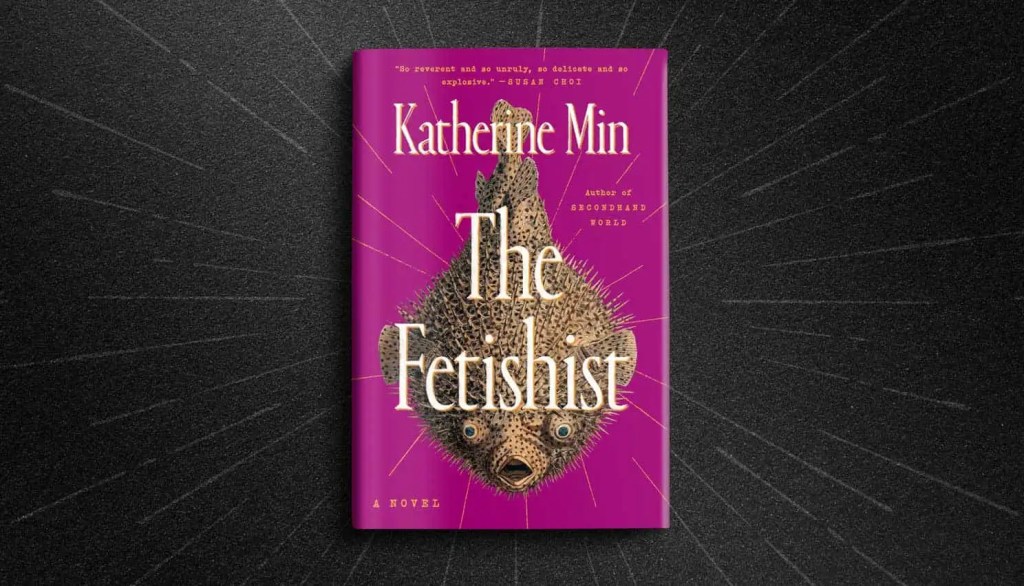
The Fetishist by Katherine Min – Book

From a Google Image Search – Barnes and Nobel

Picking the next book to read is often problematic, a momentary panic sends me back to my book lists scribbled casually in notebooks full of political research, budget info, wordle episodes, drafts of essays, and wish lists. So many tantalizing titles are published each year that my list often leap frogs on to the newest releases without ever finishing with the older lists. There is always guilt and regret. Sometimes I wish I was a Large Language Model filled to the brim with all the world’s great literature and turned into a more well-rounded individual through a corresponding grasp of math and science. I read by instinct and thankfully there are so many excellent choices that I am rarely disappointed. 

I stumbled upon Katherine Min’s book The Fetishist and once again I was not mislead by my instincts. This is a book for grownups. The book was published posthumously by Katherine Min’s daughter. The content is sophisticated and serious; fantastical and funny. Alma is sometimes the narrator and always the main character. She was a famous cellist who toured worldwide and sat in the first chair in global orchestras. She started playing at the age of 5 and by 11 she was obsessed with the cello. 

“It was very physical, more like dancing than playing an instrument, and all her life Alma had felt this weirdly mystical space, the notes like steps, like gestures, the music like breath, like breeze, and the feeling of wide-ranging freedom, of expanse and embrace, and of always ending up somewhere else.” (p. 38)

Alma has MS and can no longer play the cello. Her body betrays her. Her fame is real, but it is a thing of the past. She has plenty of time to think back over her life. Alma fell in love with Daniel, a charming man, a fellow musician, and a womanizer. Daniel had commitment issues. Daniel also gets to narrate at times. Daniel, on an impulse, bought Alma an engagement ring, proposed, and then got caught by Alma doing the deed with Emi, another musician, another Asian musician. Daniel and Alma were engaged for about 5 minutes just before Alma had a very public medical episode that ended her life as a cellist.

“…and because being in a coma means having a lot of free time on your hands and the vagaries of the human brain are such that you never know what will pop into your head at any given moment. Alma finds herself surveying the fetishists she has known over the years. Ri-i-i-sssss kkk-iii-nggggs, rice chasers, Asiaphiles, victims of that mysterious disease known as Yellow Fever. Every Asian woman knows the generic type, but Alma, classical musician, world traveler, and unconscious taxonomist, breaks them down into three categories. 1) The cultural ambassador, 2) The carnal colonialist, 3) The rational revolutionary. (These are covered in more detail.)

A parade of rice kings wherever she went lecherous, treacherous, beseeching–enfolded like origami, bent like bonsai, draped in silk, and embellished with hanzi–presenting themselves like gifts to a foreign bride.” (pp 77-80)

This is the meat of the matter and there is more. Does Daniel pay for his sins? Revenge for Alma was banishment, cutting Daniel off, but her MS weakened the gesture as she no longer felt desirable. Someone else takes on the revenge of Daniel as his past leads to the most unusual kidnapping and Daniel’s mental reckoning. Kornell and Kyoto have their reasons. 

This book is a literary gem, while offering an activist view against “Asiaphiles” who have given us terms like “Tiger Lily, China Doll, Geisha Girl, Baby-san, Miss Saigon, Suzie Wong, Me Love You Long Time, Goddamn Madame Butterfly!” (p 80) How you make a book with an axe to grind into a humorous and classy adventure is by being a talented writer; a writer who will entertain us no longer. This is our loss. Books, like music, take us “somewhere else.”

The Blueprint by Rae Giana Rashad – Book

From a Google Image Search – Paper Literary

Imagine if Martin Luther King never existed, or if the Civil Rights movement came too late to prevent a second Civil War. It’s not hard to imagine if you just find old videos of Strom Thurmond on You Tube. In Rae Giana Rashad’s book The Blueprint, we meet Solenne and Bastien, who sound like characters in a romance book. But this is no ordinary romance. Bastien is a Councilman headed to become President of the new America known as The Order. Solenne is a young Black woman, fifteen years old, headed to become a ‘concubine’. Since this book is written by a Black woman, I will use her words to offer insight into her story. In the Author’s Note, Rashad refers to female slaves in real America as “forgotten handmaids,” so here is another handmaid’s tale, every bit as chilling as the original, except it explains how Atwood’s tale of the handmaids is even more fraught for Black women.

Page 13

“Then he was gone, ballroom lights tunneling the dark, the hush of champagne on my tongue. THE PATH WE WALKED TO BECOME Black women wasn’t straight; it was a loop. Starting from nowhere, it brought you back to nowhere. A man at one end, a man at the other, humming the same song. ‘It’s just a body. Nothing special.’ If that were true, why did they want it? Why couldn’t it belong to me.”

Page 25

“I would never know how it felt to walk boldly because this world wasn’t mine…There was no protection for me, a Black girl, no tender touch, no consideration for a delicate exterior. No space to scream.”

Page 31

“They bragged about their accomplishments in private, boasted about the difference between them and their brother. But skin quality and quantity of sleeve emblems aside, from neck to ankle, the men were identical.”

“Councilmen were the Order’s most decorated men. The talented, skilled, brilliant. Engineers, physicians, cryptographers, developers. But fundamentally they were soldiers. Killers.

Page 104

“And still, this country is better than it was when it was the United States. An economy outpaced by the rest of the world, the racial unrest, the increasing crime and abortion rates, no, we couldn’t go on with so much death.”

Page 133

“From his frame above the fireplace, Thomas Jefferson watched me. What had Sally seen in him? He brought her to France at fourteen, where she worked, lived, and earned money as a freed woman. When he decided to return to America two years later, she didn’t stay like the French urged her. She returned to America, where she remained enslaved, and the babies followed like footsteps.

Page 214

“Seven years of militias, fragmented state governments, and millions of deaths. We’re fortunate the Founders of the Order had a vision for the country. Their sacrifice ended the war.”

(Solenne’s great-grandfather wounded, and in the hospital, talks about that war and the aftermath.)

“In that unseasonably warm January of 1960 in Metairie, Louisiana, he witnessed a military dictatorship seamlessly replace the civil government. Where did these men come from, he asked his nurse. She couldn’t have been more than thirteen. Nobody knows, she said. They came from nowhere. But that wasn’t true, they were military officers police officers, senators, governors, a World War II veteran like Bastien’s grandfather. While my great-grandfather slept, Black and white men stood in offices letting the ink dry on treaties. In those documents women had fewer rights than they did before the war, and Black women caught the worst of it.”

[Black men were given the state of Louisiana as a free state, but they had to relocate by 1962 or accept the new Constitution]

Page 249

“They knew that once you get that taste of freedom nothing will keep you in line. Lucas [Bastien’s rival] knew it. I’d already seen the sunset over Sanibel Island in pink and orange. Seeing something like that makes you feel like somebody created something just for you. It was like unwrapping a present every time I blinked. I wanted to keep it forever. Not a piece of it. All of it.

Page 277

“Pleading. This was the only system designed for us. We were girls, fifteen, sixteen, seventeen. We were our ancestors, forbidden to read or write while lying under the arms of men who drafted legislation.”

Page 293 Author’s Note

“It was difficult to read these stories of forgotten handmaids and their forced reproduction. Though the United States outlawed the international slave trade in 1808, slaveholders found a way to increase the slave population by exploiting the domestic slave trade. They forced Black women into men’s beds, punishing those who didn’t have multiple children by their teens and rewarding those who did.”

Who wins, Bastien or Solenne? Find out how they both win, and both lose. Clearly this book connects to the America that we live in now, in 2024. There is talk from time-to-time about the possibility of a second Civil War when discourse heats up or when rights are lost. Women’s rights recently experienced a setback in the Supreme Court, a setback that will figure in the upcoming election and that could escalate depending on the results of the next election. The fears of Black women, that they might become “concubines” if the right-wing wins must be quite real and harrowing. Throughout Rashad’s story of Solenne, she is writing a book about a slave from 100 years ago, Henriette (Kumba) drawing parallels between the two women’s lives, reminding us that Black women are not property or sexual objects and warning us about the dangers of allowing racism to rule ever again.

I feel a kinship to Rae Giana Rashad because I wrote a similar book about losing freedoms if America becomes an authoritarian state. She did a better job than I did since she had to create all her characters from scratch, and I used both real and fictional people. My attempt in this genre is entitled 2028: The Rebellion. Rashad is offering fair warning to everyone. You should read the book.

The Fox Wife by Yangsze Choo-Book

From a Google Image Search – NPR

China is an ancient land with some ancient superstitions leading to tales to tell, either delicious or horrific depending on the storyteller. Although we are wary of foxes here in America, we haven’t built up a mythology about them. They are predators and it’s hard for domesticated humans to coexist near predators. Sometimes that is also hard in China since foxes are not considered good neighbors. 

The Fox Wife by Yangsze Choo has us mixed up in the business of three foxes. Unusually this is a love story and a mystery. Snow is a fox who can shape-shift and live in human form. In human form foxes are quite beautiful and have charisma that almost tips off the humans around them that something supernatural is afoot, Some humans become obsessed with their foxy friends.

Snow had a baby fox, a girl, that was dug from her snug hole in the ground and then died. There is guilt since mother and father had both left the baby alone but who would have thought anyone would dig in that spot. Snow is grieving the loss of her lovely child, and she is out for revenge. A photographer from Mongolia is involved and she must find him and kill him for what he has done. Her sad passions are so deep that she is not rational. Fortunately for Snow, the man is difficult to find. We follow her (human name -Ah San) on her wild journey to find Bektu Nikan, the photographer. On the way, we run into two more foxes, two males, both known to Snow. One is Shiro, the white fox, the other is Kuro, the black fox. 

Two concubines have been found dead with brilliant smiles on their faces, one propped at a restaurant’s back door, frozen. The owner of the restaurant, familiar with Bao’s (Bao is a human) reputation as a detective asks him to find the dead woman’s name so that she can be buried properly by her family. Bao takes the case.

Bao has carried an old love in his heart for years and perhaps a curse, or a cure gone bad, that has affected his luck in business and in life for decades. He had a childhood friend, Tagtaa, from Mongolia and they built a fox shrine together. He fell in love with her, but this family would not allow the relationship. When Snow takes a job with Tagtaa as a companion, we realize that Bao’s path will cross that of his old playmate and young love once again. Because of his childhood experiences with the fox shrine, he knows that foxes are involved in this somehow.

Snow reunites with Shiro and Kuro but she is angry with both of them. Three foxes, all in human form is a lot. Tagtaa’s grandson and his friends also get involved in this mess which somehow has the photographer at the center. Fables are not my normal reading fare, but this one was entertaining, full of sorrow and also hope. Snow brought sweetness and her loss of her child, her beauty and her anger to pull us into the story. 

Snow speaks.

“I wept bitterly then. Because I was the one who told Kuro to get out. To never come back or speak to me again. I hope you die, I’d said, snarling and furious. Because you can never bring our child back.Sometimes our wishes come back in the darkest, most twisted ways, like a thorn that pierces and grows through your flesh. A tree that drinks blood and blocks out the sun. The sin was mine; I had watered it with hatred and tears of rage, and it had grown to cast a monstrous shadow.” (p. 346) 

In the Epilogue, Kuro speaks.

“I was very sad without you,” he said simply.

“There’s not much one can say to declarations like that. It’s my fault for having married someone who makes me blush with his seriousness.”

I enjoyed the story immensely.

System Collapse by Martha Wells-Book

From a Google Image Search – Tor.com

Ever since I met Martha Wells’ Murderbot I have looked forward to new books in the series, although they are finished much too quickly. The latest book is called System Collapse. This installment in the life and times of Murderbot opens with an action scene. Some ag-bots have been contaminated with an alien virus and are attacking anyone or anything that gets too close. If you are thinking about starting the series with this book, don’t. Start at the beginning. In this installment, Wells doesn’t do much in the way of summarizing previous adventures. SecUnit is here with ART, a university-run ship that conducts research and supports humans and bots who are being exploited by corporations. Can a ship be a character? Of course, just think of the Enterprise.

Fighting against alien contamination to protect a human community is difficult enough but our SecUnit is dealing with a personal issue (redacted) and a ship from Barish Estranza, a corporation that tricks populations in planetary settlements that are in disarray into signing contracts to work in corporate mines as corporation serfs or slaves. It turns out that some of the colonists on this planet split off to establish a separate community, but all communications have been abandoned between the original group and the splinter group. SecUnit finds those who left living in a pre-corporate space, but so does Barish Estranza. 

SecUnit usually soothes itself when overloads occur or it needs to rest up by watching episodes of The Rise and Fall of Sanctuary Moon, which it wishes it could access much more than the constant need to pay attention to real-world events allows, but Sanctuary also taught SecUnit lots of useful strategies and has educated SecUnit (an organic and inorganic construct) in human behaviors. In fact, SecUnit introduced ART to the videos and he also uses it to help other SecUnits after they disconnect their governor modules.

What has SecUnit redacted? Is SecUnit becoming more and more human? Will SecUnit be given a human name? That is all up to Martha Wells. I am just a human organic form who enjoys following SecUnit all along the corporate rim and beyond. It’s a literary amuse bouche in space.

First Lie Wins by Ashley Elston-Book

From a Google Image Search – Shreveport’s Secrets

First Lie Wins by Ashley Elston was chosen by Reese Witherspoon for her book club. Since it seemed that it might involve some creative plotting and offer entertainment, two things on my reading radar, I added it to my iPad Kindle app. It’s not great literary fiction, but it succeeded in satisfying my desire for a dessert course.

There is no sense in naming our main character since she has many names. When she finds herself at a young age having to support her mother who is dying and herself, when she has to pay all the household and medical expenses, she becomes a jewel thief. She finds a job that allows her to meet women who come shopping wearing their valuable jewelry. She learns to separate the gems from their settings as the settings make the jewels too recognizable. She is caught, but not by the police. A very scary man she never meets in person exploits her fear of exposure and pays her very well to use her skills for his purposes.

What happens when she falls in love with her assigned target forces her to face the unsavory side of her current situation and the fears that keep her tied to this blackmailer posing as a benefactor. Can she beat him at his own game? Can she learn his identity? Although her attraction to the man she is being paid to target motivates her, the last straw is when her dream of one day returning to her real identity is destroyed and all seems hopeless. She makes use of all she has learned to turn the tables. The first lie wins! The story is both creative and entertaining. The reader wins!

Iron Flame by Rebecca Yarros-Book

From a Google Image Search – Apple Books

Rebecca Yarros’ Empyrean Series will eventually have five books. So far, we have two. The first book was Fourth Wing. The second is called Iron Flame. The kingdom of Navarre has isolated itself from the rest of the known world and Basgiath College is not only running the kingdom (although there is king), training up the citizens who will protect the kingdom militarily, but they are also hiding something. Violet Sorrengail, whose mother is one of the administrators who run the college, is estranged from her mom. Violet is now in her second year, and she has been chosen by not just one dragon, but two, although she only rides one. She came in as a frail girl who barely passed the rigorous admissions tests and has become strong by building physical strength and by learning how to lean on other skills that make her extraordinary. The college trains foot soldiers (infantry), and the dragons train the riders, there are scribes who keep the history, and healers who mend the wounded.

Xaden Riorson is one of 104 children of a rebel group from another kingdom whose parents were executed. The children are marked with tattoos along one arm and Xaden was cut 104 times on his back by Violet’s mother to remind him that he is responsible for the others. Although he sets out to make Violet’s life at the college difficult because he thinks she is too weak to be there, she has opportunities to show him that she can keep a secret. She is also dangerously attracted to Xaden. A fantasy with a hot romance combines two genres that have plenty of fans. Readers will get very invested in the love blooming between these two. 

The kingdom of Navarre is protected by wards that keep out enemies, but why are there enemies and who are they? Who is attacking the kingdoms on other continents where the wards have failed? Why are the college administrators so secretive about what is happening at the fringes of the kingdom? If the rebellion was quelled who are the enemies of Navarre? The riders sent to the fringes are battling flyers who seem to think that Navarre is their enemy. But something else is out there and Violet, who studied history with her father, knows what they are up against. She knows that the college administrators have hidden away books that would enlighten everyone, and perhaps show how to reactivate the failing and failed wards that used to keep evil away. 

Is there such a thing as unconditional love? Violet and Xaden are about to find out, in the next book. You might be tempted to unlove this series but perhaps the author has points to make, and you might want to hang in to find out. Will the people of Navarre have to vanquish all their enemies, or will they find a way to unite all the world in utopian tolerance and keep the lovers together to bring joy to the new world? How will the dragons deal with the changes that they must internalize? This is a series that has readers on an emotional rollercoaster and that gives it value if you like to read for entertainment.

Fourth Wing by Rebecca Yarrow – Book

Sometimes taking a break from reading about weighty subjects is good for the brain. We might return to a genre that has given us pleasure in the past, in a novel that flies by, the passing of time forgotten. Fourth Wing by Rebecca Yarros promised to be just such a novel. It has been given a new genre classification, romantic fantasy. There are dragons, family intrigue, magic, power struggles, and love happening at a military college training kids to become soldiers to defend the kingdom. Some at the college are training to be infantry, some to be riders bonded to a dragon, some to be scribes to keep the books that record the history of Navarre, and some to be Healers. 

Violet Sorrengail is the newest cadet to walk the Parapet to gain entry to this school that is headed by her estranged mother. Violet has a weak joint disease and was trained by her father to be a scribe, but she decides to become a rider, despite the challenges her fragile body presents. Violet surprises everyone, especially the wingleader, Xaden Riorson who would like to see her fail but is drawn to her by a powerful sexual attraction. Violet, although not training as a Scribe, realizes that something is wrong with the Basgiath College archives. Books are missing. Parts of the histories of Navarre have been lost or locked away. And the wards that guard Navarre’s borders are weakening or falling.

It takes a while to put together a group of true friends when you are in a new school. There is a lot of social power jockeying and close friendships emerge along with personal enemies. The power of friendship and love to align the forces of good against the forces of evil is part of any good fantasy world and the Empyrean is no exception. It is these friendships, sexual attractions, and love relationships that bond us to the characters in a fantasy, even the dragons, and it is the animosities, the evil plots that inspire us to read further to see what unfolds. We always hope that good will win, that our heroes will grow and add to their talents. Until George R. R. Martin this outcome was predictable. Not so much now. 

This book is part of a projected series of fantasy books known as the Empyrean Series. Iron Flame is the second book in the series, but the last three books have not yet been written. If you like Nora Roberts and hot sex you may like Fourth Wing

Outline, Transit, Kudos: Rachel Cusk Trilogy – 3 Books

From a Google Image Search – Literary Hub

Rachel Cusk’s trilogy encompasses books entitled Outline, Transit, and Kudos. In every case Cusk presents character stories of people met in chance, or occasionally planned, encounters. In Outline, the author, Faye, (characters are typically unnamed or given only first names) is on a plane headed to a Book fair in Greece where she will sit on a panel and be asked to speak. Her seatmate on the plane gets in-depth treatment as we learn the story of his life and his marriage. Even at the book panel, the event runs out of time before the author speaks, but one outgoing male author has plenty to say.

Hardly any of the characters in these books have names, or they might have a first name, as already mentioned. This seems to be a new trend in fiction which probably has a purpose, as in allowing us to relate to the character, not wanting to create a character that jumps off the page and becomes an icon or to make it easier for the reader to imagine that s/he is the main character. The main character in this case is an author who has been through a crushing divorce. She and her husband have two sons. But her writing career is taking off, first literally to the Book Fair in Greece. 

Rachel Cusk has a talent for telling stories of the people who meet this author as she travels, renovates an apartment, and goes to a second writer’s convention where awards are being given. But we know little about the author or her book. We are treated to an in-depth exploration of all the people she sits next to or interacts with. She seems to have no close friends, but this story is not really about the author. It is about men and women and the difficulties of intimate male-female relationships, especially in marriages in the twenty-first century. 

Even as she fights off the bile of her new downstairs neighbors in Transit, she finds out the details of the life of the contractor who spends the most time on her renovation. Her neighbors are a nasty pair who knock on the ceiling with a broom as they follow her footsteps through her new flat. The downstairs couple seem to be bound together by their hatred for whoever lives upstairs, and they delight in intimidation. These are people I would want to run away from, but she stands her ground (without a rifle). When they realize that she is soundproofing the floor their hatred knows no limits but never gets physical. It is all bluster, an act to drive her away. The author has sent her sons to stay with their father while the reno is undertaken and although they beg and cry to come home to her, she encourages them to be independent. Is she a bad mother?

In the last book, Kudos, the author has obviously had some success and is attending a conference where she is supposed to be interviewed on television. Although she learns the life story of the interviewer, the technicians are never able to make the electrical hookups and the interview is called off. She meets another interviewer, a book critic, and he never learns a single fact about her, but we learn all about him. Almost all the people we meet are men and what they have to say about marriage is not encouraging. She also meets a wealthy woman who has given up on men and now invites writers and artists to come stay in her mansion where they can be warm all year long and enjoy more sun than the author has ever enjoyed in England where she lives with her sons in her redone flat over her miserable neighbors. Will she take Paolo up on her offer? Although this exploration of modern relationships is relevant this is a literary book than many readers are likely to skip. Rachel Cusk, however, has earned much praise from those critics who know and love well-written fiction.

From a Far and Lovely Country by Alexander McCall Smith – Book

                              From a Google Image Search – Penguin Random House

With all the weight of world events and the serious issues on our minds it was my pleasure to spend some time in Gaborone, Botswana with Mma Ramotswe and Mma Makutsi at the #1 Ladies Detective Agency. This is a long series of books about the simplest, the sweetest, and sometimes the bitterest things we encounter in our lives. These life lessons are learned under blue skies and in the shade of acacia trees with plenty of breaks for a cup of tea, preferably red bush tea. From a Far Away and Lovely Country was written by the Scottish author Alexander McCall Smith who lived in Botswana and never lost his love for this little nation. He depicts it as struggling to be modern without losing the values of the land and those who raised cattle on it. 

Mma (Precious) Ramotswe set up her detective agency almost by accident. Then Mma Makutsi of the big eyeglasses and peculiar ways became the secretary (who scored 97% on her final exam at secretarial school). Mma Makutsi has promoted herself into a role as another detective in the agency and now Charlie, apprentice to J.B.L. Matekoni (mechanic and husband of Precious Ramotswe) is taking his first try at taking on an investigation on his own. 

Two cases need solutions when we visit Gaborone this time. Julia Cotterell has arrived from America, newly widowed, looking for distant relatives in Mochudi where Mma Ramotswe grew up. Then when Mma Ramotswe visits her friend Mma Potokwane who runs the orphanage a new house mother, Mma Ikobeng, talks about a new club in Gaborone which is advertising that it is a place for single’s to meet, but it appears that the men who pay to belong to the club are married and just pretending to be single.

This is all happening on Mma Ramotswe’s birthday, which her beloved husband seems to have forgotten. And then there is the incident of the red dress. Most of the cases that Precious takes on are family problems, or minor crimes or misbehaviors. She is very wise and never lets praise go to her head. She solves cases in human ways, without a need for weapons or action scenes. 

Mma Ramotswe is with Julia looking down on the village where she spent her childhood. “They stood in silence, each lost in the sort of thoughts that come to us when we look upon a place we love or are ready to love. Then the sound of cattle bells drifted from below, and Julia turned and looked at Mma Ramotswe and said in wonderment, “There are bells Mma.” And Mma Ramotswe smiled and pointed towards the place where, far beneath them, cattle moved between the acacia trees. It was a sound that all those raised in Botswana had imprinted upon their hearts: the anthem of the land, the notes of the country. And it reminded her of her father and all that he meant to her.” (pg. 140)

These little books contain plenty of homespun philosophy that is necessary in such a complex world as ours. “Experience had taught her that there were many people who seemed to be searching for something that they could never find–who might not even know what they were looking for. That, she thought, was because so many of us felt that there must be an answer to the questions we all asked at one point or another–what was the purpose of our lives and why was there so much suffering?–and if we looked hard enough we would find the key to that search, although understandable, was one that was more or less destined to fail, and inevitably we were disappointed. The way to deal with the sorrow of the world, Mma Ramotswe thought, was not to think you would ever necessarily understand why the world was the way it was. Rather you should list the things you felt were good, and work towards bringing those into the lives of others. That would keep you busy enough, because there was always-always-room for more kindness and love (and tea) in our lives, none of which needed any explanation.” (pg. 140)

I keep reading this series of books because I know they will offer me a dose of kindness, refresh me, and send me back out into the real world where kindness is much harder to find. You will find that kindness is still around if you dish out a bit of kindness yourself. Alexander McCall Smith’s version of Botswana is a lovely place to find myself every time I visit.

Tom Lake by Ann Patchett – Book

From a Google Image Search – The Harvard Crimson

Tom Lake by Ann Patchett is a pandemic book of sorts. Lara and Joe Nelson own a farm, rows of cherry trees, some plum trees, some pear trees. The cherries are the money makers. Sweet cherries must be hand-picked. The tarter cherries for pies and cooking can be shaken from the trees onto tarps and they can be frozen.

The pandemic has made it difficult for their usual pickers to arrive. Lara and Joe’s three daughters, all grown but not yet married, come home to ride out the pandemic and to help pick the cherries. When Lara’s daughters find out that she dated Peter Duke, a famous and handsome movie star, Emily, Maisie, and Nell enliven a tedious repetitive task by prying the story of their mom and Peter Duke out of their reticent mother.

Once upon a time a local presentation of the play Our Town finds Lara and her friend registering local actors for the upcoming production in their New Hampshire town where Lara’s mother and father live. Our Town is a big deal in New Hampshire. If you have read the play, you know why. If you haven’t read it, you should. After a failure to find an “Emily” to play that important role, Lara ends up trying out. Turns out she is a natural. Her Emily is so well done that she is invited to go to Hollywood to test for a movie. Lara feels a connection to the Emily character but is she a great actress she wonders. After she wins the part in the movie playing another Emily-style character the film is shelved for several years. Lara is packed off to play Emily in Our Town again, this time in a professional summer theater in Tom Lake, Michigan.

Lara’s daughters, picking cherries and prodding their mother to get to the part where she meets Peter, find that they are finally there. But they want more, they want details. Because these daughters did not come home to tend to their mom on her deathbed (as in some novels and movies), this is a far lighter novel with only a few tragic elements. It’s basically a book that would make a great Nora Ephron movie. Do we have a new Nora Ephron? If Ephron was a product of her times, then we may never have another Nora Ephron, nor another Ann Patchett. 

The challenges of being an independent farmer are braided through the other elements in the book and the specter of all those cherries which represent the farm’s income rotting on the trees with no one to pick them is a pressure as intense as our desire to hear about Lara and Duke and why Lara is a farmer’s wife rather than a movie star. Readers also get an interesting peek into what it’s like to work in a summer theater.

Tom Lake was a good read, but it’s also a trip to more carefree, innocent days even though it is during the COVID pandemic. Perhaps people envy America these days in the 21st century because some people still get to live such a life. How much longer? How many of us? Although it is a new novel it already feels nostalgic. The orderliness of a well-run farm, the lines of heavily laden cherry trees under blue, blue skies. You might enjoy spending some time in a place that seems so fragile so in danger of disappearing altogether. I borrowed this book from my local library.