All Systems Red: BooK 1: Murderbot Diaries – Book

all-systems-red Tor.com

All System Red: Book 1 of The Murderbot Diariesby Martha Wells is an instant hit with me. It is a fine addition to the science fiction and artificial intelligence genres. There is a picture of our particular murderbot on the cover of the book but even the term for this class of robots is designed to instill fear. Encountering one could make you start looking back over your life in case you might be a target. Murderbots are big, they are a combination of organic and mechanical elements, which seems like a poor design for a bot that constantly encounters violence and woeful bodily injuries, injuries which can only be repaired with the help of human or tech systems. Many a murderbot ends up on a scrap heap.

But our murderbot is not happy with his assigned role in society. He (it seems like a he) has figured out how to escape the control of HubSystems by overriding his governor module. If a regular murderbot is scary, a rogue murderbot could turn your hair white if it decided that it liked killing and went on a campaign of mass murdering. But our bot discovers 35,000 entertainment modules buried in the  hub system which it can now download at will. He starts binging on series created for human entertainment and he begins to resent any time that he is asked to do the work he was designed to do.

In this first adventure Murderbot finds himself assigned by the company to a group of scientists doing research on an unnamed planet. Mysterious things begin to happen and his humans (horror of horrors) seem to want to befriend him. Martha Wells, you did a good thing, writing The Murderbot Diaries for us to enjoy. I have already moved on to Book 2. These are not long books, sort of a small tray of four tasty amuse bouche. Martha Wells won a Hugo Award and a Nebula Award for best novella All Systems Red.

Photo Credit: From a Google Image Search – Tor.com

Find me on goodreads.com as Nancy Brisson

Of Blood and Bone by Nora Roberts – Book

of blood and bone Characters Wanted

Of Blood and Bone by Nora Roberts is the second book in a trilogy called Chronicles of the One. This is a dystopian saga, but it is not Cormac McCarthy’s The Road. Roberts pits wholesomeness, the sweetness of summer sunshine, bees, honey, family, children, love—life lived simply and communally—against lives that feature hate, fear, intolerance, and brutality.

When Mr. McLeod cracked the shield and dark Magick was loosed on the world, two-thirds of the world’s population died of an incurable virus which became known as the Doom. Many survivors found themselves with magical talents. Some became faeries, some elves, and some witches. The world split into the light and the dark and war was in the air. Humans who survived with no magical talents also split between good and evil. Some humans felt that magical creatures were an abomination and they tortured, killed, or executed them whenever they got the chance. What was left of governments captured magical creatures ostensibly to save them and to study them, but they imprisoned them and strapped them to metal tables so they could learn what they could and then eliminated them. And gangs bent on chaos and mayhem killed anyone who was vulnerable.

The child of Lana and Max, two witches who had to flee NYC in the worst days of the Doom (Book 1),  Fallon Smith, was known to be “the One” who would set things right before she was even born. Fallon has lived quietly on an isolated farm with her family but now, on her thirteenth birthday, Mallick comes to take Fallon away for training. From here on the story resembles the King Arthur story, except this time the King is a woman. Mallick is her Merlin and when she successfully finishes her training she wins the sword and the shield from the sacred well. During her training she also wins three unusual and powerful companions.

It’s a great tale even if Fallon is a bit like heroic Barbie and the young man, Duncan that she meets in New Hope is a bit too much like Ken. Fortunately, although the novel holds out the promise of romance at some point in the future, for now it stays focused on war and setting the world to rights. This seems as if it would make a great YA fantasy series depending on where it goes in Book 3.

I liked Of Blood and Bone. Apparently, in real life, there was a little issue about two similar titles between two authors, but it was settled amicably I believe. I look forward to the third book. But if we find ourselves in a truly dystopian world I don’t expect that Magick (or even magic) will save us. There is too much fantasy in this to put it in the category of dystopian literature. Still when you need entertainment this trilogy could be a fun choice for a quick break from more serious fare.

Photo Credit: From a Google Image Search – Characters Wanted

Educated: A Memoir by Tara Westover – Book


Westover-632x362 Barnes and Noble

Educated is a memoir by Tara Westover. There were seven children in the Westover family and they loved their father and their mother as children do. He, the father, had a powerful charisma, although his entire world view, shared passionately with his children bordered on insanity. He was ostensibly a strict Mormon, but so paranoid that his religious beliefs were completely twisted by his absolute distrust of the government and of socialism, which he saw as synonymous with government; and of what he called “the Illuminati” (all prevalent fears stoked in current conspiracy theories). In addition he was a survivalist who hoarded food, guns, fuel and who did not allow his children to go to school. The family lived on rural land at the foot of a mountain in Idaho.

Gene Westover used religious guilt, end-of-days conviction, and parental disappointment expressed in lengthy religiously-toned sermons to manipulate his children and his wife to perform dangerous work that was well beyond their strength and skills level. His children and his wife, and even he, the father sustained horrible injuries. But doctors and medicine were things he categorized as socialism and therefore “of the devil”. Tara’s mom was a herbalist, and when forced by her husband, a midwife. Everyone in the family, even if almost injured to the point of dying, was treated with externally applied herbal salves and tinctures designed to be taken internally. In a few cases family members were taken to a hospital. Still childhood in this family, even though they loved their parents, sounded like living in one of the rings in Dante’s Inferno. Even negative situations often offer some positive side effects, and, in this case, learning to deal with dangerous situations did give some of these children strength and ingenuity.

Tyler is one of the Westover children who refused to be a part of the insanity whenever he could escape his father’s notice and he learned ways to do that fairly often. He loved books and music and cleanliness and order. He was the first of the children to go to, and finish, college. Shawn and Luke, two of Tyler’s older brothers left home but they continued to do jobs that required physical stamina, like long distance trucking and they eventually returned home to work in the family junkyard and to build barns and silos with their dad and the other kids.

Shawn had such anger in him, and he had a mean, violent streak, which could be almost lethal when mixed with skills in martial arts and a body made strong by hard work. He started out teasing his little sister Tara, but he eventually became judgmental with unpredictable outbursts of bullying, physical torture and mental abuse, frequently calling Tara, who was twelve and then thirteen, a whore. Her parents never intervened.

Fear that he would do her major harm or even kill her eventually drove Tara to listen to Tyler, who told her that even though her parents lied about the home schooling, if she can pass the ACT she can go to college. Tara had some experiences in the community outside the family domain. She’d been able to sing in the church choir and take part in some community theater. Her dad seems proud when she shines in public. She has taught herself to read and do math through algebra, but gets help from a friend to learn trigonometry. She passes the ACT on her second try and is accepted to Brigham Young University where she becomes an A student. Good fortune slowly pulls her out of the grasp of her delusional family. During her undergraduate days I continued to hold my breathe every time she used a college break to go home. Her professors helped her get into Cambridge in London, and then, for her doctoral studies, into Harvard. She did have to deal with some psychological fallout.

This is a powerful story that aroused my anger and left me at times in despair. Tara Westover makes the point that the lives of her college educated family members differ in quality to the lives of those who did not leave the family, even though Tara’s mother eventually made the family very wealthy with one of her herbal concoctions. Education opened Tara’s eyes to how little her father knew or chose to accept of actual history and how his powerful demeanor and limited world view hurt his family, who he wished to hold onto as virtual prisoners. Tara’s family disputes her version of events in the family. There are lawsuits pending.

Photo Credit: From a Google Image Search – Barnes and Noble

Unsheltered by Barbara Kingsolver

Unsheltered floral KUOW

Unsheltered by Barbara Kingsolver is not the first book by this author that I have read. I have enjoyed her writing since her first book, The Bean Trees, appeared in 1988. I have also read Pigs in Heaven, Prodigal Summer, Flight Behavior, and The Poisonwood Bible (although I think I read all these books before I joined goodreads.com).

Kingsolver is an environmentalist who likes to use fiction to call attention to the havoc human excesses wreak on nature. She does it subtly, but unmistakably in very readable novels, that reflect the changing zeitgeist of the 30 years she, and we, have lived through since she started writing.

Her inspiration for Unsheltered came when she learned of a woman scientist named Mary Treat and she was given access to her notes and correspondence. Dr. Treat was a woman ahead of her time, a wife who thrived when her husband left her. She was fascinated by the plants and insects that lived in the Pine Barrens that were near her home. She filled her living room with small jars that look like terraria, but each contained a tower-building spider (small variety of tarantula).

Mary Treat wrote letters to Charles Darwin, who had recently published his Origin of the Species, a book that seemed to refute God, and set the world on fire, and he wrote back. She wrote to Dr. Asa Gray and he also answered her letters. Mary Treat is real, and a truly interesting woman. Thatcher Greenwood is also real. When he married his wife Rose, her family owned the house next door to Mary Treat. Thatcher Greenwood was hired to teach science in a high school run by a man who believed Darwin to be an abomination. The house he is living in was poorly built and is falling apart, as is his life.

A parallel story 150 years after Darwin’s book was published, gives us a family of the Trump era, living in the second incarnation of Thatcher Greenwood’s house, which was rebuilt by a second someone, equally without regard for sound building principals. A twice-unlucky house. When Willa’s family inherits the house in New Jersey from her Aunt, it is at a time when the economy is changing for everyone. Willa, a writer, loves her solid career footing but then the magazine she writes for folds. If she stays in New Jersey she will have to accept freelance writing jobs. Iano, her husband, a professor of political science cannot find a path to tenure, and in middle age is still working as an adjunct.

Their son, Zeke, is left, tragically, with a baby son, who he leaves with Willa to try for a tech startup with his college roommate. He owes $110,000 in college loans which he must pay off. Tig, their daughter, is an enigma as a member of what seems to be a whole new generation. She is a dynamic, pint-sized activist with dreadlocks who lived in Cuba for a year and took part in the Occupy movement. Tig (short for Antigone) may have the best grasp on our new shifting social landscape.

The house is what ties the two eras together and the two “evolutionary” women, Mary Treat and Antigone Tavoularis (Tig). As the house falls down around the inhabitants some find it extremely unsettling and others find it strangely freeing.

Kingsolver is a queen of dialogue, which makes her novels flow easily along, in spite of how dense the content seems after the fact. It was interesting that she never mentioned the modern folks who still deny Darwin and the sneaky tactics they often employ to make it mandatory to teach “Creationism” in 21st century schools. She may not have wanted to focus on something more political than environmental. The literary device that has us skipping back and forth over 150 years in every other chapter makes the reader look forward to getting back to the story line that will be taken up in the next chapter.

We have wandered pretty far from nature and I wonder how many of us would feel comfortable without a home base. Is there a generational divide, or will that disappear as mature responsibilities must be met? Will we have to learn to respect nature and live in greater harmony, without many of the creature comforts that we have convinced ourselves prove that we are above other living things. Will we ever be able to overcome our sense of superiority and separateness which allows us to believe that our survival trumps (sorry) theirs? Will we ever learn to feel our organic connection to every living and nonliving thing on this planet?

Engaging our thoughts is a hallmark of a skilled author. I can’t decide if the separation in time is so large that this felt more like two stories that blinked on and off like lights or if the connections are powerful enough to unify the novel. However this is a relatively insignificant flaw which was not jarring enough to ruin my enjoyment of Barbara Kingsolver’s book, Unsheltered.

Photo Credit: From a Google Image Search – KUOW (cropped)

December 2018 Book List

Books new 2 TheEconomist

It’s time for the December 2018 Book List. December is often not the best month for newly published books since people are looking backward to pick their best books of the past year, but that is not so true this year. With the holidays coming up there is a book on this list to interest almost every adult on your gift list. There is crime, fantasy, art, picture books (coffee table), mystery, music, romance, America’s foreign policy and our role in the world, Dungeons and Dragons, graphic novels, biographies and memoirs, books on feminism, books on racism, books on beauty. I love the idea of all these books, but of course I cannot read them all. My quick picks are followed by an asterisk but I may change my mind or get tantalized by some other title on this month’s list. Happy holidays, peace on earth, and I hope you get to read at least one great book this month.


Amazon


Literature and Fiction

North of the Dawn: A Novel by Nurrudin Farah

The Dakota Winters: A Novel by Tom Barbash

The Songbird by Marcia Willett

The Day the Sun Died by Yan Lianke, Carlos Rojas

Radiant Shimmering Light by Sarah Selecky

The Museum of Modern Love by Heather Rose

Once Upon a River: a Novel by Diane Setterfield

Trying by Emily Phillips

Milkman: A Novel by Anna Burns*

Mystery and Thriller

The Mansion: A Novel by Ezekiel Boone

Broken Ground (Karen Pirie) by Val McDermid

Watching You: A Novel by Lisa Jewell

Once Upon a River: A Novel by Diane Setterfield

Milkman: A Novel by Anna Burns

Pandemic by Robin Cook

The Kingdom of the Blind: A Chief Inspector Gamache Novel by Louise Penny

Before We Were Strangers by Brenda Novak

Biographies and Memoirs

Never Grow Up by Jackie Chan

My Thoughts Exactly by Lily Allen

King of the Dinosaur Hunters: The Life of John Bell Hatcher and the Discoveries that Shaped Paleontology by Lowell Dingus

Kitchen Yarns: Notes on Life, Love and Food by Ann Hood

All That Heaven Allows: A Biography of Rock Hudson by Mark Griffin

The Warner Boys: Our Family’s Story of Autism and Hope by Curt Warner, Ava Warner with Dave Boling

Daniel Morgan: A Revolutionary Life by Albert Louis Zambone

The Annotated Memoirs of Ulysses S Grant by Ulysses S Grant, Elizabeth Somet

Bring It On Home: Peter Grant, Led Zeppelin and Beyond-The Story of Rock’s Greatest Manager by Mark Blake

Nonfiction

The Atom: A Visual Tour (The MIT Press) by Jack Challoner

This Is Cuba: An American Journalist Under Castro’s Shadow by David Aristo

Theater of the World: The Maps that Made History by Thomas Reinerstsen Berg, Alison McCullough

Congo Stories: Battling Five Centuries of Exploitation and Greed by John Pendergast, Fidel Bafilemba, Sam Ilus (illustrator)

McSweeney’s Issue 54: The End of Trust by Dave Eggers, Julia Angwin, Madeline Ashby

Influenza: The Hundred Year Hunt to Cure the Deadliest Disease in History by Dr. Jeremy Brown

You Are a Badass Every Day by Jen Sincero

Unruly Waters: How Rains, Rivers, Coasts and Seas have Shaped Asia’s History by Sunil Amrith

Dear Los Angeles: the City in Diaries and Letters, 1542 to 2018 (Modern Library) by David Kipen

Science Fiction

Bright Light: Star Carrier: Book Eight by Ian Douglas

The Day the Sun Died by Yan Lianke and Carlos Rojas

Sword Heart by T. Kingfisher

The Frame-Up (The Golden Arrow Mysteries) by Meghan Scott Molin

Marked By Stars (Songs of the Amaranthine, Book 1) by Forthright

Blood and Bone: Chronicles of the One, Book 2 by Nora Roberts *

The Razor by J. Barton Mitchell

The Mortal Word (The Invisible Library Novel) by Genevieve Cogman


New York Times Book Review


Nov. 11

Nonfiction

Frederick Douglas by David W. Blight

The Souls of Yellow Folk by Wesley Yang (essays)

Always Another Country: A Memoirs of Exile and Home by Sisonke Msimang

The Letters of Sylvia Plath, Vol. 2 edited by Peter Steinberg and Karen Kubil

Heart by Sandup Janhar

Becoming by Michelle Obama

The Shortlist

Consent on Campus: A Manifesto by Donna Freitas

Equality for Women = Prosperity for all by Augusto Lopez-Claros and Bahiyyih Nakhjavani

Can We All Be Feminists?: Seventeen Writers on Intersectionality, Identity, and Way Forward for Feminism by June Eric-Udorie

Fiction

Gone So Long by Andre Dubus III

Fiction (women with cancer)

Craving by Esther Gerritson, trans. by Michele Huchinson

The Bus on Thursday by Shirley Barrett

Fiction (cont.)

The Novel of Ferrar by Giorgio Bassoni

Samuel Johnson’s Eternal Return by Martin Riker

Night of Camp David: What Would Happen if the President of USA Went Stark-Raving Mad? By Fletcher Knebel (new reprint)

Nov. 18

Audiobooks

Accessory to War by Neil deGrasse Tyson

Parker: Selected Stories by Dorothy Parker read by Elaine Stritch

Patti Smith at the Minetta Lane: Words and Music by Patti Smith, read by the author

The Tattooist of Auschwitz by Heather Morris, read by Richard Armitage

My Squirrel Days by Ellie Kemper, read by the author

Out of My Mind by Alan Arkin, read by the author

We Are Not Yet Equal: Understanding Our Dark Racial Divide by Carol Anderson and Tonya Bolden, read by Robin Miles

We Say #Never Again, edited by Melissa Falkowski and Eric Garner, read by Melissa Falkowski, Eric Garner and the Parkland student journalists

Fiction

The Feral Detective by Jonathan Letham

Scribe by Alyson Hagy

Love Songs for a Lost Continent by Anita Felicelli

Useful Phrases for Immigrants by May-Lee Chai

Destroy All Monsters by Jeff Jackson

Nonfiction

(5 Books About Being Jewish in America)

The Chosen Wars: How Judaism Became an American Religion by Steven R Weisman

The New American Judaism: How Jews Practice their Religion Today by Jack Wertheimer

The Jewish American Paradox: Embracing Choice in a Changing World by Robert Mnookin

God is in the Crowd: Twenty-First Century Judaism by Tal Keinan

Dear Zealots: Letters From a Divided Land (Essays)

General nonfiction

Churchill: Walking with Destiny by Andrew Roberts

Best of Enemies by Gus Russo and Eric Dezenhall

Storm Lake by Art Cullen

Heavy by Kiese Laymon

The Red and the Blue by Steve Kornacki

Latinx: The New Force in American Politics and Culture by Ed Morales

The Shortlist (Americas’s Role in the World)

A New Foreign Policy: Beyond American Exceptionalism by Jeffrey Sachs

Unrivaled: Why America Will Remain the World’s Sole Superpower by Michael Beckley *

The Jungle Grows Back: America and Our Imperiled World by Robert Kagan *

Nov. 25

Nonfiction

Debussey: A Painter in Sound by Stephen Walsh

Fryderyk Chopin by Alan Walker

Vietnam: An Epic Tragedy, 1945-1975 by Max Hastings*

The Hell of Good Intentions by Stephen M. Walt *

Schumann: The Faces and the Masks by Judith Chernaik

There Will Be No Miracles Here by Casey Gerald

In Extremis: The Life and Death of the War Correspondent Marie Colvin by Lindsey Hilsum

I Am Dynamite! A Life of Nietzsche by Sue Prideaux

Hiking with Nietzsche: On Becoming. Who You Are by John Kaag

A Graphic Tribute to Anne Sexton by Katie Fricas

Dec 2

Fiction

(Other worldly)

Exit Strategy by Martha Wells (fourth part of Murderbot Diaries) *

Ghostographs: An Album by Maria Romasco Moore

The Monster of Baru Cormorant by Seth Dickinson (second in a series)

Heresy by Melissa Lenhardt

Romance

Consumed by J R Ward

High Risk by Brenna Aubrey

Beautiful Sinner by Sophie Jordan

Rafe by Rebekah Weatherspoon

General Fiction

An Almost Perfect Christmas by Ruth Reichl

Berlin by Jason Lutes (graphic novel)

The Waiter by Matias Faldbakhen

Jeeves and the King of Clubs by Ben Schott

The Western Wind by Samantha Harvey *

Crime novels

Kingdom of the Blind by Louise Penny

Bryant and May: Hall of Mirrors by Christopher Fowler

The Shadows We Hide by Allen Eskens

Suitcase Charlie by John Guzlowski

More Fiction

The Last Poets by Christine Otten

Nonfiction

Hungover by Shaughnessy Bishop-Stall

(3 Art Books)

Henry Taylor: The Only Portrait I Ever Painted of My Mama was Stolen by Sarah Lewis, Charles Gaines, Zadie Smith, and Rachel Kaadzi Ghansak

The Sweet Flypaper of Life by Ray De Carava and Langston Hughes

I Too Sing America: The Harlem Renaissance at 100 by Will Haygood

Magnum China edited by Colin Pantall and Zheng Ziyu, add. Text by Jonathan Fenby (photos)

Chalk: The Art and Erasure of Cy Twombly by Joshua Rivkin

Dungeons & Dragons Art & Arcana: A Visual History by Michael Witmer, Kyle Newman, Jon Peterson, and Sam Witwer

Food on the Move: Dining on the Legendary Railway Journeys of the World edited by Sharon Hudgins (essays)


Publisher’s Weekly


Nov 9

Money in the Morgue by Ngaio Marsh and Stella Duffy (mystery)

Dear Los Angeles: The City in Diaries and Letters edited by David Kipen (NF)

Miss Blaine’s Prefect and the Golden Samovar by Olga Wojtas (F)

Hearts of the Missing by Carol Potenza (mystery)

The Blood by E S Thomson (crime

Eighteen Below: A Fabian Risk Novel by Stefan Ahnhem, trans. from the Swedish by Rachel Wilson-Broyles (F)

King of the Road by R S Belcher (F)

My Favorite Half-Night Stand by Christina Lauren (F) (rom-com)

Deep War: The War with China and North Korea – The Nuclear Precipice by David Poyer (NF)

On Thomas Merton by Mary Gordon (Bio)

Stronger, Faster, and More Beautiful by Arwen Elys (NF)

Army of Empire: The Untold Story of the Indian Army in World War I by George Morton-Jack (NF)

The Kansas City Star Quilts Sampler: 60+ Blocks from 1928-1961 by Barbara Brackman (Art Picture Book)

A King in Cobwebs by David Keck (Fantasy)

Babel: Around the World in Twenty Languages by Gaston Dorren (NF)

Hunting Game by Helene Tursten, trans. from the Swedish by Paul Norlen (crime)

Nov 16

Faking It: The Lies Women Tell About Sex—and the Truths They Reveal by Lux Alptraum (NF)

City of Broken Magic by Mirah Bolender (Fantasy)

The Houseguest by Amparo Davilia, trans. from the Spanish by Audrey Haris and Matthew Gleeson (Short stories)

I Am Young by M. Dean (Short stories)

All the Life We Never Lived by Anuradha Roy (F)

Ways to Hide in Winter by Sarah St. Vincent (F)

Your Place in the Universe: Understanding Our Big, Messy Existence by Paul M Sutter (NF)

Dec 3

The Dakota Winters by Tom Barbash * (F)

Cold, Cold Heart by A J Cross (F)

Photo Credits: From a Google Image Search – The Economist


America: The Farewell Tour – Book

America - Hedges 2 Forum Network

Chris Hedge’s book America: The Farewell Tourbegins with a chapter entitled “Decay”:

“I walked down a long service road into the remains of an abandoned lace factory. The road was pocked with holes filled with fetid water. There were saplings and weeds poking up from the cracks in the asphalt. Wooden crates, rusty machinery, broken glass, hulks of old filing cabinets and trash covered the grounds.”

His prose is personal and relatable. He is a well-respected journalist and does not ride a desk. He goes out to meet the world and provides plenty of anecdotal backup for the points he makes. He also recognizes that anecdotes need to be backed up by overviews that offer data collected by organizations who study these issues. Everything is footnoted and properly attributed as you would expect from someone who attended Colgate and Harvard (Divinity School). He has bona fides; he knows how to do research. Other chapters include: Heroin, Work, Sadism, Hate, Gambling, Freedom. However Hedges also had a thesis in mind when he began, and so the material in this book is not scientific in that sense. If you know what you want to find in advance it can affect what you observe.

The city that is home to the abandoned lace factory is Scranton, PA which leads into the challenges faced by the city leaders who find their city on the edge of bankruptcy. His point is that the lace factory  is emblematic, “is America”, as is the city of Scranton.

Chris Hedges tells us, in his tale of American decay, that he is a socialist. He quotes Karl Marx, a Communist. He says Karl Marx knew:

“that the reigning ideologies—think corporate capitalism with its belief in deindustrialization, deregulation, privatization of public assets, austerity, slashing of social service programs, and huge reductions in government spending—were created to serve the interests of the economic elites.”

However, he adds

“The acceleration of deindustrialization by the 1970’s created a crisis that forced the ruling class to devise a new political paradigm…This paradigm, trumpeted by a compliant media shifted its focus from the common good to race, crime, and law and order. It told those undergoing profound economic and political change that their suffering stemmed not from corporate greed, but from a threat to national integrity. The old consensus that buttressed the programs of the New Deal and the welfare state was attacked as enabling criminal black youth, welfare queens, and social parasites. The parasites were to blame. This opened the door to authoritarian populism.”

Hedges believes we are “witness-[ing] the denouement of capitalism”. He goes on to paint a pretty grim picture of America, a snapshot of our less than stellar moment in time here at the beginning of the 21stcentury. Addiction destroys individuals but it also is a symptom of rot in a culture. The kinds of work and the way work in America has changed has caused a decline in worker’s pride in their work, in their prosperity, and is turning us into corporate serfs. Lots of evidence is offered for these contentions.

Sadism is real, but, thankfully does not crop up often in my little world but Hedges goes to speak with the people who provide such experiences, and with other sex workers. This information is very graphic and I confess that I sometimes had to skip the details and seek out the conclusions Hedges arrived at. We need to understand the male domination in our culture and the abuse of women and if just reading about this aspect of American culture takes you to a dark place, you can imagine what it does to women (and exploited men) who feel this is the only way they can make a living. Hate and Gambling are further signs of the decay we see all around us in America. The chapter on Freedom begins with a discussion of incarceration as a tool of the capitalist elite to control populations with the most reason to resist or revolt. Also included is the Native American movement to block tar sand pipelines in South Dakota and the use of military might against people who were peacefully protesting.

I never read Chris Hedges before except for an old article in the Christian Science Monitorbecause I believed that our politics were very different but after reading this book I think we have more in common than not. However, I cannot blame problems on “isms”. The ways we organize economies are neither inherently good nor bad. Capitalism is not bad, but capitalists certainly can be. We have seen enough of unregulated capitalism to know that it gives full scope to the greediest, meanest impulses that reside in all of us very flawed humans.

Clearly though, the same weaknesses can be found in Communism and Socialism, because the defects are in us. We know that our natures are full of paradoxes. We all have a best self and a worst self and lots of degrees in between. We can rationalize that our worst behavior is beneficial with shocking ease. Communism, which lifted up those who had been oppressed, did solve the problems of inequality for a tiny minute (everyone was poor), except the Soviet Union got hung up on issues of purity and they began to purge anyone whose ideology was not pure enough. This is a trend we are finding in America right now, without the gulags (or, are our prisons our gulags).

This is where I differ from Mr. Hedges. I don’t think simply switching to socialism will magically save our democracy from decay and ruin. I do agree that what we have in America right now is nothing like the democracy/republic our forefathers foresaw.

“Our capitalist elites have used propaganda, money, and the marginalizing of their critics to erase the first three of philosopher John Locke’s elements of the perfect state: liberty, equality, and freedom.”…”Liberty and freedom in the corporate state mean the liberty and freedom of corporations and the rich to exploit and pillage without government interference or regulatory oversight.”

Hedges finds Republicans and Democrats equally guilty of turning America into a corporate state. I see the Democrats as more likely to feel some shame about this, and I also think that Democrats have not had many opportunities to introduce meaningful reforms because their power has been limited by a pretty successful Republican power grab. Hedges has some recommendations for strategies that we the people can employ to wrest back power from the corporations and the elite but he admits it will not be easy.

“All of the movements that opened up the democratic space in America—the abolitionists, the suffragists, the labor movement, the communists, the socialists, the anarchists, and the civil rights movement—developed a critical mass that forced the centers of power to respond. The platitudes about justice, equality, and democracy are just that. Only when ruling elites become worried about survival do they react. Appealing to the better nature of the powerful is useless. They don’t have one.”

I can agree with many of the progressive policies that Hedges supports although I do not call these programs socialist. The elites label these ideas as socialist to stigmatize them.

“…mechanisms that could ameliorate this crisis—affordable housing; well-paying jobs; safe, well-staffed, and well-funded schools and colleges that do not charge tuition; expanded mental health facilities; good public transportation; the rebuilding of the nation’s infrastructure; demilitarized police forces; universal government-funded health care; an end to predatory loans and practices of big banks; and a campaign to pay reparations to African Americans and end racial segregation.”

In a democracy we the people are meant to determine how our tax dollars are divvied up. If we want the federal government to manage utilities because it is fairer and more convenient and offers greater equality of access, then that is a democratic decision to use a socialist strategy for economic reasons. In other areas we might find that regulated capitalism works best, or it might make sense to make room for communal arrangements, or to even employ bartering if that suits the situation.

It is impossible to cover all that is in this book in a short commentary, but it is a deep dive into the maladies affecting America, which the Trump presidency did not cause, although the transparent looting of America by the Trump family and friends makes the direction we are headed much easier to predict. In America: The Farewell Tour, Chris Hedges focuses on capitalism as the real culprit in the decline of the quality most of us find in our lives in modern America and it is not just about money, but much, much more. This one is well worth reading and you should not let political prejudices stop you.

The Other Woman by Daniel Silva – Book

The Other Woman National Review

Gabriel Allon, our green-eyed agent for Israeli Intelligence has finally agreed to become the Chief of “the Office”. Gabriel is not in Israel though. He’s in Vienna, waiting to welcome a man, code name Heathcliff, who has been a Russian courier for years, now defecting to the West. This compromised Russian spy, real name Konstantin Kirov, is shot by an assassin on a motorcycle before he can get to the safe house where Gabriel and his team are waiting. Obviously Gabriel’s op was not as secret as he thought it was, but why?

It was my quest this summer to read all of the Gabriel Allon books that Daniel Silva has written (so far). The Other Woman is Silva’s most recent book so my quest is done, but it is no longer summer; it is December. No matter, it is satisfying to reach a goal, and reading a number of good stories is a pretty painless path to pursue.

This particular Silva book takes us back to Moscow. Why? Some of the best classic spy thrillers were written during the Cold War between Russia and the West. When the Berlin Wall and the Iron Curtain fell, novels set in Russia lost their cachet. Many call these days at the beginning of the 21st century a new Cold War. Traditional spy craft is pertinent again (Moscow rules), although enhanced by cyber-warfare techniques. Silva’s books tend to follow hot spots of violence that threaten Israel (and its allies). This choice for his new plot perhaps reflects the heating-up of threats from a new Russia that is acting an awful lot like the old USSR.

It is fitting that an old spy, Kim Philby (real person) turns out to have fathered a new spy. Gabriel and his crew, while investigating how their Kirov op got blown, also manage to solve the mystery of Kim Philby’s offspring and prevent the successful installation of a mole at the head of MI6. Will Graham Seymour, current head of MI6 survive the scandal? Will Gabriel be able to save his once-close rapport with Seymour and British intelligence? The Other Woman by Daniel Silva is classic stuff, but it might make you wish that the bad old days did not seem to be returning.

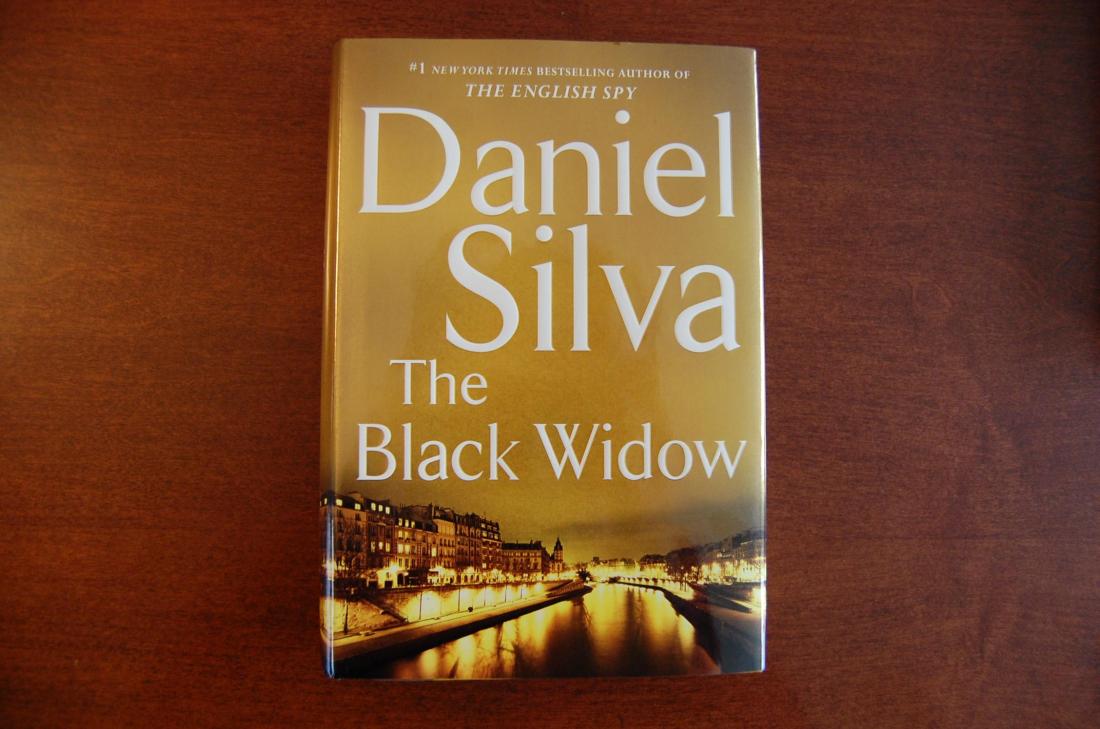
The Black Widow by Daniel Silva-Book

The Black Widow by Daniel Silva - Book

The Black Widow( Bk. #16) by Daniel Silva opens with the violent death of another venerable Jewish person intent on preventing a reoccurrence of the atrocities of Hitler’s Germany. Hannah Weinberg created the Isaac Weinberg center for the Study of Anti-Semitism in France (fictional) at the end of Silva’s novel, The Messenger  (Bk. #6 ) She also owns a (fictitious) van Gogh painting, Marguerite Gachet at Her Dressing Table, used to call attention to real events in French history – Jeudi Noir and the Paris Roundup of 1942.

Who is responsible for this bombing and assassination that kills Hannah and other prominent invitees to a conference at the center in Paris? Why are so many Jews leaving France to go to Israel in the midst of Palestinian rocket launches into Israel?

This particular book seemed to touch on issues that are not settled territory for me, perhaps because it brings us to a time that is more contemporary than previous books in the Allon series. For one thing I cannot help having some sympathy for Palestinians, although I think their militant approach to what they see as Israeli imperialism made it impossible to take a diplomatic stance that could have led to shared ownership and peace, instead of eliciting a corresponding violence in the Jewish people. Having just learned of the annihilation of 6 million Jews in Europe, the Jewish people found themselves homeless until they were granted a toehold in Israel, and the lesson they had learned, that they could not afford to trust any nation, had just been driven home so tragically. They were more than ready to defend their new nation.

The second part of this particular Gabriel Allon op was about Syria, and refugees, and ISIS, and the radicalization of Arabic people displaced by war (and others). ISIS appears to promise the vulnerable and dispossessed a new nation – a caliphate – a chance to restore pride and offer them a return to their homeland. (There is no place like home.) There is no instant fix to the whole issue of how Muslims and Christians can learn to live in closer proximity than we did before the Iraq war; it requires an investment of time and tolerance. I cannot help but feel sorrow for people who were forced to empty out their country because of Bashar al Assad’s unwillingness to be humane. But I also find myself fearful at the idea of a regimented caliphate that exhibits a violent missionary zeal. Fighting terrorism seems an appropriate action for nations to undertake.

Does it trivialize the rise of ISIS to put it at the center of a thriller. Perhaps a little. But it also allows readers who don’t pay much attention to news to get some insight into the genesis of ISIS, its history, its rationale, and its modus operandi. This time Gabriel turns a secretary/administrative assistant into The Black Widow who can join ISIS and perhaps track down the identity and location of Saladin, the illusive man directing recent terrorists activities in Europe and hoping to do so in America.

We know Gabriel does not have a problem using females in spy ops and we also know they often end up in great physical peril, as does Gabriel. How does his black widow fare? The issues I encountered with The Black Widowwere personal, so see what feelings this interesting thriller, full of all your favorite Silva characters, engenders in you. I did like the perspectives it gave on the war in Syria and the rise of ISIS.

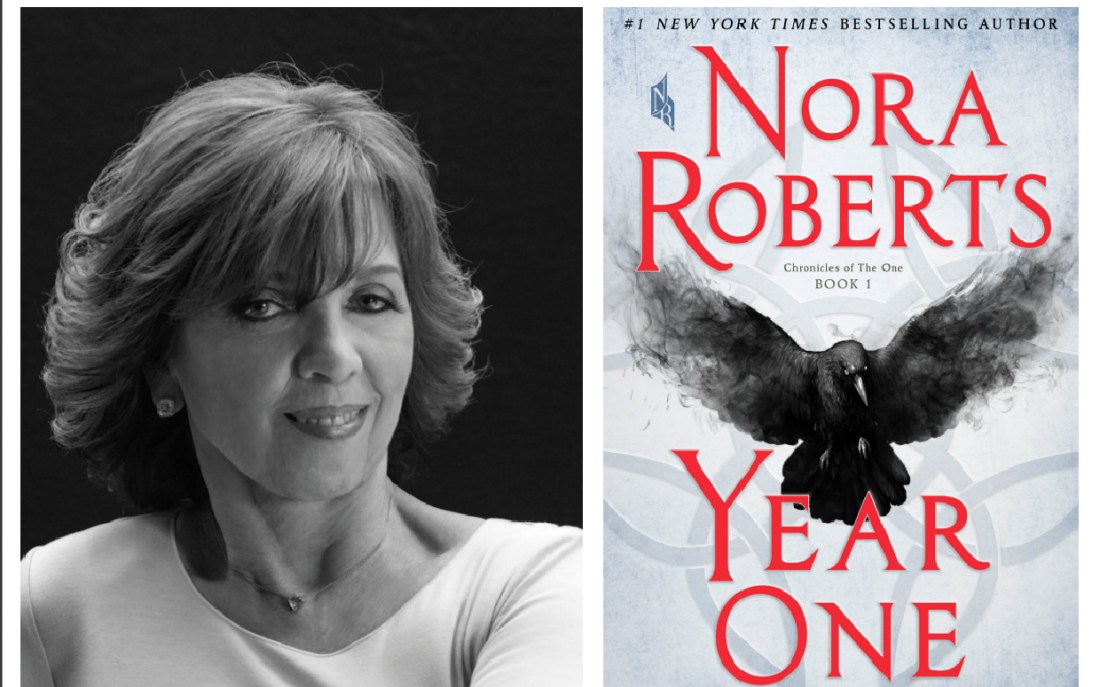
Year One by Nora Roberts – Book

nora-roberts-year-one-ftr

Nora Roberts, author of Year One usually writes romance novels. I do enjoy a good romance novel. It doesn’t necessarily give your brain a workout but it sends you on an emotional journey that often ends in a happy sigh and a temporary uplift in your spirts. Lately I forgo the brief jolt of endorphins offered by fake joy for books with a more mental punch. But I will say that I think even fake joy can make your day. This time Nora Roberts goes off the chart and gives us an apocalypse. Even if it still encompasses a good deal of romance, there is also suspense and grief and magic and black magic, and this is only the first book of a trilogy, The Chronicles of the One. One of my sisters passed this book on to me.

The story begins in Scotland where Ross MacLeod, who now resides in NYC, visits the family farm in Dumfries, Scotland which has been in the family for over two hundred years. Ross goes for a walk on his land and changes the world when he shoots a pheasant that lands in a magic circle and activates an old blood sacrifice he accidentally contributed to fifty years earlier, simply by tripping and scraping a hand on a stone that sits in that ancient stone circle on the property. Ross is a bit freaked by the circling of crows above the site but he is no believer in magic. When he gets very ill he thinks it is a flu virus. Then he dies. Soon this untreatable and incurable disease, named the Doom, begins to spread as rapidly as people move around the globe these days.

The grief people feel is enormous. Max and Lana, newly in love and experimenting with some talents they seem to possess which indicate they might be witches, do not sense the enormity of the escalating depopulation right away. For a moment they are a spot of joy in a city that is being devastated by disease and looting and violence. Lana is a chef, Max a writer. Arlys, a newscaster on a popular NYC stations has been promoted to the main news desk by default. She offers daily news to anyone who is still listening. Fred is an intern who works with Arlys and who has a secret which might help explain her effervescent personality. One day Arlys is given reasons to tell her listeners the real news, which is far more frightening than what she is used to offering. Rachel is a doctor, Jonah an EMT. They are trying to run a hospital with fewer and fewer staff, and patients they are unable to save.

When these New Yorkers finally accept that they must leave their beloved city and travel to more rural areas we see them depart in pairs to look for more people who have survived the Doom. Why some people survive while others do not is something that has no satisfactory answer. Some survivors have found that they now have magical talents. Fred’s secret is that she is a faerie with wings and a sprightly spirit that makes her quite lovable. Max and Lana find that they have become more talented witches than they ever were before. Some people find they are elves. And yet some people like Rachel and Arlys have no discernible magical talents and yet they survive.

Getting out of New York is not an easy thing for anyone. It turns out that magical people, like normal people can use their talents for good or for evil. Many survivors have turned to evil and can harm magical people who strive to be good if they catch them off guard or if their talents are unequal. There are also the usual gangs that thrive on chaos. Traveling is scary and dangerous and there is more safety in numbers. Eventually all these New Yorkers meet, not quite by accident in a new community that is taking shape in New Hope, Virginia.

There is social commentary here. The Uncanny, as the magical humans are named, become “the other” and are feared by intolerant humans who cannot accept people with magical talents as neighbors. They taunt them and troll them and make sharing a community uncomfortable and sometimes worse things happen when the intolerants do more than use their words.

As soon as the internet is partially restored this message is posted:  “If you are reading this, you are one of the chosen. No doubt you have lost those dear to you and have felt, many still know, despair. No doubt you have witnessed firsthand the abominations that have desecrated the world Our Lord created. You may believe the End Times are upon us. But take heart! You are not alone! Have faith! Have courage! We who survived this demonic plague wrought by Satan’s Children face a Great Test. Only we can defend our world, our lives our very souls. Arm yourselves and join The Holy Crusade.” – The Purity Warriors

The Purity Warriors pretend to save the world in the name of religion but they actually spread terror and violent rape and death, especially targeting the Uncanny. But Lana is carrying The One. Will she bear the child in safety to grow to her full powers? How will she change the sad equation in a ruined world? Good stuff for real, even if a bit too much sugar on occasion.

Photo Credit: From a Google Image Search – Parade

Find me on goodreads.com as Nancy Brisson

The Heist by Daniel Silva – Books

the Heist by Daniel Silva NewsOK

Daniel Silva’s 14th book featuring his reader’s favorite Israeli spy is The Heist. Gabriel Allon kills the people who do evil in the world (Europe and the Middle East for the most part). Gabriel is an unlikely hero, slight of build, not very tall, with a full head of dark hair graying at the temples. He has aged some through the years and is somewhere in his fifties but he has a new young wife, Chiara, who also works for “the Office”. Gabriel feels regret for the killing he does but he doesn’t let that govern him because these are villains exhibiting some serious anti-social behaviors.

Gabriel is an unusual spy because he is a great art restorer (who perhaps would have been a great artist except for his mentor, Ari Shamron). Shamron recruited him and he wants Allon to agree to become the head of Israeli Intelligence. Gabriel has resisted this role but has recently promised that he will do that when Uzi Navot’s term ends.

Art heists have become common in Europe. Security in museums is often fairly lax or spread a bit thin. Art thieves have many ways to trick museums, but one of the safest is to employ a great forger. Empty spaces tend to attract attention, but it often takes time to identify a really good forgery as a fake. One painting, missing for a long time, is a Caravaggio painting of a mother and child. Gabriel may be Jewish but he specializes in restoring Renaissance religious art. He hopes to find that Caravaggio, but the painting seems to have fallen into the hands of a dictator who gases his own people.

So, there is a Syrian connection in this story, and Silva provides an informative backstory of the origins of the regime of Bashar al Assad, which is now in Gabriel’s sights. Gabriel cannot assassinate Assad, but he can try to make some of his ill-gotten fortune turn up in other bank accounts. There is a woman involved who works for a Saudi man who hides Assad’s fortune in lots of places where banking secrets are seen as sacred, and where laws can’t reach, such as the Cayman Islands. Gabriel doesn’t let women off the hook as sources and allies in matters of conscience. He has only lost one of the women he enlisted to help so far, although she was already ill and dying. Does the woman he recruits this time live through this op?

Does Gabriel Allon get Assad’s money? Does he find the Caravaggio? Does Chiara lose the twins she is carrying? Fourteen books later, still good stuff.

Photo Credit: From a Google Image Search, NewOK