From a Google Image Search – McNally Jackson Books
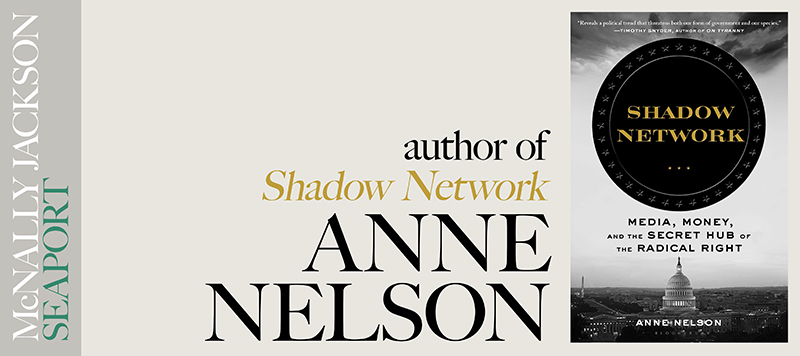
I was attracted to the book Shadow Network: Media, Money and the Secret Hub of the Radical Right by Anne Nelson because I already knew that Evangelicals (white evangelicals in particular) shared Republican ideology, and liked this ideology better as it got more extreme. What I did not know is that Evangelicals, also called Fundamentalists, were prime movers in turning Republican politics into a well-oiled voter turnout machine.
Anne Nelson is on the faculty at the Columbia School of International and Public Affairs. She acknowledges the help of colleagues and students in the end notes. Although I have written on these subjects many times Anne Nelson had access to resources I did not. Her work is important to me because it offers proof that my “cheap seats” interpretations of recent events in our government have merit. It would be more satisfying if the truths did not back up the facts that the church has been meddling in our federal government and that they grew from scratch into a very effective organization, using tools both legal and possibly illegal to get Republicans elected.
Southern Baptists were not leaving the church the way other Americans were. The advent of church on TV had given birth to the megachurch phenomenon. Pastors with large numbers of followers became almost religious rock stars. For decades there had been a strong church presence on the radio, especially across the South and Midwest. Stardom can go to your head, at least that seems to be what happened. At first churches met, “convocated,” held conventions, and church leaders talked about the moral decline which they linked to the decline in religious observance in many parts of America. They felt that religion would cure our moral “slippage.” They were angered that it was no longer legal to pray in school. They began to understand that their numbers and their media network gave them power to change the things they did not like about America. Their natural allies were the Republican Party, even more so with the advent of the Tea Party.
Evangelicals began to found a series of social organizations which were ostensibly formed to deal with aspects of America’s slippage, things like the disintegration of the nuclear family, abortion, contraception, the exclusion of religious teachings from school, the increasing concentration of power at the federal level when it could benefit the church’s ability to thrive if power was concentrated instead at the state level (small government).
Evangelicals came to see that if they could get Republican voters to the polls they could get everything they wanted because the Republican agenda matched the Evangelical wish list. They eventually went digital and collected data on a house-by-house basis in places that leaned right.
One problem with this (among many) is that these groups are classified as 501 c3 (nonprofits for religious reasons) and 501 c4 (nonprofits for social welfare reasons). These groups, in order to keep their tax exempt status, are not supposed to be partisan or participate in getting members of any particular party elected. These groups, in an incestuous relationship with the Republican Party and rich Republican donors like the Koch brothers and the DeVos family, were violating their tax exempt status, not to mention colluding to have an outsized effect on our national, state, and local politics. This story is essentially a political thriller, except its real.
Anne Nelson’s very interesting book may not be to everyone’s taste but should be read by anyone who believes that we should participate in our democracy/republic.
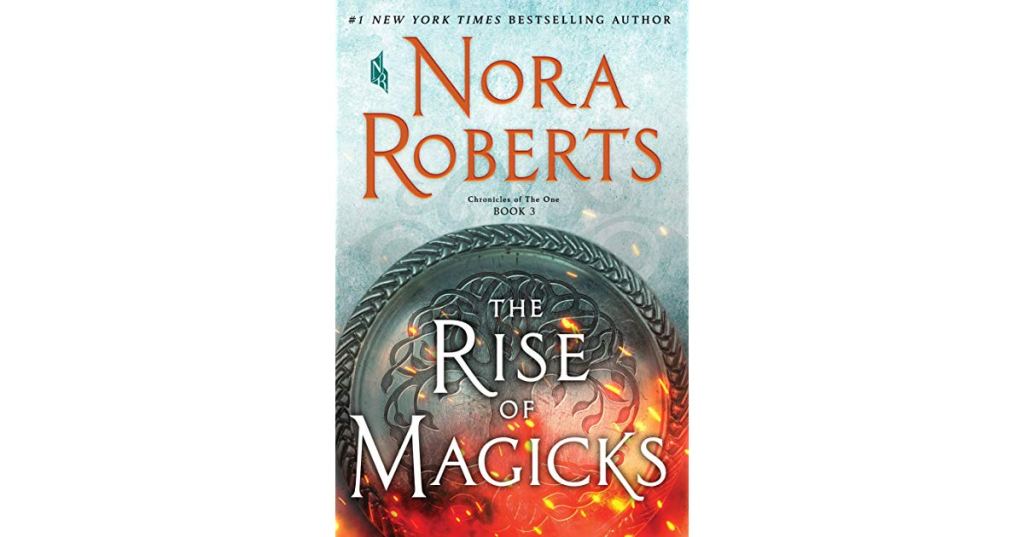
Although I found fault with the adolescent atmospherics in the second book in Nora Roberts most recent trilogy which began with Year One and continued with Of Blood and Bone, I decided that I enjoyed the first two books enough to want to read The Rise of Magicks, the last volume in the trilogy. (It could just be that, like Sheldon Cooper in The Big Bang Theory, I am unable to leave something unfinished.) I liked this last volume almost as much as I liked the first volume. Although I don’t believe in magic or even ‘magicks’, there was enough universal cultural commentary relevant to the times to keep me hooked. And I will confess that one of my guilty pleasures when it comes to reading was a love of the romance genre, especially the Regency romances of Barbara Cartland and Amanda Quick. I blame this on (or credit this to) my sister who loved these books so much. Although I rarely crave this particular genre these days, I’m guessing that particular endorphin pathway is still neurologically strong. Nora Roberts trilogy has enough romance to reengage those particular neurons and she does it with all the delicacy some of those Regency romances entailed.
When the seal that holds magick away from humans is broken in Scotland and both good and evil magic are loosed on the world they come in the form of a virus. Many die from this virus, millions, and the world is thrown into chaos. Some humans begin to learn that they have morphed into magical beings and some other humans, who have no magic are horrified by these magical humans and see them as abominations. They capture them and put them in containment centers where they devise experiments with various deviant purposes. So we have a culture that is dealing with the ‘others’, aliens, and it is not a proud moment in fictional human history, but which has some parallels in the real world.
Lana and Max, the first generation heroes, are witches who are being hunted by a group called the Purity Warriors, and by magical people who chose the dark side, the Dark Uncanny. They decide to halt their desperate escape at a small town which they, along with other first generation virus survivors, will turn into a community called New Hope. But this final book is the story of Lana and Max’s daughter, Fallon Swift, known far and wide as The One. And she is a refreshingly down-to-earth female heroine even though she is trained by her own Merlin and her path to power resembles the Arthurian legends (but this Arthur is a girl/woman). This final book in the trilogy, The Rise of Magicks is full of war and of love. This time Duncan and Fallon are grown-ups, no longer teens, and if you were frustrated that they each went their own way at the end of Book 2, then you will find it was worth the wait. While these are not the great American novel(s) they are an entertaining and addictive read delivered by a really talented, and very prolific, writer.
I decided not to put together a book list for December, although I may do that later when life slows down. But here are links to lists of the best books of 2019.
The Testaments by Margaret Atwood is the sequel to The Handmaid’s Tale, much anticipated (possibly demanded) by fans of the TV series based on Ms. Atwood’s book. By the end of The Handmaid’s Tale we know that there is a resistance movement. It is modeled on the real and desperate escape route for American slaves, the Underground Railroad. This time it is called the “Female Road” and the magic rescue word offered to handmaid’s, who are virtually sex slaves, is May Day. Offred escapes Gilead through this underground route. But what happens after she escapes? Does she die? Does she find a safe place and live out her days in peace? Does she join the resistance?
Margaret Atwood is able to use her words to build scenes from both the past and the future that are vivid and that come to life in our minds. She builds the entire nation of Gilead. She does it like one of those artists who can capture the essence of a person or a place with just a few deft strokes. We find we don’t need every little detail. Because her new nation is similar to things we already know our mind fills in the blanks. The same skill is at work as we follow the resistance movement inside and outside of Gilead, and as a very surprising character engineers the demise of Gilead.
Gilead has besides the handmaids; the Commanders, their wives, the Marthas, the Econowives, the Aunts, the Guardians, and the Eyes. The Aunts are modelled somewhat on nuns. They live regimented lives, ruled by prayers and bells, they are the teachers of handmaids and of the daughters of Commanders, they are the only women in Gilead allowed to keep books and to read and write. Big mistake. In this male-dominated world men believe that women are now powerless, completely reliant on men, and that even the powers of previously educated, professional women such as doctors, lawyers, and judges have been completely defused. In The Testaments we find Commander Judd and Aunt Lydia basically in a respectful/hostile power struggle. Aunt Lydia was a force in The Handmaid’s Tale, but in The Testaments we learn about her secret powers (no magic is involved, just intellect). We learn that what Commander Judd cannot imagine will eventually bring him down.
We also meet a young teen who is living with a couple of resistance fighters who she almost believes are her real parents. We meet the Pearl Girls, missionaries from Gilead who are also unwitting partners in the resistance. When Gilead uncovers “Nicole’s” parents and blows them up Nicole (Baby Nicole was stolen from Gilead) is hurriedly trained to infiltrate Gilead as a captive of the Pearl Girls. Watching her reactions as she is introduced to this repressed culture and watching the reactions of the others to her is part of that charming skill that Margaret Atwood brings to her writing. Atwood successfully, but not exhaustively, wraps up the tale of the handmaids and offers us a new hero, a woman, of course.
As it had been many years since I read The Handmaid’s Tale by Margaret Atwood, I wanted to read it again before I read her new sequel, The Testaments. The Handmaid’s Tale was written in times when women’s reproductive rights were a hot topic, although not at the height of the women’s consciousness movement. The birth control pill was greeted by women with relief and sighs for the freedom it gave women to avoid unwanted pregnancies. It also seemed to offer women the same sexual freedom that men exercised, although that freedom proved to be somewhat more illusory than women thought for a number of reasons, some having to do with the fact that we still live in a male-dominated society, some having to do with sexually transmitted diseases, and some having to do with social disapproval and the need to maintain a “good” reputation. The pill was greeted very differently by the church, especially the Catholic Church and the Pope. In 1973 the Supreme Court allowed for legal abortions in the United States in the now famous/infamous Roe v Wade decision and the reactions of women and the church were pretty much a repeat of the reactions to the birth control pill. I know – all this history – what a way to make a really good story really boring. The actual history is important, however, to any deep understanding of this very original tale. These women’s rights were always controversial although The Handmaid’s Tale was written in 1985, when these new rights for women were less startling.
I like science fiction and The Handmaid’s Tale is, in a way science fiction and it is certainly dystopian. It predicts a time in near-future America when men of religious faith decide that the new freedoms for women are not what God intended. Women are not meant to be equal to men. They are meant to be wives and mothers and submissive to their husbands. These men stage a revolution against the United States of America. They manage to kill the president, scatter Congress and nullify the US Constitution. They win enough territory in the middle of America and most southern states, except Maine, California, Florida and Texas, to form a new nation, the nation of Gilead.
Offred is a handmaid in the new nation of Gilead. She used to be a free American woman who was having an affair with Luke, a married man, who later divorced his first wife and married her (I tried to find her original name but did not find it). They had two children. Venereal disease and a viral weapon against mumps had rendered many men sterile and women often had problems conceiving or delivering healthy offspring. Population was declining. Women who had borne healthy babies were very desirable to the new nation of Gilead. They would suspend women’s ID cards and credit cards and make them unemployable and then they would kidnap them and reeducate them to be Handmaids in Gilead. It is not easy to turn a woman who has experienced freedom into what is basically a sex slave in a distinctive red habit hemmed in by about a million rules and almost as many Eyes (spies). Offred is not a happy camper.
Of course you may have watched the TV series which I have not seen yet, but you really ought to read the book. It’s a classic. Choosing a name that would have fit right into Chaucer’s Canterbury Tales was not an accident. Here we are, almost 50 years after the Supreme Court made it legal to have an abortion, woman’s choice, and we still find concerted efforts, trickier but less militant, to overturn women’s rights to make important decisions about their own reproduction. We find many states passing laws that force clinics to comply with regulations that large hospitals can barely afford to comply with and when the clinics cannot meet the new requirements the clinics must close (TRAP laws), We find Evangelical churches that argue that even contraception is against God’s law. Federal courts are being stuffed with Conservative judges using as bait the overturning of Roe v Wade, and now marriage freedom. The Handmaid’s Tale by Margaret Atwood has never been more relevant.
I have a recurring dream. I am escorted to a well-appointed studio apartment with all the new books for the month piled on every available surface. I am given a key, a valet robot who can cook and clean, and an AI virtual presence to handle my business and social interactions. I can read as long as I like but I can’t take any books out of the apartment and if I leave I can’t come back in. Am I obsessed? Actually this is a dream that could turn into a nightmare. However if you could take books out into the world with you and if you could come and go as you please, it might just be perfect.
Amazon
Literature and Fiction
The Starless Sea by Erin Morgenstern F*
This is Pleasure: A Story by Mary Gaitskill F
On Swift Horses: A Novel by Shannon Pufahl F
Girl, Woman, other: A Novel by Berndine Evaristo F*
The Innocents: A Novel by Michael Crummay F
Find Me: A Novel by André Aciman F
The Revisioners: A Novel by Margaret Wilkerson Sexton F
The Confession Club: A Novel (Mason) by Elizabeth Berg F*
Nothing to See Here by Kevin Wilson F*
Mary Toft: or The Rabbit Queen: A Novel by Dexter Pullman F*
Mysteries and Thrillers
The Lost Causes of Beale Creek: A Novel by Rhett McLaughlin, Link Neal
Broken Glass (A Nik Pohl Thriller) by Alexander Hartung and Fiona Beaton
A Christmas Gathering by Anne Perry
Nothing More Dangerous by Allen Eskens
The Family Upstairs: A Novel by Lisa Jewell
Kiss the Girls and Make Them Cry: A Novel by Mary Higgins Clark
The Siberian Dilemma 9 (The Arkady Renko Novels) by Martin Cruz Smith
An Equal Justice (David Adams) by Chad Zunker
A Minute to Midnight by David Baldacci
36 Righteous Men by Steven Pressfield
Nonfiction
Vicksburg: Grant’s Campaign that Broke the Confederacy by Donald L Miller
Valley Forge by Bob Drury and Tom Clavin
Acid for the Children: A Memoir by Flea, Patti Smith *
When the Earth Had Two Moons: Cannibal Planets, Icy Giants, Dirty Comets, Dreadful Orbits, and the Origins of the Night Sky by Erik Asphang
Our Wild Calling: How Connecting with Animals can Transform our Lives and Save Theirs by Richard Louv
The Beautiful Ones by Prince
Hymns of the Republic: The Story of the Final Years of the American Civil War by S. C. Gwynne
Checkpoint Charlie: The Cold War, the Berlin Wall and the Most Dangerous Place on Earth by Iain McGregor *
Canyon Dreams: A Basketball Season on the Navajo Nation by Michael Powell
The Great Pretender – The Undercover Mission that Changed our Understanding of Madness by Susannah Cahalan *
The Witches Are Coming by Lindy West
User Unfriendly: How the Hidden Rules of Design are Changing the Way We Live, Work and Play by Cliff Kuang with Robert Fabricant
Why Are We Yelling: The Art of Productive Disagreement by Buster Benson
Don’t Be Evil: How Big Tech Betrayed its Founding Principles – and all of us by Rana Foroohar
Volume Central: Hearing in a Deafening World by David Owen.
Science Fiction and Fantasy
The Deep by Rivers Solomon and Daveed Diggs
The Pursuit of William Abbey by Claire North
Call Down the Hawk (The Dreamer Trilogy, Bk. 1 by Maggie Stiefvater
Star Wars – Resistance Reborn: The Rise of Skywalker by Rebecca Roanhorse
Made Things by Adrian Tchaikovsky
Fate of the Fallen (Shroud of Prophecy) by Kel Kade
New York Times Book Update
Oct. 4 th
The Topeka School by Ben Lerner F
Sarah Jane by James Sallis – Crime
Bloody Genius by John Sanford – Crime
Gallows Court by Martin Edwards – Crime
The Bird Boys by Lisa Sandlin – Crime
Cantoras by Carolina De Robertis F
Akin by Emma Donoghue *
Growing Things by Paul Tremblay – Short stories – Horror
The Cabin at the End of the Lane by Paul Tremblay – Horror
Sealed by Naomi Booth – Horror
Nonfiction
Talking to Strangers by Malcolm Gladwell
A State at Any Cost: The Life of David Ben-Gurion by Tom Segev
What was Liberalism? The Past, Present, and Promise of a Noble Idea by James Traub
The Stakes – 2020 and the Survival of American Democracy by Robert Kuttner
The Accusation by Edward Berenson
Scarred by Sarah Edmondson – Nxivm
Super Pumped by Mike Isaac (Uber)
The Anarchy by William Dalrymple
Oct. 11 th
Fiction
The Shadow King by Namwali Serpell
The Sweetest Fruits by Moneque Truong
A Pure Heart by Rajia Hassib
The World that We Knew by Alice Hoffman
A Man in Love by Martin Walser (Göethe)
The Shortlist – Love and War in European Fiction
Country by Michael Hughes
Will and Testament by Vigdis Hjorth
The Girl at the Door by Veronica Raimo
Nonfiction
Transaction Man by Nicholas Lemann
Know My Name by Chanel Miller
The Second Founding by Eric Foner
Beaten Down, Worked Up by Steven Greenhouse
Homesick by Jennifer Croft (Memoir)
Fashionopolis by Dana Thomas
We are the Weather by Jonathan Safran Foer
Syria Secret Library by Mike Thompson
A Polar Affair by Lloyd Spencer Davis (promiscuous penguins)
New York Times does Halloween but I don’t.
Nov. 1 st
The Old Success by Martha Grimes – Crime
Death in Focus by Anne Perry – Crime
Elevator Pitch by Linwood Barclay – Crime
The Quaker by Liam McIlvanney – Crime
Grand Union by Zadie Smith – Short Stories
The World Doesn’t Require You by Rion Amilcar Scott
Fiction
Olive Again by Elizabeth Strout
Girl by Edna O’Brien
Call Upon the Water by Stella Tillyard
Lampedusa by Steven Price
Nonfiction
Edison by Edmund Morris – Bio.
To Build a Better World by Condoleezza Rice and Philip Zelikow
Sontag by Benjamin Moser – Bio.
Who is an Evangelical? by Thomas S. Kidd
The Immoral Majesty by Ben Howe
The Problem with Everything by Meghan Daum
The Economist’s Hour by Binyamin Appelbaum
The Marginal Revolutionaries by Janek Wasserman
The Shortlist – 3 Memoirs by Famous Women
Inside Out by Demi Moore
Home Work: A Memoir of My Hollywood Years by Julie Andrews with Emma Walton Hamilton
Touched by the Sun: My Friendship with Jackie by Carly Simon
Publisher’s Weekly
Oct. 7 th
Salt Show by Julia Armfield
Ninth House by Leigh Bardugo
Ordinary Hazards: A Memoir by Nikki Grimes
Older Brother by Mahir Guven, trans. from French by Tina Kover Europa
American Radicals: How Nineteenth Century Protest Shaped the Nation by Holly Jackson
How We Fight For Our Lives: A Memoir by Saeed Jones
Passing: A Memoir of Love and Death by Michael Korda
Anti-Social: Online Extremists, Techno-Utopians, and the Hijacking of the American Conversation by Andrew Marantz
Tuesday Mooney Talks to Ghosts by Kate Racculia
Cosmosknights: Book One by Hannah Templer
Commute: An Illustrated Memoir of Female Shame by Erin Williams
Oct. 14
Celestial Bodies by Jokha Alharthi trans. from Arabic by Marilyn Booth (Oman) F
Wild Game: My Mother, Her Lover, and Me by Adrienne Brodeur
The Body: A Guide for Occupants by Bill Bryson NF
Your House Will Pay by Steph Cha F – based on true case
Life Undercover: Coming of Age in the CIA by Amaryllis Fox Memoir
Music: A Subversive History by Ted Gioia History
One Hundred Autobiographies: A Memoir by David Lehman Memoir
The Adventure of the Peculiar Protocols: Adapted from the Journals of John H. Watson, MD by Nicholas Meyer F
The First Cell: And the Human Cost of Pursuing Cancer to the Last by Azra Razer NF
Salvaged by Madeleine Roux Science Fiction Thriller
It Would Be Night in Caracas by Karina Sainz Borgo trans. from Spanish by Elizabeth Bryer (Caracas, Venezuela) F
Olive Again by Elizabeth Strout
Oct. 21
All This Could Be Yours by Jami Attenberg F *
The Peanut Papers: Writers and Cartoonists on Charlie Brown, Snoopy and the Gang, and the Meaning of Life – Edited by Andrew Blauner (Essays, Poems, Cartoons) (Valentines to Charles M. Schultz)
The Night Fire by Michael Connelly F
The Deserter by Nelson DeMille and Alex DeMille Thriller *
Initiated: Memory of a Witch by Amanda Yates Memoir
Janis: Her Life and Music by Holly George-Warren Biography *
The Family Upstairs by Lisa Jewell Thriller
Edison by Edmund Morris Biography
The Promise by Silvina Ocampo trans. from Spanish by Suzanne Jill Levine and Jessica Powell F
The Fragility of Bodies by Sergio Olguin, trans. from Spanish by Miranda France, Bitter Lemon Crime
The Fountains of Silence by Ruta Sepetys (Franco, Madrid) F
Famous in Cedarville by Erica Wright F
Oct. 28
Blue Moon: A Jack Reacher Novel by Lee Child F
The Lives of Lucien Freud: The Restless Years, 1922-1968 by William Feaver Biography
Overview: A New Perspective of Earth by Benjamin Grant Photos
Blood: A Memoir by Allison Moorer Memoir
Shadow Network: Media, Money and the Secret Hub of the Radical Right by Anne Nelson NF*
The Factory by Hiroko Oyamada, trans from Japanese by David Boyd F
The In-Betweens: The Spiritualists, Mediums, and Legends of Camp Etna by Mira Ptacin NF
Nothing to See Here by Kevin Wilson (humor) F
Nov. 4
The Movie Musical! by Jeanine Bassinger NF
The History of Philosophy by A. C. Grayling NF
Get a Life, Chloe Brown by Talia Hibbert (“a contemporary page-turning winner”) F
In the Dream House: A Memoir by Carmen Mava Machado (same sex domestic abuse) Memoir
The Starless Sea by Erin Morgenstern F
The Book of Lost Saints by Daniel Jose Older F
The Arab of the Future 4: A Childhood in the Middle East, 1987-1992 by Riad Sattouf, trans. from Frenchy by Sam Taylor Autobiography *
The Siberian Dilemma by Martin Cruz Smith (Arkady Renko #9) by Thriller
Love Unknown: The Life and Worlds of Elizabeth Bishop by Thomas Travisano Biography and Literary Study
The Dutch House by Ann Patchett is a study of a family, an American family. It is a story told by the second child, a boy named Danny. It’s a story about a clueless father and husband who buys his wife a house, a famous house, built with much attention to detail by a wealthy family, the VanHoebeeks,. The ceiling in the dining room is a work of art, literally. The house has a ballroom and a conservatory. Since the sale was an estate sale, all the VanHoebeek’s belongings are still in the house, including portraits of husband and wife over the mantle in the drawing room. Despite all the architectural glories the house has a very small kitchen because the staff would use it, not the family. There is also a pool.
Into this ritzy house Cyril Conroy brings his wife. He bought the house for her as a surprise. At the time they had one child, their daughter Maeve. The house was a source of pride for the husband who was a real estate investor and property manager. But his wife, was appalled by the expensive details. She yearned to dedicate her life to helping the poor. Clive found Elna just as she was preparing to enter a convent, not yet a nun. He whisked her away and married her. We often see our partners in life through cloudy mirrors. We make assumptions that if they love us they must be like us. The Dutch House is a story about misplaced love and misunderstood love. Maeve shoulders all the responsibilities of these selfish parents when the family falls apart. Some people should never have children. She yearns for what they lost, the family and the house and the hired women who took care of them, Fluffy, Sandy, and Jocelyn. Maeve is obsessed and cannot move on with her own life.
Although this is a story of a family, and of loss and reunion, even more it is a story of a house. If you have ever given a home and your heart to cats you know that some cats fall in love with people, but some cats fall in love with houses. How do Maeve and her brother lose The Dutch House and then get it back? Although nothing earthshaking happens, there are plenty of repercussions. What stories are more interesting than stories about families? Take your pick, but I will usually enjoy a good family saga by any writer as skilled as Ann Patchett. This book will probably be made into a movie, but doesn’t even have to be made into a movie because it already creates one in your mind.
For me, it’s official, Mr. Coates can write. In The Water Dancer, Ta-Nehisi Coates proves he can write fiction that is just as deep and accessible as his nonfiction. In The Water Dancer he writes about slavery (which he calls the Task) and abolitionists and the Underground, a subject that has had some good authorial attention in recent years. But, although the movement is present in the story, for Coates it is the people affected by slavery, the families torn apart, the histories lost, that matter. It is the inspirational struggles to create new family ties and to hold on to traditions, even if they had to be formed anew in a strange and terrible land.
Virginia is the state where the Lockless plantation tries to maintain an idle lifestyle, maintain a genteel veneer which rests on the shoulders of those who are tasked to do anything that might even vaguely be considered work. Every white person even has a personal maid or valet, a slave, who bathes them, grooms them, and dresses them.
These white plantation owners were supposed to be farmers but they were so greedy and so tied to the payouts from their tobacco crops that they refused to believe that the crops they depended on were depleting the land they were planted in. Some of those who “tasked” on the land understood what was happening but either no one listened or, as the land produced less income, those who understood the land and the crops were sold away south and west – to Natchez and beyond. Slaves really were sold away to Natchez but Coates also uses Natchez as a symbol for family separation, for sorrow, for harsher conditions, for loss.
Plantation owners, slave owners, sold off the most valuable “taskers” first so the family members who remained were left without the strongest among them, perhaps the most characterful, and the older slaves who kept the stories of celebrations and family ties alive. Sorrow that is never given time to abate collects and turns “the task” into a sadder, even more burdensome duty to preserve a failing white lifestyle even as the “taskers” see the community of their own, that they have been able to create in their captivity, disintegrate daily into grief and tearful good-byes.
Hiram Walker is a mixed-race son of Howell Walker, who also has a son by his white wife. Hiram who finds a home on the Street where the “tasked” live, a home with Thena, a women he is not related to, is a child with an excellent memory. He remembers every detail of what he sees and hears. But he cannot remember his mama. He knows her name is Rose. He knows she was a water dancer. He has seen her dancing in a vision on a bridge. A water dancer can dance joyfully and gracefully with an earthenware jar full of water on her head and not spill a drop. He knows his mother was a beauty, and he knows she had a sister, Emma – also a water dancer – because his “adopted” people have told him so. But where his own memories of his mother should be there is a hole.
Hiram also has a special talent. He can conduct himself across distances without being seen. In a land where no slave can walk off the land of his/her “master” without a pass, and where running away can be punished by near death (slaves are valuable property and so are rarely killed outright), someone who can “conduct” himself unseen has a very great gift indeed. But Hiram cannot control his talent and this is somehow related to what he does not remember about his mother. His love for another Lockless slave, Sophia, has grown over the years and it allows him to also accept and love her mixed-race child. Hiram needs to learn how to control his talent so that he can take the two women he loves and the child to freedom in the North.
Whether or not Hiram learns to control “conduction” and how he uses it is at the heart of this story but for me toil and survival, family and heritage; anger and sorrow and the mistaken idea that one person can “own” another – these things are the true heart and soul of this story. Conduction is part of an almost-lost origin story which never died even though the people the story belonged to were kidnapped, abused and held without freedom (in a land that supposedly treasured freedom).
I happen to be reading the Frederick Douglass biography by David Blight at the same time as I am reading Coates’ novel. These two book pair very well and one book seems to riff on the other. If white folks ever hope to understand not just why slavery was wrong but how the repercussions of this aberrant human behavior will echo forever in the souls and families of our fellow Americans of African Descent then The Water Dancer by Ta-Nehisi Coates should add depth to your quest for understanding. I cannot speak to how black and brown people experience Coates’ novel but I hope to get exposure to some of their reactions.
Here’s my October 2019 Book List compiled from the Amazon front page for books, NYT Books, and Publisher’s Weekly Tip Sheet. Fiction and political nonfiction are probably the winning categories on this list with the most contenders for our attention. If you like crime books NYT always gives good crime. And there are plenty of thrillers. I imagine myself sitting in a chair surrounded by stacks of books. As soon as I am done with one the next one is close at hand. Of course the needs of the human body must still be met but I do so reluctantly and wish for a robot to at least bring me foodstuffs to graze on. Hint: Don’t give in to a fantasy like this. Our bodies deteriorate if we sit all the time. You still need fresh air and walks in the park. This is what books read aloud for our listening pleasure are for.
Amazon
Literature and Fiction
All This Could Be Yours by Jami Attenberg *
The Man Who Saw Everything by Deborah Levy *
Frankissstein by Jeanette Winterson *
The Topeka School: A Novel by Ben Lerner *
Cilka’s Journey: A Novel by Heather Moss *
Sarah Jane by James Sallis *
Olive Again: A Novel by Elizabeth Strout
Metropolitan Stories by Christine Coulson *
Divide Me By Zero by Lara Vapnyer *
Mysteries and Thrillers
The Guardians: A Novel by John Grisham
Empire of Lies by Raymond Khoury
The Deserter: A Novel by Nelson DeMille
The Night Fire by Michael Connelly
The Butterfly Girl: A Novel by Rene Denfeld
Agent Running in the Field: A Novel by John le Carré
Ninth House by Leigh Burdugo
Blue Moon: A Jack Reacher Novel by Lee Child
Sarah Jane by James Sallis
Nonfiction
The Body: A Guide for Occupants by Bill Bryson
Dreams of El Dorado: A History of the American West by H. W. Brands
Catch and Kill: Lies, Spies, and a Conspiracy to Protect Predators by Ronan Farrow
The Infinite Game by Simon Sinek
The End is Always Near: Apocalyptic Moments, from Bronze Age Collapse to Nuclear Near Misses by Dan Carlin
Civilized to Death: The Price of Progress by Christopher Ryan *
On the Plain of Snakes: A Mexican Journey by Paul Theroux
Movies and Other Things by Shea Serrano, Arturo Torres
Letters from an Astrophysicist by Neil deGrasse Tyson
Running with Sherman: The Donkey with the Heart of a Hero by Christopher McDougall
Biographies and Memoirs
How We Fight for Our Lives: A Memoir by Saeed Jones
Face It by Debbie Harry
Horror Stories: A Memoir by Liz Mair
Wild Game: My Mother, Her Lover and Me by Adrienne Brodeur *
Homework: A Memoir of My Hollywood Years by Julie Andrews and Emma Walton Hamilton
Me: Elton John: Official Autobiography by Elton John
Life Undercover: Coming of Age in the CIA by Amaryllis Fox
I Will Never See the World Again: The Memoir of an Imprisoned Writer by Ahmet Altan
Edison by Edmund Morris
Beautiful on the Outside: A Memoir by Adam Rippon
Things We Didn’t Talk About When I was a Girl by Jeannie Vanasco
Unfollow: A Memoir of Loving and Leaving the Westboro Baptist Church by Megan Phelps-Roper *
Science Fiction and Fantasy
Supernova Era by Cixin Liu, Joel Martinsen
The Girl With No Face: The Daoshi Chronicles by M. H. Boroson
Ormeshadow by Priya Sharma
The Grace Year by Kim Liggett
Salvaged by Madeline Roux
The Library of the Unwritten by A. J. Hackwith
Steel Craw Saga by Paul Keueger
The Future of Another Timeline by Annalee Newitz
How Rory Thorne Destroyed the Multiverse – Book One of the Thorne Chronicles by K. Eason
New York Times Book
Sept. 6
Quichotte by Salman Rushdie F – see my review on goodreads.com
Overthrow by Caleb Crain F
The Memory Police by Yoko Ogawa F
If You Want to Make God Laugh by Bianca Marais F
The Warlow Experiment by Alix Nathan F
Travel Light, Move Fast by Alexandra Fuller Memoir
The Optimist’s Telescope by Bina Venkataraman NF
Audience of One by Gene Shteyngart NF
Learning from the Germans by Susan Neiman NF
Floating Coast by Bathsheba Demuth NF
Silver, Sword, and Stone by Marie Arana NF
First You Write a Sentence by Joe Moran NF
Karl Marx: Prophet of the Present by Shlomo Avineri Biography
Year of the Monkey by Patti Smith Memoir
4 Books about CIA
Black Site: The CIA in Post-9/ll World by Philip Mudd NF
The Targeter: My Life in the CIA, Hunting Terrorists and Challenging the White House by Nada Bakos with David Coburn NF
The Moscow Rules: The Secret CIA Tactics that Helped America Win the Cold War by Antonio J. Mendez and Jonna Mendez with Matt Baglio NF
Surprise, Kill, Vanish: The Secret History of CIA Paramilitary, Armies, Operators, and Assassins by Annie Jacobsen NF
All the Powers of Earth: The Political Life of Abraham Lincoln, Vol. 3 by Sidney Blumenthal NF
The Nature of Life and Death: Every Body Leaves a Trace by Patricia Wiltshire Autobiography
Our Dog: Ourselves: The Story of a Singular Bond by Alexandra Horowitz NF
Defending Israel: The Story of My Relationship with My Most Challenging Client by Alan M Dershowitz NF
Editor’s Choice
Human Relationships and Other Difficulties: Essays by Mary-Kay Wilmers Essays
Faber and Faber: The Untold Story by Tony Faber NF
The Grammarians by Cathleen Schine F
Drive Your Plow Over the Bones of the Dead by Olga Tokarczuk F
Reasons to be Cheerful by Nina Stibbe F
The Lie: A Memoir of Two Marriages, Catfishing and Coming Out by William Dameron NF
And How Are You. Dr. Sacks? A Biographical Memoir of Oliver Sacks by Lawrence Weschler Biographical Memoir
Buzz, Sting, Bite: Why We Need Insects by Ann Sverchup-Thygerson, trans. by Lucy Moffatt NF
Sept. 13
The Institute by Stephen King
Crime (4)
Heaven My Home by Attica Locke F
What Rose Forgot by Nevada Barr F
Missing Person by Sarah Lotz F
Three Hours by Anders Roslund and Gorge Hellstrom, trans. by Elizabeth Clark Wessel F
We the Survivors by Tash Aw F
Ducks, Newburyport by Lucy Ellman F
The Outlaw Ocean by Ian Urbina NF
Inconspicuous Consumption by Tatiana Schlossberg NF
The Many Lives of Michael Bloomberg by Eleanor Randolph NF
Savage Appetites by Rachel Monroe NF
Love Falls on Us by Robbie Cory-Boulet NF
A Good Provider is One Who Leaves by Jason De Parle NF
Maoism: A Global History by Julia Lovell NF *
New Dystopian Novels
The Diver’s Game by Jesse Ball F *
The Warehouse by Rob Hart F *
The Nobody People by Bob Proehl *
Sept. 20
The Testaments by Margaret Atwood F *
Dominicana by Angie Cruz F *
A Door in the Earth by Alice Waldman F
Hard Mouth by Amanda Goldblatt F
Coventry by Rachel Cusk Essays
She Said by Jodi Kantor and Megan Twohey NF
The Education of Brett Kavanaugh by Robin Pogrebin and Kate Kelly NF
Gender and Our Brains by Gina Rippon NF
See Jane Win by Caitlin Moscatello NF
Nobody’s Victim by Carrie Goldberg NF
Consent by Donna Freitas NF
YA Crossover
Who Put This Song On? By Morgan Parker
Juliet Takes a Breath by Gabby Rivera
American Royals by Katharine McGee
The Beautiful by Renée Ahdieh
Sept. 27
The Dutch House by Ann Patchett F
Red at the Bone by Jacqueline Woodson F
Now We Shall Be Entirely Free by Andrew Miller F
Night Boat to Tangier by Kevin Barry F
Cold Storage by David Koepp F
Bottle Grove by Daniel Handler F
How to Be An Antiracist by Ibhram X Kendi NF
The Education of an Idealist by Samantha Power NF
How the Other Half Learns by Robert Rondiscio NF
The Years that Matter Most by Paul Tough NF
The Geography of Risk by Gilbert Gaul NF
How to Fight Anti-Semitism by Bari Weiss NF
On Fire: The (Burning) Case for a Green New Deal by Naomi Klein NF
The Green New Deal: Why Fossil Fuel Civilization Will Collapse by 2028, and the Bold Economic Plan to Save Life On Earth by Jeremy Rifkin NF *
Oct. 4
The Topeka School by Ben Lerner F
How to Fight Anti-Semitism by Bari Weiss NF
Crime (4)
Sarah Jane by James Sallis
Bloody Genius by John Sanford
Gallows Court by Martin Edwards
The Bird Boys by Lisa Sandlin
Cantoras by Carolina DeRobertis F
Akin by Emma Donoghue F *
Talking to Strangers by Malcolm Gladwell NF
A State at Any Cost: The Life David Ben-Gurion by Tom Seger NF
What was Liberalism? The Past, Present and Promise of a Noble Idea by James Traub NF *
The Stakes: 2020 and the Survival of American Democracy by Robert Kuttner NF *
The Accusation by Edward Berenson NF
Scarred by Sarah Edmondson NF
Super Pumped by Mike Isaac NF
The Anarchy by William Dalrymple NF
Publisher’s Weekly
Sept. 6
Clear My Name by Paula Daly – Thriller
Animalia by Jean-Baptiste Del Amo, trans. from French by Frank Wynne – F
Ducks, Newburyport by Lucy Ellman “challenging but undoubtably brilliant”, 750 Pages, Short-listed for Man Booker Prize F *
The Institute by Stephen King F *
Transaction Man: The Rise of the Deal and the Decline of the American Dream by Nicholas Lemann NF *
Don’t Forget About Me by Mhairi McFarlane – rom com
Guest House for Young Widows: The Women of ISIS by Asadeh Moaveni NF *
Tinfoil Butterfly by Rachel Eve Moulton (horror) F *
A Season on Earth by Gerald Mumane F *
A Song for a New Day by Sarah Pinsker F *
The Education of an Idealist: A Memoir by Samantha Power NF
Ruby and Roland by Faith Sullivan F *
Sept. 13
A Little Hatred by Joe Abercrombie – Thriller
Gamechanger by C. X. Beckett – Science Fiction
The Undying: A Meditation on Modern Illness by Anne Boyer – Memoir
Opioid Indiana by Brian Allen Carr F
Gallows Court by Martin Edwards – Mystery
Think Black: A Memoir by Clyde W. Ford – NF *
The Paris Orphan by Natasha Lester (based on a real story) F *
Heaven, My Home by Attica Locke (Aryan Brotherhood storyline) – Mystery
Wildhood: The Epic Journey from Adolescence to Adulthood in Humans and Other Animals by Barbara Natterson Horowitz and Kathryn Bowers
The Secrets We Kept by Lara Prscott (Women in the CIA) – F *
Pittsburgh by Frank Santoro – Memoir
Snowflake, AZ by Marcus Sedgwick – YA 14+
Imagined Life: A Speculative Journey Among the Exoplanets in Search of Intelligent Aliens, Ice Creatures, and Super Gravity Animals by James Trefil and Michael Summers NF
Red at the Bone by Jacqueline Woodson “this is a wise, powerful, and compassionate novel” F *
Sept. 20
Mycroft and Sherlock: The Empty Birdcage by Kareem Abdul-Jabbar and Anna Waterhouse F
The Water Dancer by Ta-Nehisi Coates (currently reading) F *
Baron Wenckheim’s Homecoming by Lászió Krasznahorkai, trans. from Hungarian by Ottilie Mulzet F *
The Shadow King by Manza Mengiste (“a slice of Ethiopian history”) F
The Future of Another Timeline by Annalee Newitz Science Fiction
The Dutch House by Ann Patchett F
The Fool and Other Moral Tales by Ann Serre, trans. from French by Mark Hutchinson – Short stories
Exile from Eden by Andrew Smith – Dystopian F – YA
Year of the Monkey by Patti Smith – Memoir
Rusty Brown, Part 1 by Chris Ware – Graphic Novel
Sept. 30
I Will Never See the World Again: The Memoir of an Imprisoned Writer by Ahamet Altan, trans. from Turkish by Yasemin Congar NF
A Tall History of Sugar by Curdella Forbes (Jamaica) F
The Shape of Night by Tees Gerritsen – Thriller
The Library of the Unwritten by A. J. Hackwith – Fantasy
Qualifications: A Graphic Memoir in Twelve Steps by David Heatley (addicted to rehab) Memoir
Dry Country by Jake Hinkson F
Whisper of Shadow and Flame by L. Penelope – Fantasy
Sarah Jane by James Sallis F
Frankissstein by Jeanetter Winterson F *
Oct. 6
Salt Slow by Julia Armfield – Short stories
Ninth House by Leigh Burdugo – Fantasy
Ordinary Hazards: A Memoir by Nikki Grimes – Memoir in verse
Older Brother by Mahir Guven, trans. from French by Tina Kover F
American Radicals: How Nineteenth Century Protest Shaped the Nation by Holly Jackson NF *
Fake Bingo by Jac Jemc – Short Stories
How We Fight For Our Lives: A Memoir by Saeed Jones – Memoir
Passing: A Memoir of Love and Death by Michael Korda (wife with brain cancer) NF *
Anti-Social: Online Extremists, Techno Utopians, and the Hijacking of the American Conversation by Andrew Marantz NF *
Tuesday Mooney Talks to Ghosts by Kate Racculia F *
Grand Union by Zadie Smith – Short stories
Commute: An Illustrated Memoir of Female Shame by Erin Williams – Memoir
Quichotte, Salman Rushdie’s most recent book is chock full of India-Indian Americans who seem as at home and doomed, with lives as empty as any American whose family has lived here for decades, or even centuries. Why are we here, not in America, but on this planet? Why are we intent on destroying the planet that is our home? What do we want? What does it all mean? We seem, in Rushdie’s tale as aimless as five dice in a Yahtzee cup.
Thematically Rushdie covers a lot of territory. Immigration or at least transplantation is in there, as are journeys, tilting at windmills, nostalgia, despair, guilt, hate, love, forgiveness, human failings, cultural failings, Planet B, apocalypse, dystopia and more, sort of an I Ching of modern pathologies.
This is a story loosely based on the Don Quixote story and Quichotte (Key-shot) is on a journey from Motel 6’s to Red Roof Inns across America peddling meds for his distant relation, Dr. Smile. Our Quichotte is a man with a big hole in his memory, a retrieval problem. He follows meteor showers from one magical western rock formation to another as he distributes his samples. Dr. Smile and his wife Happy Smile don’t think of themselves as drug dealers, but they are – so is Quichotte although he can barely be considered as capable of peddling anything.
Dr. Smile has created a new form of fentanyl to help cancer patients with breakthrough pain. It is sprayed under the tongue killing pain instantly. But it is very seductive and dangerous, the perfect pairing to make it beloved by those who abuse drugs. It is opioids on mega-steroids. Of course the drug escapes the medical boundaries of its designers and gets prescribed to just about anyone who wants it.
Quichotte does not know he is a drug dealer. He is just working for his relative and fortunately he gets fired before his job becomes an issue, fortunate because he has many other issues, one of them being that he is in love. Dr. Smile and Quichotte cross paths again though.
If you have seen a mirror that reflects the same scene back to a vanishing point, mirror after mirror, then you have some idea of Rushdie’s story structure. Or perhaps it’s like a set on nesting dolls. We have brothers, sons, fathers, sisters, all over the place, all estranged, all seeking to reconcile. Everyone is questing to bind wounds from the past. Everyone is looking for love, mostly of the sibling variety, except for Quichotte who has fallen in love inappropriately with a young TV star, and has created a son (Sancho) from a fervent wish on a meteor shower. Also, the world is starting to flicker around the edges like an old film that is fading in spots or dying from overexposure to light or heat in others.
I always say that India and America are soul mates but it is perhaps more likely that the people of our two nations are the actual soul mates. Thanks for the trip Salman Rushdie. I hope this story, Quichotte, which seemed to say farewell, will be followed by more Salman Rushdie productions in the future. Maybe despair is our present and our future, but maybe not. Perhaps we can turn our own planet into Planet B and soon, before we destroy each other along with the planet.







 So Many Books, Choose Wisely