David Szalay’s main character Istvan, in his Booker Prize (2025) winning book, Flesh, is an exploration of “contemporary masculinity” according to Esquire. Esquire also describes the writer’s style as spare. Okay. If you read the book, you might be tempted to count the number of times the response “okay” appears in the dialogue. It could be argued that English is not Istvan’s first language, he is Hungarian, one of the most difficult languages to learn, we are told.
Istvan’s vapidity does not seem to be related to being Hungarian, however. He is not the only character to respond with just the one word “okay”. Perhaps his lack of verbal content reflects the emptiness of his mind, or his soul. And perhaps other characters copy his laconic way of speaking.
He must be handsome because women seem to like him, especially women with older husbands. His first sexual experience happens with a middle-aged neighbor woman when he is fifteen. It ends badly (an understatement). He does not seem to carry around a burden of guilt. After subsequently serving in the Hungarian army, Istvan goes to England. He works as a bouncer until he has the good fortune to meet a mentor (male) who hires him to serve as a driver for wealthy families. As his bank account gets healthier, he leaves his mentor’s company, and he becomes a permanent driver for Helen, Karl and Thomas. His life gets more complex, but his feelings are as opaque as ever and the dialogue is still monosyllabic.
The author allows us to know some of the inner workings of Helen’s mind and some of the details of her married life, but no insight into Istvan’s mind. Helen’s son Thomas assigns nefarious motives to Istvan, but Istvan seems to be unworried about whether his actions might be considered immoral and criminal. It all just happens. (Okay.) Istvan accepts Thomas’ hostility, perhaps remembering his own sullen behavior from his younger days. He makes a few feeble attempts to connect with Thomas, but he lacks any real motivation.
It’s not easy to write a book so lacking in emotional depth and to make it a great read. One day, Istvan may become one of those classic characters who we refer to as if he’s a real person. He is so passive that when he could be accused of murder, or theft he shakes it off, he doesn’t own that any repercussions of his actions might rebound on him. The way he handles grief also exposes a coolness bordering on coldness. I get what Szalay has done. At least I think I get it. After all I am just a girl.
From a Google Image Search – Holly Gramazio’s author website
Lauren, Lauren, Lauren. OMG. Or should I say Holly, Holly, Holly because Holly Gramazio wrote the very bizarre book, The Husbands. Her book is unique, a real trip to modern culture, to reality – to somewhere. Lauren and her sister Nat own a pair of flats in London. Lauren lives in one and her sister, mother of Magda lives elsewhere. When the bulb in Lauren’s attic is replaced, it triggers some kind of electric wormhole in the universe or an anomaly in the space-time continuum. From that time on Lauren’s attic seems to offer her an endless supply of husbands.
Lauren is single, but one day when she comes home from work and finds a guy in her flat who says he is her husband, Michael. Lauren plays along. She even finds pictures of their wedding in her phone. Her apartment is painted in different colors. There are other changes – furniture and layout. One day she sends Michael into the attic, and he disappears. But a new husband climbs down. Who remembers husband’s names? We are simply fascinated as Lauren temporarily lives with each new husband or sends him immediately back to the attic. While it’s interesting to meet some of the 200 plus husbands Lauren meets and discards, it becomes somewhat repetitive and then unnerving. How many examples does one need to learn a life lesson? Is there such a thing as a perfect husband?
Lauren gets attached to a couple of these guys. She falls for Carter, but he does not fall for her. She learns, eventually, that these are real guys who exist in her world. She sees what happens in some of their lives after she discards them. Lauren decides to fly to Denver, Colorado when she learns that Carter lives there. She also meets someone (the name is unusual so it’s hard to grasp it on Audible – perhaps Vorhees) who is experiencing the same anomaly, only with wives. They correspond.
The great thing about discarding husbands (not always great) is that her financial circumstances, her jobs, her decor all change with each new husband. Sometimes these circumstantial changes help her decide whether a husband should be instantly discarded or kept around for a while. One really useful change is that debts disappear with each new adventure in husbands.
The book is too long. There are a few too many husbands. But it is entertaining and in the end there is a point, which I will leave it for you to figure out. If someone tells you there is nothing new under the sun, Holly Gramazio will make you rethink.
Michael Lewis’ book The Fifth Risk is nonfiction. It examines what happened in several government agencies when Trump won the 2016 election. Presidents usually put their own people in as heads of our government agencies, and they tend to do it quickly and strategically. A team is generally sent in to make a smooth transition in services that benefit key groups which in turn benefit American citizens.
When Trump took office several department/agencies saw no transition team arrive and if a new head of agency had been appointed, they tended to arrive alone and late and to ignore the transition materials prepared by outgoing staff.
By now Americans have heard plenty about the Heritage Foundation’s agenda for the RNC if Trump wins in 2024 in the nearly 1000-page Project 2025 pdf. Lewis in his book The Fifth Risk takes a deep dive on a few areas where Republicans already showed us what changes they plan to make in programs that Americans rely on, programs that Republicans want to shut down. Trump, in his first term as President, tended to replace career people who were experts in their fields with loyalists who planned to deconstruct the departments they led.
One of these departments was the Department of Energy. Trump and Republicans are climate deniers. They do not want to implement alternative energies; they would rather rely even more heavily on fossil fuels. Employees in the Department of Energy expected people to be sent by the new administration to the department for the transition. They had all the transition notebooks ready to bring the new staff up to date on things like how to stop a virus, how to take a census, how to tell if a foreign nation has nuclear capability. No one showed. A man named Pyle finally showed up but would not listen to experts in the department. He suggested weekly meetings but never attended them. He sent a list of 24 questions which asked for lists of attendees to energy meetings. All DOE scientific experts were told to leave despite the need for national nuclear security.
Chapter II tells the story of Ali Zaidis whose parents moved him from Karachi to a small American town with no Muslims. Ali became a Republican until he traveled with the America’s Promise Board to help in New Orleans after Katrina. He was shocked by the poverty he saw. He asked himself how anyone could “lift themselves up by their own bootstraps” when there were no bootstraps. This question also came up – “If you’re a store owner after a weather crisis, should you hike up the cost of flashlights.” Members of the Republican Club said yes. Ali said no. So, Ali joined the Obama campaign and took a job at the White House. He was using data from the Department of Agriculture. It was a month before anyone showed up in 2016 from the Trump administration. The appointee was a hunter and gun enthusiast. He wanted a list of employees who worked on climate change. The Trump administration sent in employees with little or no agriculture experience and everyone was instructed not to say “climate change”. Sonny Purdue finally arrived in April.
The USDA had a particularly complicated budget. They oversaw food services and school lunch programs and WIC. Trump cut food stamps over 25%. People are convinced that food stamp recipients buy things that are not acceptable and sell their food stamps for cash. Since the EBT cards were put into use cheating was rare. Hungry people are not always fed. The states get the money, but they don’t have to use it to feed people. “We are proud to do the absolute minimum,” said one state leader. I haven’t told you all the sad anecdotes. It’s the Department of Agriculture after all and we haven’t even talked about farms yet. Changes in ag-science drive changes in society.
The third department discussed by Lewis is the department that keeps track of the weather. Before the technology developed and computers were able to handle complex data, there was very little data available about the weather. After a deadly hurricane hit Joplin, Missouri it was noted that tornado warnings often came too late. We have seen the improvement in weather data since early days. When the Trump team came in to the agency employees were not allowed to say the word “tornado”, because I guess if you don’t say it then it won’t happen? (Ridiculous) Since the arrival of weather channels like AccuWeather people tend to think that their weather reports come from private endeavors, and they don’t realize the role of government and science in supporting the collection of weather data. Republicans want to stop sending out weather data for free and to sell it to private enterprises that will then sell it to us.
Although this book is about the first Trump administration the author warns us of what might happen in a second Trump term. Michael Lewis covers information that many citizens don’t have access to in his book The Fifth Risk. Be informed.
Ken Follett’s fifth book in the Kingsbridge series is The Armor of Light. The Pillars of Earth is the most famous book in the series covering the era when the cathedral was built in Kingsbridge in fascinating, if fictional, detail. Reading this book enticed me to finish the rest of the books. Although not quite as good as The Pillars of Earth, all the books in this series tackle different eras in British history. The Evening and the Morning tells a story of the Middle Ages. World Without End brings readers to Kingsbridge two centuries after the building of the cathedral. A Column of Fire immerses us in the period of the Reformation. The Armor of Light focuses on the ways progress in the textiles trade affected the residents of Kingsbridge along with the involvement of England in the war against Napoleon Bonaparte.
In each case Follett writes about the injustices that arise from having only two classes, the wealthy who control government, laws, and the courts, and the worker class at the mercy of the rich who show little or no compassion. He uses real historical moments and peoples them with fictional characters we can relate to. In Part I, The Spinning Engine, 1792-1793 we meet Sal Clitheroe, her unfortunate and beloved husband, Harry, and their son Kit. They are picking turnips and loading a cart under the watchful eyes of the Squire’s son Will Riddick, a coldly entitled and incompetent overseer. They are serfs who are paid tiny wages for hard physical labor. The workers can see that the cart is overloaded and not safe, so they are not surprised when a wheel breaks and Harry is trapped underneath. When Harry dies a distraught Sal has to fight for Poor Relief, she has to let her six-year-old son go to work polishing boots at the Manor House. Sal’s challenges are unending because she must stick up for herself and Kit, usually unsuccessfully as employers would rather fire injured workers than pay them, and the courts are manned of the powerful aristocrats or church officials. One church official says, “I’m not in the business of feeding other people’s children.” (An Anglican church leader talking of Methodists) (p. 49)
Here we have the moment when cottage industries must give way to machines, in this case a spinning jenny that spins 8 threads at a time, and right on its heels, a machine that spins 48 threads at a time. Housewives in cottages tend to produce 3 threads per day.
In Part 2, The Revolt of the Housewives, 1705, when inflation arrives because of war with France bread becomes very expensive. Eventually, the housewives who don’t have enough grain to make their own bread become an angry crowd when they find that Kingsbridge has not bid high enough to stop their grain from going to another town. Local bread will be costly, and supplies will run out quickly. The housewives do not want the flour to go to another town when they will be left with no grain. Again, there is Poor Relief, but it is difficult to get enough to live on as Harry’s widowed wife Sal learns. Bread has become unaffordable just as people are losing jobs because of the new machines at the mills, a conjunction of events that can lead to social pandemonium. The militia is called to stop the insurrection of the housewives, but these local boys won’t fire on their neighbors. Steam machines are more reliable than those that run on the water from the river so workers must adjust to new methods and new job insecurities once again.
In Part 3, when workers try to form groups to be able to force owners and gentry to inform workers when more efficient machines continue to replace workers Parliament passes The Combination Act in 1799 which makes it illegal for workers to gather to try to get protections from owners who tend to keep advances in technology secret (to unionize). One owner imported “scab” workers from Ireland when workers tried a strike. In Part 4 we meet The Press Gang, 1804-5. As the war escalates England needs more and more soldiers. “My guess is that about fifty thousand men have been forced into it (the military),” Spade (David Shoveller) said. “According to the Morning Chronicle there are about one hundred thousand men in the Royal Navy and something like half of them were impressed. Part 5 finds Britain at war with the French led by Napoleon Bonaparte and most of the men and older boys from Kingsbridge go off to war. Wars are often social levelers. When the war is won Parliament passes workers’ rights reforms begin to create fairer conditions.
There are plenty of characters whose lives intertwine with the events related to the workers’ rights battles exposed in Follett’s book. Some marry, have affairs, have children, and form same-sex pairs which must be kept secret. Some run afoul of the gentry or the factory owners and suffer out-sized consequences because the same people that own and run the factories also control the courts. If you like to learn history while enjoying the literary presentation of fictional characters affected by that history, Ken Follett is someone who does a great job with both.
The Secret Hours by Mick Herron is a sort of spy story, but it’s not James Bond. No loveable Moneypenny or Q here. No clever devices that look ordinary but have magical abilities to save an agent in dire straits. In fact, half of the characters are not even spies, but their story begins when the Berlin Wall falls and an actual spy comes out of the East and meets a grieving wealthy man who lost his sister and who knows what happened to her and who did it. Who is Max and why is he being chased down the Green Lanes as the book begins by people who seem intent on killing him?
You will have to spend some time in the Regent Park Office in London where a group has been set up to find what kinds of unethical business the hired hands in the spy business have been up to. The committee’s remit is called Monochrome, which perfectly describes how Griselda Fleet and Malcolm feel about being assigned to this investigation. Both thought they were headed up the ladder to plum assignments and both are unhappy and worried to have been shunted sideways. They did not even have access to documents from Regent’s Park where actual scandals might have been expected to lurk. If you happened to read any bits from David Foster Wallace’s unfinished book, The Pale King, which takes place in the IRS, then you feel right at home in the home office.
Don’t get too bored because you are going to have all the action you can handle in Berlin (the spook’s zoo). They are a depraved bunch who have seen it all and are jaded and deep in the aftereffects of WWII. Myles has been embedded in East Berlin and has experienced the peak moments of postwar Soviet spying, the dossiers, the imagined crimes, the real crimes, the Stassi, the paranoia, the tattling, and the terrible repercussions of the tattling. Into this foreign office enters Allison, a young intelligent innocent who had expected to work at a desk and now finds herself pretending to complete assigned paperwork. At the same time, she does the real work assigned her which is to spy out what is going on in Berlin. However, the crux of this matter is personal, not professional. So, not about true spying at all, although it feels exactly the same. It’s about people, people who will surprise you. I can’t tell you; it’s a spy story, sort of.
Clearly wars do not end when treaties are signed, when spoils are divided, when horrendous war crimes are turned up, when revenge is planned and eventually taken. Names change, years pass, people age and disguise themselves and become unrecognizable. Justice gets done but not in a court. First Desk proves to be not all talk and no action. The author knows how to set a scene. Don’t you just love a good spy story. This one is very good while you are reading and great after contemplation. Don’t just move on to your next book until you have sat with this one for a bit.
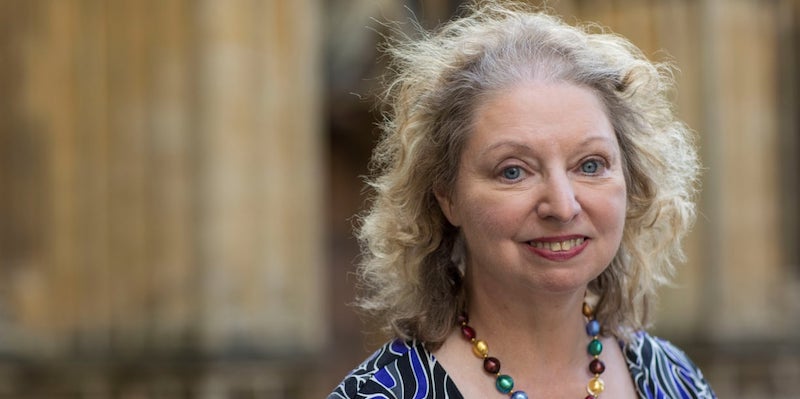
From a Google image Search – Dame Hilary Mary Mantel – Literary Hub
How shocking to hear that Dame Hilary Mary Mantel died at 70 years old of a stroke at the end of September 2022. I did not even catch on to Hilary Mantel until she wrote Wolf Hall, and even then, the title didn’t attract me at first. But once I started Mantel’s trilogy about the life of Thomas Cromwell and his importance to the volatile Henry VIII, I was glad I waited because I got to read all three books with barely a pause.
These are hefty books, about 500 pages each, and they are historical fiction. Some historians are purists and will not read historical fiction, but in truth all history tends to be slanted by the point of view of the recorder of the events that make up the history that is being observed and set down. It is almost impossible to be totally objective about human history. If you are a reader, it is a joy to begin a really large tome or series of any genre, one that deposits you into a world different to your own, one that makes you sigh with melancholy and satisfaction when the books are done. Hilary Mantel gave us just such a trilogy before her body, which had often caused her pain, set her free to go wherever great authors go when they die.
If you want to read an obituary that tells you about Dame Mantel’s life in greater detail this article from The Guardian. The Guardian is not behind a paywall, but they may hit you up for a donation. Follow your budget on this one.
I include the review I wrote of each book in the trilogy. I think one day soon I will read them all again.
Wolf Hall
Wolf Hall by Hilary Mantel is the story of Thomas Cromwell, an abused child of an English blacksmith who ran away to be a soldier to save his own life, a choice that strikes me as an unusual way to save your life, but there were not a lot of choices then. He did much more in his travels than just soldiering and, by the time he returned to England, his experiences had turned him into a formidable young man. He became the advisor and confidant of the King and held so many royal offices and honors that envy earned him aristocratic enemies who did not dare to act as enemies
In Wolf Hall, named after an estate that actually figures very little in the first book, we find Henry VIII who wants to set aside his first wife, Katherine, the Queen, so he can marry Anne Boleyn, a woman with many seductive skills. Henry needs a son as heir and since Katharine has not given him one, he hopes the younger, prettier Anne, will.
England is Catholic and there are all kinds of problems with the Pope and the Cardinals who believe the first marriage is legal and cannot be set aside. Cromwell has an ingenious solution to make this marriage happen, a solution that turns England upside down. Maybe you already know what it is, but you didn’t hear it from me.
The history of England has always interested me. My mother’s ancestors trace back to Shoreditch, which was an actual place near London even in the days of the Tudors, so perhaps I am genetically inclined to be an Anglophile, or perhaps I am just a fan of royalty. But I don’t think the attraction comes from either of these passions. I think it has more to do with the longevity of British history. The nation is old, and the human kindnesses and cruelties get so exaggerated when a succession of kings and queens becomes the focus of both hope and despair for an entire nation, one generation at a time. It’s fascinating. All the best and worst traits of humans, especially humans with power, are revealed., but at a safe historical remove.
If Mantel’s book, Wolf Hall, starts a bit slowly at first, it may be the pronouns that are at fault. It sometimes seems difficult to figure out the antecedent to “he” or “her” or “they.” There are so many characters involved. Just don’t get hung up on figuring our exactly who is talking. The writing pace is quick, and the pronoun trick helps speed things along. Stay with it. It does not take long at all to get your Brit geek in gear. On to Book 2. (It’s a trilogy!)
Bring Up The Bodies
Bringing Up the Bodies by Hilary Mantel is the second book in her trilogy about Thomas Cromwell. Mantel’s books are full of detail and paint a picture of life in 1500’s England. Her prose is exceptional, and her descriptions are so well done that the book plays like a movie in your head.
Apparently, Cromwell has not been the subject of in-depth research. Mantel brings him to life using the known to extrapolate about the unknown. She fleshes the man out. She uses fact and imagination to make him a living contemporary of Henry VIII. In this second book, we begin to understand why Cromwell was a formidable figure. Cromwell, in Wolf Hall, had been loyal to his mentor Cardinal Wolsey. Great men trained up younger men with promise, and Wolsey saw much promise in Cromwell. When Henry VIII wanted to set aside his first wife Katherine to marry Anne Boleyn, the Catholic Church stood in the way. Cardinal Wolsey, wealthy, learned, and powerful, represented the Catholic Church in England.
Wolsey could not approve the King’s divorce. His property was seized, and he lost all his comforts, was forced to live in rougher circumstances than his advanced age could tolerate, and he died of illness before he could be executed. Cromwell happened upon a play that mocked the fall of Wolsey. This masque was described in Wolf Hall, Book 1. Cromwell looked behind a screen as the players shed their disguises. He makes a mental note of who is the left front paw, the right front paw, the left rear paw, and the right rear paw of the beast in the play.
In Bringing Up the Bodies, Cromwell gets his revenge. He also reveals himself as so much more than the intelligent businessman and mentor of his own domain and the friend and ally of Henry, the King. We see his dark side. Previously we understood people’s envy and incredulity that this commoner could rise so high; now we understand how Cromwell becomes an object of fear. He becomes a man to deal with cautiously. Henry is now convinced that he needs to be free of Ann Boleyn so he can marry Jane Seymour. Cromwell makes it so in horrifying fashion. I was liking Cromwell. However, he is slipping in my regard, even though I still admire his many talents.
Cromwell and the King have already found a way to make the King the head of the church of England. Now they are beginning to dismantle the holdings of the Catholic Church and transfer the wealth to the King. Cromwell is ‘way out over his skis.’ Will he fall or remain upright? People near the King are falling like flies. Cromwell might be making too many enemies. I could look up the outcome online, but I want to wait and let Mantel take me there. I’m looking forward to Book 3.
The Mirror and the Light
The Thomas Cromwell that Hilary Mantel gives us in her trilogy, and especially in this last offering, The Mirror and the Light is half real, half imagined and yet he seems entirely real. Thomas Cromwell was the son of a blacksmith who drank. Thomas never knew when his father, Walter, would turn abusive and beat him, but he was always bruised and on the verge of running away. He grew up in a situation that could have led to a harsh life and an early grave. A few relatives intervened when they could and eventually, he was given a place in the kitchen of a wealthy family. Then he, in a fit of anger, killed a boy his own age who liked to bully him. He did not intend to kill him and there was never a charge resulting from his violence. But killing someone changes you.
This third book in the trilogy has Thomas in his 50’s. He has succeeded in law, in business, and he has become the closest advisor of the King, Henry VIII. Henry needed to bypass the Pope in Rome when he wanted to divorce his first wife so he could marry Anne Boleyn. Cromwell knew the sins of the Catholic Church, the usual sins of greed, gluttony, lust, and the scams involving the sale of relics and the statues that cried blood. He did not think the Catholic Church represented any true connection to God. It is the time of Martin Luther, but he is considered a heretic. Anyone who challenges the church in Rome is, by association, also considered a heretic. When Henry declares himself the head of the church in England, when he basically combines the functions of Pope and King in one body (his), Cromwell backs him up, and keeps sending emissaries into Europe to keep track of repercussions against England. Will the Catholic nations go to war against Britain. Cromwell also helps Henry break up the monasteries and nunneries and move their wealth from the church to Henry’s treasury. He helps himself to some of the properties that become available and divvies others out to British royals and aristocrats. He is valuable to the king. He has become a very stable, organized, and talented man – and very rich.
Cromwell straddles the Catholic religion and the new religions that allow even poor people to read the Bible, now that it has been printed in every language. His mentor in his early years was Cardinal Wolsey, a Catholic who is turned out of all his houses and left, as an old man, in conditions far cruder than he is used to. Wolsey will not back the King’s divorce. He is on the way to his execution when he dies of natural causes. When Cromwell is asked to rid the King of Anne Boleyn, he sees his chance to also take down Wolsey’s enemies, the men who mocked him in the play in the second book. Cromwell holds this grudge and takes his revenge. Killing so many courtiers though may lead to his eventual downfall.
Cromwell lives, in this third book, both in his past and in his present. Is he too distracted to make the decisions he has always made with confidence? Henry VIII is a very unstable king to serve. He imagines that he is still young and heroic, when he is actually old and portly, with an injured leg which will not heal. He looks in his mirror and he finds himself bathed in the light of earlier days (there are many mirrors in this book so full of self-reflection). He is shocked when his new wife, in a marriage that Cromwell helped arrange, cannot hide her disappointment that she will marry this old man. She is not as beautiful as Henry thought she would be. The marriage does not take and Henry blames Cromwell. He wants out.
At this critical time Cromwell has a return bout with the malaria he picked up in Italy and while he is ailing others in the council and the parliament creep in and influence the King. Cromwell is arrested and charged as a heretic who supports the church of Luther, and he is charged with treason because jealous men attest untruthfully that Cromwell wished to marry the King’s daughter Mary and place himself on the throne of England. Although Cromwell is guilty of pride and has feathered his own nest and enjoyed the advancements the King has offered, although he has his fingers in every British pie, he is not guilty, according to what records are available, of either heresy or treason. But the King is ever worried about betrayal and once he thinks you have betrayed him all your loyalty means nothing.
These books are a tour de force and I am sorry to leave the England of Hilary Mantel and Thomas Cromwell. Mantel’s writing alone evokes the mid 1500’s in the reign of Henry. There is an immediacy in her prose:
“The Cornish people petition to have their saints back – those downgraded in recent rulings. Without their regular feasts, the faithful are unstrung from the calendar, awash in a sea of days that are all the same. He (he is always Cromwell) thinks it might be permitted; they are ancient saints of small worship. They are scraps of paint-flaked wood or stumps of weathered stone, who say and do nothing against the king. They are not like your Beckets, whose shrines are swollen with rubies, garnets and carbuncles, as if their blood were bubbling up through the ground.”
And this is just a tiny taste. It’s a long book, but since I didn’t want to leave it, the length made me happy.
I am sorry that we didn’t get to have Dame Hilary Mary Mantel around to write a few more immersive tomes. I hope that if you haven’t read the Thomas Cromwell books that you will. You could spend an entire winter in the reign of Henry VIII, who is not so different from leaders we encounter today.
This little book, Assembly by Natasha Brown, packs a big wallop. Our narrator is unnamed, but we get to be inside her head. She is a Black woman living in London, a British citizen who White Brits still see as an interloper, a colonial intruder, easy to focus on as a person of color who cannot hide in the whiteness that Britain feels is its historical identity.
Our brilliant and disciplined lady had worked her way up from the bottom at her bank to a corner office, although she has to share it with a White contender who management does not want to slight. What has our winner had to give up to get here? She repeats the word “assimilation,” not with approval. She lives in a world of White folks now and there is money, security, savings, a fine apartment, the White boyfriend, son of a wealthy and famous politician. Her boyfriend intends to follow in his father’s footsteps. He mentions Bill DeBlasio whose Black wife probably helped him get elected in NYC. She, his Black girlfriend will be an asset.
She has been invited to come for the weekend to the family pile and to attend a party. So many wins in her life, but she is empty – cannot help feeling that her choice doesn’t fit her, doesn’t feed her soul (although, there is no talk of souls).
She is in hostile territory, judged by those who felt they deserved the win, that she was promoted only to help the bank appear diverse, a woman, a Black woman. She, on the other hand, feels no closeness, no warmth in her working life. Her coworkers at this level are mostly middle-aged White men with pallid skin and flabby bodies.
Even her personal life seems bleak and lonely. When she arrives at her boyfriend’s house, she is greeted warmly, but in the morning, when the mother and daughter are at work in the kitchen helping the caterers, the mother doesn’t include her in the camaraderie of the kitchen or give her a little job to do, instead she sends her off on a walk.
She, our narrator, observes her life; she doesn’t inhabit it. Her description of her potential mother-in-law chewing a piece of toast is mechanical, anatomical, and extremely unflattering. It reveals her position as an outsider. This is not just a class phenomenon, it’s about race.
Women who move up the career chain can relate to the loneliness of succeeding in a male world, but they do not have the added set of negative cultural experiences that Black people, and especially Black women, share as a sad legacy of past White cultural crimes. Our narrator has another challenge and how she is planning to deal with it is possibly tied into her fear that the winning may, in fact, be losing – a dynamic she chose, without realizing how empty it would make her feel. Terrible to think that our culture cannot find a warm place even when a Black person succeeds on terms White people define.
The style and flow of the prose in Assembly, the lack of prose structure, is part of this little book’s power. We need your voice, Natasha Brown, and your talent.
The Love Songs of W.E.B. Du Bois by Honorée Fanonne Jeffers surprised me. I expected it would be commentary on the works of W. E. B. Du Bois, but it ended up being a family saga of a uniquely American family. Mr. Du Bois did introduce each section of the book and there was an amusing and somewhat substantive debate between two characters about whether Booker T. Washington or W. E. B. did more to raise up African Americans. So, the author, who speaks in the afterword about her personal hero, the one in the title of the book, manages to offer both a tribute and to speak some truths in her novel.
Of course, African Americans brought here as slaves did not choose America as their home, it was forced on them. But theirs is still a quintessentially American story and not always one white Americans can be proud of, which is probably the basis of American racism. This is Roots for girls, women are in the lead in this family saga, what women endure, how they endure it, what was done to Black women in this country, and because this fictional family begins with a marriage between a Black man and an indigenous (Creek) woman, two ethnic tragedies become intertwined.
When white farmers moved into Georgia, these men forced the Creek tribe out, and as their farms grew into plantations, they bought slaves to farm the land. Slaves were their property and not considered to be evolved humans, and so women and men, even children were exploited and abused. Slaves survived, reproduced, were relocated, or died at their “master’s” whim. Because of forced interbreeding many of the family trees of black folks are involuntarily intertwined with white families, although perhaps unacknowledged until modern times. White people were shamed by having black relatives, but for all the wrong reasons. Their behavior was beastly and that is what the shame should be all about. The author does not say these things but these feeling can be extrapolated from what she writes.
We come to enjoy each visit to Chicasetta, Georgia, as much as the characters in this story. Although it is not a real place it becomes real by the gift of the writer’s art. We time travel back and forth between the beginnings of a couple of family trees and the modern family that was born out of these beginnings. Ailey Garfield is the narrator, and her dialect is evocative of the South and the warm manners of Black families who reside there. Her mother Belle and her father Zachery Garfield married because Belle was pregnant with her first child. They were almost separated by the Black Power movement but became stable and loving parents. Belle had to give up on her college degree, but she became a mother who tried to inspire her three daughters to succeed where she had fallen short and, for the most part she succeeded. Lydia is the middle sister. Coco is the oldest daughter.
It’s a long book and it is engrossing. It took me a long time to read it only because I kept getting distracted by my own projects and chores. It’s a wonderful book and a great addition to the genre. Ailey’s relations are quite strong characters, and I came to admire Jason Thomas ‘Uncle Root greatly. Eliza Two, Rabbit and Leena are also interesting characters to keep an eye on. It accomplishes some of the same goals as Coates’ book, The Water Dancer, except with more realism, less magical realism.
The Invisible Life of Addie LaRue by V. E. Schwab warns us to follow her neighbor Estelle’s advice and never make a deal with gods who answer after dark. The tale of Adeline LaRue shows what can happen if you make such a deal, even by accident, or because you are desperate. Adeline ends up making a very bad deal with a tricky god who takes on the appearance of Adeline’s perfect partner, a made up figure she has been drawing for many years.
Adeline grows up in the 18th century in a small village called Villon in France. It is practically impossible for a daughter to avoid a local marriage and the life of a wife and mother, hard and full of toil if you are not from a wealthy family. Adeline doesn’t want this life. She wants to be free, in a time when freedom for women was also something that might be marginally possible only if you were rich. Adeline’s family is not rich. Her father carves small, and quite desirable figures from wood and sells them at local markets.
Be careful what you ask for.
I almost put this book aside because I don’t usually read fiction about the occult or magic but I was ready for light entertainment and so I kept reading. Adeline’s deal means that she gets to live a long life as a ‘free’ woman, but no one remembers her. She can’t rent a hotel room or own any thing or have a normal relationship because she is always unknown. Everything is temporary. She can’t even say her own name. She is not really free at all because she sold her soul to ‘Luc’ for a freedom that is worthless. Luc visits Addie frequently to see if she is ready to give up her soul yet, but she is a stubborn girl. The more he tries to get her to give up, the more determined she becomes to go on. Three hundred years later, looking back, she acknowledges the things she has gained from her long life. Certain pieces of art work seem to give credence to Addie’s story. But she is tired.
In 2014 she finds a way to change the deal – at least temporarily. How does that happen? Read and find out. This was an inventive and entertaining piece of fiction, although the word ‘palimpsest’ cropped up a bit too often perhaps. Good job, V. E. Schwab.
The only complaint I have about Andy Weir’s new book Project Hail Mary is that I finished too quickly. But I had a big smile on my face most of the time. Weir’s book has upset some physicists and astronomers because they say Andy Weir doesn’t always get the science right. I am not a physicist or an astronomer, although I like to read articles about both areas so, for me, this book offered enough math to make it seem authentic, without getting too esoteric. The main character, Ryland Grace, is, after all, just an eighth grade science teacher and the math seems just about right for that level. Acceleration in different gravities, temperature ranges that support life, an alien culture that uses base 6 rather than base 10, spectrographic analysis and control screens that can offer up any missing information or do the math—all of these elements are intended for readers who are not physicists or even biologists.
I don’t usually read reviews before I write about books but The Washington Post kept dangling one in front of me so I finally opened it but I tried to just lightly skim it. Another thing the reviewer found annoying was the use of coma amnesia by the author as a device to prevent information overload. We learn everything in flashback mode. If our reluctant astronaut only remembers info as needed we learn about technicalities as he relearns them or remembers them. He wakes from his coma alone and has lost the team of true experts that were supposed to keep the mission on track. This device did not bother me, it seemed useful, but it might bother some readers.
Earth has a pressing problem. For some reason the sun’s energy is being diminished and it looks like the culprit is Venus. With a probe scientists are able to collect samples from the place where the ‘Petrovian’ line heads from the sun and hits the atmosphere of Venus. We learn that the true culprit is a tiny organism called an ‘Astrophage’ and that it goes to Venus to breed because it needs carbon dioxide to reproduce, which cannot be found in the sun. It then returns to the sun to collect more energy for a return trip. Each trip increases the Astrophage population. So, as if climate change were not enough, now our own sun will get so dim that we will starve to death.
When Grace (corny name or perfect?) finds himself alone in space he hears a Tap, Tap, Tap and finds he has a neighbor, an alien spaceship is nearby. He makes a leap of faith and allows his neighbor to connect the two ships with a tunnel. “Rocky” and Grace cannot share the same spaces or they will die. Rocky requires an atmosphere heavy on ammonia and he lives in extreme heat. Thank goodness for xenonite. Rocky’s planet is also being attacked by Astrophage, but Tau Ceti, the sun they are both visiting is infected with Astrophage and yet it is not losing energy. Why? Grace and Rocky find ingenious ways to figure it all out.
When my friend’s daughter was four she saw a movie over and over, as children love to do. The movie was called The Land Before Time. There was a character in the movie, Ducky, who would always say “yup, yup yup” or “nope, nope nope,” three times. It was so catchy and we all heard it so many times that summer that it has stayed with me all these years, although I never even watched the movie. Rocky and Grace also talk in threes after they learn enough of each other’s language. “Bad, bad, bad” they intone, or “good, good, good.” Rocky is a really lovable little alien engineer with a can-do attitude and a pretty even disposition. Does he make the book childish? I don’t know. That WaPo critic claims that the book is written like a movie script rather than a novel. Maybe. But Ducky prepared me well for a space engineer that looked like a turtle on top and a spider underneath, who had the lovable habit of saying things three times.
What is relevant about the book is not an imminent Astrophage attack on our sun, but the way humans come together to solve the problem quickly and efficiently. It is reminiscent of the way The Ministry for the Future by Kim Stanley Robinson tackles climate deniers by just finding ways to develop strategies that bypass them, right down to the leader of the Ministry, Mary Murphy, a strong woman who doesn’t take no for an answer. Dr. Eva Stratt is just such a strong woman and she leads the group of scientists from all of earth’s nations in getting a mission ready to travel to Tau Ceti as soon they see that earth will die if they don’t figure out why that other sun is not losing energy.
Mary Murphy had a male counterpart who used the most aggressive and unethical approaches. Dr. Stratt plays both roles. She does not mind getting down and dirty. But this idea that humans, even humans and aliens, can let go of jealousy and animosity when the survival of their species is at risk is present in both books. It is cooperation, even enforced cooperation, that solves existential problems. We end up with the question of whether our problems are existential enough to get us to work together towards a common goal, which just so happens to also be related to carbon dioxide. What do I have to say about Project Hail Mary? It was good, good, good!




 So Many Books, Choose Wisely