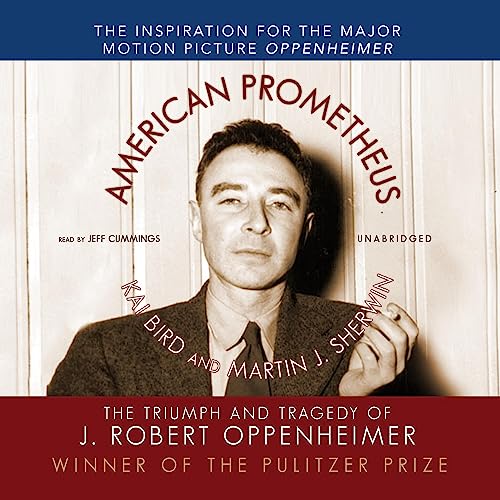
American Prometheus by Bird and Sherwin – Book

This image is from Amazon.com

I chose to read the book American Prometheus: The Triumph and Tragedy of J. Robert Oppenheimer by Kai Bird and Martin J Sherwin before I knew that it had been made into a movie. Cormac McCarthy’s book The Passenger led me to hunt for a book about Oppenheimer. McCarthy’s characters in The Passenger and in Stella Maris are Bobby and Alicia Western, a brother and sister whose (fictional) parents were part of the Manhattan Project that built the atomic bomb. These two knew the work of all the famous theoretical physicists of the era. Albert Einstein, J. Robert Oppenheimer, Enrico Fermi, Niels Bohr, and Paul Dirac are names shared by the Oppenheimer biography and McCarthy’s fictional story. 

Imagine learning that what your often missing-in-action parents were up to in your childhood was making a weapon that would be too powerful to use again after Hiroshima and Nagasaki. What would you think when you were grown and understood that this scientific product of a partnership between science and government would hang over the world and be used as a threat of total annihilation by any nation that happened to understand the physics, build the appropriate equipment, and collect the raw materials – the uranium and the plutonium – that could build such a bomb? 

The biography that Bird and Sherwin wrote is a voluminous and detailed story of Oppenheimer’s life, and it is a history text, as well as the story of this famous American physicist. Oppenheimer lived through several important eras in American history so as we learn about Oppy’s life, and as that life of science also becomes entangled in the world of government, we get an interesting spyhole into the events he lived through. 

Although Oppenheimer was born to a well-to-do family, he was slow to mature and had some worrisome quirks. One ill-considered action could have made him a murderer if the results had been different. In the various schools Robert’s parents sent him to and in college, Robert had problems with socializing. He also had similar problems in his early adult years in Germany where the predominant theoretical physicists were to be found at the time. By the mid 1930’s he was at the University of California at Berkeley where he felt at home. He was far more mature and consequently more productive and confident than previously. However, Berkeley is also where he and other intellectuals joined the Communist Party or at least attended meetings sponsored by the Communist Party,

Oppenheimer’s friendships with American communists (including his brother Frank who did join the Communist Party), the money he gave to local communist causes for humanitarian activities and because of his sympathies in the Spanish American War, all his actions before the Manhattan Project were used by a powerful enemy of Oppenheimer to destroy Oppenheimer’s reputation after his work at the head of the Manhattan Project. Oppenheimer was the director at Los Alamos, New Mexico where the first atomic bomb was built and successfully tested. While originally praised for his accomplishment in leading the project to a successful conclusion, Oppenheimer’s loyalty to America and his security clearance were soon under examination, and the possibly illegal proceedings that followed turned against him. 

Achieving the distinction of both conquering the physics of atomic fission and seeing the horrifying repercussions of its use as a weapon of war, it would seem normal to feel both celebratory and aghast at what your efforts had wrought. If you see the possible repercussions of some new knowledge, should you do all you can to keep that knowledge locked away from the world? Compare this to our present arguments about the ethical considerations of Artificial Intelligence (AI). Given the circumstances of Hitler in Germany and the bombing of Pearl Harbor it had seemed easy to justify making the bomb. Oppenheimer assumed, as did others in the project, that several nations were trying to make a working atomic bomb, and Oppenheimer believed that they would eventually make such a bomb. America needed to be first, everyone (the scientists, the military, the government) agreed. It was, as we know, a race to be armed. Oppenheimer won and he also lost. It’s a great and awful story. 

Isn’t it possible to believe that any Communist leanings Oppenheimer might have had were turned by circumstances into total loyalty to America and a dedication to winning World War II. But the things we do that we think are in the past can come back to haunt us. Although Joe McCarthy did not lead the case against Oppenheimer, America was soon to witness the Black Lists and the show trials that hounded anyone who ever expressed any sympathies that leaned too far to the left (at least anyone who was famous).

We are asked by the title to remember Prometheus, the god who gave fire to mankind against the wishes of the rest of the Mt. Olympus crew. Prometheus was tied to a rock in the Caucasus Mountains and everyday an eagle came and ate part of his liver. Then each night the liver would regrow, which meant he had to endure his punishment for eternity. (As Google tells it). The parallels are obvious. Revered scientist creates the bomb he is requested to deliver and then receives his punishment from someone he ticked off along the way. But Oppenheimer’s life does not end there, and of course, his liver was never attacked so he finds a new chapter in his life in which he learns to sail and spends part of his year on a harbor on St. John (Virgin Islands) and giving lectures at the invitation of admirers. 

My six degrees of separation moment with Oppenheimer – we both spent an entire week watching the TV coverage in the aftermath of the assassination of John F Kennedy. I was 19, Oppenheimer was 58. He was scheduled to be awarded a medal by President Kennedy; I was not. Oppenheimer won the Fermi Award, I, of course, did not. End of the degrees of separation saga.

There is no way that I can do justice to this incredibly detailed and readable book. There are just too many people mentioned to enumerate out of context without driving you to commit seppuku. There are the wives and lovers, surprising as Oppenheimer’s life focus was not sensual in the least. He tended to fall in love with intelligence in females, which most men felt intimidated by. I guess it made him quite lovable to those few smart women he singled out. There are his students, many who considered him a mentor for life. There are all the meetings, conventions, parties, and dinners. It’s amazing to immerse yourself in someone’s life with so much depth, but it’s not fodder for a brief commentary on the book. I understand the movie does an excellent job and I look forward to seeing it. As to my own love affair with all things physics and the physicists who understand the science, I haven’t a clue why I find the subject so enticing. I used to tell my students that physics is the science that explains the movement of nonliving things. That is what helped me understand how the inorganic sciences are related to each other. 

As I read this book, American Prometheus, I could not help going back to McCarthy’s book The Passenger, wondering if J. Robert Oppenheimer is the passenger missing from the mysteriously undisturbed aircraft sitting underwater that Bobby Western enters when his diving service is hired to investigate its disappearance. Everyone on the flight died, except one passenger who is not still aboard the plane. Who was that passenger? What did Bobby know about him? Was the FBI following Bobby because of the money he had found buried in his grandparent’s basement? Were they the tax men? Or was the government in possession of some secret about the passenger that they didn’t want Bobby to reveal? Bobby went back once to the site of the underwater plane, and he went beyond the plane and ended up on an island which showed signs of someone being dragged and of footprints. All signs ended abruptly. Weird. Oppenheimer died on the island of St John and was cremated, his urn buried at sea. Oppenheimer was hounded by the FBI and later by the AEC, the Atomic Energy Commission (he was a member of the board until Lewis Strauss had him thrown off). 

Oppenheimer ended up repeating a sentence from the Bhagavad gita, “Now I am become death, the destroyer of worlds.” The Passenger ended with Bobby Western telling anyone who will listen that neither math nor physics will give us the answer to life, the universe, and everything. Douglas Adams said that the meaning of life is 42. Mr. Natural said, “It don’t mean she-eit.” None of these sources bode well for anyone who likes to believe there is a prime mover and a plan and that we will either somehow end up with “the best of all possible worlds,” or at the apocalypse or the Rapture depending on the state of your spiritual side. This is a biography that inspires deep thoughts.

Note: I am having some problems with my eyes so I listened to this book on Audible.

The Great Reset and the War for the World by Alex Jones – Book

From a Google Image Search – Current Affairs

I made a new friend who said that he liked Alex Jones and thought that everyone should listen to what he has to say. I wanted to say a few choice words about Mr. Jones but when I searched my Alex Jones schema in my old gray matter, I found that my scaffolding was shockingly full of holes. What I did know is that he claimed on his media platforms that the Sandy Hook massacre of twenty-six school children, teachers, and staff never happened, that it was “fake news.” He was convicted in a civil suit of defamation and ordered to pay a very large financial penalty ($473M). This factoid certainly doesn’t work in favor of Jones in my estimation, but my friend is, in fact, a genius, and he thinks this guy is brilliant so, in an attempt to fill in the holes in my brain, I decided to read Alex Jones’ book The Great Reset and the War for the World.

It turns out that Alex Jones is either very paranoid and is offering us a timely warning, or has been misguided by his right-wing leanings (or both). His book is written in the style used in Bible studies as an exegesis of books by other authors. He begins with a detailed discussion of Klaus Schwab’s book, The Fourth Industrial Revolution. Klaus Schwab is the founder and executive chairman of the World Economic Forum which sponsors the annual meeting of the wealthy and powerful from around the world in Davos, Switzerland. Jones quotes a section of Schwab’s text and then reacts to it. His theory is that these world leaders are up to no good in Switzerland, or whenever they speak together. He sees “globalization” as a danger to ordinary humans. He is talking about global government rather than global trade although he does address global trade later in his book. Jones warns us that world leaders plan to rule over all nations and will destroy all national governments, economies and cultures replacing individuals with essentially human clones. They will do this through surveillance, fear, threats, whatever it takes. They will be free, we won’t. 

Jones’ paranoia extends to the area of vaccines. Vaccines could be used for nefarious purposes. They could be used for mind control. They could be used to control overpopulation. They could just be toxins that are slowly killing us on behalf of the rich and powerful.

He expresses the right-wing paranoia about strategies that are supposed to be designed to improve livability factors that are being challenged by climate change. If climate change is made up or if, as right-wingers contend, humans didn’t cause it and nothing we can do will fix it, then perhaps the issue is simply being used, he suggests, as more tactical ammunition for globalists who want to corral us all into cities where we will be easy to spy on and where we can be put to work at menial tasks which limit any time we might have to exercise freedom of thought or action. 

Another chapter is dedicated to the messages that environmentalists are putting out about our food. Without nitrogen-based fertilizers, the manufacture of which releases lots of CO2, we will not be able to grow enough food to feed the growing earth population. Bill Gates, for example, has a factory/research center to design plant-based meats that can replace beef, chicken, and pork because all of these animals are sources of methane emission, and contribute more to global warming than things that release CO2 directly. “What if,” asks Alex Jones, “even what is going on with our food is part of the global takeover by the wealthy class?” (Not a direct quote). He asks the same question about the supply chain.

We can all tap into this paranoia about what the rich and powerful are up to. We all would like to believe that climate change is a made-up crisis. We may not make millions or billions from fossil fuels as many of the rich and powerful have, but we have kept warm in winter and cool in summer fairly predictably with fossil fuels and we’re not sure that alternative energies are up to the job or will offer the same comfort. But we suspect that we cannot trust people in the oil and gas industries to speak the truth in these matters. Those who argue about changing our habits to lessen our CO2 emissions do not seem to have a dog in the fight as the oil and gas people do. 

How paranoid should we be? Can we stop these guys from world domination? How would we go about that? Would we be willing to give up our freedom if our creature comforts were protected? Would we be willing to fight for our freedom when we have such a nebulous grasp of what freedom means that we think wearing a mask to protect us from disease is a true risk to our freedom? 

Whether you believe Alex Jones’s paranoia is justified and an important forewarning of a future we always hoped to defend against or not, this man, with only an associate degree from a community college in Austin, Texas has managed to make a fortune on social media and podcasts and radio, etc., preaching the gospel against globalism and blaming everything bad on the left, while the right-wing chooses dictators as cohorts, dictators like Orbán in Hungary and Putin in Russia.

Is he a “shock jock” with a suitably raspy voice and the disheveled grooming of a modern philosopher, is he a true philosopher, or is he just a guy who knew how to exploit the gifts life gave him. I find him confusing. He says things we have all thought about the rich and powerful but attributes the policies that will help the globalists win to the Left, while we can clearly see that it is the Right protecting the hoarding of money with tax cuts, giving money human rights as in Citizens United v the FEC, and thus growing the power of the wealthy.

Perhaps the rich and powerful do not divide the world into left and right; rather simply by rich and not rich. I have not become an Alex Jones devotee, but I have learned more about him. If making a fortune is the test of brilliance, then well-done Alex. However, simply accruing wealth does not offer absolute proof of genius, or at least it didn’t used to. Perhaps we no longer know what true genius is. None of our heroes seem able to pass the tests of a divided nation/world.

The Covenant of Water by Abraham Verghese – Book

From a Google Image Search – Chicago Review of Books

There have been two books by beloved fiction authors published recently that are set in the same area in India, along the southwestern coast. Salman Rushdie’s offering, Victory City, is a mythic fantasy that is inspired by the site of an ancient and fallen civilization. The Covenant of Water by Abraham Verghese is set in the years from 1900 – 1977 as a family saga and an exploration of how the effects of a hereditary condition affect the fortunes of the family. Verghese, who also wrote the best-selling novel Cutting for Stone, is known for the medical stories he tells. 

The Covenant of Water takes place in the watery landscape that is known today as the state of Kerala. We begin in the years of British occupation, although this is not a story about imperialism and winning independence. India does win free of Britain during this period, but the novel is the story of a family living on a property known as Parambil. A very young woman is contracted to wed the owner of Parambil and we share her trepidation as she travels along the waterways that provide transportation throughout the area. She is a Christian woman and is marrying a man who belongs to the same church of St. Thomas. Her husband lost his wife to childbirth and the child lived. He gives his twelve-year-old wife time to grow into the relationship. 

Big Ammachi is the name that this child-woman becomes known by as she becomes the stable and enduring center of the family. She discovers that many of the members of this family she has married into suffer from an aversion to water. This is a big deal in the watery world they occupy. When those who are afflicted get into water they become disoriented, and grievous accidents and drownings cause beloved family members to die early. The family keeps a family tree that records the tragic path of destruction that “the Condition” has left behind. There is no science to explain this type of hereditary situation in 1900, and in fact the physical basis for this condition is not known until we arrive in 1977 near the end of this book. 

In a parallel story we have the promising doctor, Digby Kilgore, in India but from Scotland, who is beginning a career in surgery. He is partnered with a doctor addicted to alcohol who leaves all the Indian patients to Digby while he treats the very few white patients who are admitted into a separate ward. Digby falls in love with Celeste, the talented wife of this addicted surgeon who should have already lost his right to practice medicine. Their passion leads to a fire that changes Digby’s life forever. With his burned hands he knows his time as a surgeon is over. Connections he has made as a surgeon lead to the next chapter of his life which becomes intwined in the life of a man who builds a compound for lepers. He falls in love again with Elsiamma the beautiful wife of Philipose, Big Ammachi’s grandson. Eventually this connection leads to finding the cause of “the Condition.” Mariamma, who believes she is the child of Philipose and Elsie, learns about her true parentage when her life crosses the life of Digby Kilgore.

Besides offering glimpses into a part of the world we were basically unacquainted with, we get a sense of the slow development of our store of information about disease and the hereditary roots of it. Science cannot offer insight until the tools that allow observations inside the body have been invented. And the brain is almost impossible to study humanely while we are alive, at least this was true before modern imaging and is still true to some extent. It took three-quarters of a century to trace the origins of this one disease, which affected so few people that the discovery of its roots was almost stumbled upon by accident. If Mariamma had not decided to become a doctor the discovery may have been delayed even longer. 

There is an aspect of both Rushdie’s Victory City and Verghese’s The Covenant of Water that gives them common cause besides geography and that is the focus given to women, their victories, and their heartbreaks. Pampa Kampana, the woman who creates Victory City, ironically never gets to rule it. She does, however, establish that women will one day give up entering the fire, as her mother did, when their husband dies. Since the women in The Covenant of Water are rarely affected by “the Condition” and since Big Ammachi did not have this genetic defect she forms the backbone of her family and her village, offering warmth and love to all who inhabit her world including “Damo” the elephant who often visits and who Big Ammachi once caught looking into her kitchen with his big old elephant eye. Romance is also a part of Verghese’s story, although even the happiest of unions face tragic circumstances. Even the lepers are treated lovingly and the research on leprosy makes possible the research on “the Condition.” This is a long novel, but following at least three, possibly four generations of one family takes time and we learn that, simple or fancy, life makes unsung heroes and heroines irrespective of economics.

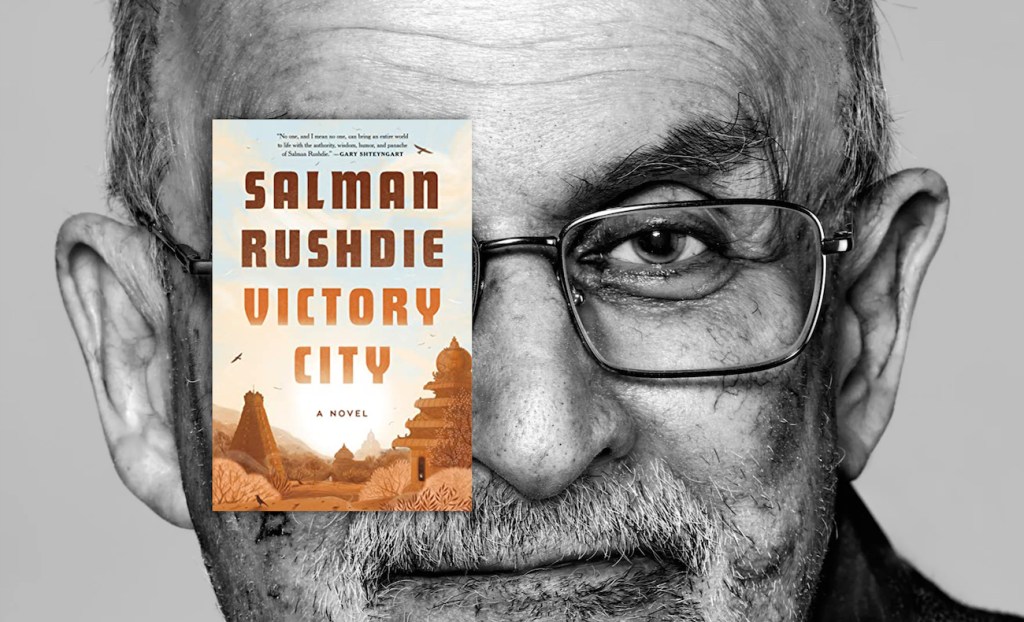
Victory City by Salman Rushdie – Book

From a Google Image Search – American Kahani

Salman Rushdie, prolific and celebrated author, was born in Mumbai (Bombay) India. He was born to Islamic parents but became an atheist. One of his early books was The Satanic Verses. It was considered sacrilegious by the Ayatollah Khomeini in Iran who issued a fatwa on February 14, 1989, requiring the faithful to seek out Rushdie and kill him. For many years Rushdie lived in hiding in London under the protection of the British government. The Ayatollah died without lifting the fatwa, so it was never rescinded but Rushdie felt secure enough to live freely in NYC for many years. On August 12, 2022, standing on the stage at the Chautauqua Institute in New York Rushdie was attacked by 24-year-old Hadi Matar who stabbed him multiple times with a knife before security and participants were able to apprehend him. Rushdie was severely injured and lost the use of one eye.

Victory City is the first book Rushdie has published since his near-death experience. Salman Rushdie is back on home turf with this book. His heroine, as a nine-year-old girl, sees her mother walk into a fire to die as custom required of widows. She is shocked that her mother would chose the fire rather than stay with her. But she is given a gift from the goddess Pampa who she is named for. She is given two gifts by the goddess. She is gifted with long life. She is also gifted with the magical ability to sow seeds and grow her own city.

The goddess tells her, “You will fight to make sure that no more women are ever burned in this fashion, you will live long enough to witness both your success and your failure, you will see it all, tell its story and then you will die immediately. Nobody will remember you for 450 years until they unearth your verses.” (not an exact quote). It turns out that knowing your future often brings both joy and pain.

First Pampa Kampana spends years reaching her maturity in the cave (mutt) of a spiritual teacher and sexual predator, Vidyasagar. Fortunately, Vidyasagar studies for long hours as he memorizes all the holy texts, but he occasionally finds time to rape Pampa. The monk seeks the answers to two questions. The first is whether wisdom exists or there is only folly. The second question is to find out if there is such a thing as Vidya or true knowledge, or only many different kinds of ignorance. His goal is (ironically) how to ensure the triumph of nonviolence in a violent age. Although grateful for learning the contents of the holy books, she never forgets the humiliation she suffered when she was helpless to fight back.

When Pampa Kampana is eighteen two cowherds arrive at the mutt. She sends Hukka and Bukka Sangama out to sow the seeds of her city. She names the city Bisnaga or Victory City. Since her city is peopled by people who have no personalities, who know no history, who don’t know their identities, Pampa Kampana whispers to fill the minds of each individual in Bisnaga. It is a city created by magic. 

Magic is one of the best aspects of Rushdie’s writing. The existence of magic allows him to be a great storyteller in the Eastern manner. This book does not have Islamic roots; it celebrates Hinduism but as myth more than religion. It’s interesting that Pampa Kampana’s life and the life of Victory City are exactly 247 years, the same as the life of the American Republic (probably not an accident). There is plenty of commentary on the rise and fall of great cities, or great empires. Why are empires successful and why do they fail? Is failure inevitable? 

In our world we have no magic that we know of. We live in non-magical times. We can’t blame the gods and goddesses for our failure. We have only ourselves to blame. Still, a good story entertains us and makes us think in new directions. Victory City is an engrossing tale of magic and life that centers around a female heroine who builds a great empire, which is quite rare. Salman Rushdie is writing again and that is cause for celebration.

Theresa, et al by Jean Hackel – Book

From a Google Image Search – Amazon – the ratings are from readers on Amazon

A rather chilling abortion story has been written by Jean Hackel in her book Theresa, et al. When Theresa decides to have an abortion the Dobbs decision has not yet turned abortion laws over to the states. Abortion is still legal. Theresa goes to the wrong clinic however, and winds up in the hands of some women who have formed an abortion vigilante group. Theresa’s mother, a very devout Catholic, who honors her religion above her children, allows a fanatic named Lucy Meyer to come into her home with some of the militant women from Maureen Haig’s church. Theresa is living in her family home while her husband is on active duty in the armed forces. Theresa is shocked that her mother pretends that she (Maureen) does not seem to see that these women plan to stop her daughter from completing a personal choice about her pregnancy. They eventually kidnap Theresa.

“Theresa sat on the bed, her back against an iron-spindle headboard. Both of her wrists were attached to the grillwork. Her feet were tied together with fabric to prevent kicking. Lucy sat down on a wooden chair at the edge of the bed.” (p. 132)

There are many repercussions from this violent and criminal act. Could this really happen? Perhaps it already has but this may also be a graphic way to discuss forced birth and the effect it may have on women, families, and even children. 

Where were the authorities in this situation? There were eventually many agencies involved, but Theresa got no justice. On top of all the pain of. being a victim, Theresa’s husband is injured by an IED on the way home to her and when he finally gets to a hospital in the states, he has a tough recovery ahead. Since the hospital is in Alabama, when Theresa is found in Minnesota where her own family lives, Woodrow (a great guy) takes her to stay with the Coles who are Charlie’s family. From her cold, judgmental mother she enters the sphere of a warm and loving family, and her life begins to normalize. Turns out though, that justice is far harder to come by given the strength of the “pro-life” movement. Quite a timely novel, which calls to mind The Handmaid’s Tale, although it is completely original.

Violeta by Isabel Allende – Book

From a Google Image Search – Houston Chronicle

Isabel Allende set some of her books in California, showing glimpses of the lives of Americans who migrated from Central and South America. Violeta, the main character in Allende’s eponymous book, lives in an unnamed country in South America, in a city that is named Sacramento, echoing her California stories. (The internet tells me there are 31 cities named Sacramento.) Violeta lived for one hundred years and is able to portray the instability of the government in her country against her own ability to stay successful in business. She never fell afoul of the various governments or regimes that ruled her country, especially the authoritarian or military governments, which often expressed their power by executing key figures and their supporters from the previous government. Violeta Del Valle and her family knew how to be invaluable to government while staying out of politics.

Violeta was also lucky with the people who surrounded her, her extended family. Violeta tends to turn those who are close to her into family members. Her governess from Scotland, Josephine Taylor and Josephine’s lover Teresa Rivas, a bohemian social activist, are loyal to Violeta. Teresa has family in Patagonia, Chili with a farm. When the country’s democratic government is overturned, Violeta escapes danger by going to the Rivas farm. Teresa’s family becomes Violeta’s second family.

Miss Violeta has a series of husbands and lovers. Her first husband is a German immigrant from a wealthy family who is so engrossed with the science of artificial insemination of farm animals that the relationship with his wife just kind of fizzles out without offspring. Although, when Violeta wants a divorce, it doesn’t prove easy to make that happen.

Julián Bravo, a swashbuckler, takes up quite a few of Violeta’s 100 years. If her last romance fizzled, this romance sizzles. It turns into more of an addiction than a love story. Julián lives at the edge of adventure, crime, and political disaster. He doesn’t want children and is irate when Violeta is pregnant with his son. Their relationship is tempestuous and toxic, but Violeta can’t give him up. They also have a daughter, Nieves. They never marry. After Violeta’s daughter moves to America with her father, Nieves falls into the traps many modern children have fallen into. Throughout the tragic moments of Nieves’ life, there is a man who steadfastly keeps Violeta informed about her daughter. Ray Cooper is an ex-convict; he is now a detective. He comforts Violeta and they enter into a calm long distance relationship that satisfies both of them.

Violeta is not a novel full of literary techniques and esoteric symbolism. Allende give us a woman who is simply telling the story of her 100 years to her grandson, Camilo, in a letter, a really long letter. Violeta’s story does not need literary poetics. She is a businesswoman. We get to live her life through her as she experiences a century of worldly events that are not so much history as events that touch her life and the lives of the people she loves. She is a strong woman, and she understands how to earn and keep money. At the end of her life, she meets another man, this time from Norway, who should be boring but isn’t. I always like where Isabel Allende takes me. This time she takes to a remarkable life of a remarkable woman. Does it have elements of autobiography? Hard to say unless you know Allende very well. 

Surrender by Bono – Book

From a Google image Search – Entertainment.io

Bill Gates recommends books in his Gates Notes which you can subscribe to. He posts them on Linkedin. One of the books he read last year was Surrender by Bono of U2 fame. I have been reading the writings of well-known rockers on occasion. I read Flea’s book (Red Hot Chili Peppers) Acid for the Children, hoping all the while that the title was symbolic. It was and it wasn’t. I also read The Year of the Monkey by Patti Smith. Patti Smith’s book covers a melancholy time when friends were dying and is both nostalgic and surreal. She’s such a good writer. So that’s why I decided to follow Gates’ lead and dip into Surrender

Bono was born in Dublin and grew up at 10 Cedarwood Road with his “da” Bob Hewson, his mom Iris Hewson, née Rankin who died when he was fourteen of a brain aneurysm and his brother Norman. He was born during the “Troubles,” but his parents were not involved in the war. Bono’s dad was Catholic, and his mom was Protestant and that seemed to temper their animosities. There exists a level of spirituality throughout Bono’s life. He meets his bandmates when he is a teen. They remain an active band throughout their lives with ups and downs as individual lives are lived out over decades. Read the book. 

Each chapter begins with the lyrics to a song and a bad drawing although the drawings improve as the book progresses. Bono takes us with him to 10 Cedarwood Road so we can know his roots and then he takes us around the world. The book is long and detailed and well-written so take your time with it. It’s a remarkable story of a man who played no instrument and had to develop as a singer but who had the luck to have great band members, Larry, Adam, and Edge, stable, honest management, and a knack for meeting the right person at the right time.

Bono moved from punk rock to activism as he became richer and more famous. He married Ali and they had a family. Although he was often gone, he was lucky in his marriage too. Ali was a solid partner, and she also had her own life to live. He had enough security in his life to allow him to tune into world events. These were the days of the AIDS epidemic. At the time there were drugs, but they were very expensive. The disease took a terrible toll, offering up a tortuous death from various pneumonias and cancers, causing disfigurement and starvation. So many talented people were lost to this disease, which arrived seemingly from nowhere. Rock musicians raised money for AIDS research and treatment at massive concerts like LIVE AID and Bono and U2 were there through all of this, although the band was not all about activism.

How does a rock star who throws himself into crowds with abandon, stay a rock star but also become an activist? How does the band stay together and the marriage? Bono makes it clear that he was lucky to have great people around him in his band and in his private life. Rock bands travel all over the world. They see things that we only hear about in the news. Ali and Bono went to Africa and saw what was needed. It didn’t just take one rock concert, regardless of how many artists performed, to raise enough money to take AIDS treatments to Africa. Bono made contacts in the American government. He made deals. America was reluctant to budget the kinds of funding needed to wipe out AIDS in Africa. Bono won. 

It’s a great story of how a boy from Dublin ended up meeting political power brokers in Washington DC and in the Oval Office. You also get the bonus of lyrics for 40 U2 songs. Rock stars lead interesting lives. Read the book.  

How the World Really Works by Vaclav Smil – Book

Bill Gates recommends books for me to read. Well, okay, not just for me but for millions of people who subscribe to his Gates Notes and to the letters from The Bill and Melinda Gates Foundation. Sometimes I recommend books to him, in the comment section on his Linkedin page. I assume he takes my suggestions seriously. (Just kidding.) He may never look at the comments. So, it was at the behest of Mr. Gates that I decided to include Vaclav Smil’s book, How the World Really Works, written during COVID home isolation, on my reading list. Now that I have finished Smil’s book I can’t say that I loved the things he had to say, but he is a polymathic professor at the University of Manitoba and my elder. (only by two years) He has several areas of expertise, all related to knowledge that is important to solving climate change, ocean pollution, and uneven distribution of fresh water. Although you may experience a Smil downer, the theses in this book must be taken into account as we try to approach getting to zero carbon emissions while still housing, feeding, and quenching the thirst of a global population that is still growing (despite lower rates of reproduction in many nations).

By methodically and numerically talking us through the 4 pillars of modern culture, steel, ammonia, cement, and plastics Smil shows us a series of daunting tasks. It is illuminating to read about how completely fossil fuels are entangled in almost every aspect of making these four key products that cannot be easily replaced. 

“The real wrench in the works: we are a fossil-fueled civilization whose technical and scientific advances, quality of life, and prosperity rest on the combustion of huge quantities of fossil carbon, and we cannot simply walk away from this critical determination of our fortunes in a few decades, never mind years.

Complete decarbonization of the global economy by 2050 is now conceivable only at the cost of unthinkable global economic retreat, or as a result of extraordinarily rapid transformations relying on near-miraculous technical advances.” (pg. 5)

Smil takes us through the intricacies of agriculture and of fertilizing soil. Without fertilizers to replenish nitrogen in our soils we would never be able to grow enough food to feed the 8 billion people who now inhabit the planet. This is where ammonia comes in. It is important in helping nitrogen take a form that plants can use. 

Smil says, “None of the people reading this book will relocate to Mars, all of us will continue to eat staple grain crops grown in soil on large expanses of agricultural land, rather than in skyscrapers imagined by the proponents of so-called urban agriculture, none of us will live in a dematerialized world that has no use for such irreplaceable natural services as evaporating water or pollinating plants. But delivering these existential necessities will be an increasingly challenging task, because a large share of humanity lives in conditions that the affluent minority left behind generations ago, and because growing demand for energy and materials has been stressing the biosphere so much and so fast that we have imperiled its capability to keep its flows and stores within the boundaries compatible with its long-term functioning.” (pg. 3)

Makes you want to prove Vaclav Smil wrong, doesn’t it? Before you set out to do that you had better read the book. He has done the math for you. First chapter covers Energy Fuels and Electricity, second chapter covers Food Production: Eating Fossil Fuels, third chapter covers Our Material World: The Four Pillars of Modern Civilization. fourth chapter covers Globalization Engines, Microchips, and Beyond, the fifth chapter covers Understanding Risks: From Viruses to Diets to Solar Flares and the sixth chapter covers Understanding the Environment: The Only Biosphere We Have.

In the last chapter Smil talks about how we are swinging between apocalypse and the singularity. 

“Apocalyptic visions of the future–with assorted hells offered by major religions–have been strongly revived by modern promoters of doom, who have been pointing to rapid population growth, environmental pollution, or now, increasingly, to global warming as the sins that will transport us to the netherworld. In contrast, incorrigible techno-optimists continue the tradition of believing in miracles and the delivery of eternal salvation. It is not uncommon to read how artificial intelligence and deep learning systems will carry us all the way to the “Singularity.” (pg. 213)

Vaclav Smil is basically telling us that there are far too many places and procedures that still rely on fossil fuels to get to zero or to decarbonize even by 2050. He also chastises us for not having done our due diligence over the many decades that we have known about climate changes like global warming, damages to our oceans and the unequal distribution of freshwater resources. We could still, if we worked together design a plan that might involve, for example, making sure soil in Africa has adequate supplies of fertilizer and fresh water to grow their own food and enough steel and concrete (made with cement) to build housing that will protect them from hot spots. Given that we cannot all agree that we need a wider, more global plan our situation looks bleak but Smil believes that earth will stay livable for many years to come.

Is this a wake up call or and admonition? Have we done too little and left things until too late? We will have to live it to learn it. Meanwhile, I assume and hope that environmentalists will keep plugging away. If they stop believing we are in big trouble.

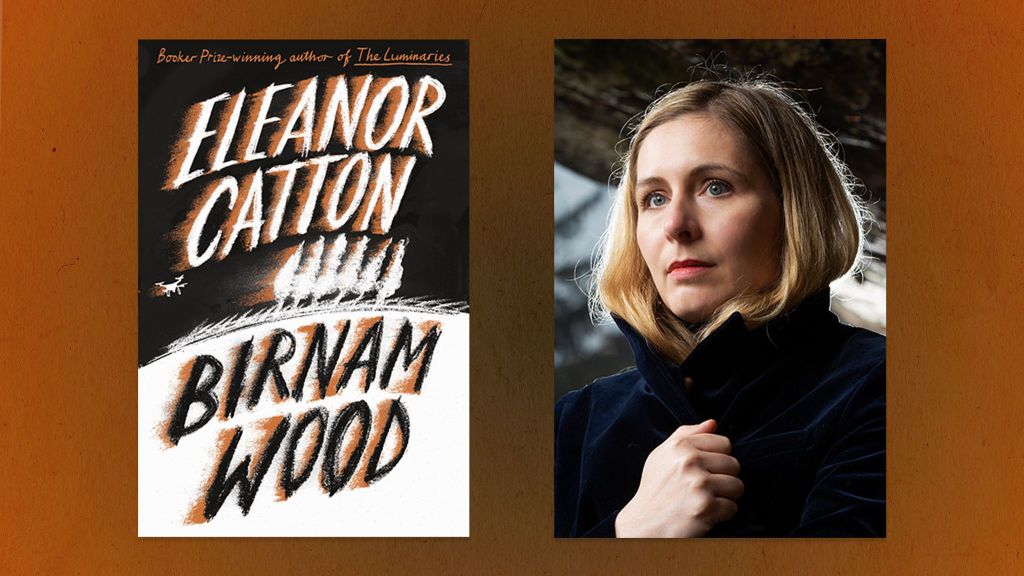
Babel by R. F. Kuang – Book

From a Google Image Search – Orange County Register

Science fiction and social commentary are for all practical purposes in love and married to each other. Writers of sci-fi may build worlds but they generally have something to address in the actual world we occupy. In her book Babel: or, The Necessity of Violence: An Arcane History of the Oxford Translator’s Revolution, R. F. Kuang creates a new world right on the nineteenth century campus of Oxford University. England runs a bit differently than it does in our histories. In Kuang’s novel England runs on silver and language, and the whole system is run by translators.

The eight-floor high tower of Babel sits on the Oxford University Campus and only translators and their professors are allowed inside. Students enter on the first floor and work their way up to the eighth floor where their language skills allow them to make powerful decisions that keep the Empire running smoothly. 

Although the quality of people’s lives is affected by the silver/linguistics technology, England is otherwise the same colonial power as history records. Wealthy Brits believe that other nations on other continents are full of savages with primitive intelligence and backward customs, even in the case of a culture like China which existed for centuries before the English arrived. China opened its doors to trade for a brief period in the nineteenth century providing England with much coveted Chinese tea, but England is running out of the silver it needs to keep its wealthy citizens happy. China is not willing to mine silver for England or let England mine China’s silver. England plans to secretly flood China with opium to make it a quiescent nonentity. Surprise, surprise. China figures out this secret plan and does not agree with it.

Because the silver effect is controlled with word pairs from two different languages and by the etymological connections between the meanings of the paired words, this system does not work without the translators. All translators must have a firm grasp of Latin and Greek and at least two other languages. One of the languages must be English. Students must study for three years before they get to work in the silverworks on the eighth floor. 

In order for word pairs to function the words must not both be in common use. As the age of discovery and colonization begins to connect nations words that once belonged to a single geographic region become popular in common use across many nations. This makes it more difficult for England’s translators to come up with unique pairs. Suppose you want the sewer system throughout the country to function well and the rivers to stay clean, the drinking water to stay potable. Silver bars with the correct word pairs can make this happen if you happen to live in an elite neighborhood or an important village.

As England looks around the world for more esoteric languages, they find ways to parent children with native women, or they seek out talented children and they place them in the homes of wealthy sponsors or professors and offer them all the comforts of a wealthy life while they force these children to learn Latin, Greek, and English. They must also retain proficiency in their native language. What happens when these children grow up and attend Babel to become translators is the crux of this novel and the part where social commentary comes to the fore. How do you think children from nations Brits feel are inferior are treated at Oxford? Where does violence come into the picture? 

R. F. Kuang’s novel is complex, perhaps a bit too complex. The action should reach a crescendo at some point, but the intensity seems to be tamped down to a sort of monotone. The social commentary is clear, but it ends too abruptly in a simple epilogue. Will the actions the central characters finally choose have the desired effects? The author does not really answer that question. Does heroic sacrifice work as an alternative to violence? Will any of the voracious appetites of the wealthy be kept under control? The book is interesting, and the characters affect us much as the characters in Harry Potter do, but the book needs to go on to the aftermath for a bit. Perhaps there will be a sequel. It was an interesting read. The book has echoes of Neal Stephenson’s Quicksilver Trilogy, except that he is a small g “god” of sci-fi.

The Last Chairlift by John Irving – Book

From a Google Image Search – CBC

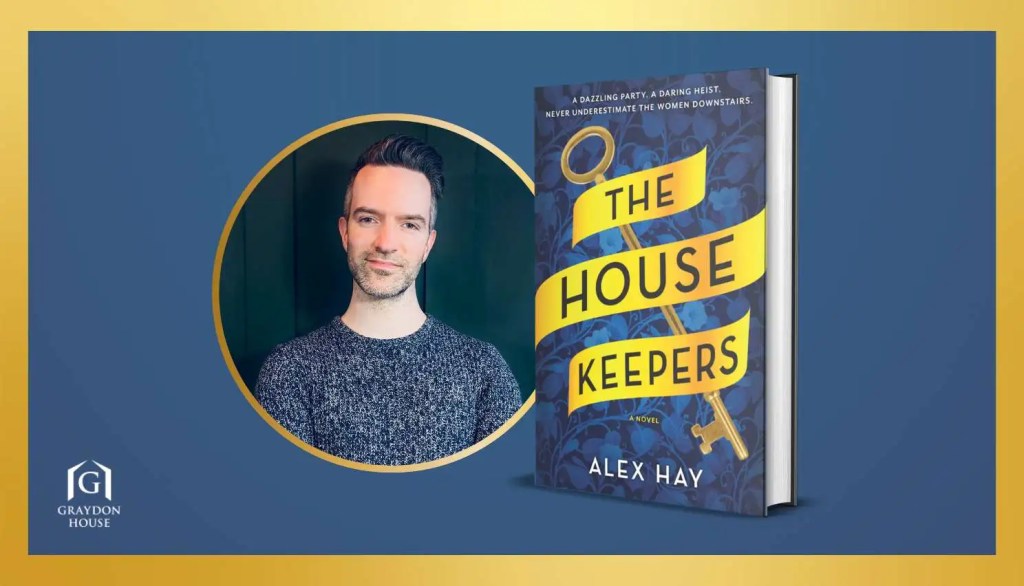
It took me a while to adjust to John Irving’s bizarre characters and plotting details in The Last Chairlift, but John Irving knows how to have his way with his loyal readers. Will new readers of Irving like this book? Can an old activist discuss the wide array of modern genders without being guilty of cultural appropriation? Well, he has his tricks but perhaps only true readers, celebrated in this book, will go the course, ski the diamond runs.

John Irving is from New Hampshire. Skiing and skiers are things he probably knows quite a bit about. In The Last Chairlift his mom is a ski instructor and Adam is her one and only (child). She begat him in Aspen at the Jerome Hotel from a boy just entering puberty. She lives in a sort of dorm full of raucous and fun-loving girl ski instructors with her partner, Molly, a trail groomer, and a big old reliable girl with a sweet spirit. A number of women in Irving’s book have a big problem with penises. Then there are the characters who see ghosts and those that don’t. Adam and Little Ray (his mom) both see ghosts, especially at the Jerome Hotel but several ghosts visit Adam in the attic bedroom at his grandmother’s house where he lives while is mother is busy at various ski mountains. 

Adam is from a family of small people. His father, who does not appear until late in his life is small, his mother is small, thus the nickname “Little Ray,” she marries the very small Elliot Barlow (not too small to be a good wrestling coach, just the right size for a man who should have been born a woman). Small size does not make these characters small in spirit. 

Adam has a big cousin, Nora, a lesbian, and a true activist, bold, creative, and outspoken and much admired by Adam. Nora’s girlfriend, with the legendary wild and loud orgasms, is actually mute. These two have a comedy act at a NYC club that resembles The Stonewall Inn, called Two Dykes, One Who Talks. Em doesn’t talk but she becomes a master of awkward pantomime. She’s the pretty one. Adam loves all these people, but it seems he is in unrequitable love with Em (McPherson).

Moby Dick plays a big role in this novel, perhaps similar to the role the dog, Sorrow, played in Hotel New Hampshire, as a source of literary content, social commentary and “dick” humor. Repetition is one of the ways Irving gets us to immerse ourselves in his mayhem. Irving plays his usual comic tricks that never fail to provide humor that makes us shake our heads because it is so outlandish and sick. Adam’s early sexual liaisons with injured women, one on crutches with twitchy nerves, one with a cast, one who is a bleeder, might prove as obstacles to normal sexual development to a young man who did not have Little Ray and Molly and his nonchalant grandmother in his corner. 

But love is all around, and it tempers all the many disasters in this long tale. It is typically Irving, over-the-top, endearing social commentary intended to change your views and make you suspend your disbelief. Who decides when a great writer is too old to write? It’s a thing between writers and readers. This may or may not be Irving’s last novel, but in this one he’s still got his writer mojo.