I love to read. BA from SUNY Potsdam, MEd from University of Arizona at Tucson. I write about books to remember them and to share my memories of them. After you read hundreds of books it is nice to be able to have a reference to refer back to that reminds you of how the book affected you.
Rachel Cusk’s trilogy encompasses books entitled Outline, Transit, and Kudos. In every case Cusk presents character stories of people met in chance, or occasionally planned, encounters. In Outline, the author, Faye, (characters are typically unnamed or given only first names) is on a plane headed to a Book fair in Greece where she will sit on a panel and be asked to speak. Her seatmate on the plane gets in-depth treatment as we learn the story of his life and his marriage. Even at the book panel, the event runs out of time before the author speaks, but one outgoing male author has plenty to say.
Hardly any of the characters in these books have names, or they might have a first name, as already mentioned. This seems to be a new trend in fiction which probably has a purpose, as in allowing us to relate to the character, not wanting to create a character that jumps off the page and becomes an icon or to make it easier for the reader to imagine that s/he is the main character. The main character in this case is an author who has been through a crushing divorce. She and her husband have two sons. But her writing career is taking off, first literally to the Book Fair in Greece.
Rachel Cusk has a talent for telling stories of the people who meet this author as she travels, renovates an apartment, and goes to a second writer’s convention where awards are being given. But we know little about the author or her book. We are treated to an in-depth exploration of all the people she sits next to or interacts with. She seems to have no close friends, but this story is not really about the author. It is about men and women and the difficulties of intimate male-female relationships, especially in marriages in the twenty-first century.
Even as she fights off the bile of her new downstairs neighbors in Transit, she finds out the details of the life of the contractor who spends the most time on her renovation. Her neighbors are a nasty pair who knock on the ceiling with a broom as they follow her footsteps through her new flat. The downstairs couple seem to be bound together by their hatred for whoever lives upstairs, and they delight in intimidation. These are people I would want to run away from, but she stands her ground (without a rifle). When they realize that she is soundproofing the floor their hatred knows no limits but never gets physical. It is all bluster, an act to drive her away. The author has sent her sons to stay with their father while the reno is undertaken and although they beg and cry to come home to her, she encourages them to be independent. Is she a bad mother?
In the last book, Kudos, the author has obviously had some success and is attending a conference where she is supposed to be interviewed on television. Although she learns the life story of the interviewer, the technicians are never able to make the electrical hookups and the interview is called off. She meets another interviewer, a book critic, and he never learns a single fact about her, but we learn all about him. Almost all the people we meet are men and what they have to say about marriage is not encouraging. She also meets a wealthy woman who has given up on men and now invites writers and artists to come stay in her mansion where they can be warm all year long and enjoy more sun than the author has ever enjoyed in England where she lives with her sons in her redone flat over her miserable neighbors. Will she take Paolo up on her offer? Although this exploration of modern relationships is relevant this is a literary book than many readers are likely to skip. Rachel Cusk, however, has earned much praise from those critics who know and love well-written fiction.
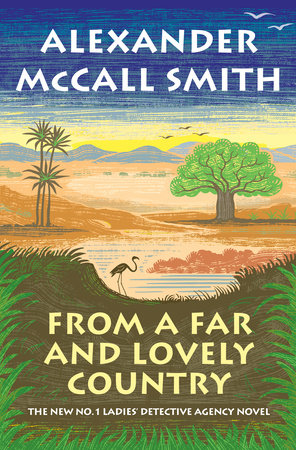
With all the weight of world events and the serious issues on our minds it was my pleasure to spend some time in Gaborone, Botswana with Mma Ramotswe and Mma Makutsi at the #1 Ladies Detective Agency. This is a long series of books about the simplest, the sweetest, and sometimes the bitterest things we encounter in our lives. These life lessons are learned under blue skies and in the shade of acacia trees with plenty of breaks for a cup of tea, preferably red bush tea. From a Far Away and Lovely Country was written by the Scottish author Alexander McCall Smith who lived in Botswana and never lost his love for this little nation. He depicts it as struggling to be modern without losing the values of the land and those who raised cattle on it.
Mma (Precious) Ramotswe set up her detective agency almost by accident. Then Mma Makutsi of the big eyeglasses and peculiar ways became the secretary (who scored 97% on her final exam at secretarial school). Mma Makutsi has promoted herself into a role as another detective in the agency and now Charlie, apprentice to J.B.L. Matekoni (mechanic and husband of Precious Ramotswe) is taking his first try at taking on an investigation on his own.
Two cases need solutions when we visit Gaborone this time. Julia Cotterell has arrived from America, newly widowed, looking for distant relatives in Mochudi where Mma Ramotswe grew up. Then when Mma Ramotswe visits her friend Mma Potokwane who runs the orphanage a new house mother, Mma Ikobeng, talks about a new club in Gaborone which is advertising that it is a place for single’s to meet, but it appears that the men who pay to belong to the club are married and just pretending to be single.
This is all happening on Mma Ramotswe’s birthday, which her beloved husband seems to have forgotten. And then there is the incident of the red dress. Most of the cases that Precious takes on are family problems, or minor crimes or misbehaviors. She is very wise and never lets praise go to her head. She solves cases in human ways, without a need for weapons or action scenes.
Mma Ramotswe is with Julia looking down on the village where she spent her childhood. “They stood in silence, each lost in the sort of thoughts that come to us when we look upon a place we love or are ready to love. Then the sound of cattle bells drifted from below, and Julia turned and looked at Mma Ramotswe and said in wonderment, “There are bells Mma.” And Mma Ramotswe smiled and pointed towards the place where, far beneath them, cattle moved between the acacia trees. It was a sound that all those raised in Botswana had imprinted upon their hearts: the anthem of the land, the notes of the country. And it reminded her of her father and all that he meant to her.” (pg. 140)
These little books contain plenty of homespun philosophy that is necessary in such a complex world as ours. “Experience had taught her that there were many people who seemed to be searching for something that they could never find–who might not even know what they were looking for. That, she thought, was because so many of us felt that there must be an answer to the questions we all asked at one point or another–what was the purpose of our lives and why was there so much suffering?–and if we looked hard enough we would find the key to that search, although understandable, was one that was more or less destined to fail, and inevitably we were disappointed. The way to deal with the sorrow of the world, Mma Ramotswe thought, was not to think you would ever necessarily understand why the world was the way it was. Rather you should list the things you felt were good, and work towards bringing those into the lives of others. That would keep you busy enough, because there was always-always-room for more kindness and love (and tea) in our lives, none of which needed any explanation.” (pg. 140)
I keep reading this series of books because I know they will offer me a dose of kindness, refresh me, and send me back out into the real world where kindness is much harder to find. You will find that kindness is still around if you dish out a bit of kindness yourself. Alexander McCall Smith’s version of Botswana is a lovely place to find myself every time I visit.
Tom Lake by Ann Patchett is a pandemic book of sorts. Lara and Joe Nelson own a farm, rows of cherry trees, some plum trees, some pear trees. The cherries are the money makers. Sweet cherries must be hand-picked. The tarter cherries for pies and cooking can be shaken from the trees onto tarps and they can be frozen.
The pandemic has made it difficult for their usual pickers to arrive. Lara and Joe’s three daughters, all grown but not yet married, come home to ride out the pandemic and to help pick the cherries. When Lara’s daughters find out that she dated Peter Duke, a famous and handsome movie star, Emily, Maisie, and Nell enliven a tedious repetitive task by prying the story of their mom and Peter Duke out of their reticent mother.
Once upon a time a local presentation of the play Our Town finds Lara and her friend registering local actors for the upcoming production in their New Hampshire town where Lara’s mother and father live. Our Town is a big deal in New Hampshire. If you have read the play, you know why. If you haven’t read it, you should. After a failure to find an “Emily” to play that important role, Lara ends up trying out. Turns out she is a natural. Her Emily is so well done that she is invited to go to Hollywood to test for a movie. Lara feels a connection to the Emily character but is she a great actress she wonders. After she wins the part in the movie playing another Emily-style character the film is shelved for several years. Lara is packed off to play Emily in Our Town again, this time in a professional summer theater in Tom Lake, Michigan.
Lara’s daughters, picking cherries and prodding their mother to get to the part where she meets Peter, find that they are finally there. But they want more, they want details. Because these daughters did not come home to tend to their mom on her deathbed (as in some novels and movies), this is a far lighter novel with only a few tragic elements. It’s basically a book that would make a great Nora Ephron movie. Do we have a new Nora Ephron? If Ephron was a product of her times, then we may never have another Nora Ephron, nor another Ann Patchett.
The challenges of being an independent farmer are braided through the other elements in the book and the specter of all those cherries which represent the farm’s income rotting on the trees with no one to pick them is a pressure as intense as our desire to hear about Lara and Duke and why Lara is a farmer’s wife rather than a movie star. Readers also get an interesting peek into what it’s like to work in a summer theater.
Tom Lake was a good read, but it’s also a trip to more carefree, innocent days even though it is during the COVID pandemic. Perhaps people envy America these days in the 21st century because some people still get to live such a life. How much longer? How many of us? Although it is a new novel it already feels nostalgic. The orderliness of a well-run farm, the lines of heavily laden cherry trees under blue, blue skies. You might enjoy spending some time in a place that seems so fragile so in danger of disappearing altogether. I borrowed this book from my local library.
Prophet Song by Paul Lynch won the Booker Prize. That would be enough reason to read it, but the dystopian nature, reflecting America’s possible descent into authoritarianism, makes it essential reading. Eilish and Larry Stack are having a perfectly ordinary night with their children (except the oldest boy who like most teens does not always get home on time). Bailey and Molly are in front of the TV and Ben is breast-feeding, as the author muses on behalf of Eilish,
“The night has come and she has not heard the knocking, standing at the window looking out into the garden. How the dark gathers without sound the cherry trees. It gathers the last of the leaves and the leaves do not resist the dark but accept the dark in whisper. Tired now, the day almost behind her, all that still has to be done before bed and the children settled in the living room, this feeling of rest for a moment by the glass. Watching the darkening garden and the wish to be at one with the darkness, to step outside and lie down with the fallen leaves and let the night pass over.
But the knocking… ” (pg. 6) (Paul Lynch’s writing would drive Grammarly crazy which doesn’t make it wrong.)
This proves to be one of the last ordinary nights the Stack family ever has. Who is at the door? The police, but not the ordinary police, these are the police of the new order, the order that is making up rules against every aspect of the state in which the people have lived for decades, perhaps centuries.
What do these people want, these people who were once neighbors, fellow citizens but are now, somehow, the police who can come to anyone’s door and make them disappear? It seems that they want nothing except power over you and your family. As Eilish struggles on her own, once her husband is rounded up and his fate becomes a mystery, she at least still has a job. Soon her job too falls afoul of whatever it is the new government will tolerate and she loses her grasp on the equanimity that routine offers. Everyone tells her to leave but she can’t imagine leaving while her husband is still being held, while her oldest son is off fighting with the revolutionaries against the new government which sees all citizens as enemies. Why? There appears to be no why, but just a quest for absolute power. These new leaders seem to offer nothing to citizens. Eilish’s sister wants her to come to Canada, but she wants to wait it out, believing it to be a temporary upheaval.
This is a disturbing book that we still ought to read since our senses tell us that this is something that could happen in America right now. Who would know better than Ireland (where this is set) what can happen in a divided nation? What would you do if the stormtroopers, no matter how polite they seem and how officially they are dressed, were to start appearing at doors across America warning you about mysterious transgressions that you were accused of committing? What would you do if family members were taken into custody and never returned? Suppose no information about their whereabouts was forthcoming? Would you leave America? Where would you go? You would have to be quick about it before the rules got too stringent and security measures forced you to find illegal ways to travel. It’s chilling to read about it, but it would be far more chilling to live it. A very timely book and a warning to all of us.
In Absolution by Alice McDermott, we travel back to the days when America was first getting involved in the war in Vietnam, perhaps hoping to solve the issues between north and south with diplomacy while using private corporations to get South Vietnam ready for war. The story is told through the vivid memories of a woman who was only just married to her husband Peter at 23-years-old when he is sent to Vietnam as a consulting engineer. Tricia goes with him. She describes her aspiration at that time was “to be a helpmeet for my husband.” Her father told her on her wedding day to “be the jewel in his crown.” She doesn’t exaggerate. This is the way daughters were raised at that time. Like Mrs. Bennett in Pride and Prejudice who had five daughters to find husbands for, my mother had six daughters to marry off. I was once presented to the pots and pans salesman as a potential bride. I confess that I disappointed my mom.
This is a story of another time, of the time many wish we could recapture, although not necessarily the part where we venture into Vietnam. Tricia describes her days as an endless round of cocktail parties bringing together men (and their families) from the military, the government, and corporations. Women, being helpmeets for their husbands, spent hours wearing gauzy cocktail dresses over iron-clad undergarments at garden parties in humid, hot discomfort, attempting to look cool and pretty. She begins her story by telling what a typical day was like. Wives would bathe in the morning, staying in their bath until noon. Then they would do their nails, send out little witty notes to other wives, burn joss sticks to perfume the heat. After that they would apply face powder, rouge, lipstick, pin dress shields in the chosen cocktail dress, don undergarments and stockings, add shoes, and spray some perfume. Tricia says that she would be “faint with heat in my column of clothes.”
Obviously, Absolution is not a book about the Vietnam War. It offers a peek into something we never thought to wonder about. What was daily life like for the wives of the men who were trying to make peace while preparing for war. America tends to turn the foreign countries where it spends time into spaces that resemble America as much as possible. Except for their servants and shopping in the marketplaces these wives saw little of what life was like for the Vietnamese. Tricia describes the Vietnamese women who passed them by as “girls we passed on the streets…were like pale leaves stirring in the humid stillness, sun-struck indications of some unseen breeze, cool, weightless, beautiful.” Alice McDermott is a good writer.
Charlene, who befriends Tricia, is a mother of three and “a seasoned corporate spouse.” She practices the small charities that she would have pursued if she was still in America, taking baskets of small gifts into hospitals for example. She comes up with the idea to dress Barbie dolls in Vietnamese attire and she sells them to help her buy the supplies for her baskets or she gives them as gifts sometimes. Tricia, although shy, is easily persuaded to help the beautiful and confident Charlene with this and other activities. Tricia is having a crisis of her own as she attempts to be the perfect helpmeet and partner by making a family, having a child. She has a series of miscarriages that make her feel guilty, damaged, and which undermine her own confidence.
It’s a little gem of a book that too many might dismiss as a “girl book.” The way the author immerses us in the mores of the 1950s and 60s, the evocation of a world and a time most of us have never experienced makes this novel well worth a read. Some key scenes have been left out of this review to make them fresh when you encounter them for the first time. While it would have perhaps had more universal appeal if we also followed the husbands as they lived out their days, there is no way for most of these women from these times to have any intimate knowledge about that.
“But how I wished that there existed someone to whom I could say I was sorry.” says Tricia in the Epilogue, quoting Graham Greene from The Quiet American.
While The Jinn-Bot of Shantiport by Samit Basu is not great literature, this novel epitomizes the discussions of AI that dominated 2023. It also does that thing that sci-fi does so well. It offers commentary on modern and future society and politics.
Shantiport is a once-prominent city with a port that was busy and thriving. It is now a backwater decaying city that has internal problems which keep it in existential danger of dying out completely.
We wonder how we will ever become home to multicultural societies which should be easy for us because we are all humans. Shantiport wants to become a multicultural oasis which seamlessly protects the rights of both humans and bots. The bots seem to exhibit the same propensities as humans for violence, elitism, and tribalism. In this case the Tiger clan is warring against the Monkey clan.
The bot characters are well done and are as appealing, at least those who are main characters, as the human main characters. In fact, we find that those main characters, both bot and human, are a family unit as in brothers/sisters/ancestors. When the “jinn” is recovered from where it was hidden (Aladdin of legend) the one who holds the jinn gets three wishes. If your goal is to restore Shantiport to its former glory and make it a truly multicultural city what would your three wishes be? Be careful, it’s a very tricky jinn.
The same difficulties apply if you are trying to profit personally and don’t really care about the fate of Shantiport. This may not be literary fiction, but it is fun, and inspires thoughts about our own present and future dilemmas.
Sadly, not many Americans will read Tyranny of the Minority by Levitsky and Ziblatt. It’s not difficult to understand, but it is dense with historical evidence/proofs to back up the authors’ points. Still, this is an important book, and all citizens ought to read this treatise or at least read a summation of the points these two now-famous authors make. They are neither revolutionary nor extremist, but rather scholars who study democracies – why democracies work, how they work, and what dismantles them or makes them less democratic.
Americans revere the founders and our documents, the authors say, but our founders knew our Constitution would need to be revised and updated. Certain antique features that have remained as facets of our republic, which democracies that formed later did not include in their founding documents, have allowed a minority party to exploit these anti-majoritarian features to keep power even though their numbers are in the minority.
Chapter 1: Fear of Losing opens with a lesson from Argentina and the Peron family. This is a discussion of the peaceful transfer of power. At the time when our nation was formed handing over power was not the norm anywhere in the world. Also discussed is the struggle between John Adams and Thomas Jefferson when the Federalists wanted to hold on to power and Jefferson contemplated the use of violence. “Outsized fear of losing turns parties against democracy,” says one source. Examples from the German terms in office of Angela Merkel and from modern Thailand are also discussed.
Chapter 2: Banality tells the story of the crisis of a French party in 1934. What are the expectations of those who are loyal to democracy?
1. To respect the outcome of free/fair elections.
2. To reject the use of violence to stay in power.
3. To always break with undemocratic forces and watch out for semi-loyal democrats who play a passive role in democratic collapse.
2. Sever all ties with groups that back anti-democratic behavior.
3. Loyal democrats must unambiguously decry violent acts and condemn them publicly. Semi-loyalists try to have it both ways.
4. Join forces with rival democratic parties to defeat authoritarianism.
Examples from Spain in 1936 are used to make their point along with Joe McCarthy’s Unamerican Activities campaign in America.
The authors list four ways to subvert laws:
1. Exploiting gaps or loopholes (Ex. denying Obama chance to name a Supreme Court Justice – had never happened before)
2. Excessive or undue use of the law (Ex. presidential pardons meant to be used sparingly, also impeachment).
3. Selective enforcement of laws.
4. Law-fare (as in warfare) – laws are used to target the opposition.
Orbán’s journey towards illiberal democracy in Hungary is summarized:
1. Voting system was changed
2. Purged and packed the courts.
3. Expanded numbers of judges in their supreme court.
4. Passed a law changing retirement age for justices. By 2013
the judiciary was a puppet of the government.
5. Media became a government propaganda arm.
6. Used constitutional hardball to change the way seats were filled on Electoral committees and retained control of parliament regardless of the popular vote.
Chapter 3: It Has Happened Here brings to our attention a time after the Civil War when freed Black men began to fill important positions in the government of Wilmington, NC. This seemed to open the door to multiracial politics until a group of prominent white Democrats launched a violent crusade to restore white rule (remember those Democrats are now Republicans as the parties switched in the 1960’s). It’s not a pretty story but you should know about it. The prospect of multiracial rule angered the South in part because it upended social and racial hierarchies.
Chapter 4: Why the Republican Party Abandoned Democracy
During the term of Lyndon Johnson and the passage of the 1964-65 Civil Rights Bills these reforms passed with votes from both parties. 60 years later, the authors say, the Republican party has become unrecognizable. He reminds us that Republican Mike Lee called for “liberty, peace and prosperity” but not democracy. They inform us about VDEM which issues an annual illiberalism score. The GOP’s illiberal score soared after 2000. Examples include the Republican’s “Southern Strategy” and State’s Rights and the added White Christian strategy of the “Moral Majority.” Once again the rise of multiracial society threatens the White party, the Republicans.” This chapter offers up the current situation in America.
Is the entire Republican Party anti-democratic? Answer these questions to determine their Democracy grade.
1. Did they sign on to the amicus brief to nullify votes in 2020?
2. Did they accede to manipulations of the Electoral College votes?
3. Did they cast doubt on the legality of the election?
4. Did they vote against Trump impeachment?
5. Were they against an independent commission to investigate 1/6?
6. Did they refuse to hold Steve Bannon in contempt for ignoring a subpoena?
Chapter 5: Fettered Majorities begins with a discussion of the disemboweling of the Voting Rights Act pre-clearance section in Shelby County v Holder and the 26 states that subsequently passed restrictive voting laws. Although Dems had total control when the John Lewis bill came to the floor the bill died again and again and finally two Democrats, Joe Manchin and Kirstin Sinema, killed it. A partisan minority is currently blocking majority power the author tells us. It can’t be too easy to change the rules in a democracy and it can’t be too difficult to change the rules either. We protect minority rights, but we are learning that there can also be a tyranny of the minority. In addition, one generation can tie the hands of future generations far into the future.
Chapter 6: Minority Rule begins with a discussion of German “bread lords” and the urban/rural divide in Germany at that time. Political institutions were frozen in place despite demographic and social changes. We are experiencing that same situation in 21st century America. Only in the 21st century have counter-majoritarian rules benefited a single political party. This is due to the same urban/rural divide encountered by the Germans in the 20th century. We now have a rural state bias in the US Senate, the Electoral College, and the Supreme Court. As a result, say the authors, “we run the risk of descending into ‘minority rule’.” They explain in some detail.
Chapter 7: America The Outlier explores how a country (America) that set out to find an audacious new idea for government has now fallen behind other democracies on scores determined by Freedom House. Most countries dismantled undemocratic sections of their constitutions. Elections would no longer be determined by “first past the post” rules. Upper chambers of government were no longer elitist, but either more representative or no longer existed at all. Cloture rules were simple as opposed to our filibuster rules which allow minorities parties to delay cloture altogether. Judicial review which allows Supreme Courts to overrule legislative laws is an area that has not been reformed. Other nations have laws about term limits for judges or specify a retirement age, which we do not. We have made some changes to rules to make them less counter-majoritarian as with the laws that allow direct elections of Senators, but we have kept most of the laws mentioned above. “The US” the authors say, is a democratic laggard.” We have the hardest constitution to change and are now the least democratic of the world’s democracies.
Chapter 8: Democratizing Our Democracy is necessary because in America majorities do not really rule. Remedies are offered up by the authors and most of them have to do with upholding the right to vote. I should not steal the author’s thunder by offering potential readers a comprehensive list. You really should read the book. However, here are a few of the suggestions:
1. Establish automatic voter registration.
2. Expand mail-in and early voting
3. Schedule elections on weekends or holidays.
4. Restore national voting rights with federal oversight.
5. Ensure that elections results reflect what people want.
6. Abolish the Electoral College
7. Reform Senate to be proportional to the population.
8. Eliminate partisan gerrymandering.
9. Abolish the Senate filibuster, etc.
10. Make it easier to amend the Constitution.
This is an important book, and it is well-researched. I did not get to read a print version because I was having cataract surgery (which has turned out well). Listening to an academic book that reads like a text is not ideal. Page numbers to give attribution for direct quotes are not available and some quotes get missed because they go by too fast. This is a book that would be best added to your library in print so that you could refer to it as necessary. I had to take notes. These two authors will most likely not be heard by those who need to hear/read these truths because of our current partisan divide but Levitsky and Ziblatt are fighting along with many of us to save our democracy. Their academic approach adds gravitas to the points those of us who love democracy are trying to make.
The Secret Hours by Mick Herron is a sort of spy story, but it’s not James Bond. No loveable Moneypenny or Q here. No clever devices that look ordinary but have magical abilities to save an agent in dire straits. In fact, half of the characters are not even spies, but their story begins when the Berlin Wall falls and an actual spy comes out of the East and meets a grieving wealthy man who lost his sister and who knows what happened to her and who did it. Who is Max and why is he being chased down the Green Lanes as the book begins by people who seem intent on killing him?
You will have to spend some time in the Regent Park Office in London where a group has been set up to find what kinds of unethical business the hired hands in the spy business have been up to. The committee’s remit is called Monochrome, which perfectly describes how Griselda Fleet and Malcolm feel about being assigned to this investigation. Both thought they were headed up the ladder to plum assignments and both are unhappy and worried to have been shunted sideways. They did not even have access to documents from Regent’s Park where actual scandals might have been expected to lurk. If you happened to read any bits from David Foster Wallace’s unfinished book, The Pale King, which takes place in the IRS, then you feel right at home in the home office.
Don’t get too bored because you are going to have all the action you can handle in Berlin (the spook’s zoo). They are a depraved bunch who have seen it all and are jaded and deep in the aftereffects of WWII. Myles has been embedded in East Berlin and has experienced the peak moments of postwar Soviet spying, the dossiers, the imagined crimes, the real crimes, the Stassi, the paranoia, the tattling, and the terrible repercussions of the tattling. Into this foreign office enters Allison, a young intelligent innocent who had expected to work at a desk and now finds herself pretending to complete assigned paperwork. At the same time, she does the real work assigned her which is to spy out what is going on in Berlin. However, the crux of this matter is personal, not professional. So, not about true spying at all, although it feels exactly the same. It’s about people, people who will surprise you. I can’t tell you; it’s a spy story, sort of.
Clearly wars do not end when treaties are signed, when spoils are divided, when horrendous war crimes are turned up, when revenge is planned and eventually taken. Names change, years pass, people age and disguise themselves and become unrecognizable. Justice gets done but not in a court. First Desk proves to be not all talk and no action. The author knows how to set a scene. Don’t you just love a good spy story. This one is very good while you are reading and great after contemplation. Don’t just move on to your next book until you have sat with this one for a bit.
You know the story. Boy meets girl. Girl and boy spend time together, grow up together. It’s a love story – no, not Romeo and Juliet, not that kind of love story, It’s complicated.
In Tomorrow and Tomorrow and Tomorrow by Gabrielle Zevin, Sam Mazur and Sadie Green meet at a hospital. Sam has already experienced two traumas that would mess up anyone’s mind. Sadie has a family member in the hospital so has a fair bit of trauma in her life also. Her sister had cancer, but it has responded to treatment and Alice is there for more routine reasons. Sadie is getting ready for her Bat Mitzvah. Sam is tuned into his own grief. He lost his mother in a car accident and crushed a foot in the same car accident. Sam and his mother had moved from New York City to Los Angeles after a bizarre accident in that city seemed like a warning of danger. Moving obviously didn’t work. Sadie only spends time with Sam reluctantly at first, but they become close friends for a while. When Sam learns that Sadie is counting her time with him as community service for her Bat Mitzvah he is hurt and angry. They lead separate lives until Sam runs into Sadie at a train station.
What Sam and Sadie have in common is gaming. Sam’s Korean grandfather owns a pizza shop with a Donkey Kong machine he hoped would attract customers. Sam had permission to play as much as he wished. Since Sadie kept getting kicked out of her sister’s hospital room, Sam and Sadie played computer games, passing Sam’s laptop back and forth.
This may not be a conventional love story and it is not, despite the title, a literary novel. It is however a great gamer story and there is love and betrayal, and anger, and possibly undeserved blame. There are relationships, there is the passage of time, and there is more trauma.
My own gaming experiences are limited to the maligned “shooters” which Sadie and Sam find unartistic and antisocial. The games I played were Pac Man, Snood, and Space Invaders, shooters all. Sadie’s favorite game was Oregon Trail. In college she had as her professor Dov, a young Israeli game designer who had created and successfully marketed a popular game.
Sadie and Sam eventually create a game called Ichigo – a game with a child lost at sea who must be rescued. The game has beautiful graphics and becomes iconic. Sam’s college roommate Marx Wantanabe, is a wealthy guy with amazing social skills. Marx provides upfront money and resources for Sadie and Sam while they code and look for an engine that will drive the graphic results Sadie pictures in her mind. Marx and Sadie share a love of art and literature, especially Asian art and Shakespeare. These gamers are all very young, they drop out of college for a semester to create Ichigo. By the time they are out of their twenties, they are financially successful which seems to affect their lives very little. Love and friendship are far more difficult to maneuver through though.
You can enjoy this novel as a story. The characters are immersive. Or you can enjoy this book as a blueprint to reach gamer stardom. It’s a coming-of-age-story with a twist. It’s also a success story. I am still waiting for eye surgery, so I am still reading on Audible which I am getting used to. It doesn’t put me to sleep anymore. Although I am too old to be the intended audience for this book, I still enjoyed it. We all have a bit of the entrepreneur in us along with a taste for romance. For me the relationships seemed more like they were mapped out by a game creator than offering the personal involvement with love that readers can sometimes experience. There was always a distance between even the characters who did get intimately involved. Not my favorite book ever, but I looked forward to listening each time I got the chance.
After reading Alex Jones’s book, The Great Reset, which takes readers down the “New World Order” rabbit hole it seemed important to read someone who might get readers out of that endless antisemitic rabbit hole and back on the solid ground of more reasonable levels of paranoia. Mike Rothschild’s book Jewish Space Lasers: The Rothschilds and 200 Years of Conspiracy Theories was published in 2023. Mike Rothschild tells us that his family is not genetically connected to the wealthy and famous (infamous) Rothschilds.
This well-researched nonfiction book is packed with details and is practically a textbook about the Rothschilds. Mike Rothschild explains that he did try to interview people who are descendants of Mayer Amschel Rothschild. M. Rothschild had a problem though. He was trying to prove a negative, that there was no Rothschild conspiracy to take over the world through control over its financial institutions, that the Rothschilds did not finance both sides of every war, that they did not back both sides in the Civil War, or plot to divide America between Britain and France – that while some Jewish people may have prodigious talents in understanding and profiting from economics and finance, and although they may head many world banking institutions, there is no plot to bring about a “New World Order”. (introduction)
His chapter headings show his journey through the evidence he unearthed. Although Mayer Amschel Rothschild and his very successful son, Nathan, left behind very few records, there were many other primary resources to study. Ch. 1 talks about Greedy, Cheap and Blessed: The History of Jewish Money Tropes, Ch.2 covers A Brief History of the Rothschilds, Part 1, 1565-1868. In Ch. 3 we learn about the Waterloo Canard: the Rothschild myth to end all myths, Ch. 4 tells us about The Satan Pamphlet, and Ch. 5 A Brief History, Part 2, 1868-1933. Ch. 6 summarizes Rothschild myths in America and Ch. 7 talks about the Rothschilds during World War II. Ch. 8 is titled Calling all Crackpots: Rothschild Conspiracy Theories in the Postwar World, Ch. 9 covers the “Disinformation Superhighway”, Ch. 10 is about the Rothschilds in popular culture, Ch.11 talks about Jewish conspiracy theories around the World, Ch. 12 immerses readers in the most recent sections of the “rabbit hole”, Rothschild Conspiracy Theories in the Age of Trump, and Ch. 13 suggests how George Soros became the Rothschilds of the 21st Century.
Sources covered by Mike Rothschild are varied and he tells us that he is not creating a bibliography to guide our reading. He also tells us that the contents of some of these materials are distasteful and often almost incomprehensible. He is saving us the effort of reading hate-filled ranting. He discusses a 1947 film called Gentlemen’s Agreement which he describes as a blunt examination of the banal nature of antisemitism in upper-class America. But this source is mild compared to others. He tells us in some detail about the activities of the poet Ezra Pound. Then we learn about Pound’s acolyte, Eustace Mullins (born in 1923) Mullins wrote “The Secrets of the Federal Reserve” which was finally published with that title in 1983. He wrote a pamphlet entitled, “Adolf Hitler: An Appreciation”, and another called “The Biological Jew, Murder by Injection: The Medical Conspiracy Against America. “Mullins,” says the author, “bridged the gap between Pound and Alex Jones.”
In fact, Alex Jones called Mullins “the great-grandfather of the movement against the Federal Reserve and the New World Order.” (p. 145) Mullins did not die until 2010. Glenn Beck promoted the “Secrets of the Federal Reserve” in 2010 “to attack the Fed, George Soros, and Obama-era monetary policy.”
M. Rothschild cites Willis Carto who published a newsletter called The Liberty Letter. He was a Holocaust denier. He attacked “all manner of Rothschilds, Rockefellers, and Communists and Carter, and Bankers, and Rich People and the Trilateral Commission.” (p. 146) Mike cites Conde McGinley in 1947 – 1972 writing a publication titled “Common Sense“. In a 1970 issue, Mike tells us, McGinley wrote about “Rothschild Bank Syndrome” as “the cause of all modern woes” – “Rothschild banks have financed both sides of every war.” McGinley’s publications were made possible through the Christian Education Association. All modern sources harken back to “The Protocols of the Elders of Zion” which came out of the antisemitism of Tsarist Russia in 1900.
“To understand Kanye West ranting on Alex Jones’s show about how great Hitler was requires understanding the influence of that John Birch Society speechwriter Gary Allen’s 1971 book, None Dare Call It Conspiracy, had on Jones, an effect which he has spoken of many times. Allen’s book, which sold millions of copies by attacking Jewish ‘insiders’ like the Rothschilds, was inspired in part by Secrets of the Federal Reserve (xv) which can be traced back to The Protocols of the Elders of Zion.”
Of course, the most titillating bits of the book are in the last chapters. In chapter 12 Donald Trump enters the arena. M. Rothschild tells the story like this. “The Tea Party movement exploded in the US during Obama’s first term, fueled by conservative terror over imaginary wealth confiscation and the looming specter of Marxist control and/or martial law.”… “Patriotism-tinged allegations of Jewish/New World Order/Communist/Leftist domination were nothing new,” the author goes on to say. (p. 223) … “But one American celebrity, mulling over the idea of throwing his considerable cultural and financial weight into politics was paying attention… He noticed the power and appeal of the movement’s unhinged conspiracy theories, vague accusations of a global super-government, and ‘us versus them’ rhetoric when they were unleashed by radio talkers and blogs on disaffected Republicans angry about the Black president with a foreign-sounding name. And Donald Trump wanted in.” (p. 226) Next chapter, George Soros.
Here is the reason the Rothschilds gave for not agreeing to be interviewed by Mr. Mike (who is not from ‘those’ Rothschilds). The Rothschilds declined because they would be forced “to do something that essentially can’t be done, which is prove a negative. They would have to prove that they don’t have $500 trillion, that they didn’t conspire to use the Civil War to divide the United States between Britain and France, or that they didn’t sell their Austrian hunting lodge in a rush because QAnon found out they hunted humans for sport there.” They go on to say that “[t]he accusers won’t believe them anyway.” (p. xvii)
Will the accusers believe Mike Rothschild? Although he makes a strong case that these theories are “unhinged,” and he uses sarcasm and innuendo to embarrass those who at least pretend to be convinced by the persistence of the conspiracy theories and by their admiration for their fellow believers (perhaps a mutual admiration society), this detailed discussion may not change the minds of the convinced or of those who have become wealthy through keeping these conspiracy theories and the antisemitism they give credence to alive.
“For many Jews,” says Mike Rothschild, “the Rothschilds have been a beacon of hope in dark times, a reminder that anything is possible with unity and a steadfast devotion to family and tradition.”
“Any minority with its own language, customs, clothing, and culture is bound to be resented by the majority. But historically only Jews have found outsized professional success through that majority – loaning it money, managing its finances, settling its legal disputes, entertaining it, and the like. And they’ve suffered outsized resentment because of that success. Antisemitism and Jewish wealth are bound up in each other, and Jewish success is at the core of the conspiracy theories about them.”
Good job, Mike Rothschild in collecting all this information in one book, for making us think about where we stand on a set of conspiracy theories that has lasted for centuries. We do think it is quite possible that the wealthy tip the global scales towards policies they favor, but we do not all necessarily think that this is a strictly Jewish endeavor. Sometimes people who are trying to commit an unethical cultural act project the blame onto others to detract from what they are trying to do. Perhaps in our times, the right-wing in American politics wants to become the New World Order and the world’s central bankers and they think that blaming the Jewish people is convenient because of the long history of this particularly paranoid antisemitic conspiracy trope. If the Jewish people were/are so talented it seems that they would have taken over everything long ago. If they already have taken over, we might expect the world to be running a bit more smoothly than it is.
Disclaimer: I had just finished this book when Hamas attacked Israel and it is perhaps not the best time to discuss the materials covered in this book. However, the conspiracy theories about the Rothschilds are not directly connected to the current atrocities. This discussion has far more relevance to the diaspora than it does to the existence of a Jewish state or a Palestinian state except to say that for people who were exiled and who belonged to new nations only temporarily, the talents of Jews seem even more amazing and perhaps resulted from their dispossession, their lack of aggression, and their steadfast cohesion as a group.










 So Many Books, Choose Wisely