What We Can Know by Ian McEwan-Book

From a Google Image Search – LA Times

Ian McEwan’s new book What We Can Know is a non-dystopian view of how human indifference might change world geography, it’s a celebration of nature, the humanities and poetry, and it’s a mystery. Any story that begins in the Bodleian Library generally offers us a kind of magic. I guess we can blame that on Deborah Harkness and on the academic glamor of Oxford University.

It takes a while to place everything in the correct historical time and to adjust to bouncing back and forth across a century. Tom Metcalfe is living in 2119, but he is a historian whose interest lies in the period from 1990 to 2030. He is trying to find a poem that was written by a writer named Francis Blundy for his wife Vivien. Blundy read it aloud on her fifty-fourth birthday at what came to be called “the Second Immortal Dinner.” Then he gave Vivien the poem, and no one ever saw it again. There are secondhand reports of what was said in the poem, but the poem itself vanished.

The poem was written in a very lengthy and difficult form called a corona. Blundy’s corona consisted of 14 Petrarchan sonnets and a fifteenth which had to repeat the first line of each of the 14 and that had to make sense. A Petrarchan sonnet had 8 lines that rhyme ABBAABBA and 6 lines that rhyme CDECDE. The literary world held its breath, but after almost a century the poem was still missing. Tom has taken on the task of finding the “Corona”. As he searches, we get glimpses of what neglecting to deal with climate issues has done to the planet. There are allusions to Nigeria, although they are rather vague. Tom seems to live in what is left of England, now a series of archipelagos and islands. The Bodleian library has been moved to higher ground making it problematic to travel there.

Apparently, the humanities academics have always been a rather randy bunch, with all kinds of sexual adventures and affairs causing ruffled emotions that are often hidden under polite exteriors (and sometimes not). Vivien was apparently a charming and beautiful woman who had a few adventures before she married Percy Green and a few while she was married to him. She loved her husband very much but only enjoyed his company for a few years as he developed early onset Alzheimer’s. He had been a craftsman making classical-quality violins. Alzheimer’s disease worsens over time and requires extended and intense caregiving. Percy’s Alzheimers was already advanced by the time Vivien met Francis Blundy, although she had already ended an affair with his editor, Harry.

Tom, in an off again, on again relationship with Rose is somewhat in love with Vivien although she has been gone from his world for a hundred years. He loves the property she lived in with Francis, after Percy died and they married. The property was known as The Barn and Vivien had her own office in the dairy building nearby. Everything had been carefully renovated, and since the “Derangement” (wars, and flooding) had not happened yet much of nature was still intact.  Tom gets a valuable clue from a colleague about the possible place where the Corona might be buried. What he finds out says more about human nature than it does about poetry. It’s a book to love and ponder about, but it does not mince words about the human condition.

Circle of Days by Ken Follett-Book

From a Google Image Search – People.com

In the Pillars of Earth, Ken Follett got us involved in the building of a Gothic cathedral in the fictional town of Kingsbridge. Many readers already knew the architectural features of classic Gothic cathedrals right down (or up) to the flying buttresses. It was one of Ken Follett’s finest novels. Obviously, cathedrals were not a primitive undertaking. Societies and population had to reach a certain point before such a building might be needed or even imagined.

In Follett’s newest book, Circle of Days, he weighs in on the speculations of how a place like Stonehenge could have been built before the age of machines. His words draw for us a possible moment in time when tribes of people occupied a fictional Great Plain. He gives us the flint miners, the herders, the farmers, and the Woodlanders. The herders have more time to think about eternal questions like the human spirit and practical matters like seasons, the heavens, and math (counting) all of which affect the herds of cattle they protect. Herders’ duties were not constant burdens as were the survival struggles of the other groups.

Often the fortunes of a tribal group depended on the temperament of the leaders. Follett’s farmers have a cruel authoritarian leader, who does not respect the boundaries of the other tribes and who exercises absolute authority over everyone (especially women).

Herders happen to have a council of leaders who make decisions after discussion by majority agreement. It’s not voting but it’s similar, although only involving a small group of elders. 

Woodlanders are more primitive than other tribes. They love their woods which provide them with all their simple needs. They stay hidden and speak a language of their own. 

The herders have built a circle of tall tree trunks joined by a wooden lintels and arranged in pairs. They have priestesses who know how to count, something others have trouble mastering beyond what they can see on their fingers and toes. The priestesses know how long a year is. They memorize songs which keep their knowledge in a form that can be passed on to new priestesses. They know about equinoxes and solstices, although not necessarily by those words. Four times a year they perform the songs, and they count. The tribes gather and travelers come to trade. The flint miners play a large part in these markets.

But because these are humans, the tribes do not always live in harmony. When there is a years-long drought, those who are cruelest seem to have better survival skills because these leaders have no boundaries and will steal land or cattle or woodlands, exercising a sort of early imperialism. When the farmers (the men only) decide to divert the midsummer market, which is the biggest market, from the monument of the herders with the circle of trees, they burn down the circle to rob the herders of the ceremonies that bring travelers to the village near the circle. 

Because of the moral character of some of the herders (mostly the women) the priestesses refuse to be beaten. Joie, daughter of the wisest woman Ani, has seen a field of giant stones out on the Great Plain. She wants to build the monument circle out of these giant stones so they cannot be destroyed.

Follett tells the story of how he thinks they did it. Are humans with extraordinary talents, born at the right moment, responsible for the progress of human societies? Follett seems to suggest that is true. This project is not as complex as building a cathedral but, considering that the population of the area was much smaller and the social structures so much simpler, we have all wondered and speculated about why Stonehenge would have been imagined and how it could have been built. 

Reading about the state of humans on and around the Great Plain is made interesting by giving the people in the story names, personalities, families, sexual structures that helped prevent inbreeding, and by creating a crisis that brings out the best and the worst in his characters. Even more interesting is Follett’s theory of how this magical circle was built which stays close to our current educated guesses about how such primitive people could produce such a sophisticated monument involving a detailed knowledge of astronomy, in particular the movements of the sun and moon. I found the novel enjoyable. Perhaps you will too.

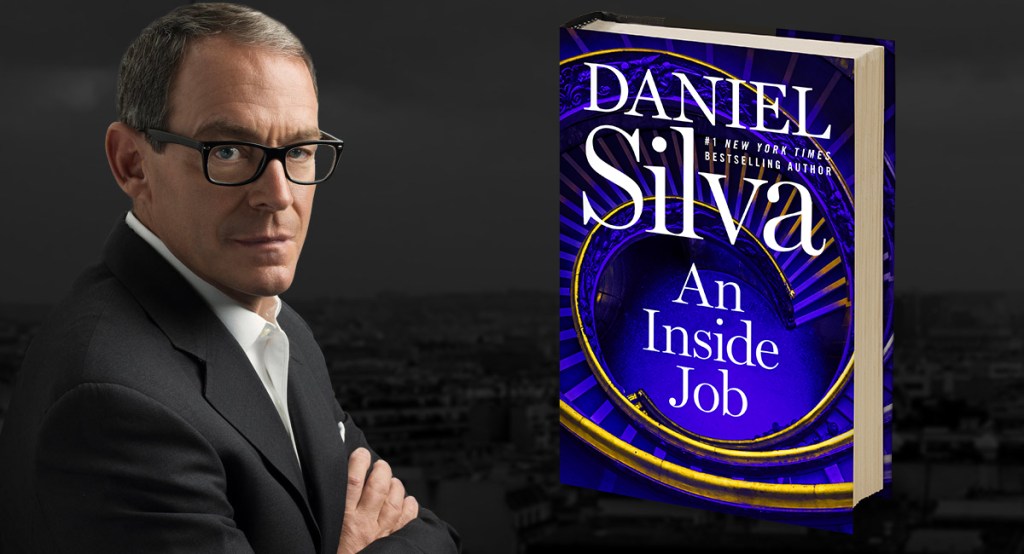
An Inside Job by Daniel Silva – Book

From a Google Image Search – Daniel Silva

Daniel Silva has published a new book called An Inside Job. His key character is Gabriel Allon, a retired head of Israeli intelligence. He is also a talented artist who restores Renaissance Italian artworks, often frescos in cathedrals. He has a connection to the Pope and knows his way around the Vatican because he has worked on restorations there. He lives with his wife Chiara and their precocious twins in Venice.

Gabriel is almost finished with his current restoration project, a project requiring scaffolding and spotlights with a canvas curtain to separate him from tourists. When he spots an anomaly in Venice waters one day, the police investigate and pull the body of a young woman from the harbor.

This young woman has a connection to the Vatican, so we leave the rather lighthearted watery environs of Venice and find ourselves once again immersed in the Byzantine politics that surround, but do not implicate, the Pope. This time the object of contention is the discovery of a possible new painting by Leonardo da Vinci. It’s all about money after that and involves a shadowy mafia-style group that skims money from the Catholic Church and is determined to keep these activities secret.

Facing possible murder, Allon finds the evidence to hold the perpetrators accountable along with the help of some of our favorite old members of the Allon team. In the end we find ourselves back having ice cream with Chiara and the twins in Venice. All-in-all a very satisfying installment, rumored to be based in reality, and, indeed, An Inside Job á la Daniel Silva.