The Next Day by Melinda French Gates – Book

In her book The Next Day: Transitions, Change, and Moving Forward, Melinda French Gates reveals what led her to divorce Bill Gates, but this book is not intended to feed the gossip mills. Gates explores her life lessons arising from several times of transition, in her life. 

Melinda Gates does not travel a superficial path. She may be religious, but in this book her journey is more spiritual. She acknowledges her feelings, analyzes her deepest fears, and conquers obstacles.

Leaving a supportive, loving family to go to college at Duke in North Carolina she encountered homesickness, loneliness, doubt, and academic difficulties but she stayed at Duke. Sometimes she found solace in books or poetry. She joined a sorority and made new friends. What she went through is not unusual. Many freshmen make this adjustment. But she knew that it would change her life if she left school. She even went on to earn an MBA at Duke. Her father saw her as a scientist and mathematician, giving her the confidence to compete in tech fields mostly pursued by men.

A second key moment Gates describes came at the birth of her first child, Jennifer Katharine Gates. An earthquake brought this realization:

“My new world spun on a new axis, with Jenn at its center, I realized I would have died for her that night. I would have sacrificed Bill for her in an instant. I would have given my own mother’s life to save Jenn’s.” (p. 32)

She continues to talk about parenting:

“Eventually, I found that framework in the concept of the “good enough” parent. The concept traces back to a British psychologist named Donald Winnicott, who coined the phrase in the 1950s… (p. 42)

and

“Most of all, we need the discipline to separate our own needs from our children’s and the wisdom to know when to let go. (p. 35)

Bill and Melinda had a close bond with another couple, Emily and John. When John dies of cancer, Melinda goes through all that comes with a great loss. She describes how she goes on with her life, and how she supports Emily in her grief.

The moment Melinda understands that her gut is telling her that she needs to divorce Bill and pursue her own goals almost sends her world almost out of control. She finds a therapist, after much self-reflection who helps her find her way to her next day. 

All these transitions are difficult, but even more so when your life is so public. Melinda wants to put her considerable gifts to work helping women around the globe achieve their own goals. Considering the challenges to women’s rights, even in supposedly enlightened nations, we can only applaud her present and future contributions on behalf of women. 

Melinda French Gates is an authentic person, as reflected in her book The Next Day. Her experiences are not so different from those of all women. Even so, her book is inspirational and aspirational because of the courage and clarity with which she faces each challenge. 

The Oligarch’s Daughter by Joseph Finder-Book

From a Google Image Search – AP News

The Oligarch’s Daughter by Joseph Finder is a thriller that brings Russia to America. Arkady Galkin lives large and seems to be wired into power in two nations that we usually think of as enemies. However, when Paul Brightman falls in love with and marries the oligarch’s daughter, Tatyana, it becomes quite clear that the Russian is somehow connected to powerful people in America and that Paul is at risk. Paul had a job at a hedge fund, a job he liked with people he also liked. Galkin pressures Paul into working for him in his “investment firm”. As Paul learns that Galkin’s business involves illegal financial moves, Paul becomes aware that his new father-in-law will not tolerate any disloyalty. He decides that he needs to run.

The book opens with a man with two names fighting for his life. Grant Anderson/Paul Brightman wins this battle, but it’s just the beginning of a war for his own survival. Paul’s father was a survivalist who lived much of his life in the deepest forests of America. Paul, who lost his mom at sixteen, thinks his father is a nut. He finds him embarrassing. Little does he realize that the survival skills his father taught him are about to come in handy. 

As we switch back and forth from Paul’s past with Tatyana to his present life as Grant Anderson, we find Paul caught up in running from dangers he should have been aware of as he courted Tatyana. Why are the FBI and CIA involved in all this, and why are they not on Paul’s side.

It’s a good thriller, although a bit offbeat from a classic one. We share Paul’s anxieties and his controlled panic. We travel to Moscow and back in the years of Paul’s marriage and then we run with him through the woods chased by people who should not be chasing him in the present. Of course, people die. 

There is a section in the middle of the story which gets a bit bogged down in complexities and details. slowing our fevered dash from danger. It’s complicated. But soon it’s a headlong adventure in survival and Paul learns to take new pride in his father’s lifestyle. Who survives and who doesn’t? What happens to Paul’s wife Tatyana and Grant Anderson’s girlfriend, Sarah? It’s a good read, but not on my best thriller’s list.

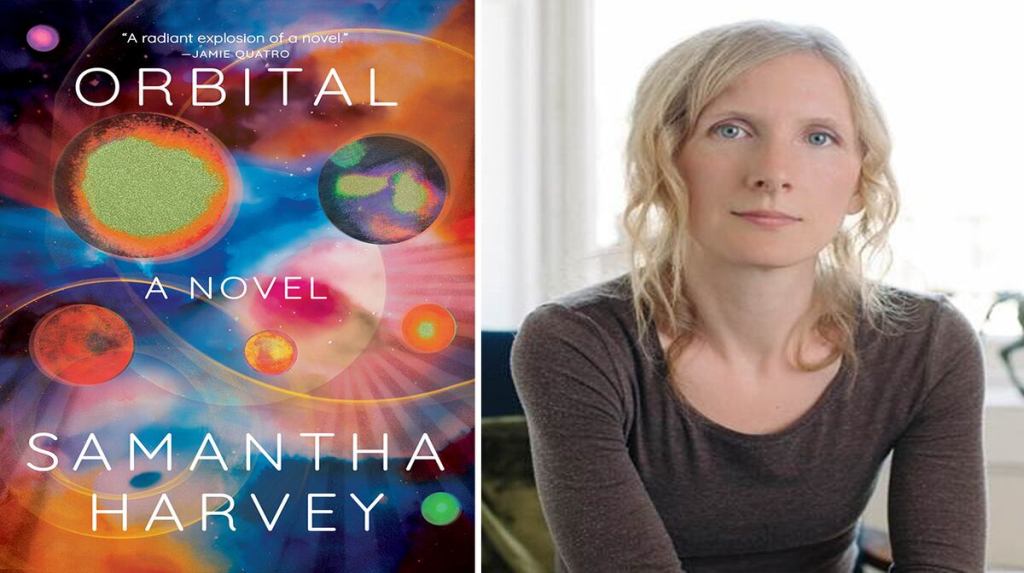
Orbital by Samantha Harvey – Book

Being a physical chicken made me realize that I could never be an astronaut although I love science fiction stories that take place in space. No Blue Origin for me. No Mars on the Space X Starship. However, it no longer matters because Orbital by Samantha Harvey will allow even the most cowardly human to travel in space for a too-brief time. We travel with Anton, Roman, Pietro, Shaun, Chie and Nell, a diverse six pack of astronauts, aboard the space station. 

No plot, no conquest of space and time, no spin-out into emptiness, only small dramas. Just the day-to-day minor miracles in the lives of these six people, eating, sleeping, conducting experiments in space science, their travels across time zones, across dawns and evening and nights. The earth in daylight appears unpopulated – at night the clusters of lights from cities and towns makes life visible from space, but the stars glowing in inky space outshine the city lights. 

These astronauts have been through years of training to sleep in sleeping bags that hang without gravity. The descriptions reminded me of the way whales sleep, hanging vertically in the salty ocean, sleeping together in pods. 

“Outside the earth reels away in a mass of moon-glow, peeling backward as they forge towards its edgeless edge; the tufts of cloud across the Pacific brighten the nocturnal ocean to cobalt. Now there’s Santiago on the South American coast in a cloud-hazed burn of gold. Unseen through the closed shutters the trade winds blowing across the warm waters have worked up a storm, an engine of heat. (p. 2)

“They retreat inside their headphones and press weights and cycle nowhere at twenty-three times the speed of sound on a bike that has no handlebars, just a set of pedals attached to a rig, and run 8 miles inside a slick metal module with a close-up view of a turning planet. 

Sometimes they wish for a cold stiff wind, blustery rain, autumn leaves, reddened fingers, muddy legs, a curious dog, a startled rabbit, a leaping sudden deer, a puddle in a pothole, soaked feet, a slight hill, a fellow runner, a shaft of sun. Sometimes they just succumb to the uneventful windless humming of their sealed spacecraft.” (p. 16)

“How the earth drags at the air. See how the clouds at the equator are dragged up and eastward by the earth’s rotation. All the moist warm air evaporating off the equatorial oceans and pulled in an arc to the poles, cooling, sinking, tugged back down in a westward curve. Ceaseless movement. Although these words – drag, pull, tug – they describe the force of this movement but not its grace, not its what? It’s synchronicity/fluidity, harmony.” (p. 83)

“And when the ocean comes again you think, oh yes, as if you’ve woken up from a dream in a dream until you’re so dream-packed that you can find no way out and don’t think to try. You’re just floating and spinning and flying a hundred miles deep inside a dream.” (p. 189)

“You are looking now straight into the heart of the Milky Way, whose pull is so strong and compelling that it feels some nights that the orbit will detach from earth and venture there, into that deep dense mass of stars. Billions upon billions of stars that give off their own light, so that it’s no longer true to speak of darkness.” (p. 191)

In this space station, “far from the earth” they watch two earth events – an enormous typhoon and a moon launch. Although they think about what will happen to the humans in the typhoon’s path and they envy the astronauts going to the moon, they are not sorry they chose this mission. These events, in the end, do not change life aboard the space station. You should go on this mission. I doubt that Samantha Harvey ever went to space, but she nailed it – the beauty, the possibility for disaster, the tedium, the homesickness. The full-color-palette beauty of earth overrides all. Orbital is a trip.

**I have a Space playlist. It begins with Space Oddity by David Bowie, then Major Tom (Coming Home) by Peter Schilling, Rocketman by Elton John, Starman by David Bowie, Shooting Star by Bad Company, Drops of Jupiter by Train, and A Sky Full of Stars by Coldplay