Intermezzo by Sally Rooney – Book

From a Google Image Search – Chicago Review of Books

Sally Rooney wrote Intermezzo, a story of two brothers, the Kubek brothers. An intermezzo is an intermission. We meet the younger Kubek brother first. Ivan is in his twenties, and he considers himself socially awkward. All his previous encounters have not gone well. He would become filled with anxiety and unable to approach social situations with an acceptable level of poise. He used his alone time, and it was considerable, to become an expert chess player. When he goes to a small town to play some chess against amateur players, he meets a beautiful 36-year-old woman, and he becomes involved with her. She does not find him the least bit awkward.

Peter is Ivan’s brother. He’s 35 and dating the 20-something Naomi. Peter is also involved with Sylvia, who he intended to marry. She was in a terrible accident, and although he still loves her, she can’t be there for Peter as a wife because she lives with constant pain.

Ivan and Peter recently lost their father and have not yet dealt with the pain of their loss. Their parents were divorced when Ivan was quite young, and the boys lived with their father. Since Peter is so much older than Ivan, he soon went off to college. There is that dynamic of who did Dad love best. Losing their father throws them temporarily off balance. Does the title refer to the time spent adjusting to this major change in their lives?

Rooney add in some Wittgenstein, a physicist I find quite abstract (pg. 399). Schrödinger’s box makes an appearance. Conversations between Sylvia, a professor, and Peter were too esoteric for me, a reflection, I imagine, of their level of intellectual sophistication, and a contrast to Naomi, who is needy, pretty, good company and surprisingly wise for someone so young but no intellectual. I usually like brain puzzles to unravel but this time I will have to go back over that part of the book to see if it is worth trying to grasp what these two characters are saying, or if the author is just showing off her erudition. (Sally Rooney wouldn’t do that.)

“Something about fascism he says, and they go on walking, talking about fascist aesthetics and the modernist movement. Neoclassicism, obsessive fixation on ethnic difference, thematics of decadence, bodily strength and weakness. Purity or death. Pound, Eliot. And on the other hand, Woolf, Joyce. Usefulness and specificity of fascism as a political typology in the present day. Aesthetic nullity of contemporary political movements in general. Related to, or just coterminous with, the almost instantaneous corporate capture of emergent visual styles. Everything beautiful immediately recycled as advertising. The freedom of that, or not. The necessity of an ecological aesthetics, or not. We need an erotics of environmentalism.” (pg. 393)

Since the story takes place in Dublin and small towns nearby, the odd sentence structure may reflect local dialect. Sentences often seem to be written backwards to avoid the use of conjunctions. Is this a Rooney thing or an Irish thing. I do not know. I found it interesting but not annoying.

“Terribly childish wish he feels once in his life to do as he’s told.” (pg. 410)

Sally Rooney gives us characters who seem like real people we could meet and know. Ivan and Margaret, Peter, Sylvia, and Naomi could be friends of ours. How they deal with traumas in their lives, how they deal with nontraditional relationships, how they come of age, regardless of their age in years; these are the interactions that hold our interest. If the ending seems a bit too happy, I don’t mind.

The Queen’s Fool by Philippa Gregory – Book

From a Google Image Search – Flickr – (C)KIM BECKER

A friend gave me the book The Queen’s Fool by Philippa Gregory for Christmas. I had read several Philippa Gregory books, but not this one. Gregory writes period fiction, usually about English history, especially royalty. These books are very readable and immersive. In The Queen’s Fool Gregory focuses on the short reign of Edward, too young to be king and too ill to rule for long and the sisters who followed him on the throne of England. 

Many readers know this story well because two half-sisters were waiting to be queen. Mary was first in line. Mary was the daughter of Henry VIII’s first wife, Catherine Parr. He divorced her mother to marry Anne Boleyn. Elizabeth was the child of this marriage. Although she was declared illegitimate when Anne Boleyn was executed, she was later declared legitimate.

Mary was not the queen most of the English people wanted. Henry, her father left the Catholic church (and the authority of the Pope) when he wanted a divorce, and the church would not grant it. England was turned upside down as Henry closed the monasteries, took the riches that had been amassed, and executed formerly powerful church officials. He eventually founded the Church of England which was closer to Protestantism. Mary was a devout Catholic who, once she became queen, turned England upside down again by restoring the Catholic church and punishing prominent Protestants. Subjects who wanted to stay alive had to return to behaving like loyal Catholics. Mary’s half-sister was not old enough when Edward died to be queen, but she was a Protestant who had no fixed ideas about God or the Church. 

The Queen’s Fool, threading her way through all this religious upheaval, was Jewish, a religion that was unwelcome in almost every nation at the time. Jews had to pretend to be Protestants when that was expedient and Catholics when nations were loyal to the Pope. Hannah became the queen’s fool because she had the “sight.” If you remember your history of Mary and Elizabeth, then you remember that Lord Robert Dudley and Elizabeth were an item for a while. Hannah Green once saw Robert Dudley in the street and behind him she saw the angel Uriel. Dudley was the one who recommended her to be a fool for the Tudors. Lord Dudley’s protection kept Hannah alive through many tense moments.

Reading books about royalty is a guilty pleasure that I don’t often indulge anymore but I was happy to enjoy this book. Adding the Jewish faith into this mix, at this time when religions were matters of life and death, was a new twist. Hannah lived with her mother and father in Spain until her mother was burned at the stake by the Inquisition. Hannah and her father kept moving around Europe trying to find somewhere they could live in safety. It was dangerous for Hannah to be involved with the Catholic reign of Mary. 

The Jewish people have been hunted throughout history until they found safety in America and Israel, but they realize that this safety could be ephemeral once again. We all live with some religious uncertainties in the twenty-first century, but no people have been as consistently hounded as those of the Jewish religion. Exploring a historical moment we have explored in other books, as seen through the lens of religious turmoil and of one Jewish girl at the mercy of fate, kept me reading and reminded me of how fraught the Jewish diaspora has been for believers in the Jewish faith. Gregory took a timeless story we are familiar with and added another layer.

This book may be out of print.

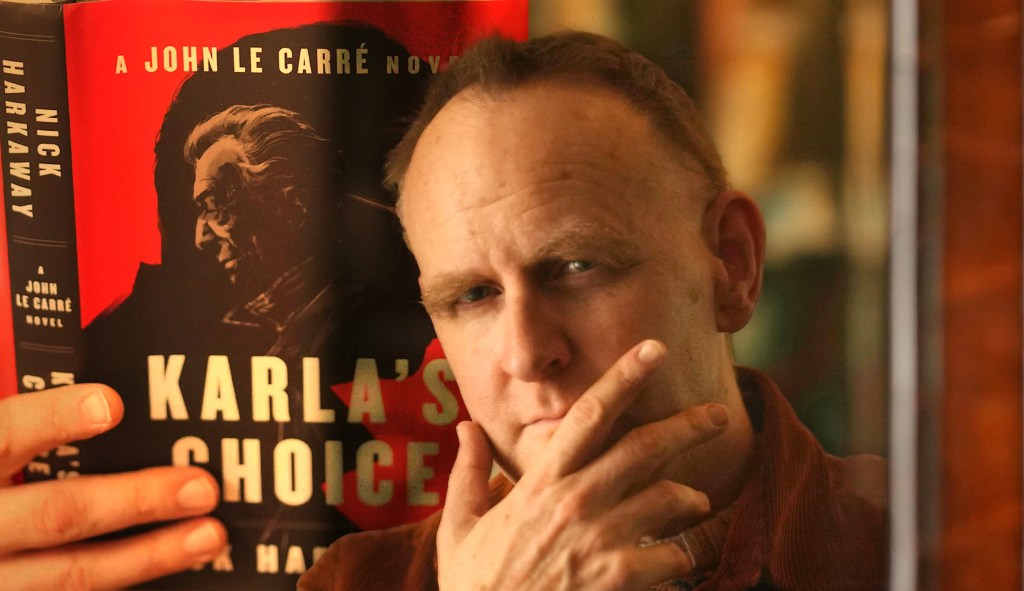
Karla’s Choice by Nick Harkaway-Book

From a Google Image Search – Washington Examiner

Spies make for what is often edge-of-the-seat reading. Spy novels often offer references to obscure historical activities that may not have been universally covered by the media and which may have only been uncovered long after the actual events. John le Carré has long been considered the master of spy stories involving classic spy craft methods which may not work as well in our age of high tech. This may be why so many books about spying refer to WWII and its aftermath in the Cold War and the times when a wall divided East and West Berlin. The end of wars often leaves loose ends which reveal themselves much later. Now spying usually happens on a grand scale, as portrayed by events like China’s recent hacking of the US Treasury Department, and classic up-close and personal spying is out of fashion. 

John le Carré has passed the torch to Nick Harkaway, his son. In Karla’s Choice Harkaway takes us to the Circus in London with all the quirky characters who help keep the world safe from the forces which oppose democracies. Harkaway also gives us George Smiley, called back from retirement to unravel a situation involving death and a man who is on the run. Smiley may lose his wife over this one.

Harkaway does a good job of capturing le Carré’s style, and the novel takes us back to post-war days. We tune into events happening behind the Iron Curtain as the runner, Róka, who left London leaving a dead man behind, is a Hungarian national with connections to Communism. The backstory of Róka is perhaps a bit too complicated. I found myself tuning some of it out. Harkaway’s inclusion of Szusanna, Roka’s secretary, lent complications to the operation which added value. Szusanna gave us a reason to stay interested enough to get to the real focus of this tale, Karla. Karla is an agent of Russia and has a reputation for being both brutal and ruthless. Smiley offers Karla a choice. Will he take it? Has the Circus lost some of its effectiveness since the end of the war? This is a good legacy book, but not a great one. It may not be due to the author’s skills as a writer but rather to all the ways the world of spying has changed. Still, we are lured on to solve the mystery of Róka.