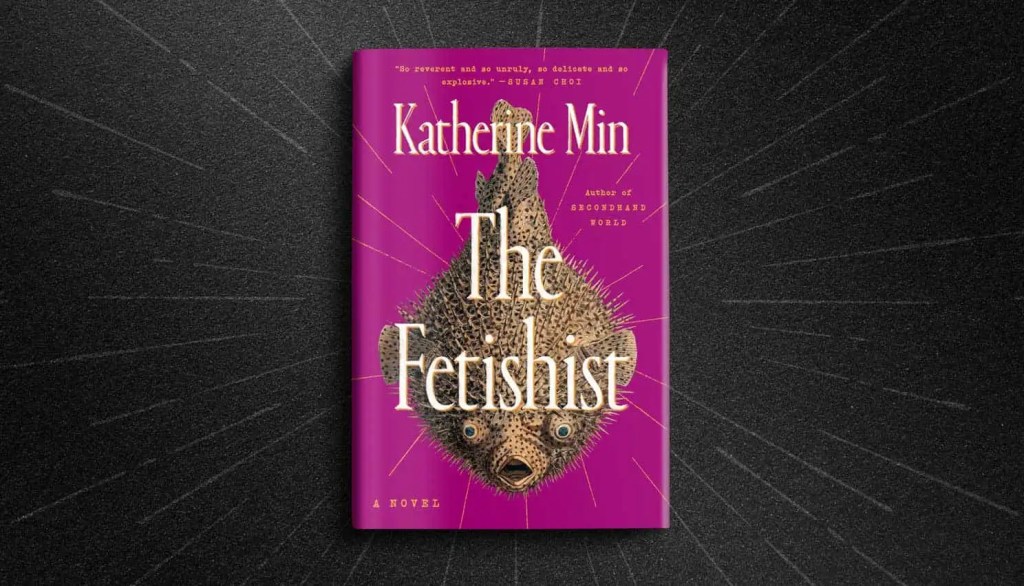
The Fetishist by Katherine Min – Book

From a Google Image Search – Barnes and Nobel

Picking the next book to read is often problematic, a momentary panic sends me back to my book lists scribbled casually in notebooks full of political research, budget info, wordle episodes, drafts of essays, and wish lists. So many tantalizing titles are published each year that my list often leap frogs on to the newest releases without ever finishing with the older lists. There is always guilt and regret. Sometimes I wish I was a Large Language Model filled to the brim with all the world’s great literature and turned into a more well-rounded individual through a corresponding grasp of math and science. I read by instinct and thankfully there are so many excellent choices that I am rarely disappointed. 

I stumbled upon Katherine Min’s book The Fetishist and once again I was not mislead by my instincts. This is a book for grownups. The book was published posthumously by Katherine Min’s daughter. The content is sophisticated and serious; fantastical and funny. Alma is sometimes the narrator and always the main character. She was a famous cellist who toured worldwide and sat in the first chair in global orchestras. She started playing at the age of 5 and by 11 she was obsessed with the cello. 

“It was very physical, more like dancing than playing an instrument, and all her life Alma had felt this weirdly mystical space, the notes like steps, like gestures, the music like breath, like breeze, and the feeling of wide-ranging freedom, of expanse and embrace, and of always ending up somewhere else.” (p. 38)

Alma has MS and can no longer play the cello. Her body betrays her. Her fame is real, but it is a thing of the past. She has plenty of time to think back over her life. Alma fell in love with Daniel, a charming man, a fellow musician, and a womanizer. Daniel had commitment issues. Daniel also gets to narrate at times. Daniel, on an impulse, bought Alma an engagement ring, proposed, and then got caught by Alma doing the deed with Emi, another musician, another Asian musician. Daniel and Alma were engaged for about 5 minutes just before Alma had a very public medical episode that ended her life as a cellist.

“…and because being in a coma means having a lot of free time on your hands and the vagaries of the human brain are such that you never know what will pop into your head at any given moment. Alma finds herself surveying the fetishists she has known over the years. Ri-i-i-sssss kkk-iii-nggggs, rice chasers, Asiaphiles, victims of that mysterious disease known as Yellow Fever. Every Asian woman knows the generic type, but Alma, classical musician, world traveler, and unconscious taxonomist, breaks them down into three categories. 1) The cultural ambassador, 2) The carnal colonialist, 3) The rational revolutionary. (These are covered in more detail.)

A parade of rice kings wherever she went lecherous, treacherous, beseeching–enfolded like origami, bent like bonsai, draped in silk, and embellished with hanzi–presenting themselves like gifts to a foreign bride.” (pp 77-80)

This is the meat of the matter and there is more. Does Daniel pay for his sins? Revenge for Alma was banishment, cutting Daniel off, but her MS weakened the gesture as she no longer felt desirable. Someone else takes on the revenge of Daniel as his past leads to the most unusual kidnapping and Daniel’s mental reckoning. Kornell and Kyoto have their reasons. 

This book is a literary gem, while offering an activist view against “Asiaphiles” who have given us terms like “Tiger Lily, China Doll, Geisha Girl, Baby-san, Miss Saigon, Suzie Wong, Me Love You Long Time, Goddamn Madame Butterfly!” (p 80) How you make a book with an axe to grind into a humorous and classy adventure is by being a talented writer; a writer who will entertain us no longer. This is our loss. Books, like music, take us “somewhere else.”

The Blueprint by Rae Giana Rashad – Book

From a Google Image Search – Paper Literary

Imagine if Martin Luther King never existed, or if the Civil Rights movement came too late to prevent a second Civil War. It’s not hard to imagine if you just find old videos of Strom Thurmond on You Tube. In Rae Giana Rashad’s book The Blueprint, we meet Solenne and Bastien, who sound like characters in a romance book. But this is no ordinary romance. Bastien is a Councilman headed to become President of the new America known as The Order. Solenne is a young Black woman, fifteen years old, headed to become a ‘concubine’. Since this book is written by a Black woman, I will use her words to offer insight into her story. In the Author’s Note, Rashad refers to female slaves in real America as “forgotten handmaids,” so here is another handmaid’s tale, every bit as chilling as the original, except it explains how Atwood’s tale of the handmaids is even more fraught for Black women.

Page 13

“Then he was gone, ballroom lights tunneling the dark, the hush of champagne on my tongue. THE PATH WE WALKED TO BECOME Black women wasn’t straight; it was a loop. Starting from nowhere, it brought you back to nowhere. A man at one end, a man at the other, humming the same song. ‘It’s just a body. Nothing special.’ If that were true, why did they want it? Why couldn’t it belong to me.”

Page 25

“I would never know how it felt to walk boldly because this world wasn’t mine…There was no protection for me, a Black girl, no tender touch, no consideration for a delicate exterior. No space to scream.”

Page 31

“They bragged about their accomplishments in private, boasted about the difference between them and their brother. But skin quality and quantity of sleeve emblems aside, from neck to ankle, the men were identical.”

“Councilmen were the Order’s most decorated men. The talented, skilled, brilliant. Engineers, physicians, cryptographers, developers. But fundamentally they were soldiers. Killers.

Page 104

“And still, this country is better than it was when it was the United States. An economy outpaced by the rest of the world, the racial unrest, the increasing crime and abortion rates, no, we couldn’t go on with so much death.”

Page 133

“From his frame above the fireplace, Thomas Jefferson watched me. What had Sally seen in him? He brought her to France at fourteen, where she worked, lived, and earned money as a freed woman. When he decided to return to America two years later, she didn’t stay like the French urged her. She returned to America, where she remained enslaved, and the babies followed like footsteps.

Page 214

“Seven years of militias, fragmented state governments, and millions of deaths. We’re fortunate the Founders of the Order had a vision for the country. Their sacrifice ended the war.”

(Solenne’s great-grandfather wounded, and in the hospital, talks about that war and the aftermath.)

“In that unseasonably warm January of 1960 in Metairie, Louisiana, he witnessed a military dictatorship seamlessly replace the civil government. Where did these men come from, he asked his nurse. She couldn’t have been more than thirteen. Nobody knows, she said. They came from nowhere. But that wasn’t true, they were military officers police officers, senators, governors, a World War II veteran like Bastien’s grandfather. While my great-grandfather slept, Black and white men stood in offices letting the ink dry on treaties. In those documents women had fewer rights than they did before the war, and Black women caught the worst of it.”

[Black men were given the state of Louisiana as a free state, but they had to relocate by 1962 or accept the new Constitution]

Page 249

“They knew that once you get that taste of freedom nothing will keep you in line. Lucas [Bastien’s rival] knew it. I’d already seen the sunset over Sanibel Island in pink and orange. Seeing something like that makes you feel like somebody created something just for you. It was like unwrapping a present every time I blinked. I wanted to keep it forever. Not a piece of it. All of it.

Page 277

“Pleading. This was the only system designed for us. We were girls, fifteen, sixteen, seventeen. We were our ancestors, forbidden to read or write while lying under the arms of men who drafted legislation.”

Page 293 Author’s Note

“It was difficult to read these stories of forgotten handmaids and their forced reproduction. Though the United States outlawed the international slave trade in 1808, slaveholders found a way to increase the slave population by exploiting the domestic slave trade. They forced Black women into men’s beds, punishing those who didn’t have multiple children by their teens and rewarding those who did.”

Who wins, Bastien or Solenne? Find out how they both win, and both lose. Clearly this book connects to the America that we live in now, in 2024. There is talk from time-to-time about the possibility of a second Civil War when discourse heats up or when rights are lost. Women’s rights recently experienced a setback in the Supreme Court, a setback that will figure in the upcoming election and that could escalate depending on the results of the next election. The fears of Black women, that they might become “concubines” if the right-wing wins must be quite real and harrowing. Throughout Rashad’s story of Solenne, she is writing a book about a slave from 100 years ago, Henriette (Kumba) drawing parallels between the two women’s lives, reminding us that Black women are not property or sexual objects and warning us about the dangers of allowing racism to rule ever again.

I feel a kinship to Rae Giana Rashad because I wrote a similar book about losing freedoms if America becomes an authoritarian state. She did a better job than I did since she had to create all her characters from scratch, and I used both real and fictional people. My attempt in this genre is entitled 2028: The Rebellion. Rashad is offering fair warning to everyone. You should read the book.

The Fox Wife by Yangsze Choo-Book

From a Google Image Search – NPR

China is an ancient land with some ancient superstitions leading to tales to tell, either delicious or horrific depending on the storyteller. Although we are wary of foxes here in America, we haven’t built up a mythology about them. They are predators and it’s hard for domesticated humans to coexist near predators. Sometimes that is also hard in China since foxes are not considered good neighbors. 

The Fox Wife by Yangsze Choo has us mixed up in the business of three foxes. Unusually this is a love story and a mystery. Snow is a fox who can shape-shift and live in human form. In human form foxes are quite beautiful and have charisma that almost tips off the humans around them that something supernatural is afoot, Some humans become obsessed with their foxy friends.

Snow had a baby fox, a girl, that was dug from her snug hole in the ground and then died. There is guilt since mother and father had both left the baby alone but who would have thought anyone would dig in that spot. Snow is grieving the loss of her lovely child, and she is out for revenge. A photographer from Mongolia is involved and she must find him and kill him for what he has done. Her sad passions are so deep that she is not rational. Fortunately for Snow, the man is difficult to find. We follow her (human name -Ah San) on her wild journey to find Bektu Nikan, the photographer. On the way, we run into two more foxes, two males, both known to Snow. One is Shiro, the white fox, the other is Kuro, the black fox. 

Two concubines have been found dead with brilliant smiles on their faces, one propped at a restaurant’s back door, frozen. The owner of the restaurant, familiar with Bao’s (Bao is a human) reputation as a detective asks him to find the dead woman’s name so that she can be buried properly by her family. Bao takes the case.

Bao has carried an old love in his heart for years and perhaps a curse, or a cure gone bad, that has affected his luck in business and in life for decades. He had a childhood friend, Tagtaa, from Mongolia and they built a fox shrine together. He fell in love with her, but this family would not allow the relationship. When Snow takes a job with Tagtaa as a companion, we realize that Bao’s path will cross that of his old playmate and young love once again. Because of his childhood experiences with the fox shrine, he knows that foxes are involved in this somehow.

Snow reunites with Shiro and Kuro but she is angry with both of them. Three foxes, all in human form is a lot. Tagtaa’s grandson and his friends also get involved in this mess which somehow has the photographer at the center. Fables are not my normal reading fare, but this one was entertaining, full of sorrow and also hope. Snow brought sweetness and her loss of her child, her beauty and her anger to pull us into the story. 

Snow speaks.

“I wept bitterly then. Because I was the one who told Kuro to get out. To never come back or speak to me again. I hope you die, I’d said, snarling and furious. Because you can never bring our child back.Sometimes our wishes come back in the darkest, most twisted ways, like a thorn that pierces and grows through your flesh. A tree that drinks blood and blocks out the sun. The sin was mine; I had watered it with hatred and tears of rage, and it had grown to cast a monstrous shadow.” (p. 346) 

In the Epilogue, Kuro speaks.

“I was very sad without you,” he said simply.

“There’s not much one can say to declarations like that. It’s my fault for having married someone who makes me blush with his seriousness.”

I enjoyed the story immensely.

System Collapse by Martha Wells-Book

From a Google Image Search – Tor.com

Ever since I met Martha Wells’ Murderbot I have looked forward to new books in the series, although they are finished much too quickly. The latest book is called System Collapse. This installment in the life and times of Murderbot opens with an action scene. Some ag-bots have been contaminated with an alien virus and are attacking anyone or anything that gets too close. If you are thinking about starting the series with this book, don’t. Start at the beginning. In this installment, Wells doesn’t do much in the way of summarizing previous adventures. SecUnit is here with ART, a university-run ship that conducts research and supports humans and bots who are being exploited by corporations. Can a ship be a character? Of course, just think of the Enterprise.

Fighting against alien contamination to protect a human community is difficult enough but our SecUnit is dealing with a personal issue (redacted) and a ship from Barish Estranza, a corporation that tricks populations in planetary settlements that are in disarray into signing contracts to work in corporate mines as corporation serfs or slaves. It turns out that some of the colonists on this planet split off to establish a separate community, but all communications have been abandoned between the original group and the splinter group. SecUnit finds those who left living in a pre-corporate space, but so does Barish Estranza. 

SecUnit usually soothes itself when overloads occur or it needs to rest up by watching episodes of The Rise and Fall of Sanctuary Moon, which it wishes it could access much more than the constant need to pay attention to real-world events allows, but Sanctuary also taught SecUnit lots of useful strategies and has educated SecUnit (an organic and inorganic construct) in human behaviors. In fact, SecUnit introduced ART to the videos and he also uses it to help other SecUnits after they disconnect their governor modules.

What has SecUnit redacted? Is SecUnit becoming more and more human? Will SecUnit be given a human name? That is all up to Martha Wells. I am just a human organic form who enjoys following SecUnit all along the corporate rim and beyond. It’s a literary amuse bouche in space.